You launch a boosted post because the sales team needs volume this week. It picks up some engagement, spends through the easy audience first, and then stalls. The next move is usually more manual work. More audience splits, more creative revisions, more budget checks inside Ads Manager, and more guesswork about what caused the result.
That workflow does not scale.
Boosting social media gets more profitable when it runs as a system instead of a sequence of isolated tasks. Strong teams treat creative production, audience selection, budget allocation, and measurement as one operating model. AI matters here because it increases testing speed, shortens the feedback loop, and helps teams spot patterns across far more variables than a human can review manually.
Meta rewards that kind of discipline. The platform has enough automation built in that weak inputs get exposed fast, while structured accounts with clear testing rules usually find efficiency sooner. The edge is not access to the platform. The edge is operational control.
This article focuses on the frameworks that hold up under scale, especially on Meta. That includes AI-assisted creative workflows, segmented audience models, sequential retargeting, real-time budget decisions, and testing structures that produce usable signals instead of noisy dashboards. If your team is also expanding creative volume with synthetic image workflows, these Midjourney alternative tools for marketing teams fit naturally into that process.
The goal is simple. Build a repeatable growth engine that can test faster, learn faster, and scale what works without rebuilding the account every week.
1. AI-Powered Creative Generation and Testing
A Meta campaign misses pace long before it misses scale. The delay usually starts in creative. One concept goes to design, feedback stretches across two rounds, and by the time the ad launches, the market has already moved. Teams that boost social media efficiently shorten that cycle and turn creative production into a testing system.
AdStellar AI supports that shift by generating structured variation at volume. The value is not endless asset output. The value is faster learning. Instead of launching one polished ad and waiting for Meta to sort it out, you can test multiple hooks, offers, visual styles, and message angles at the same time, then read performance by pattern instead of by isolated ad.

The practical goal is controlled creative volume. Meta's delivery system improves faster when it gets distinct inputs with a clear testing purpose. That means building creative in families, not in random batches.
What works in practice
- Generate around one variable at a time: Keep the offer fixed, then test different hooks. Keep the hook fixed, then test different formats. Clean inputs produce cleaner readouts.
- Build creative families: Group variants by pain point, desired outcome, proof, objection handling, or product experience. That structure makes it easier to scale the winning angle without guessing why it won.
- Tag assets before launch: Label ads by angle, format, creator style, CTA, and stage of funnel. Analysis gets much easier when naming conventions are consistent from day one.
- Use prior account data: Feed top-performing headlines, thumb-stop patterns, and failed concepts back into the workflow so each round starts from evidence, not opinion.
- Separate testing from scaling: Early tests should prioritize signal density. Scaled campaigns should prioritize spend concentration behind proven concepts.
A useful extension is a broader image and concept workflow that is not tied to one generator. This Midjourney-free alternative guide is useful for teams that need more flexibility before assets reach production. If you are pairing creative testing with audience expansion on Meta, this framework for building Meta lookalike audiences from stronger source data fits that workflow well.
One rule keeps this from turning into noise. Ask AI for testable concepts first, then refine the winners into polished ads. I usually want one angle built around pain, one around outcome, one around proof, and one around product experience. That gives the account enough contrast to learn quickly.
There is a trade-off. AI can produce dozens of near-duplicates that look different in a folder but perform the same in feed. Strong teams prevent that by setting brand constraints, message hierarchy, and kill rules before launch. More assets only help when each variation has a reason to exist.
2. Audience Segmentation and Lookalike Modeling
A common scaling problem on Meta looks like this. Creative tests find a winner, spend goes up, CPA holds for a few days, then efficiency slips because the account is still feeding broad or low-signal audience inputs into the system. The issue is rarely just audience size. It is source quality.
Strong segmentation starts before audience creation. Pull buyers apart by margin profile, purchase frequency, product category, lead quality, or time to conversion. Those groups behave differently in the auction, and they respond to different messages. If a team needs a quick refresher on the fundamentals, this guide can help you understand audience segmentation benefits.
Lookalike modeling works better when the seed reflects the outcome you want more of. Visitor pools are easy to build, but they often train expansion against weak intent. I usually start with purchasers, qualified leads, or high-LTV customers, then break those seeds into smaller cohorts that map to a real business goal.
A practical build usually includes:
- Outcome-based seeds: Build separate models from first-time buyers, repeat buyers, qualified demos, or high-AOV purchasers instead of mixing them into one pool.
- Message alignment: Pair each modeled audience with the angle that fits it. Price-sensitive prospects, category-aware buyers, and problem-aware buyers should not all see the same hook.
- Overlap control: Expansion creates hidden duplication fast. Exclusions and audience prioritization matter once multiple lookalikes start spending.
- Refresh rules: Rebuild seed audiences on a schedule so the model reflects current conversion behavior, not last quarter's customer mix.
The AI angle matters here because scale breaks manual audience logic. Once an account has multiple offers, countries, and customer types, teams need a system that groups source audiences cleanly, maps them to the right creative, and shows where modeled audiences are drifting. That is also why retargeting logic and prospecting logic need to stay connected. This framework for Meta ads retargeting automation is useful if you are building those audience branches into one operating system.
One mistake shows up often. Teams clone the same buyer seed into wider percentages and call it scaling. Real scale comes from improving the seed, separating customer classes, and testing new modeled audiences against distinct offers or angles. If CPA rises, revisit the source event and cohort definition first. Expanding a weak seed only gives the algorithm more ways to find mediocre traffic.
3. Dynamic Retargeting and Sequential Messaging
A prospect clicks from Meta, views a product, leaves, then gets hit with the same generic ad for five days. Spend goes up. Conversion rate stays flat. The problem usually is not retargeting itself. It is weak message sequencing tied to shallow audience logic.
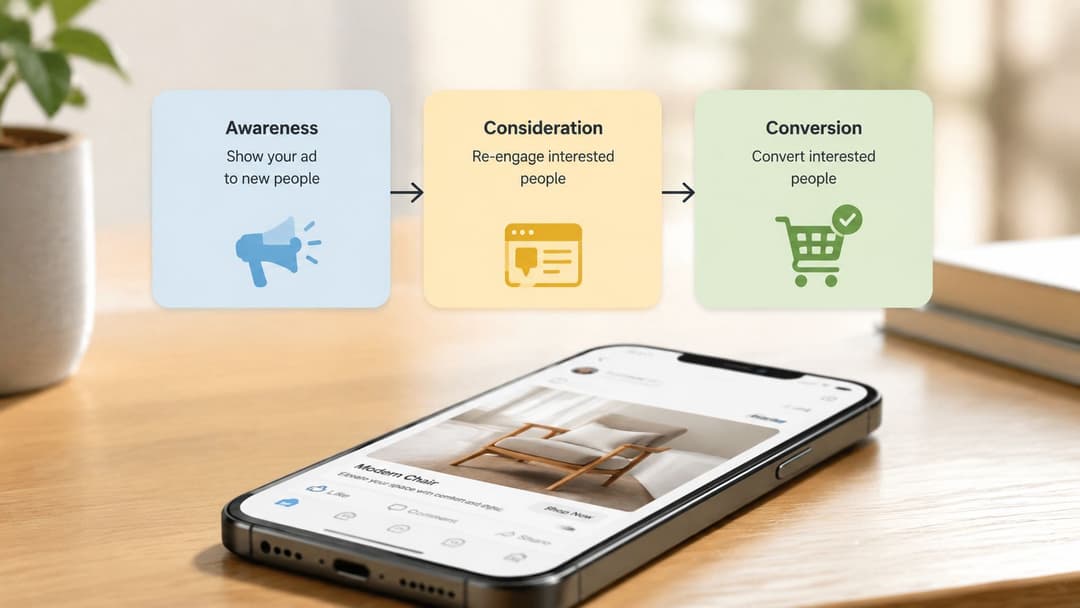
Dynamic retargeting works best when the campaign reacts to intent, not just recency. A product viewer, a cart starter, and a repeat site visitor are all in different states of consideration. Treating them as one pool forces one message to do three jobs, and it usually does none of them well.
Build the sequence around intent shifts
The strongest setups map creative to the next decision the user needs to make.
- Engaged but low-intent users: Video viewers and post engagers usually need category context, creator proof, or a clearer problem-solution angle.
- Mid-intent site visitors: Product viewers and category browsers respond better to product-specific creative, comparison points, and reasons to return now.
- High-intent abandoners: Cart and checkout users need friction removal. Shipping clarity, returns policy, payment options, credibility signals, and concise offer reminders usually outperform broad brand messaging.
The AI layer matters once this system scales across offers, countries, and creative variations. Instead of manually matching every audience to every ad, teams can use dynamic rules to route users into the right sequence, suppress messages they have already seen, and refresh creative before frequency drags performance down. That is where a disciplined workflow for Meta ads campaign optimization starts to pay off.
If you want a broader explanation of why audience structure affects conversion paths, this article can help you understand audience segmentation benefits.
One pattern shows up in underperforming accounts. The retargeting window is built correctly, but every stage uses the same angle with minor copy edits. Meta can optimize delivery, but it cannot fix weak progression. Sequence one should create relevance. Sequence two should reduce doubt. Sequence three should resolve the last buying objection.
There is a trade-off here. More stages create better message control, but they also raise operational complexity. Clean event tracking, exclusions between stages, frequency caps, and creative refresh rules are what keep sequential retargeting profitable instead of noisy. Without that structure, the account just spends more money showing slightly different ads to the same people.
4. Real-Time Performance Monitoring and Budget Optimization
A campaign looks healthy at 9 a.m. By lunch, one ad set has spent through its efficient inventory, another has started to win on a new placement, and the account average hides both shifts. Teams that review budgets once a day usually react after Meta has already repriced the opportunity.
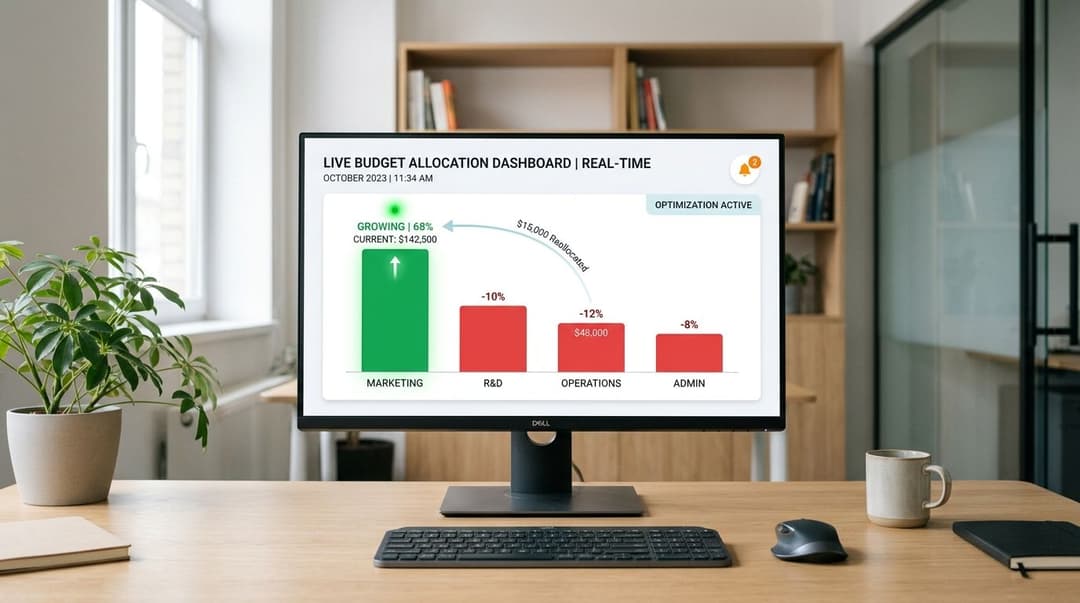
That delay gets expensive fast. The practical fix is a live monitoring system that tracks spend, CPA, conversion volume, frequency, and creative fatigue at the combination level, not just at the campaign level. AI helps because it can scan more variables than a buyer can reasonably check by hand, then flag where budget should move and where patience is the better call.
How experienced buyers handle budget shifts
Budget optimization works best when every move has a rule behind it. I look at three filters first. Statistical confidence, enough conversion volume to trust the trend, and whether the result is repeatable or just a short burst from cheap inventory.
- Increase spend on proven combinations: Add budget where offer, audience, creative, and placement are all holding target efficiency.
- Trim the weak component: If one ad is dragging down a strong ad set, cut or replace the ad before you reduce spend on the audience.
- Respect learning stability: Large budget edits can reset delivery patterns and make yesterday's winner look broken.
- Use guardrails for automation: Rules should trigger reviews and controlled changes, not blind budget moves on thin data.
The best accounts also separate monitoring cadence by campaign type. Prospecting needs tighter oversight on CPM, CTR, and first-purchase CPA. Retargeting needs closer control of frequency, audience saturation, and marginal return. If those sit in one blended report, budget decisions get sloppy.
For teams tightening post-click efficiency at the same time, this guide on how to improve conversion rates is a useful companion to media-side optimization.
The trade-off is clear. Faster decisioning can raise efficiency, but it also increases the risk of reacting to noise. Strong operators solve that with review windows, minimum spend thresholds, and prebuilt rules for scale, hold, and cut decisions. That is what turns AI-powered monitoring into a repeatable system instead of a more complex way to panic.
5. Conversion Rate Optimization Through Split Testing
A familiar failure pattern looks like this. CTR is healthy, CPC looks fine, and Meta keeps finding traffic, but purchase rate stalls after the click. That usually means the bottleneck is no longer media buying. It is message match, page structure, offer clarity, or checkout friction.
Split testing only improves conversion rate when the test is built to answer one business question. If click volume is weak, test the promise, hook, or first-frame angle. If traffic is clicking but not buying, test headline alignment, proof placement, form length, pricing presentation, or CTA copy. Blending all of that into one test gives you activity, not learning.

The teams that scale this well treat CRO tests as part of the same system as creative testing. They map each ad concept to a corresponding landing page variant, then track results by angle, not just by page version. That matters on Meta because broad delivery can hide weak message match for days if one audience slice converts well enough to mask the problem.
A practical testing framework usually includes three rules:
- Start with the promise: If the ad sets the wrong expectation, page edits rarely recover the wasted click.
- Test one primary variable per round: Headline, social proof, form friction, pricing display, or CTA. Pick one.
- Log what lost and why: Failed tests reduce wasted spend in future launch cycles, especially when AI-generated variants multiply quickly.
I also separate diagnostic tests from scaling tests. Diagnostic tests answer why a page is leaking. Scaling tests validate whether a winner holds after more spend, more placements, or colder traffic. Mixing those goals in one experiment slows decision-making and muddies attribution.
If post-click conversion is the weak link, this guide on how to improve conversion rates gives a useful framework for tightening the page before you push more budget into traffic.
The trade-off is speed versus confidence. More variants can get you to a winner faster, but they also thin out spend and delay significance. In larger accounts, AI can help generate and organize variation sets at scale. The operator still has to control test scope, minimum spend thresholds, and success criteria. That discipline is what turns split testing into a repeatable growth system instead of a pile of disconnected A/B tests.
6. Platform-Specific Creative Optimization
A campaign looks healthy in Ads Manager. CTR is acceptable. CPM is stable. Then placement breakdown shows the full picture. Feed is carrying the account, Reels is burning spend, and Stories is getting impressions without meaningful action.
That usually happens when one asset gets stretched across every placement and the algorithm is expected to sort it out. Meta can resize creative. It cannot fix a weak hook for short-form video, rebuild pacing for Reels, or make dense Feed copy work inside a Story frame.
Platform-specific optimization matters because placement changes intent. A user scrolling Feed will tolerate more context. A user in Reels decides in a second whether the creative deserves attention. Messenger placements need clarity fast and usually respond better to direct, low-friction prompts than broad brand storytelling.
The teams that scale efficiently build creative systems around that reality. They do not make one ad and crop it six ways. They produce a base concept, then create controlled variants by placement so testing stays structured and learnings stay usable.
A practical workflow usually includes:
- Hook adaptation by placement: Reels and Stories need the value proposition early, usually in the first beat or frame.
- Format-specific editing: Vertical video, safe-zone aware text, tighter cuts, and stronger on-screen captions for sound-off viewing.
- Copy compression: Feed can support explanation and proof. Stories and short-form placements need one idea at a time.
- CTA matching: "Learn more" may work in Feed. A retargeting Story often performs better with a more immediate next step tied to existing intent.
Field note: On Meta, the best creative often wins because it matches the placement's viewing behavior, not because it has the best design.
AI helps when volume becomes the bottleneck. Use it to generate first-pass variants, rewrite hooks for different placements, and organize naming conventions across testing rounds. Do not let it flatten everything into the same style. The operator still has to decide which message angle belongs in Feed, which proof point belongs in Stories, and which creator-style cut has a real chance in Reels.
The trade-off is operational load. More placement-specific versions mean more QA, more asset management, and more reporting discipline. The return is cleaner performance data and fewer false positives, especially when one strong placement hides weak creative everywhere else. That is how creative optimization becomes a repeatable scaling system instead of a batch of resized assets.
7. Cohort-Based Campaign Architecture
Two campaigns can hit the same CPA on Meta and produce very different business outcomes 30 or 90 days later. One brings in customers who reorder, upgrade, and hold margin. The other fills the CRM with buyers who churn fast or never buy again. If the account is structured only around top-level campaign goals, that difference stays hidden for too long.
Cohort-based architecture fixes that by organizing analysis around groups of users who entered the funnel under similar conditions. The practical unit is not just the campaign. It is the campaign plus acquisition window, audience type, offer, and first conversion behavior. That gives the team a way to judge paid social on customer quality, not just front-end efficiency.
This matters most in accounts with delayed revenue signals.
Subscription brands, trial-to-paid funnels, lead gen programs with offline close rates, and ecommerce brands with meaningful repeat purchase behavior all benefit from cohort views. In those cases, standard reporting can overvalue cheap acquisitions and underfund the campaigns that bring in stronger customers.
A workable setup usually tracks cohorts across a few dimensions:
- Acquisition period: Group users by week or month so you can compare campaign waves against seasonality, offer changes, and creative shifts.
- Entry path: Separate prospecting, retargeting, creator-led traffic, and offer-led traffic to see which path produces better downstream value.
- Behavior after conversion: Split first-time buyers, repeat buyers, trial users, and engaged non-buyers so follow-up messaging matches actual intent.
- Value tier: Flag higher-LTV or higher-margin customers early so budget decisions reflect revenue quality, not just volume.
The payoff is sharper budget allocation. If a broad audience campaign looks average on day 7 but produces stronger second-order revenue by day 45, it deserves a different scaling decision than a campaign that wins only on cheap first purchases.
Messaging should also change by cohort maturity. New customers usually need onboarding, proof, and friction removal. Mature cohorts respond better to cross-sell, bundles, replenishment prompts, or referral hooks. Putting every post-click user into one retargeting pool blurs those differences and drives weak sequencing.
AI helps when cohort volume gets large enough that manual analysis breaks down. Use it to tag users into repeatable groups, surface which acquisition combinations produce stronger downstream value, and flag when a campaign is buying low-quality volume that still looks efficient in-platform. That turns cohort analysis into an operating system for scaling, not a spreadsheet exercise you revisit once a quarter.
The trade-off is real. Cohort architecture adds naming discipline, cleaner event mapping, and tighter alignment between paid social, CRM, and revenue reporting. Without that foundation, the structure creates noise. With it, you get a clearer answer to the question that matters: which campaigns are finding customers worth buying again.
8. Continuous Learning and AI-Powered Insights
A Meta account can look healthy in the ads manager and still drift in the wrong direction. CTR holds. CPA stays inside target. Then efficiency slips because the winning angle is tiring out, a placement starts dragging blended results, or a prospecting ad is pulling in low-intent traffic that only shows up as weak revenue later.
That is where AI-based insight earns its keep. The job is not to generate more charts. The job is to compress thousands of creative, audience, placement, and post-click interactions into decisions a buyer can act on this week.
Useful insight starts with pattern quality. If the system is trained on messy naming, weak event mapping, or unstable conversion signals, it will produce polished nonsense. If the inputs are clean, it can surface things a busy team would miss, such as a UGC concept that keeps losing in Feed but wins in Reels, or a benefit-led headline that works only for colder segments and falls apart once frequency rises.
Three outputs matter in practice:
- Pattern detection: Spot repeated losers and repeated winners across launches, not just inside one campaign.
- Recommendation quality: Rank insights against the account's actual buying metric, such as margin-adjusted ROAS, qualified leads, or first-order CPA with downstream payback in mind.
- Knowledge retention: Store what the team has learned so each new test starts from a stronger baseline.
I have seen this matter most in accounts with high creative velocity. Once a team is launching enough variants every week, manual review turns into selective memory. People remember the obvious winners, forget the context, and re-test ideas that already failed under similar conditions.
Good systems reduce that waste. They show which hooks are fading, which combinations deserve another round, and which apparent winners only worked because they were attached to a favorable audience or short-lived promo window.
The trade-off is trust calibration. AI should prioritize investigation, not make scaling decisions on autopilot. A recommendation can be directionally right and still wrong for the business if inventory changed, lead quality shifted, or the account is in a seasonal window the model has not seen before.
The practical standard is simple. Use AI to shorten the path from signal to action, then pressure-test those signals against revenue quality, offer context, and creative fatigue before you add budget. That is how continuous learning becomes an operating advantage instead of another reporting layer.
9. Omnichannel Campaign Integration and Attribution
A Meta campaign can look average in Ads Manager and still be one of the highest-value drivers in the account. I see this when paid social creates the first touch, branded search captures the second, email closes the sale, and the team gives full credit to the last click. The result is predictable. Social gets cut, search gets too much credit, and reporting pushes budget away from the channels creating demand.
The fix is tighter channel design and stricter attribution rules.
Meta usually works best as part of a connected acquisition system across search, email, SMS, and organic social. That changes how you judge performance. Instead of asking whether one boosted post produced the sale by itself, ask what role it played in the path and whether that role was profitable at scale.
A useful setup usually includes:
- Shared messaging by stage: Meta introduces the promise, retargeting reinforces proof, email handles objection removal, and search captures existing intent.
- Channel-specific KPIs: Meta can be measured on qualified traffic, assisted conversions, lift in branded search, or lead capture rate, not only last-click ROAS.
- Consistent naming and UTMs: Clean campaign taxonomy makes it easier to compare paid social influence against CRM outcomes and downstream revenue.
- Post-click feedback loops: Import lead quality, close rate, or first-order margin back into reporting so attribution reflects business value, not just platform conversion volume.
AI offers practical utility. It can match patterns across touchpoints faster than a manual review process, flag sequences that keep appearing before purchase, and help teams spot where Meta is creating demand that another channel harvests later. That matters more as account volume grows, because assisted impact gets harder to see by eye.
There is a real trade-off. The more channels you include, the less certainty you get from any single attribution model. Platform-reported conversions, GA4 paths, CRM data, and media mix analysis can point in slightly different directions. Good operators do not treat one dashboard as final truth. They compare models, look for repeated patterns, and make budget calls based on directionally consistent evidence.
Siloed teams usually miss this. If the Meta buyer is optimizing for cheap clicks while lifecycle is pushing a different offer in email, performance drops across both channels and nobody owns the gap. Integrated planning fixes that. It gives each channel a clear job, reduces message conflict, and makes scaling decisions a lot more defensible.
10. Scaled Testing Framework
A campaign finds a winner on Monday, budget gets pushed hard on Tuesday, CPA spikes by Thursday, and the team spends Friday arguing about whether creative, audience saturation, or bid pressure caused the drop. That cycle is usually a testing systems problem, not a Meta problem.
Scaled testing works when the account has a clear path from idea to validation to expansion. The goal is not to test more for the sake of volume. The goal is to produce enough structured signal that budget can move with confidence. Teams that scale well treat testing like production. They batch inputs, control variables, and decide in advance what gets paused, promoted, or rebuilt.
Scale the process, not just the budget
A strong framework starts with repeatable inputs. Use fixed launch templates for naming, audience splits, creative formats, offer types, and budget ranges so results are comparable across cycles. That sounds operational, but it affects performance directly. Messy test design creates noisy data, and noisy data leads to bad scaling decisions.
The best setups usually include:
- Standardized test cells: Hold format, audience type, or offer constant so one variable is doing the work.
- Predefined kill rules: Cut combinations that miss CPA, CTR, hold rate, or conversion thresholds before they waste another few days of spend.
- Graduated budget increases: Raise spend in controlled steps to see whether efficiency holds as delivery broadens.
- Creative replacement cadence: Rotate new variants in before frequency climbs high enough to drag response rates down.
There is a trade-off here. Tight controls make results easier to read, but they can slow down learning if the account volume is low. Loose testing gets answers faster, but it also makes false positives more likely. The right balance depends on spend level, conversion volume, and how expensive a wrong scaling decision would be.
One practical rule helps. Do not scale a single ad based on an isolated win. Scale clusters of evidence: the same angle working across multiple hooks, the same offer holding across more than one audience, or the same concept surviving a budget increase without a sharp efficiency drop. That is how testing becomes a system you can trust instead of a streak you hope continues.
10-Point Social Media Boosting Comparison
| Strategy | Implementation complexity | Resource requirements | Expected outcomes | Ideal use cases | Key advantages |
|---|---|---|---|---|---|
| AI-Powered Creative Generation and Testing | Medium–High, model/setup and integration | Historical creatives, asset library, AI platform subscription | Rapid generation of many variants; faster winner discovery; improved ROAS | E‑commerce, DTC, agencies managing many accounts | Scale creative testing quickly; data-driven pattern discovery |
| Audience Segmentation and Lookalike Modeling | Medium, data preparation and modeling | Conversion data, CDP/CRM, analytics | Lower CPA/CPL; expanded high-quality reach | Scaling customer acquisition; SaaS and e‑commerce growth | Efficient audience expansion; reduced wasted spend |
| Dynamic Retargeting and Sequential Messaging | High, multi-touch orchestration and triggers | Pixel/events, varied creatives, automation rules | Higher conversion rates; smoother funnel progression | Cart abandoners, SaaS nurture flows, DTC journeys | Contextual, stage-specific messaging that boosts conversions |
| Real-Time Performance Monitoring and Budget Optimization | Medium–High, real-time pipelines and rules | Tracking, dashboards, automation tools, reliable data | Faster budget shifts to winners; improved ROAS velocity | Growth teams, agencies running many campaigns | Continuous budget efficiency and rapid scaling decisions |
| Conversion Rate Optimization Through Split Testing | Medium, experimentation discipline and analysis | A/B tools, traffic volume, statistical tools | Incremental conversion lifts; validated creative/landing winners | Landing pages, ad copy tests, CTA optimization | Statistical confidence in optimizations; compounding gains |
| Platform-Specific Creative Optimization | Medium, multiple formats and variants | Creative production, format templates, editors | Higher engagement and better placement performance | Reels/Stories-first campaigns, multi-placement ads | Improved CPM/CPC and platform relevance |
| Cohort-Based Campaign Architecture | High, cohort tracking and lifecycle mapping | CDP, analytics, cohort attribution setup | Clear LTV and retention insights; targeted spend | SaaS/subscriptions, retention-focused businesses | Precise budget allocation by cohort and lifecycle stage |
| Continuous Learning and AI-Powered Insights | High, ML models, ongoing training and validation | Large historical dataset, ML/analytics team, tooling | Predictive recommendations; non-obvious pattern discovery | Large accounts, enterprises with rich datasets | Automated insight generation and predictive optimization |
| Omnichannel Campaign Integration and Attribution | Very High, cross-channel data integration | CDP, multi-channel tracking, attribution modeling | Holistic channel contribution view; better ROI allocation | Enterprise marketers, full‑funnel growth strategies | Reveals channel synergies; accurate multi-touch attribution |
| Scaled Testing Framework (Pacing and Scaling Automation) | High, end‑to‑end automation and guardrails | Automation platform, templates, monitoring, APIs | Systematic scaling of winners; faster launch-to-scale | High-velocity testing teams, agencies, DTC scale-ups | Repeatable scaling process; reduced manual error and speed to scale |
Systemize Your Social Media Success
It is 4 p.m. on a Tuesday. Three boosted posts are live, CAC is creeping up, comments need replies, and the team still cannot explain which asset deserves the next dollar. At that point, boosting is no longer a content task. It is an operating system issue.
Teams that scale on Meta build a process, not a pile of campaigns. They identify organic posts with real buying signals, turn them into paid variants, match each version to a defined audience, and raise spend only when performance clears a preset threshold. That discipline protects margin because every variable affects the next one. Strong creative improves click-through rate. Better audience fit improves conversion rate. Sequencing determines whether interest turns into revenue or dies after the first impression.
The useful question is simple. What system decides which post earned paid distribution, which angle gets tested first, how the asset changes by placement, and what result justifies the next budget increase?
Generic social advice still overweights volume. More posts, faster replies, more engagement prompts. Those tactics can support performance, but they do not give a buying team a repeatable way to scale spend. Paid amplification works better when it starts with proof. Saves, qualified comments, clear product framing, strong creator footage, and conversion intent are better filters than gut feel.
Start with the part of the system that produces feedback fastest. For many accounts, that is creative testing.
Once that engine is stable, add audience modeling, retargeting sequences, budget rules, and attribution logic. The order matters. It is cheaper to scale messages that already hold attention than to force budget through weak creative and hope the algorithm fixes it.
AI raises output and sharpens decision-making when it is tied to a clear testing framework. It can generate variants faster, tag patterns across hooks and offers, and reduce the manual work that slows down launch cycles. I have seen this work best when teams use AI to increase test volume and pattern recognition, while keeping messaging strategy, offer selection, and spend control in human hands. If your process still relies on manually boosting the occasional winner, an AI-powered LinkedIn growth tool shows how structured distribution systems can support amplification workflows.
The end goal is straightforward. Modular creative. Continuous testing. Budget changes tied to rules. Reporting tied to cohorts and revenue quality, not just platform metrics. The account improves over time because the learning sits inside the system instead of inside one buyer's memory.
If content production is still the bottleneck upstream, this guide to an efficient content workflow pairs well with that approach.