You open Meta Ads Manager or Google Ads first thing in the morning and the number that matters is flat or falling. Spend is going out. Revenue isn't keeping pace. Someone on the team asks whether you should pause a campaign, raise bids, swap creative, or open a new audience. That moment is where most ROAS work goes wrong.
The default reaction is random motion. People tweak bids before checking attribution. They blame audiences before looking at the landing page. They kill acquisition campaigns because short-term return looks weak, even though those campaigns may be bringing in customers who buy again later. The account gets busier, not better.
How to increase ROAS starts with a different mindset. Treat the account like a system, not a slot machine. Diagnose first. Fix the biggest leak first. Then scale what survives scrutiny.
If your post-click experience is weak, improving conversion rates usually does more than another round of bid edits. That's the pattern growth teams keep learning the hard way.
Your ROAS Is Sinking What Do You Do Next
A familiar scenario plays out in a lot of teams. Last week, a campaign looked healthy. This week, ROAS is down, CPA is rising, and internal pressure starts building. The immediate instinct is to touch the platform controls because they feel closest to the problem.
That instinct is expensive.
Most low-ROAS accounts aren't suffering from one dramatic failure. They're leaking value in multiple places at once. Attribution windows aren't aligned. One audience is still spending even though intent has faded. Creative has gone stale. The landing page is forcing too much friction into checkout. Budget is stuck in mediocre campaigns because no one wants to disrupt learning.
Don't start with "what can I change fastest?" Start with "what's actually causing the return drop?"
The marketers who improve ROAS consistently don't rely on isolated hacks. They run a sequence. First they verify the data. Then they inspect the click-to-conversion path. Then they look at creative, audience fit, and budget allocation. Only after that do they push harder on scale.
That's the practical playbook. It works because it respects how modern ad systems behave. Platforms optimize around the signals you feed them. If the signals are wrong, or if the customer journey after the click is weak, no amount of enthusiasm inside the ad account fixes the economics.
ROAS recovery is usually less about finding a magic lever and more about putting the levers in the right order.
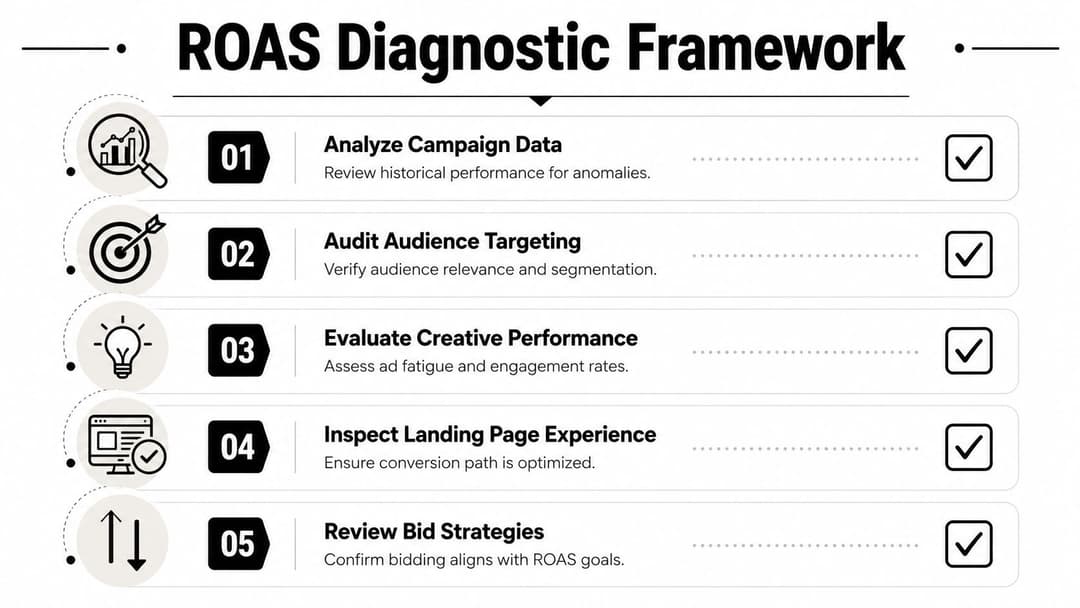
Start with a ROAS Diagnostic Framework
A ROAS drop usually triggers the same reaction. Someone opens Ads Manager, cuts budgets, tweaks bids, and hopes efficiency comes back. Good operators pause there and diagnose first, because a weak return can come from bad measurement, a broken post-click path, or low-quality spend that the platform is still happy to buy.
Normalize measurement before judging performance
Start by making sure every stakeholder is looking at the same scoreboard. If paid social is reviewed on one attribution window, search on another, and finance is using a different source of truth entirely, the team will misread what is working and cut spend in the wrong places.
I treat this as the first gate in any ROAS review. Confirm attribution settings, conversion definitions, revenue inclusion rules, and reporting windows before touching campaigns. A retargeting ad set can look like a hero when it is claiming too much credit. A prospecting campaign can look inefficient when the buying cycle is longer than the platform view suggests.
For teams trying to connect ad performance to margin, not just platform revenue, SuperX's ROI insights help frame the bigger question. ROAS can improve while profit gets worse if discounts, shipping costs, or low-quality orders are climbing underneath it.
Inspect the path from click to conversion
Once measurement is clean, inspect what happens after the click. In this phase, many teams waste time. They keep adjusting bids to fix a page problem.
Look for simple failure points first. Message mismatch is common. The ad promises a clear benefit, but the landing page opens with a generic headline. Mobile friction is another repeat offender. Slow load times, cluttered layouts, long forms, and surprise shipping costs kill conversion intent fast.
Use a practical review:
- Message match: The offer, product, and next step should match what the ad promised.
- Friction: Check form length, page speed, checkout steps, and mobile usability.
- Offer clarity: Price, value proposition, and CTA should be obvious within seconds.
- Trust signals: Reviews, guarantees, return policy, and delivery details should be easy to find.
I also check signal quality here because platform learning depends on clean event data. If tracking is patchy, automated bidding starts optimizing against noise. Teams tightening this setup should review this Facebook Conversion API guide.
Find waste before you look for scale
ROAS audits should include a waste pass, not just a winner hunt. In mature accounts, return often improves faster by removing bad spend than by squeezing more volume out of top campaigns.
Review search terms, placements, geographies, devices, and time-of-day patterns. Some segments drive cheap clicks with weak order quality. Others convert, but generate refunds, low AOV, or poor retention. Those are different problems, and they need different decisions. Cutting a bad placement is easy. Pulling back from a region with strong top-line ROAS but poor contribution margin takes more discipline.
| Audit area | What to check | Why it matters |
|---|---|---|
| Search terms | Irrelevant intent, broad mismatch | Cuts low-quality clicks before they become wasted spend |
| Geography | Regions with weak conversion quality or poor margin | Prevents budget bleed in markets that look better than they are |
| Devices | Low CVR, high bounce rate, weak checkout completion | Exposes UX issues and traffic quality problems |
| Placements | Inventory that generates clicks without downstream value | Protects efficiency and improves signal quality |
A good diagnostic framework does one thing well. It puts the levers in the right order. Verify measurement. Check the post-click experience. Remove waste. Then decide whether the problem is creative, audience strategy, or bidding. That sequence is what makes ROAS improvement repeatable instead of reactive.
Build a High-Velocity Creative Testing Engine
Monday morning looks familiar in a lot of accounts. CPA drifted up over the weekend, spend is still going out, and nobody can say whether the problem is the offer, the hook, the video, or the audience. Teams respond by launching a few new ads and hoping one sticks. That is not a testing engine. It is creative roulette.
A high-ROAS account treats creative like a production system with feedback loops. The goal is not to find one winner. The goal is to identify which message components keep producing efficient conversions, then turn those patterns into the next round of ads.
Test variables you can actually learn from
A lot of brands say they test creative. In practice, they compare three completely different ads with different hooks, visuals, offers, and CTAs, then call the top performer a winner. That gives you a result, but not a reason. You cannot scale that process because you do not know what caused the lift.
Use a tighter structure instead:
- Hook variations: pain point, aspiration, urgency, proof, objection handling
- Visual format changes: UGC clip, product demo, static image, founder video, testimonial
- Copy angle shifts: benefit-first, problem-first, comparison-first, offer-first
- CTA framing: softer intent capture versus direct purchase language
Teams typically face a trade-off. Pure one-variable testing is clean, but ad production in practice is messy and fast. I prefer controlled variation. Change one major variable at a time when possible, but keep shipping enough volume to learn on schedule.
Build around batches, not one-off ideas
Creative fatigue is an operations problem. If new concepts only appear when performance gets bad, the account is always reacting late.
A better rhythm looks like this:
- Launch a batch built around one clear question.
- Review early signals by component, not just by finished ad.
- Keep the elements that improve click quality and conversion rate.
- Cut tired angles before spend concentrates on them.
That review process matters. A video can earn a strong CTR and still hurt ROAS if it sets the wrong expectation and sends low-intent traffic to the site. Another asset can look average on click metrics but drive better checkout behavior because the message qualifies buyers more effectively. Creative should be judged on the full path from thumb-stop to purchase, not just top-of-funnel engagement.
For teams that want a tighter way to compare asset-level performance, creative benchmarking frameworks for Meta ads can help standardize how winners are evaluated.
A quick walkthrough of the process helps make the workflow concrete:
Separate good creative from useful learning
The best testing programs produce two outputs every week. They find ads that can spend. They also produce clear lessons the next batch can build on.
What usually works:
- Consistent naming conventions so analysts can trace wins back to hooks, offers, formats, and creators
- Tight test themes so each batch answers a specific question
- Fast post-mortems focused on pattern recognition, not opinions
- A lightweight approval flow so legal, brand, and growth do not slow production to a crawl
What usually wastes time:
- Hero creative cycles that take weeks to produce and arrive after the market has moved
- Review by committee that strips out the original angle
- Declaring winners too early on weak spend or noisy attribution windows
- Reusing the same concept with cosmetic edits and calling it fresh testing
Fresh creative helps, but random creative does not. Strong teams tie every new asset to a hypothesis, log what changed, and use that learning to improve the next round faster. That is how creative testing turns from a content treadmill into a repeatable ROAS lever.
Optimize Your Audiences and Funnel Strategy
A strong ad can still underperform if it hits the wrong person at the wrong stage. Audience strategy isn't just a targeting setting. It's how you decide who deserves which message, which offer, and which expectation.
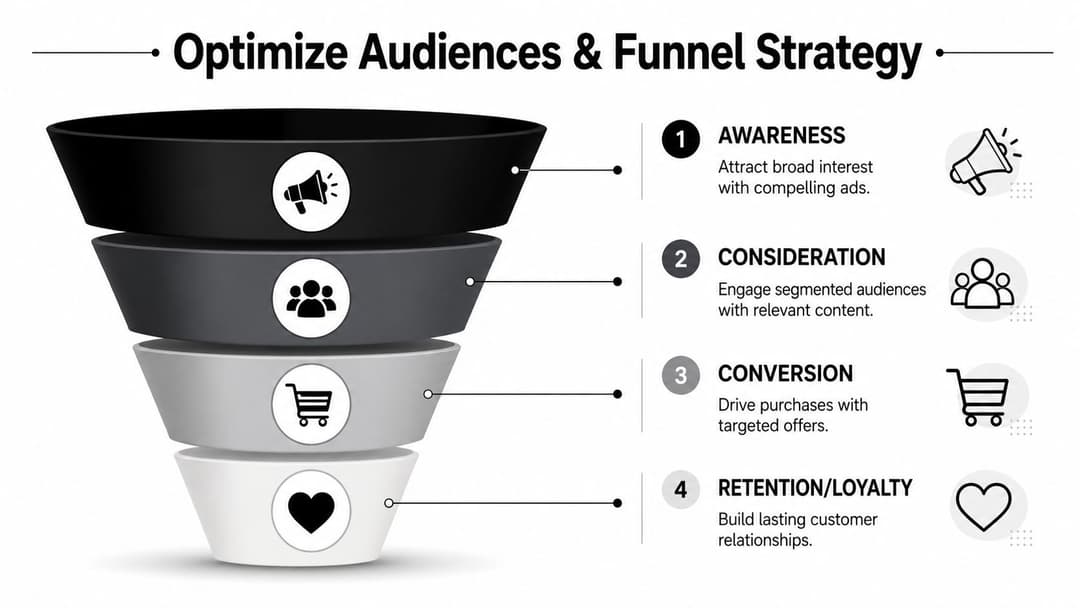
The mistake I see most often is using one ROAS standard for everything. Prospecting, retargeting, retention, and reactivation don't play the same role. They shouldn't be judged the same way either.
Stop forcing short-term ROAS to answer every question
Criteo's article on increasing ROAS points to a problem many brands create for themselves: they focus on short-term ROAS and end up cutting spend that acquires high-value customers. The article notes that prioritizing high-CLV customers and investing in retention can make initially lower-ROAS campaigns more profitable over time.
That's not a theoretical point. It's a budgeting problem.
If a top-of-funnel campaign brings in first-time buyers who come back and purchase again, a narrow short-window ROAS view can make that campaign look worse than it really is. Meanwhile, a retargeting campaign can look excellent because it's harvesting people who were already close to converting.
Build audiences by funnel intent
I like to think about audiences in four jobs, not just four lists.
| Funnel stage | Audience role | Messaging focus |
|---|---|---|
| Awareness | Introduce the offer | Problem, identity, curiosity |
| Consideration | Build conviction | Benefits, proof, differentiation |
| Conversion | Remove friction | Offer, urgency, objections |
| Retention and loyalty | Increase value over time | Refill, cross-sell, community, loyalty |
Audience segmentation takes on strategic importance. Warm visitors need reassurance and clarity. Existing customers need relevance, not another generic acquisition pitch. Cold audiences need a reason to care before they need a reason to buy.
For paid social teams refining seed quality and prospecting structure, Meta lookalike audience strategy is worth a look.
Segment by value, not just recency
Recency matters, but value matters more. Someone who bought once on discount isn't the same as someone who repeatedly buys at full price. If both sit inside the same retargeting or customer segment, the platform gets a blurred signal.
A better way to think about segmentation:
- High-value buyers: Protect these audiences. They inform both retention and better acquisition modeling.
- Recent non-buyers: They often respond to objection-handling and offer framing.
- Product viewers versus cart abandoners: They need different pressure levels.
- Existing customers: Exclude them from cold prospecting unless the offer is explicitly for repeat purchase behavior.
Audience strategy gets sharper when you stop asking "who clicked?" and start asking "who becomes valuable after the first conversion?"
That shift keeps you from overvaluing campaigns that merely close easy demand and undervaluing campaigns that create future revenue.
Master Advanced Bidding and Budget Allocation
Once the account is measured correctly, the landing path is sound, and the funnel structure makes sense, bidding becomes powerful. Before that, it's just a cleaner way to spend into confusion.
The biggest change in recent account management is that autonomous systems now outperform manual control in many mature setups, but only when you give them the conditions they need.
Know when to hand control to automation
The clearest example is AI-driven campaign automation. Implementing AI-driven autonomous campaign strategies such as Meta Advantage+ and Google AI Max increases ROAS by 18% to 32% according to 2026 industry benchmarks, because these systems optimize bidding and audience selection in real time.
That doesn't mean every account should switch everything to automation on day one. Smart systems still need enough clean conversion data to learn. If you move too early, you can end up automating noise.
A staged migration is usually safer. The verified benchmark guidance for campaign setup recommends using manual CPC for 2 to 3 weeks until 30 to 50 conversions accumulate per campaign, then switching to Smart Bidding such as Target ROAS. It also recommends keeping 3 to 5+ ad sets so the algorithm has room to reallocate budget, and only increasing spend by 15% to 20% every few days after performance is validated (Improvado's PPC ROAS playbook).
Reallocate budget like an operator, not a gambler
Many teams spend too much time tuning bids and not enough time moving budget between outcomes. That's backward. If one campaign consistently beats another, the more important decision is where the money goes.
Systematic budget reallocation from underperformers to winners can boost overall ROAS by 20% to 30%, and the strongest execution pattern is a 10% to 15% weekly reallocation based on recent performance. The same benchmark notes a clear example: shifting spend from a 3:1 performer to an 8:1 performer materially improves efficiency.
Here is the decision logic I use:
- Keep winners stable enough to learn. Don't force abrupt changes that reset momentum.
- Move budget weekly, not emotionally. A planned cadence beats same-day reactions.
- Favor signal-rich campaigns. If a campaign has stronger data integrity and cleaner conversion value, its performance is more trustworthy.
- Don't subsidize mediocrity. "Needs more time" is often how weak campaigns keep spending.
For marketers who want a broader framework for reading spend and return patterns, paid campaign analytics strategies from Gilkes Media are a helpful companion.
Feed the bidding system the right value signals
Autonomous bidding doesn't optimize for your business model automatically. It optimizes for the data you pass back. If low-quality conversions and high-value conversions look the same to the platform, the system can't prioritize the customers you most want.
That is why accurate conversion values and first-party data matter so much in AI-led bidding. If you're evaluating efficiency beyond top-line spend, this breakdown of Facebook cost per acquisition is useful because it highlights how acquisition economics and bidding logic interact.
The practical takeaway is simple. Automation works best when your account structure is disciplined, your conversion signal is trustworthy, and your budget shifts are deliberate.
Build a Continuous ROAS Optimization System
A one-time ROAS fix rarely lasts. Markets change, creative burns out, offers lose edge, and the platform redistributes attention. The accounts that hold efficiency over time run on routine.
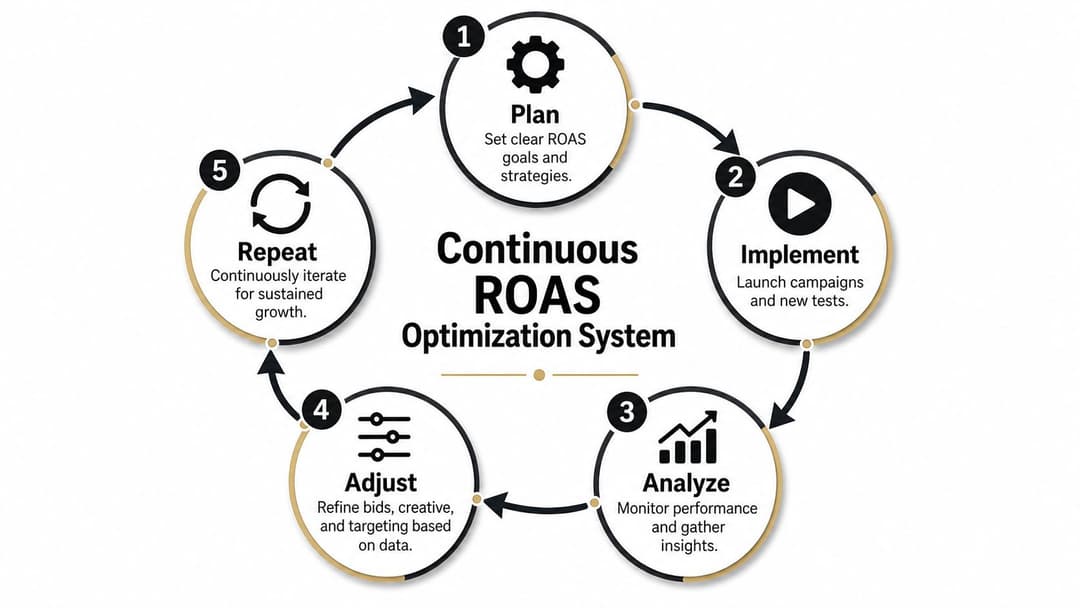
The backbone of that routine is simple: review, decide, test, reallocate, repeat. But the quality of the system comes from what gets reviewed and how decisions are made.
Run the same weekly questions every time
A useful optimization cadence doesn't need to be complicated. It needs to be consistent.
I like a weekly review built around these questions:
- Is the data trustworthy? Check attribution consistency, event quality, and any tracking irregularities.
- Where is ROAS strongest and weakest? Look by campaign, audience, creative angle, placement, and landing path.
- What should be scaled, trimmed, or rebuilt? Make action decisions, not commentary.
- What did this week's tests teach? Pull out reusable lessons.
- What goes live next? The next test batch should come directly from observed performance.
That routine prevents two common failures. First, teams stop reacting to every daily fluctuation. Second, they stop letting insights die in Slack threads and meeting notes.
Use a short operating checklist
When teams ask how to increase ROAS sustainably, they're usually asking how to avoid chaos. A checklist helps because it forces the same discipline under pressure.
A practical operating checklist might include:
- Measurement check: Reporting window is normalized and comparable.
- Creative review: Fatigued ads are identified and replacements are ready.
- Audience review: Segments are still aligned to funnel stage and value.
- Budget review: Capital is moving toward validated winners.
- Landing page review: Any friction introduced by merchandising, pricing, or UX is flagged quickly.
Systems beat heroics. A calm weekly process usually outperforms a brilliant but inconsistent optimizer.
Reallocate steadily and keep learning
The best part of a repeatable system is that scaling becomes less dramatic. You're not betting the account on one campaign. You're moving resources toward proven combinations as evidence accumulates.
That matters because systematic budget reallocation can improve overall ROAS by 20% to 30% when teams shift spend from weak campaigns to stronger ones, with 10% to 15% weekly reallocation being the most reliable pace for doing it without destabilizing platform learning.
That pace is slower than many executives want and faster than many teams feel comfortable with. It's usually right.
If you want a useful mental model for building this kind of feedback loop into everyday marketing work, continuous learning in performance systems is a strong reference point. The idea isn't to chase perfection. It's to keep the account learning faster than it decays.
A durable ROAS system has a few obvious traits. It respects data quality. It treats creative as a production engine, not a side task. It segments audiences by role and value. It uses automation where the signal supports it. And it moves budget with discipline.
If your team wants to launch more tests, learn faster from Meta performance, and scale winning combinations without drowning in manual setup, AdStellar AI is built for that workflow. It helps performance marketers generate large batches of creative, copy, and audience combinations, push them live quickly, and use AI-driven insights to identify what deserves more budget.