You're buying clicks on Meta, the ads are getting engagement, and the dashboard says traffic is up. Then you open Shopify, HubSpot, or your CRM and the outcome is flat. That gap frustrates almost every paid social team at some point.
Most of the time, the issue isn't that your media buying suddenly got worse. It's that the handoff from ad to landing page to conversion is breaking. Paid social teams often optimize creative, hooks, and audiences inside Ads Manager while the website gets treated as a separate problem. That split is where a lot of wasted spend hides.
Moving Beyond Guesswork in Your Paid Social Funnel
A lot of conversion advice starts too far down the funnel. It assumes the visitor is already well qualified and just needs a cleaner button or a stronger CTA. Paid social rarely works that way. On Meta, you're dealing with broad audiences, mixed intent, fast scrolling, and a click that often comes from curiosity before commitment.
That's why broad benchmarks matter. The average website conversion rate is about 2.35%, while top-performing websites convert at 11% or higher, according to this CRO benchmark roundup. The spread tells you something important. Most businesses don't have a traffic problem alone. They have a system problem.
If your paid social funnel converts like an average site, small leaks at every stage compound fast. The ad wins the click. The landing page softens the promise. The form asks for too much. Mobile load time drags. The user bounces, and the team blames the audience.
That's the wrong diagnosis.
What paid social teams usually get wrong
The common mistake is random optimization. One week it's a new hero image. Next week it's shorter copy. Then someone wants a homepage redesign. None of those changes are necessarily bad. They're just disconnected.
A paid social CRO process works better when it ties four things together:
- Ad promise: What the user thought they were getting when they clicked.
- Audience context: Who clicked, from which segment, and with what level of intent.
- Landing page delivery: Whether the page confirms and sharpens that promise.
- Funnel friction: What stops the user from completing the next step.
If you already benchmark ad performance, you need the same discipline on the post-click side. Teams that care about creative inputs usually benefit from a tighter creative benchmarking process, because ad winners and page winners should reinforce each other, not work as isolated assets.
Practical rule: Don't ask “How do we improve the page?” first. Ask “Where does the promise break between impression and conversion?”
That question leads to better tests than another round of cosmetic A/B experiments.
Uncover Your Funnel's Hidden Conversion Blockers
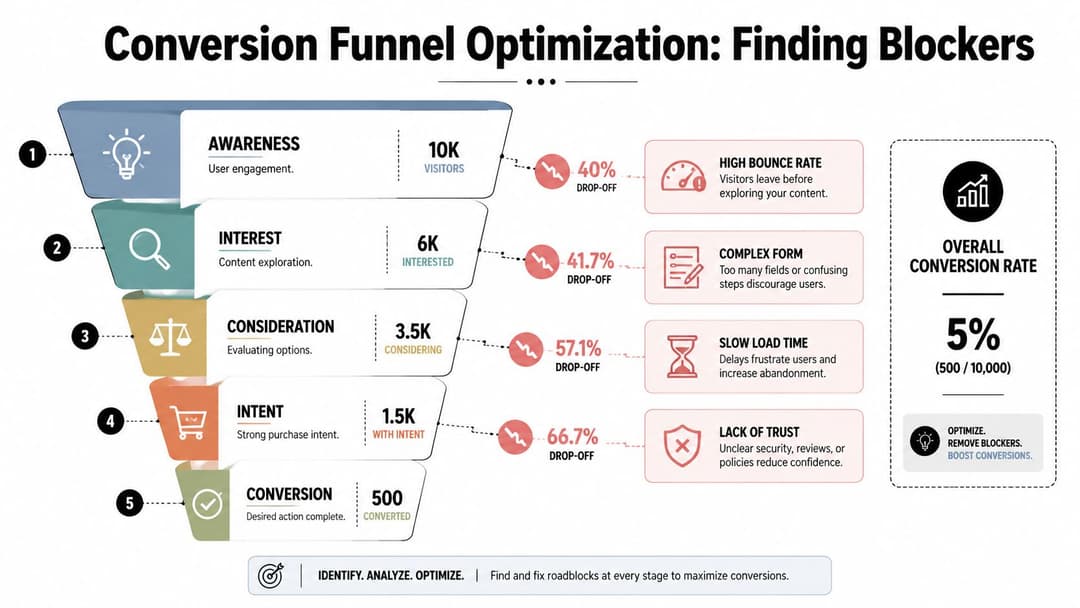
Before testing anything, diagnose the funnel. The fastest way to waste budget is to run experiments on the wrong problem. In paid social, the visible problem is often low conversion rate. The actual problem might be weak traffic quality, broken tracking, slow page performance, form friction, or message mismatch between ad and page.
Start with drop-off by volume
The first lens is quantitative. Don't start with the ugliest page or the loudest stakeholder opinion. Start with where the most users fall out.
Map the funnel in the simplest useful way. For e-commerce, that might be landing page, product view, add to cart, checkout start, purchase. For lead gen, it might be landing page, form start, form completion, booking, qualified lead. Then compare stage-to-stage drop-off by audience, device, campaign, and landing page.
An effective solution often aims at the highest-volume leak, instead of merely the most obvious design flaw.
A practical note for paid social teams: if your attribution is messy, your diagnosis will be messy too. Better event quality improves both ad optimization and CRO analysis, which is why many teams clean up tracking with tools like the Facebook Conversion API setup guide before they trust funnel conclusions.
Add behavior, not just analytics
The second lens is qualitative. Once you know where users leave, look at what they were doing right before they left.
Useful tools here include:
- Heatmaps: To see whether users notice the primary CTA or get pulled into navigation, FAQs, or secondary links.
- Session recordings: To spot hesitation, repeated clicks, scroll loops, dead clicks, form errors, and backtracking.
- Form analytics: To identify which field slows completion or triggers abandonment.
Teams often skip this step because it feels slower than launching tests. In practice, it saves time. Watching a handful of abandoned sessions often reveals patterns you won't catch in aggregate charts.
Watch the users who almost converted, not just the ones who bounced instantly. That's where hidden friction usually shows up.
Check ad-to-page message match
The third lens is the one paid social teams miss most often. A frequent conversion blocker is message mismatch. Recent guidance notes that segmenting site visitors and ensuring message matching between ad and landing page can significantly reduce drop-off, as discussed in this ActiveCampaign CRO article.
This shows up in a few familiar ways:
- The ad promises one thing, the page opens on another. Example: the ad sells speed, but the page leads with price.
- The creative targets a specific use case, but the page is generic. Example: a founder-focused ad lands on a page written for enterprise teams.
- The offer changes after the click. Example: the ad mentions a guide, but the landing page pushes a demo.
- Proof doesn't support the original claim. Example: the ad leans on UGC-style relatability, but the page shifts to abstract brand copy.
For Meta in particular, this matters because one campaign can contain many creative angles and audience combinations. A single landing page often can't carry all of them equally well. If you're serious about how to improve conversion rates, this is one of the first places to look.
Prioritize Tests for the Highest Potential Return
Once you audit the funnel properly, you usually end up with too many ideas. Shorten the form. Rewrite the headline. Split mobile and desktop pages. Reduce scripts. Create audience-specific variants. Add more proof. Remove navigation. Build a quiz. Redesign checkout. The challenge isn't a lack of ideas. It's spreading effort across too many ideas at once.
A better approach is to rank hypotheses before you build anything.
Use a simple scoring model
I like a basic PIE lens. Potential, Importance, Ease. It's not perfect, but it forces trade-offs.
- Potential: If this works, how much could it move conversions?
- Importance: How much traffic or revenue passes through this step?
- Ease: How fast can the team ship and measure it?
This pairs well with a core funnel principle from Winning by Design's guide to improving sales conversion rate: identify the largest drop-off point by volume and focus on that single area until it's fixed. That keeps attribution cleaner and prevents your CRO roadmap from turning into a pile of unrelated tasks.
Example PIE scoring for test hypotheses
| Test Hypothesis | Potential (1-10) | Importance (1-10) | Ease (1-10) | Total Score |
|---|---|---|---|---|
| Simplify lead form from current version to a multi-step flow | 9 | 9 | 6 | 24 |
| Rewrite landing page headline to match ad promise | 8 | 8 | 9 | 25 |
| Remove secondary navigation from paid landing page | 6 | 7 | 8 | 21 |
| Full homepage redesign for all traffic | 5 | 6 | 2 | 13 |
| Build segmented landing pages for top audience clusters | 9 | 8 | 4 | 21 |
The point isn't mathematical precision. The point is discipline.
What usually deserves priority
In paid social funnels, the highest-return tests often come from a short list:
- Message alignment fixes: Fast to launch, especially when ad angles are already known.
- Form friction reduction: High impact when completion is the bottleneck.
- Technical cleanup on key landing pages: Especially if mobile users struggle.
- Segment-specific page variants: Higher lift potential, but usually slower to execute.
A homepage redesign often scores lower than teams want to admit. It touches everything, takes longer, and muddies the result. A focused test on the page and audience that matter most usually teaches you more.
If your team needs a broader performance framework, this digital marketing performance guide can help connect CRO priorities with channel-level decision making.
The best test isn't the most creative one. It's the one that removes the biggest known bottleneck with the least ambiguity.
Design and Run Smart Experiments Across Your Funnel
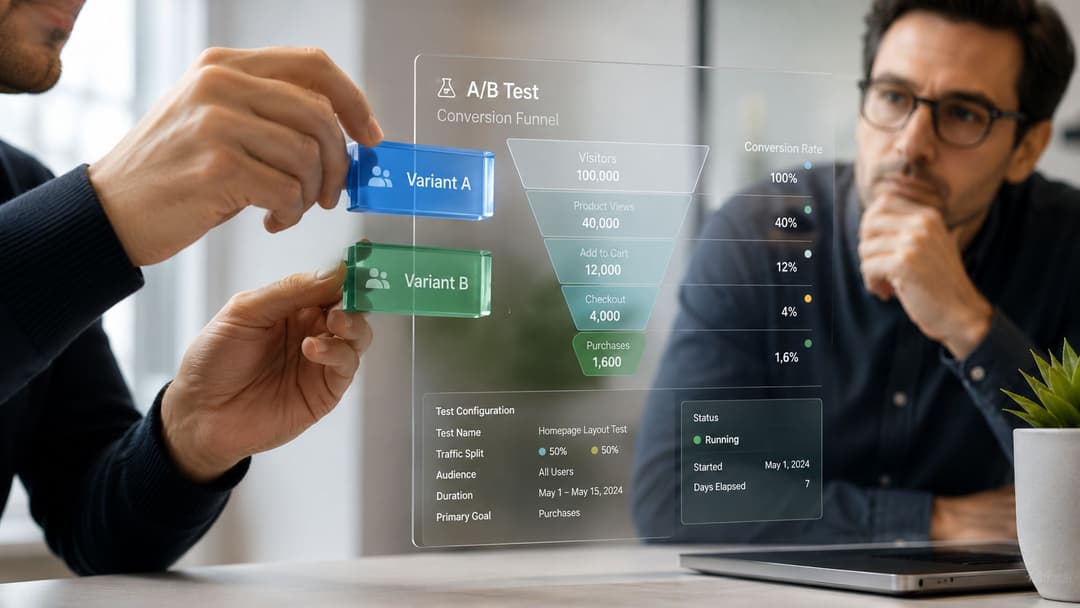
Once you've picked the priority, design the test so the result means something. That sounds obvious, but a lot of paid social experiments collapse because too many variables change at once. New creative, new audience, new page, new offer. If performance moves, nobody knows why.
A rigorous CRO workflow should prioritize one test variable at a time, because that's what makes results interpretable. Tests also need enough data to reach a meaningful conclusion, as noted in Quantum Metric's CRO testing guidance.
Ad-level experiments
Ad-level testing matters because weak post-click performance often starts with a weak or misleading pre-click promise. In Meta, creative sets expectation before the landing page ever gets a chance.
Three useful ad-level tests:
Hook angle against the same offer
Keep the landing page and audience fixed. Test one angle focused on pain point against another focused on outcome. If one drives more qualified sessions, you've learned something about intent, not just click behavior.UGC-style video against polished brand creative
This is less about aesthetics and more about expectation. A casual ad can pull in users who want a conversational landing page. A polished ad can set a different bar for proof and authority.Offer framing without changing the underlying product
Test “free guide,” “free audit,” or “demo request” only if the page and follow-up experience match that framing.Primary proof element in the ad
One variant may lead with testimonial-style proof, another with product demonstration. Keep the rest stable.
If your team runs creative at scale, a documented Facebook ad creative testing methodology helps keep these variables clean instead of mixing every change into one launch.
Audience experiments
Audience tests are easy to misuse. If the page is weak, a new audience won't save it. If the page is strong but narrow, the wrong audience will make it look broken.
Good audience tests usually answer one question at a time:
- Cold versus warmer retargeting cohorts: Do they need the same page, or does one group need more trust-building before the CTA?
- Broad audience versus interest cluster: Does one segment respond better to a use-case-specific promise?
- Exclusion logic: Are recent purchasers, leads, or high-frequency viewers polluting performance?
- Segment-specific landing page routing: Can users from one ad set land on a page tuned to their problem or identity?
A useful rule here is simple. If you test a new audience, try not to change the page at the same time unless the whole point is to validate message match for that segment.
Landing page experiments
A common perception of CRO involves certain methods, but the best page tests are tied directly to what the ad already told the user.
Common high-signal page experiments include:
- Headline match: Rewrite the hero so it mirrors the ad's main promise in clearer language.
- CTA clarity: Change the call to action so it reflects the user's next step, not your internal funnel label.
- Form friction: Test progressive profiling, inline validation, or multi-step forms when you need to reduce effort while still collecting useful information.
- Proof placement: Move testimonials, creator content, customer logos, or product evidence closer to the decision point.
- Distraction removal: Strip unnecessary navigation or competing links from paid landing pages.
A short walkthrough can help your team sanity-check how these tests are structured:
What not to do
A lot of test programs fail because of preventable mistakes:
- Changing multiple variables at once: You get movement, but not learning.
- Stopping early: Early winners often reverse.
- Using weak primary metrics: CTR or scroll depth can help diagnose, but the test needs a conversion outcome tied to business value.
- Testing cosmetic changes before structural ones: Button color rarely beats message clarity or friction reduction.
If you can't explain exactly what changed and why it should affect conversion, the test isn't ready.
Analyze Results and Systematically Scale Winners
The value of an experiment isn't the launch. It's the decision that comes after. Teams waste good testing work when they call winners too early, ignore second-order effects, or fail to preserve what they learned.
Read the result in context
First, check the primary conversion outcome you set before launch. Then inspect the path behind it. Did the variant improve form starts but hurt form completions? Did it increase checkout starts but lower purchase quality? Did one audience respond while another dragged the average down?
A “winner” that creates downstream problems isn't a real winner. Paid social teams need to watch the whole path, not just the first positive signal.
Keep a simple review framework:
- Primary outcome: Did conversion improve on the intended action?
- Segment view: Did the effect hold across major cohorts like device, audience, or placement?
- Operational quality: Did lead quality, order quality, or downstream pipeline stay intact?
- Confidence: Did the test run long enough to trust the result?
Build a learning library
A mature CRO team documents more than wins and losses. It records why the team believed the hypothesis, what changed, what happened, and what that implies for future creative and page strategy.
That repository becomes more valuable over time than any single test. It helps you avoid rerunning weak ideas. It also reveals patterns. Maybe urgency language works in ads but not on the page. Maybe testimonial-heavy pages help cold traffic but slow down retargeting users. Maybe one customer segment needs concrete proof while another responds to workflow simplicity.
Use a shared doc, Notion database, Airtable, or whatever your team will maintain. The tool matters less than the habit.
Scale what proves itself
Many teams leave money on the table. A validated message, offer, or page structure shouldn't stay trapped in one campaign.
Evidence summarized in this marketing analytics research article shows companies can see a 55% increase in leads when they expand from 10 to 15 landing pages, and organizations with over 40 landing pages can increase conversions by more than 500%. The practical lesson isn't “build pages for the sake of pages.” It's that scaling segmented winning experiences can outperform sending every click to one generic destination.
In practice, scaling looks like this:
- Roll out the winning page pattern to closely related campaigns first.
- Clone successful message structures into new audience-specific variants.
- Expand segmented landing pages around proven ad angles, not around internal org charts.
- Feed winning creative and audience patterns back into campaign production systems.
Some teams use spreadsheets and manual briefs for that. Others use platforms such as AdStellar AI to analyze top-performing creatives, audiences, and messages, then generate and launch new variants based on those patterns. The important part isn't the software choice. It's the discipline of turning one tested insight into a repeatable operating method.
A good test improves one page. A good system turns that result into a reusable pattern across campaigns.
Adopt a Mindset of Continuous Optimization
The teams that improve conversion rates consistently don't treat CRO like a side project. They treat it like operating rhythm. That shift matters because paid social conditions change constantly. Creative fatigues. Audiences broaden. Offers age. Landing pages drift away from what ads are saying. What worked last quarter can slow down without any dramatic failure signal.
Stop chasing isolated wins
One of the biggest mindset errors is local optimization. A team increases click-through rate with a stronger curiosity hook, but the landing page can't cash the promise. Another team cuts friction by shortening a form, then discovers lead quality dropped. Those aren't useless tests. They're incomplete ones.
Good CRO asks a harder question. Did the whole system improve?
That means holding ad, page, and downstream outcomes together. Paid social teams especially need this view because Meta can reward top-of-funnel engagement long before the business sees revenue quality.
Treat losing tests as useful evidence
A failed test still narrows the field. It tells you what your users didn't care about, what message didn't land, or which friction point wasn't the main blocker. Teams that fear losing tests move slowly and end up making more opinion-driven changes between tests.
That's why it helps to periodically step back and understand conversion rate optimization as a process, not a bag of tricks. The core habit is repeated learning. Measure, diagnose, test, record, scale, repeat.
Build a team that learns fast
This is usually less about talent than workflow.
A practical team culture looks like this:
- Marketers share hypotheses clearly: Why this variable, on this audience, at this funnel step.
- Designers work from intent, not decoration: The page should reinforce the ad's promise.
- Analysts protect interpretation: One clean test beats five muddy ones.
- Media buyers feed findings back into campaign structure: Winning messages deserve more than a note in Slack.
If you want that process to compound, this continuous learning framework is a useful way to think about how teams turn isolated tests into institutional knowledge.
The key advantage isn't one dramatic lift. It's a team that gets better at diagnosing why users convert, why they don't, and how to respond without starting from zero every month.
If your paid social team wants a faster way to turn winning Meta insights into new campaign variations, AdStellar AI helps automate creative, audience, and launch workflows so you can test more systematically and scale what converts.