If performance has stalled, the instinct is usually to add more. More campaigns. More audiences. More creative. More budget shifts.
That usually makes the account harder to read and easier to mismanage.
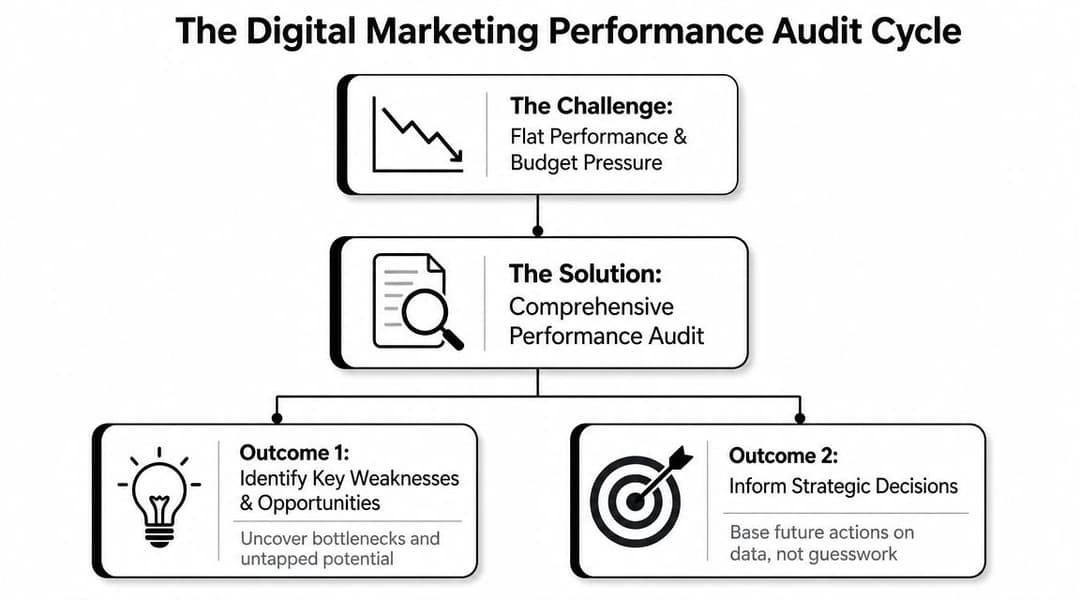
The typical need isn't for more activity, but for a better operating system. If you're trying to figure out how to improve digital marketing performance, treat it as a repeatable cycle: audit what matters, pick the few levers that can move outcomes, test with discipline, scale what proves itself, and measure impact beyond whatever the ad platform wants to claim.
Start with a Clear-Eyed Performance Audit
Flat results feel like a creative problem, a budget problem, or a channel problem. Sometimes they are. But the first failure is often simpler. The team doesn't have a clean baseline, so every decision after that is reactive.
A proper audit starts by separating business metrics from activity metrics. Impressions, reach, and clicks can help diagnose what's happening, but they don't tell you whether marketing is becoming more efficient. Industry guidance consistently points marketers back to CTR, conversion rate, ROI, and ROAS because those metrics connect message quality, audience fit, and commercial outcome. Klipfolio also notes that firms were allocating 57% of their budgets to digital marketing and planned to increase spending by another 16% in 2023, which makes tighter measurement essential, not optional (digital marketing KPI guidance from Klipfolio).
Establish the baseline before touching the account
Pull a meaningful historical window and review performance by campaign, ad set, audience, creative, placement, landing page, and offer. You're looking for patterns, not isolated wins.
Start with questions like these:
- Which campaigns produce efficient traffic: Look at CTR alongside post-click behavior. A high CTR with weak conversion usually means the promise in the ad isn't matched on the landing page.
- Where does conversion rate break down: Compare campaign-level conversion rates and then drill into page variants, device splits, and audience segments.
- Which combinations generate value: Revenue-focused views matter more than surface engagement. Some ads earn cheap clicks and still waste budget.
- What has changed over time: Creative fatigue, audience saturation, offer erosion, and tracking issues often show up as trend shifts rather than overnight collapse.
A lot of junior teams audit too shallowly. They stop at "Campaign A is down." That isn't a diagnosis. A diagnosis sounds more like this: "CTR fell after the creative refresh, conversion rate stayed steady, and the weakest segment is broad prospecting on mobile placements."
Practical rule: Don't change bids, budgets, targeting, and landing pages all at once. First write down where the break appears to be.
Define one primary KPI and a few supporting indicators
You can't optimize an account with five competing definitions of success. Pick a primary KPI for each campaign objective, then use supporting metrics to explain movement around it.
A simple structure works well:
| Campaign type | Primary KPI | Supporting indicators |
|---|---|---|
| Lead generation | Conversion rate or cost per qualified lead | CTR, landing-page behavior, audience quality |
| E-commerce | ROAS or ROI | CTR, add-to-cart behavior, conversion rate |
| Paid social prospecting | CTR or conversion rate, depending on maturity | Creative engagement, audience response, offer fit |
If your reporting still centers on traffic volume without tying that traffic to action, the audit is incomplete. That's also where broader market context helps. Looking at examples of structured market and account reviews can sharpen your own audit process, especially when you're comparing competitors, positioning, and internal performance together. This kind of industry analysis framework is useful because it forces you to connect channel data to actual market conditions rather than reading the account in isolation.
Look for operational problems, not just tactical ones
Some audits reveal bad ads. Better audits reveal broken systems.
Common operational issues include:
- Reporting fragmentation: Google Analytics, Meta Ads Manager, CRM data, and spreadsheet exports all tell slightly different stories.
- Naming inconsistency: If campaign naming is messy, your historical comparisons become unreliable.
- No review cadence: Teams that only review thoroughly once a month usually react too late.
- Too many simultaneous edits: Once multiple changes stack together, no one knows what caused the result.
A good audit doesn't just tell you what underperformed. It tells you what the team can trust, what it can't trust, and where to focus first.
Prioritize Your High-Impact Optimization Levers
An audit usually produces a long list of issues. That's where teams lose discipline. They try to fix audience targeting, bids, landing pages, offers, creative formats, and reporting all in the same week. The result is noise.
Strong optimization starts with four levers: creative, audience, bidding and budget, and funnel. All four matter. They don't all deserve equal attention at the same moment.
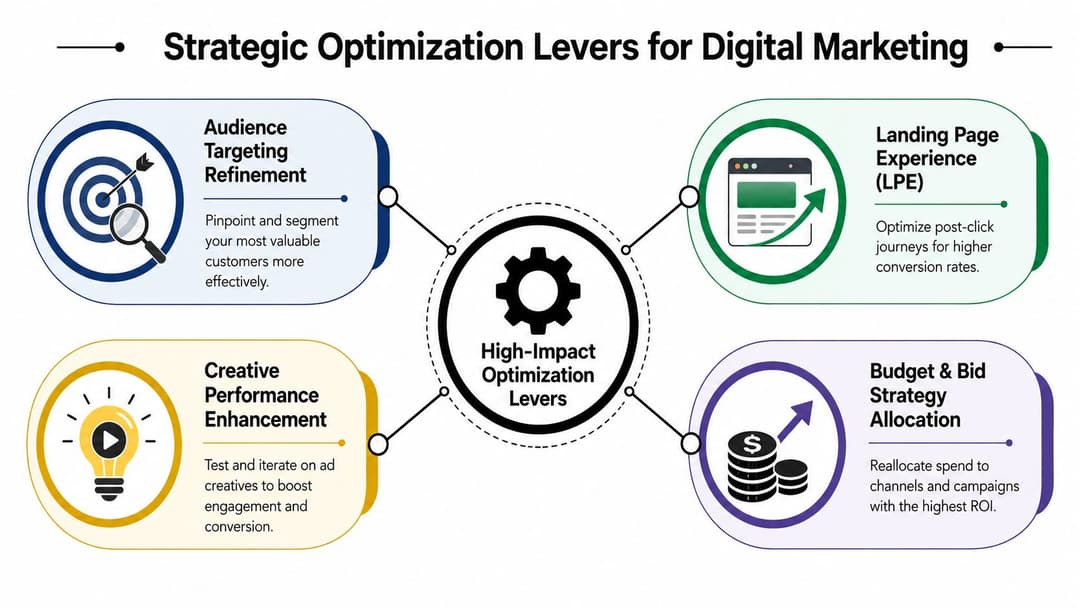
Start where the account is most constrained
If traffic quality is poor, audience work matters. If conversion collapses after the click, the funnel deserves attention. But in many paid social environments, creative is the fastest lever to move because it's the part users respond to first.
That's why creative testing deserves more respect than it gets. The problem isn't that marketers don't know creative matters. It's that many teams still don't have a production and testing system built for the pace modern platforms demand. Emarsys highlights that gap and notes Meta's own reporting that Reels ads deliver a 33% higher likelihood of action compared with standard video ads, which makes creative format experimentation a real advantage, not a cosmetic exercise (creative testing and Reels performance context from Emarsys).
Use a simple order of operations
Don't ask every lever to carry the same job. Use them in sequence.
Creative first when attention is weak
If CTR is low, your ad probably isn't earning enough interest to give the rest of the funnel a fair chance.Audience next when response is uneven
If one segment responds and another doesn't, refine where delivery goes before rewriting everything.Funnel when clicks don't become action
Good ad response with weak conversion usually points to message mismatch, a weak offer, or a poor landing-page experience.Budget and bids after signal is cleaner
Scaling bad traffic faster doesn't solve anything. Budget works best when it's amplifying a proven combination.
What works and what doesn't
A lot of optimization advice is too abstract, so here's the practical version.
What works
- Testing creative themes, not random assets: Compare clear angles like urgency, proof, problem-solution, or product demonstration.
- Matching creative to audience intent: Broad prospecting usually needs a different message than retargeting.
- Refreshing formats deliberately: Short-form video, statics, carousels, and UGC-style variations each answer different attention problems.
- Using a testing workflow: If your team runs Meta often, a more structured Facebook ads optimisation process helps prevent random edits and scattered reporting.
What doesn't
- Changing everything after two bad days
- Judging creative only by engagement
- Treating audience targeting as a substitute for weak messaging
- Scaling budget before the landing page can hold conversion
The best early optimization lever is usually the one closest to the actual user decision. In paid social, that's often creative.
Build a High-Velocity Testing Engine
Most accounts don't suffer from a lack of ideas. They suffer from unstructured testing. Someone changes the headline, another person swaps the image, the budget gets adjusted mid-flight, and by the end of the week the team says the account is "learning."
It isn't learning. It's being edited.
Northwestern Medill describes A/B testing as comparing two versions of an ad or marketing communication that differ by one element so teams can isolate what drives a better response and apply the winner at scale. That same guidance ties testing to personalization and notes that personalization dramatically increases the likelihood of interaction, which is why performance improvement now looks more like continuous optimization than occasional campaign refreshes (A/B testing and personalization guidance from Medill).
Write hypotheses that force clarity
If you want to know how to improve digital marketing performance consistently, stop launching tests with vague logic like "let's try a new version."
Use a simple hypothesis format:
We believe changing X for Y audience will improve Z metric because specific user behavior or message logic.
Examples:
- We believe replacing product-focused copy with problem-focused copy for cold audiences will improve CTR because first-touch users respond better to pain recognition than feature depth.
- We believe shortening the lead form headline will improve conversion rate because the current message asks for commitment before explaining value.
- We believe testing customer-language hooks against brand-language hooks will improve response because the current creative sounds internal, not market-facing.
A test should still be useful if it loses. That's the bar.
Keep test design tight
High-velocity testing doesn't mean careless testing. It means quick learning loops with control.
Use these rules:
- Change one variable at a time: If you're testing a headline, don't also change the image and CTA.
- Group tests by lever: Creative tests should answer creative questions. Audience tests should answer audience questions.
- Define the success metric before launch: Don't let the team move the goalposts after results come in.
- Document every test: Hypothesis, setup, dates, audience, variable changed, outcome, next action.
Here is a simple testing workflow that works well in practice:
| Step | What the team does | Why it matters |
|---|---|---|
| Form hypothesis | State expected outcome and reason | Prevents random testing |
| Build control and variant | Keep one meaningful difference | Preserves signal |
| Launch in a controlled window | Avoid overlapping major account changes | Reduces contamination |
| Review outcome | Judge against predefined KPI | Keeps decisions consistent |
| Roll learning forward | Apply insight to the next batch | Turns testing into a system |
Increase velocity without creating chaos
The fastest teams aren't the ones making the most edits. They're the ones with the best system for turning results into the next test.
That usually means:
- A test backlog: Ranked by expected impact and ease of execution
- A review rhythm: Weekly KPI checks, then monthly or quarterly structural decisions
- Version control: Clear naming, archived variants, and documented winners
- A shared framework: Everyone on the team should use the same test language and reporting fields
If your current process is loose, a structured rapid ad testing framework can help standardize how ideas move from concept to launch to analysis.
Losing tests are still productive when they remove a bad assumption from the account.
Scale Your Winners with Automation and AI
Manual optimization breaks at the exact moment performance starts getting interesting. One creative wins. One audience pair looks promising. A landing-page message starts converting better. Then the team has to duplicate campaigns, rebuild ad sets, shift budgets, pause losers, and keep naming clean across the account.
That's where a lot of good testing programs stall. The insight exists, but execution lags.
Automation should handle repetition, not judgment
The right way to use automation is operational, not lazy. Let systems handle repetitive actions that follow clear rules. Keep strategic calls in human hands.
Useful automation tasks include:
- Budget reallocation workflows: Move spend toward combinations that have already proved efficient.
- Creative rollout rules: Push winning themes into new audience segments without rebuilding everything from scratch.
- Performance alerts: Flag meaningful shifts before weekly review meetings.
- Asset organization: Keep creative variants, headlines, audiences, and outcomes tied together.
If you're sorting through options to boost efficiency with automation tools, focus less on feature lists and more on whether the tool shortens the gap between learning something and acting on it.
AI becomes valuable after the team has a system
AI doesn't fix weak measurement or random testing. It accelerates a disciplined process that's already in place.
In practice, AI helps most in three places:
First, it can analyze historical results faster than a person working across multiple campaigns and creative batches.
Second, it can surface patterns that are easy to miss manually, such as repeated message winners across different audience pockets.
Third, it can operationalize winners by generating new combinations from proven inputs instead of asking the team to rebuild every campaign by hand.
One example is AdStellar AI for performance marketing workflows, which is built around bulk ad creation, audience testing, performance breakdowns, and using prior Meta results to assemble and launch new variations. That kind of system fits teams that already know testing is the core job and want less manual setup around it.
Know the trade-off
Automation creates speed. It can also create distance from the work if the team stops checking why something is winning.
Use this standard:
- Automate execution where the rule is clear
- Keep diagnosis human when the reason for performance matters
- Review exceptions, not every tiny movement
The strongest setup is a loop. The team tests, the system helps scale what proves itself, and the humans keep refining the next round of creative, audience, and offer decisions.
Measure True Impact Beyond Platform Dashboards
Platform dashboards are useful. They are not neutral.
If you rely only on the numbers reported inside the ad platform, you risk funding channels that capture demand rather than create it. That's a dangerous habit, especially now that tracking quality is less stable and cross-platform attribution is more fragmented.
A more rigorous approach is incrementality testing. That means setting a primary outcome, building holdout groups by audience or geography, measuring lift between exposed and control groups, and scaling only after you've verified causal effect. Aidigital recommends this kind of structured lift testing and frames it alongside marketing mix modeling and other triangulation methods because platform-reported attribution can overstate channel value (incrementality testing guidance from Aidigital).
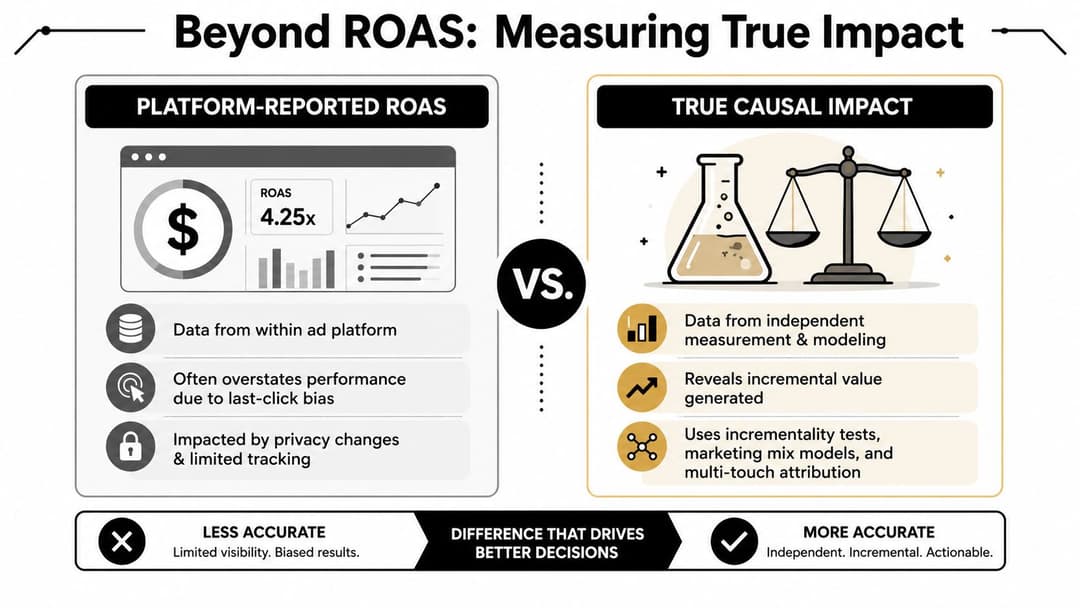
Why dashboard ROAS can mislead you
A platform can only report on what it can observe and claim. That doesn't automatically equal business impact.
Recent industry guidance highlights the broader measurement confidence problem. An IAB survey found only 34% of marketers feel very confident they can measure marketing ROI accurately, which is exactly why correlation-heavy reporting creates bad budget calls (measurement challenge context from Leadpages).
A better measurement stack
You don't need to abandon platform data. You need to put it in its place.
Use a layered approach:
- Platform reporting for tactical monitoring: Useful for spotting delivery issues, CTR shifts, spend pacing, and creative fatigue.
- Centralized dashboards for cross-channel review: Pull platform, analytics, and CRM views into one place so you can compare stories.
- Incrementality tests for causal confidence: Best for validating whether a channel is producing net new outcomes.
- Model-based analysis for budget planning: If you need a broader view, studying media mix modeling and its role in budget decisions helps when platform attribution alone isn't enough.
Ask harder questions before scaling
Before increasing spend, ask:
| Question | Weak answer | Strong answer |
|---|---|---|
| Is the platform claiming too much credit | "ROAS looks good in-platform" | "Lift held when we tested exposed versus holdout" |
| Are we seeing true new demand | "Retargeting is converting well" | "The channel produces measurable incremental impact" |
| Can we trust this trend | "It worked this week" | "It stayed consistent across repeated measurement" |
If you can't separate captured demand from created demand, you can still optimize the account and make the business worse.
Your 90-Day Digital Performance Improvement Plan
Teams often don't need another brainstorm. They need a calendar and a sequence.
Use the next ninety days to install a working system instead of chasing isolated wins.
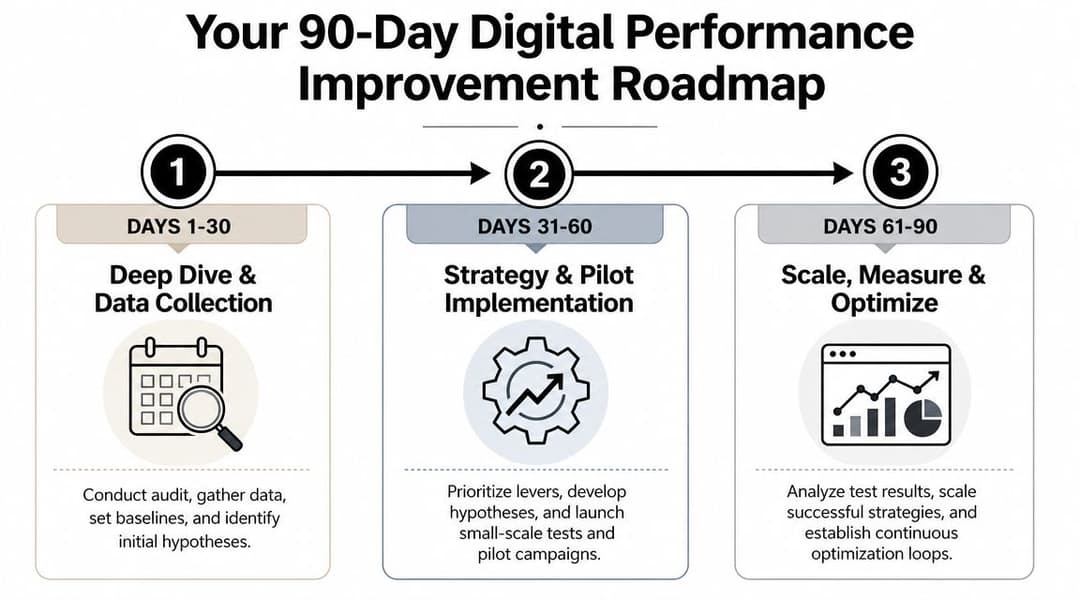
Days 1 to 30
Start with the audit. Pull your historical data, define one primary KPI per campaign objective, clean up naming, and identify where performance is breaking. By the end of this phase, your team should have a ranked issue list and a short backlog of hypotheses.
Keep the scope narrow:
- Audit the account structure
- Review KPI trends weekly
- Find one strong segment, one weak segment, and one test opportunity
- Confirm tracking and reporting logic
Days 31 to 60
Turn the backlog into controlled tests. Don't try to solve everything. Pick the highest-impact lever and run focused experiments around it.
Here, execution discipline matters most.
- Launch A/B tests with one variable changed
- Track results in a shared log
- Separate creative tests from audience tests
- Avoid major budget shifts that muddy interpretation
A short explainer can help align the team before that phase gets busy:
Days 61 to 90
By now you should know which themes, segments, or offers deserve more budget. Scale carefully, document what held up, and start layering in better automation and stronger measurement.
Focus on three outputs:
A documented winner list
Not just top ads, but winning messages, formats, audiences, and landing-page pairings.A repeatable operating rhythm
Weekly KPI review, monthly structural decisions, quarterly measurement validation.A truth-seeking measurement process
Platform dashboards for monitoring. Independent validation for budget confidence.
If you're serious about how to improve digital marketing performance, treat these ninety days as the start of a permanent operating model. Good teams don't win because they guessed right once. They win because they can audit, test, learn, scale, and measure the next cycle faster than the last one.
AdStellar AI helps performance teams turn that operating model into execution. If you're running high-volume Meta testing and want a more structured way to launch variations, learn from past results, and scale proven combinations without rebuilding everything manually, take a look at AdStellar AI.