Predictive modeling uses historical data to forecast future outcomes, and in Meta Ads that usually means estimating the probability that a creative, audience, or campaign setup will hit the KPI you care about. The shift toward explainable predictive modeling is accelerating, and recent data shows that 54% of Meta ad optimization failures stem from opaque models that cannot trace creative-performance links.
If you're running paid social right now, you know the feeling. You have six new creatives, three audience ideas, a limited budget, and pressure to find winners fast. Predictive modeling is basically what happens when you teach a very disciplined junior marketer to study your past campaigns, spot repeatable patterns, and use those patterns to make smarter calls on the next launch.
In practice, that's why the topic matters. You're not trying to build a science project. You're trying to answer questions like: Which ad is worth spending on first? Which audience is likely to fatigue sooner? Which combination looks good in the creative review doc but probably won't survive contact with the auction?
What Predictive Modeling Really Means for Marketers
Many marketing professionals hear "predictive modeling" and assume it belongs to data scientists, not media buyers. That's the wrong frame. For a marketer, predictive modeling is a way to turn campaign history into forward-looking decisions.
A clean definition comes from this overview of predictive modeling from ScienceDirect. It describes predictive modeling as a foundational statistical technique that uses historical data to forecast future occurrences. It also makes an important distinction: the job of the model isn't to explain the causal why. Its job is to predict the probability of an outcome well enough that a business can act on it.
That maps neatly to paid social. You often don't need a perfect explanation of why one static image beats another. You need a reliable signal that says, "This variation is more likely to drive the result you're optimizing for."
What that looks like inside a Meta workflow
Say you've launched enough campaigns to know certain patterns keep repeating:
- Shorter copy sometimes wins with cold traffic.
- UGC-style video often behaves differently from polished studio creative.
- Certain hooks hold up better when frequency rises.
- Some audiences click cheaply but don't convert well.
A predictive model takes those historical inputs and learns from them at a scale no person can maintain manually. It doesn't replace judgment. It gives judgment a better starting point.
Practical rule: A useful model doesn't need to be magical. It needs to help you make better budget, creative, and targeting decisions earlier than you otherwise could.
This is why the idea shows up well outside advertising too. Teams in regulated, data-heavy industries rely on predictive analytics to support decisions under uncertainty. If you want a non-marketing example of how leadership teams use this thinking, Visbanking insights for bank leaders is a good read.
For marketers, predictive modeling also sits alongside broader measurement methods. If you're sorting out where it fits compared with channel-level attribution and budget planning, this guide to media mix modeling helps clarify the difference.
What predictive modeling is not
It isn't a dashboard with trend lines.
It isn't a rules engine that says "pause ads under X CTR."
And it definitely isn't a guarantee that the next ad will win just because a similar one worked before.
What it does well is narrow uncertainty. In performance marketing, that's usually enough to matter.
The Core Concepts Behind the Predictions
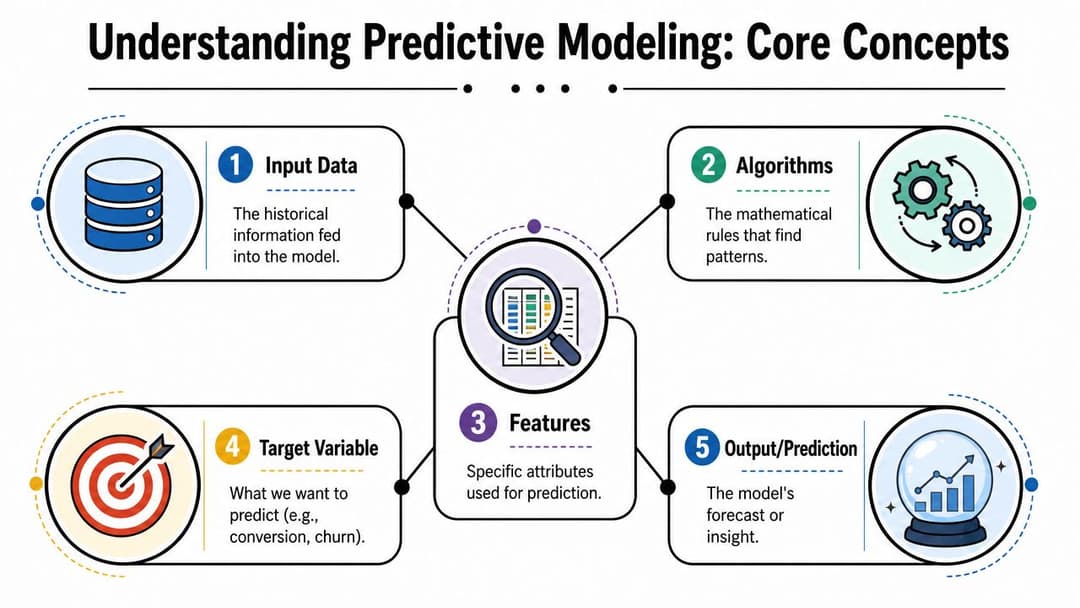
At a basic level, every predictive model needs five things: data, features, a target, an algorithm, and an output.
If that sounds abstract, translate it into campaign language.
The building blocks in marketer terms
Training data is your campaign history. That can include spend, impressions, clicks, conversions, audience details, placement, creative format, and downstream performance.
Features are the attributes the model uses to make a prediction. In Meta Ads, that might include copy length, headline style, image type, video versus static, CTA, offer category, audience source, or funnel stage.
Target variable is the thing you want to predict. That could be a category, such as whether an ad is likely to convert, or a number, such as expected ROAS.
Algorithm is the rule system that learns patterns from the data. You don't need to obsess over the math at first. What matters is whether the method fits the prediction problem.
Output is the prediction itself. Usually that's a score, a probability, or a forecasted value.
A model is only as useful as the question it answers. "Will this likely work?" is better than "Tell me everything."
If you want a related primer on how systems identify recurring structures in data, this explanation of pattern recognition is a helpful companion.
Classification and regression aren't the same job
The most important split is this: some models predict categories, and others predict numbers.
| Model Type | What It Predicts | Example Marketing Question |
|---|---|---|
| Classification | A category or class | Will this user convert or not? |
| Regression | A continuous number | What ROAS is this campaign likely to produce? |
ScienceDirect's predictive modeling overview notes that predictive problems are commonly grouped this way. Regression handles continuous targets. Classification handles categorical targets. It also lists examples of methods used for each, including linear regression for numeric outcomes and methods such as logistic regression, decision trees, support vector machines, and random forests for classification.
Why features matter more than most junior marketers think
In ad work, the model only sees what you give it. If all you feed it is campaign name, spend, and clicks, don't expect it to say much about creative quality. But if you structure features that reflect how ads differ, the model can learn more useful patterns.
Examples of stronger marketing features include:
- Creative format such as static, carousel, or video
- Message angle such as urgency, social proof, discount, or problem-solution
- Audience temperature such as prospecting, retargeting, or customer list
- Offer context such as free trial, lead magnet, product launch, or evergreen sale
Many teams struggle at this point. They have plenty of data, but not enough usable signal.
How a Predictive Model Is Built and Deployed
Predictive modeling works best when you treat it like campaign architecture, not a one-click hack. You need a clear objective, usable inputs, and a testing discipline.
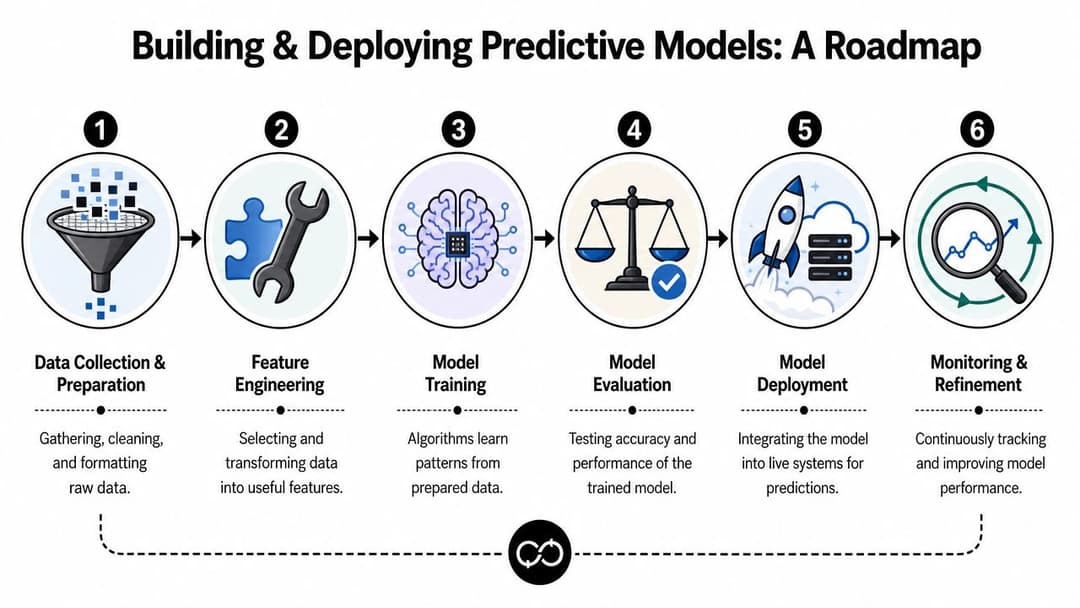
A practical summary from Sawtooth Software's predictive modeling overview is straightforward: the process starts by defining business requirements, then collecting and preprocessing data, developing the model with tools like Python or R, and validating it with methods such as cross-validation so it performs reliably on unseen data.
Here's the workflow in a marketer-friendly sequence.
Start with the business question
Bad modeling projects usually start with a vague brief. "Can we use AI on our ads?" is not a useful objective.
Better questions look like this:
- Creative triage. Which new ads should get early budget?
- Audience risk. Which audience segments are likely to underperform for this offer?
- Outcome forecast. Which combinations are likely to hit CPA or ROAS targets?
A model built to predict click-through rate won't automatically help if your real problem is lead quality.
Clean data beats clever modeling
Teams frequently underestimate the mess in their raw ad data. Naming conventions drift. Conversion events change. UTM fields go missing. Creative metadata lives in one place, audience notes in another, and actual business outcomes somewhere else.
That has to be fixed before modeling starts.
Useful inputs often come from ad platforms, analytics tools, CRM systems, and creative libraries. If your team is still tightening its data foundation, this piece on first-party data in marketing is worth reading because first-party signals usually make models more relevant and more durable.
The model doesn't care how hard your team worked to collect the data. It only cares whether the data is consistent enough to learn from.
Feature engineering is where real leverage shows up
This part gets less attention than algorithms, but it's where many gains come from. You're deciding how to represent the ad account in a way the model can use.
A weak setup uses broad labels like "video" or "image" and stops there.
A stronger setup may include:
- Copy characteristics such as length, hook type, or CTA language
- Visual structure such as product close-up, face in frame, text overlay, or demo shot
- Audience context such as broad, lookalike, retargeting, or interest cluster
- Offer signals such as urgency, discount, proof, or education-led angle
Train, validate, then deploy carefully
Once the data is prepared, the model is trained on historical examples. It then needs to be tested on data it hasn't seen before, as a model appearing brilliant on old data can still fail once conditions change.
For teams that want a basic walkthrough before getting technical, this video gives a decent visual explanation:
Deployment doesn't have to mean a complex engineering project. In many marketing teams, deployment just means the model feeds a ranking system, a scoring layer, or a decision aid inside the workflow.
What matters is whether people use it. If your buyers still ignore the scores and revert to gut feel, the project isn't deployed in any meaningful sense.
Predictive Modeling for Paid Social Marketers
Predictive modeling then stops sounding academic and starts paying rent.
In paid social, the biggest value usually comes from helping you decide what to test, where to spend, and what to cut before too much budget leaks into weak combinations.
Creative prediction is the obvious use case
Most Meta teams produce more creative variations than they can afford to test aggressively. That's where a model can help sort likely winners from likely passengers.
Appinio's discussion of predictive modeling in campaign optimization makes a point marketers should care about: in high-frequency campaign optimization, feature engineering is critical, and techniques that capture non-linear relationships between creative attributes such as copy length and image type and performance metrics like ROAS or CPA directly improve predictive power.
In plain English, ad performance rarely moves in straight lines. A longer script isn't always worse. A product close-up isn't always better. Some combinations work because the variables interact.
That's why simplistic rules often fail:
- "Video always wins" doesn't hold across funnel stages.
- "Short copy converts better" breaks when the offer needs more education.
- "Broad audiences scale best" can collapse if the creative isn't doing enough qualifying.
A predictive model can look at combinations instead of isolated variables. That's much closer to how the auction behaves in real life.
Audience response and saturation can also be modeled
Creative gets most of the attention, but audience behavior matters just as much. Marketers often want to know when a segment is likely to fatigue, where response quality is degrading, or whether a proven message should be introduced to a fresh audience.
You won't get perfect foresight. You can get earlier warnings.
Useful inputs here can include:
- Audience source quality
- Past conversion behavior
- Stage of funnel
- Creative-audience pairing history
- Placement mix
That kind of modeling is more useful than broad platform averages because it reflects how your specific account behaves.
Budget allocation gets better when prediction is operational
The payoff isn't having a score in a dashboard. It's using that score to change action.
A practical paid social workflow might look like this:
- New creative variations are tagged with structured attributes.
- A model scores likely performance based on historical patterns.
- Buyers prioritize launch order and early spend based on that ranking.
- Live results feed back into the system.
- The next round of predictions gets sharper.
Good predictive modeling doesn't replace testing. It makes testing less wasteful.
This is also where tooling matters. Some teams build internal systems in Python and push outputs into spreadsheets or BI dashboards. Others use workflow products that connect campaign data and prediction layers more directly. For marketers comparing approaches, predictive performance modeling for ad teams is a relevant reference, and AdStellar AI is one example of a platform that uses historical Meta performance data to score creative and audience combinations inside an operating workflow.
What works and what doesn't
What works:
- Structured creative metadata
- Clear optimization goals
- Fast feedback loops
- Consistent naming and taxonomy
- Marketers who treat scores as inputs, not gospel
What doesn't:
- Throwing raw exports into a model and hoping for insight
- Chasing a universal "winning ad formula"
- Using prediction without validating against actual business outcomes
- Ignoring the interaction between creative, audience, and offer
The best media buyers already think probabilistically. Predictive modeling just formalizes that habit.
Evaluating Models and Avoiding Common Pitfalls
A model isn't good because it sounds complex. It's good if it holds up on unseen data and helps you make better decisions than your current process.
The metrics you actually need to care about
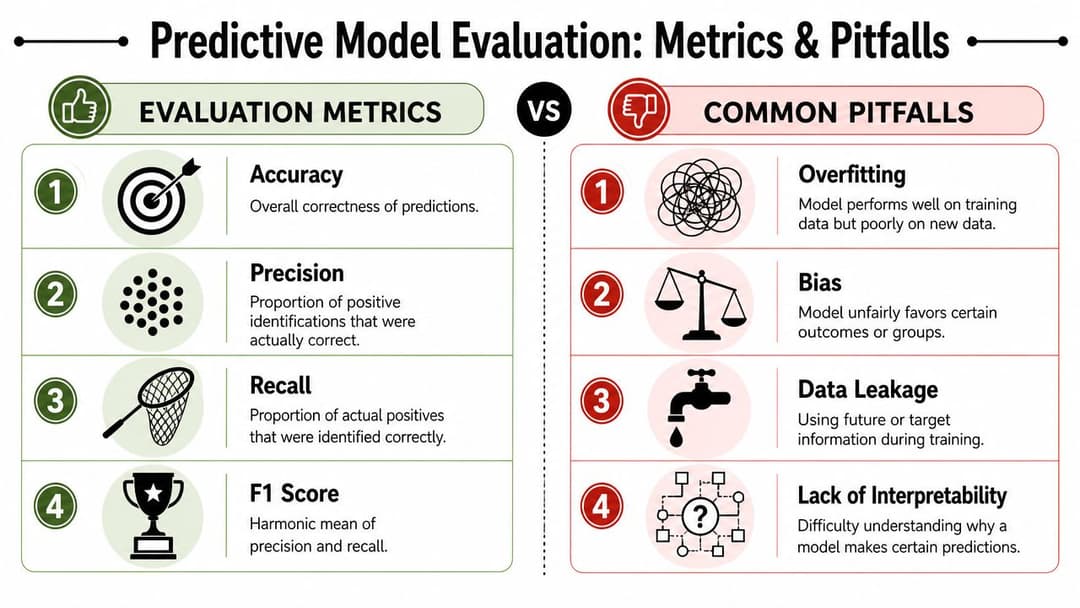
Qlik's predictive modeling overview notes that adjusting hyperparameters such as learning rate and regularization strength is essential to prevent overfitting. It also states that validation on a separate test set is mandatory before deployment, using metrics such as Mean Squared Error (MSE) for regression or F1 score for classification.
For marketers, the practical translation is simple:
- MSE matters when you're predicting a number and want to know how far off the forecasts are.
- F1 score matters when you're predicting a class and need a balanced view of correct positive calls.
- Accuracy can be useful, but it can also mislead if the classes are imbalanced.
If only a small slice of ads become real winners, a model can look "accurate" by predicting mediocrity most of the time. That doesn't mean it's useful.
If you need a refresher on how marketers should think about confidence and decision quality in testing, this guide to statistical significance is a useful companion.
Common failure modes
The most common problems aren't exotic. They're operational.
- Overfitting. The model memorizes old noise and falls apart on new campaigns.
- Data leakage. Training data accidentally includes signals that wouldn't be available at prediction time.
- Bad labels. You say you're predicting success, but the success variable doesn't match business reality.
- Weak feature design. The model never sees the creative or audience distinctions that drive performance.
- No adoption. The team doesn't trust the outputs, so nothing changes.
If a vendor can't explain how the model is validated on unseen data, you shouldn't trust the score.
A practical review checklist
Before using any predictive model, ask:
- What exactly is it predicting?
- Which data does it use?
- Was performance checked on a separate test set?
- Which metric determines whether it's good enough?
- How often is it retrained or reviewed?
- Can a buyer understand the main factors behind the prediction?
Those questions eliminate a lot of marketing AI theater very quickly.
The Future Is Explainable AI and Practical Tools
The next step isn't just better prediction. It's explainable prediction.
Traditional models often behave like black boxes. They output a score, but the marketer can't tell whether the score is driven by the hook, the visual style, the audience match, or some hidden correlation. That's a problem in advertising because action depends on interpretation.
ScienceDirect's coverage of predictive modeling trends notes that the shift toward explainable predictive modeling is accelerating, and that 54% of Meta ad optimization failures stem from opaque models that cannot trace creative-performance links in its discussion of predictive model applications. For marketers, that lands hard. If the system can't show why it prefers one ad over another, it's much harder to turn prediction into a repeatable creative strategy.
Why explainability matters in Meta Ads
Explainability helps answer questions like:
- Which creative attributes pushed this prediction up?
- Did the audience fit matter more than the format?
- Is the model rewarding the offer, the message, or the pairing?
- Should the team iterate the hook, the visual, or the targeting?
That's what makes predictive modeling practical instead of merely interesting.
What smart teams do next
Teams with technical resources may build explainable workflows in Python or R and layer in methods that make model decisions easier to inspect. Less technical teams usually need software that embeds prediction into campaign operations and shows enough reasoning for buyers to act on the output.
The important shift is cultural. Paid social teams don't need more mystery. They need systems that help them launch faster, learn faster, and understand what to do next.
If you want to put predictive modeling to work inside your Meta workflow, AdStellar AI is one option to evaluate. It connects historical campaign data, helps teams launch and test large sets of creative and audience combinations, and surfaces AI-driven performance insights in a format media buyers can use day to day.