You’re probably looking at a familiar mess right now.
Meta says one thing. Google Ads says another. TikTok looks great in-platform until finance asks whether those conversions would have happened anyway. Your CRM shows pipeline movement, but it doesn’t cleanly line up with ad platform reporting. If you also run email, retail promotions, affiliates, or offline media, the picture gets even blurrier.
Then the hard question lands: where should the next dollar go?
That question is bigger than click paths and platform dashboards. It’s a budgeting question, a planning question, and increasingly, a measurement question shaped by privacy limits and fragmented reporting. That’s why more marketers are asking what is media mix modeling, not as an academic exercise, but as a practical way to make better investment decisions.
Consider cooking. You don’t judge a finished dish by crediting only the garnish. You look at the full recipe, the ingredients, the timing, and the heat. Marketing works the same way. Sales rarely come from one touchpoint in isolation. They come from a mix of channels, timing, creative pressure, seasonality, promotions, and market conditions.
Introduction Navigating the Maze of Modern Marketing Attribution
Performance marketers live inside channel views.
You open Meta Ads Manager and see ROAS by campaign. You check branded search and notice lift. Your email team reports a strong weekend send. Meanwhile, retail or sales teams say demand was already rising before the latest push. Each view contains some truth. None of them gives the whole answer.
That gap is where Media Mix Modeling, or MMM, earns its place.
MMM is a top-down way to estimate how much each marketing channel contributed to business outcomes like sales, leads, or revenue, while also accounting for factors outside marketing. It doesn’t depend on stitching together every individual user journey. Instead, it looks at aggregated performance over time and asks a more strategic question: what moved the business?
Why marketers keep running into attribution limits
Most attribution systems answer narrow questions well. They can tell you which ad got the click, or which campaign appeared near a conversion. They struggle when you need to answer broader questions such as:
- Budget allocation: Should you put more into Meta, search, retail media, or offline?
- Cross-channel influence: Did paid social create demand that search later captured?
- External context: Were results driven by media, seasonality, pricing, or promotions?
- Executive planning: What should next quarter’s mix look like?
Those are not dashboard questions. They’re modeling questions.
MMM helps you stop asking which dashboard to trust and start asking what combination of marketing and market factors drove the outcome.
MMM isn’t new, which is one reason serious marketers should pay attention to it. It originated in the 1960s with pioneers like Procter & Gamble, and by the 1980s it had become standard for Fortune 500 brands, with strong models attributing up to 85% of sales variance to media and other factors. Today, 61.4% of advertisers are pursuing advanced MMM with AI for faster, weekly insights, according to Mass Analytics on the evolution of media mix modeling.
Why it matters more now
User-level tracking hasn’t disappeared, but it’s less complete, less portable, and less trustworthy than many teams want to admit. That makes platform-native attribution useful, but incomplete.
MMM matters because it looks at the business from above. It helps marketers see the forest instead of arguing over which tree deserves credit. For anyone managing Meta alongside other channels, that’s the difference between reactive reporting and deliberate budget strategy.
The Big Picture What Is Media Mix Modeling
The simplest answer to what is media mix modeling is this:
Media mix modeling is a statistical method that estimates how much each marketing channel and each major external factor contributed to your business results over time.
If that sounds abstract, use a kitchen analogy.
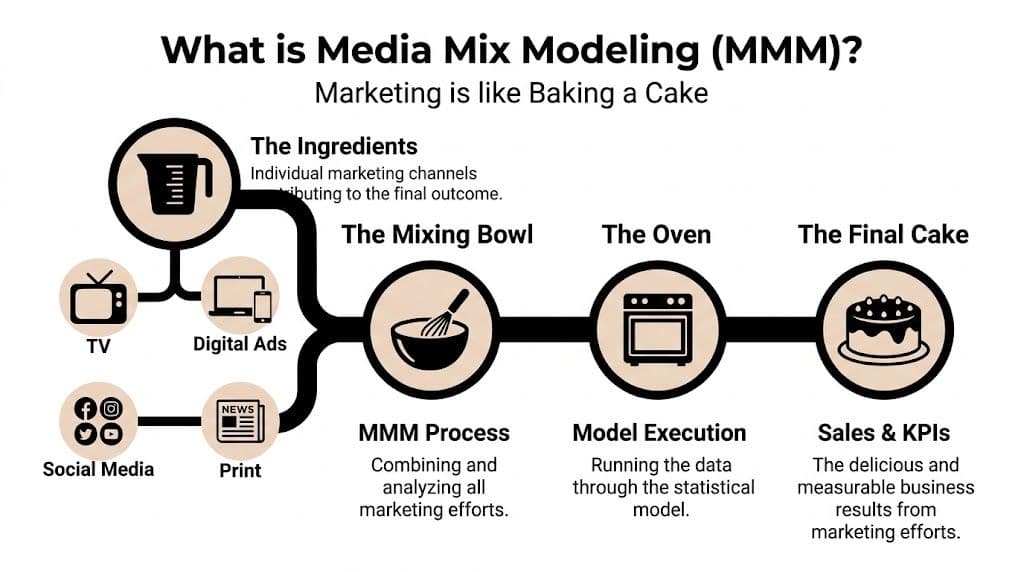
Your final sales number is the cake. Meta, search, TV, email, retail media, and direct mail are ingredients. Promotions, holidays, and market conditions are the oven temperature, pan size, and bake time. Last-click attribution gives too much credit to the frosting. MMM tries to understand the whole recipe.
The core idea in plain language
MMM usually breaks performance into a few broad pieces:
- Base sales: What you would likely sell anyway because of brand demand, existing customers, distribution, or ongoing market momentum.
- Incremental sales from marketing: The extra lift created by channels like Meta, paid search, TV, or email.
- External effects: Changes driven by seasonality, pricing, promotions, competition, or broader market conditions.
That’s what makes MMM so different from platform attribution. It’s not asking, “Which ad got the click?” It’s asking, “What added incremental business value after controlling for everything else?”
Why this matters for Meta-heavy marketers
If you spend heavily on Meta, you already know the platform can do several jobs at once. It can drive direct conversions, generate branded search later, warm audiences for retargeting, and support retail or marketplace demand. A narrow attribution model often undercounts some of that and overcounts other parts.
MMM is built to evaluate those interactions at the portfolio level. That’s one reason it belongs in any serious media strategy and planning framework, especially when you’re balancing online and offline investments.
Two ideas that confuse people
Marketing professionals often get hung up on two terms.
First is adstock. That’s the carryover effect of advertising. Not every ad works only on the day someone sees it. Some impact lingers.
Second is saturation. That’s the point where adding more spend keeps increasing cost but stops producing proportional results. You can keep pouring money into a channel and still get less useful output from each additional dollar.
Simple mental model: MMM tells you both whether an ingredient matters and how much of it belongs in the recipe before it overwhelms the dish.
What MMM is really for
MMM is most useful when you need to make decisions such as:
| Business question | How MMM helps |
|---|---|
| Where should next quarter’s budget go? | Estimates relative contribution across channels |
| Are we overspending in one channel? | Reveals diminishing returns and likely saturation |
| Do upper-funnel campaigns help lower-funnel performance? | Measures cross-channel effects at an aggregate level |
| How much performance came from media vs demand already in market? | Separates base demand from incremental lift |
That’s the strategic value. MMM doesn’t replace campaign management. It improves the decisions behind campaign management.
How Media Mix Modeling Actually Works Under the Hood
The math inside MMM can get technical fast, but the marketer’s version is manageable if you focus on a few ideas.
MMM uses multi-linear Bayesian regression to estimate how different inputs relate to outcomes like sales or ROAS. The model doesn’t just look at spend by channel. It also accounts for non-linear saturation curves and lag effects, which is why it can produce better budget recommendations than a simple spreadsheet. According to Marketing Evolution’s explanation of MMM methods, ad stock transformations for a channel like Meta often use geometric decay with half-lives of 2 to 4 weeks, and models can simulate how moving 10% of budget from a saturated channel to a stronger one could improve overall ROAS by 15% to 25%.

Adstock means marketing effects linger
Think about perfume in a room. The moment someone sprays it, the scent is strongest. Then it fades. It doesn’t disappear instantly.
That’s adstock.
A Meta campaign can influence someone now, then still affect their behavior days later when they search your brand, visit your site directly, or finally convert after seeing social proof. MMM tries to model that delayed effect instead of pretending all impact happens on the same day as the impression or click.
For a performance marketer, this matters because short reporting windows can make channels look weaker than they really are.
Saturation means more spend isn’t always smarter
Now think about watering a plant.
The first water matters a lot. The next bit helps too. Keep dumping water on it, and eventually you’re not helping growth. You’re just flooding the pot.
That’s saturation.
MMM models those diminishing returns so you can see where a channel is still productive and where it’s hitting a ceiling. This is especially useful on Meta, where audience scale, frequency, and creative fatigue can all make additional spend less efficient.
The prep work matters as much as the model
The common mistake is assuming the hard part is the statistics. For many teams, the hard part is getting the data in shape.
You need the same dates across systems. You need campaign naming cleaned up. You need sales, spend, promotions, and channel metrics aligned into a consistent time series. If one source reports weekly, another daily, and another with gaps, the model won’t rescue you from that mess.
A strong marketing campaign analytics process usually starts before modeling. It starts with disciplined data organization.
What comes out the other side
When the model is built well, it can answer practical questions:
- Which channels are driving incrementality
- Where returns flatten
- How changes in spend are likely to affect outcome
- Which budget shifts are worth testing
- What level of spend is efficient, not just possible
The power of MMM isn’t that it sounds scientific. The power is that it helps you stop funding channels based only on habit, platform bias, or the loudest dashboard in the room.
Gathering Your Ingredients The Data and Steps for an MMM Project
If the cake analogy holds, this is the pantry check.
MMM only works when the ingredients are complete, clean, and measured on the same timeline. Many teams underestimate this part. They assume they can export a few CSV files, send them to an analyst, and get strategic truth back a week later. That’s rarely how it goes.

What data an MMM project usually needs
A practical MMM project often pulls from several buckets of information.
- Outcome data: Sales, revenue, leads, subscriptions, pipeline, or another KPI tracked over time.
- Media inputs: Spend, impressions, clicks, or delivery by channel such as Meta, paid search, TV, display, or email.
- Business context: Promotions, pricing changes, launches, stock issues, or distribution shifts.
- External context: Holidays, seasonality patterns, and other market factors that might affect demand.
The model needs those inputs lined up over a long enough period to detect patterns instead of noise. For many marketers, that means gathering data from tools that were never designed to work neatly together.
The biggest operational hurdle
At this point, enthusiasm usually meets reality.
The biggest obstacle to MMM adoption isn’t the regression itself. It’s the prep. A 2024 survey found that 68% of marketers cite data quality and integration as their top challenge, and only 22% of SMBs successfully implement MMM due to resource constraints, according to HubSpot’s overview of media mix modeling barriers.
That rings true in practice. Channel exports use different naming. Finance data closes on different dates than media data. Offline sales can lag. Promotions often live in spreadsheets maintained by someone outside marketing.
Practical rule: If your input data is chaotic, your model won’t produce clarity. It will produce polished confusion.
The project flow in real life
Most MMM efforts follow a sequence like this:
Gather the history
Pull the time-series data for outcomes, media, and business context from each source.Standardize the timeline
Decide on a common reporting grain, then align all sources to it.Clean the taxonomy
Merge duplicate channel names, fix broken labels, and resolve missing values.Build the model
Fit the statistical model so it can estimate base demand, media contribution, and external effects.Validate the output
Check whether the model tracks historical behavior credibly and whether results make business sense.Run scenarios
Use the model to test spend shifts and evaluate tradeoffs.
A short explainer can help if you’re introducing this process to teammates or clients:
Telescope versus microscope
A useful way to think about MMM is as a telescope, not a microscope.
A microscope shows a single path in sharp detail. That’s useful when you want to inspect a specific conversion sequence. A telescope shows the larger pattern across the whole system. That’s what MMM is built for. It helps answer budget and portfolio questions, not just path-level ones.
The catch is simple. Telescopes still need clean glass.
MMM vs Other Attribution Models Where It Fits
Marketers often compare MMM to multi-touch attribution as if one has to win.
That’s the wrong framing.
They solve different problems. MMM is a strategic planning model. Multi-touch attribution, or MTA, is a tactical path model. Last-click is a convenience model. Each can be useful, but they work at different altitudes.
MMM vs. Multi-Touch Attribution MTA at a Glance
| Dimension | Media Mix Modeling (MMM) | Multi-Touch Attribution (MTA) |
|---|---|---|
| Data granularity | Aggregate, time-based data | User-level or event-level journey data |
| Primary use case | Strategic budget allocation across channels | Tactical optimization within digital journeys |
| Channel coverage | Online and offline | Mostly digital touchpoints |
| Privacy resilience | High, because it does not rely on user-level identity stitching | Lower, because it depends more on trackable user journeys |
| Best question answered | How much should we invest by channel? | Which touchpoints appeared along the path to conversion? |
| Typical blind spot | Less useful for day-to-day in-platform decisions | Struggles with offline channels and fragmented identity |
The telescope and microscope view
MMM is your strategic telescope.
It helps you decide whether paid social is underfunded, whether TV is supporting search, or whether promotions are masking weak media performance. It’s good for finance conversations, annual planning, and channel-level tradeoffs.
MTA is your tactical microscope.
It helps you inspect what happened inside digital paths when tracking is available. That can be useful for creative sequencing, landing-page analysis, and path optimization. It becomes less reliable when users move across devices, platforms guard data, or offline effects matter.
Last-click still has a role, but mainly as an operational shortcut. It tells you who touched the ball last. That’s not the same as who moved the game.
Where Meta marketers should place each model
If you manage paid social, the practical split looks like this:
- Use MMM to decide whether Meta deserves more or less of the overall budget.
- Use platform reporting and experiments to improve campaign structure, creative, audiences, and pacing inside that budget.
- Use a stronger attribution framework where possible for in-channel diagnosis, such as a Meta advertising attribution tracking guide.
If your team also needs a more tactical framework for social reporting, this guide on how to measure social media ROI is a useful companion because it focuses on turning platform activity into business outcomes, not vanity metrics.
MMM tells you where to place the bets. Other attribution tools help you play the hand well.
That’s why mature teams don’t treat these models as rivals. They use them together, with clear expectations for what each can and can’t answer.
Interpreting Results and Avoiding Common Pitfalls
An MMM output isn’t a command. It’s evidence.
That distinction matters. Teams get into trouble when they treat the model like a magic answer generator instead of a decision support tool. Good marketers still have to interpret the results, challenge assumptions, and connect the findings back to the way campaigns run.

What to look at first
Most MMM reports include a few outputs that matter more than the rest.
Contribution view
This shows how much of the modeled outcome came from base demand, media channels, and external factors. It helps you answer whether growth came from true media lift or from conditions that would have helped anyway.
Response curves
These show how a channel behaves as spend rises. A steep early curve suggests room to scale. A flatter curve suggests saturation.
Scenario simulations
These estimate what might happen if you shift budget. Consequently, MMM becomes useful for planning, not just measurement.
If you already work with broader frameworks for measuring advertising effectiveness, MMM gives those frameworks a stronger strategic backbone.
The piece many teams miss
Channels don’t always work alone.
Advanced MMM can model halo effects, where spend in one channel boosts performance in another. According to Prescient AI’s explanation of halo effects in MMM, a $1M Meta ad spend might show 3x direct ROAS but also create a 1.2 to 1.5x halo lift in retail sales. Those interactions can account for 10% to 30% of a channel’s total impact, and failing to model them can bias channel ROI upward by 20% to 40%.
That matters a lot for top-funnel social.
If Meta is creating demand that branded search later captures, a narrow read can make Meta look weaker than it is and search look stronger than it is. The opposite can also happen. Without halo modeling, you can underinvest in demand creation and overinvest in harvest channels.
Don’t ask only whether a channel converted. Ask whether it changed the probability that other channels would convert later.
Common mistakes that make MMM less useful
Some failures come from the model. Many come from interpretation.
- Treating contribution as certainty: MMM estimates contribution. It does not reveal perfect truth.
- Ignoring business context: Promotions, stockouts, and pricing changes can distort clean-looking charts.
- Overreacting to one readout: Strategic models are most useful over time, not as one-off verdicts.
- Skipping validation: If the output clashes with obvious market reality, stop and investigate.
- Confusing correlation with incrementality: A model can be complex and still wrong if the inputs are poor or key variables are missing.
If your team is trying to tighten the link between social activity and business outcomes, this article on Mastering Social Media ROI is useful because it complements MMM with a more execution-level lens.
Turning insight into action on Meta
The practical move isn’t “the model said increase Meta, so increase everything.”
A better move is narrower. If MMM suggests Meta has room before saturation, use that as a strategic green light. Then test where the extra budget works best. New audience segments, creative formats, placements, or funnel stages may absorb spend differently.
That’s the bridge between strategic measurement and in-market execution. MMM identifies where headroom likely exists. Campaign management determines how to capture it without wasting the opportunity.
Putting MMM into Practice Modern Tools and Integrations
For years, MMM had a reputation for being slow, expensive, and built mainly for giant brands with patient finance teams.
That reputation came from a real place. Traditional MMM projects often involved consultants, custom modeling work, and long delivery cycles. But the tooling environment has transformed, and that changes who can use MMM effectively.
The market is opening up
Enterprise MMM can still be expensive. According to Tinuiti’s coverage of modern MMM tools, enterprise MMM can cost over $100K annually. At the same time, newer open-source options such as PyMC-Marketing and Databricks’ Lakehouse accelerator are broadening access. The same source notes that, as of early 2026, these free tools can achieve up to 85% accuracy for DTC campaigns under $1M in spend, and that 75% of performance marketers still rely on last-click attribution.
That doesn’t mean open-source MMM is effortless. It means more teams can now experiment without committing to a large software contract first.
Which option fits which team
A rough decision guide looks like this:
- Technical in-house team: Open-source tools can make sense if you have analytics talent and clean data pipelines.
- Mid-sized brand with limited data science support: A managed platform or specialist partner may be more practical.
- Agency environment: The best fit often depends on whether you need repeatable client onboarding or custom model depth.
The choice usually comes down to three things. Data readiness, modeling expertise, and how often you need updates.
How MMM should connect to execution
MMM is most useful when it feeds planning and activation, not when it sits in a quarterly deck.
If the model shows that paid social deserves a larger share of investment, your next step isn’t theoretical. You still have to execute that budget intelligently. That means using channel-specific measurement, experiments, creative testing, and stronger signal capture such as Meta Conversions API implementation guidance.
What smart teams do next
They don’t ask a model to replace marketing judgment.
They use MMM to answer strategic allocation questions. Then they use platform-native tools, experimentation, and operational systems to turn that budget direction into better campaign decisions. That combination is what makes MMM practical in modern performance marketing.
A good MMM doesn’t finish the job. It points your team toward the next high-value decision.
Conclusion From Data Chaos to Strategic Clarity
Media mix modeling helps marketers answer the question that matters most when budgets get serious: what drove the business, and where should we invest next?
That’s why the question what is media mix modeling matters far beyond analytics teams. It matters to paid social managers defending spend. It matters to growth leads balancing acquisition and efficiency. It matters to finance teams that need a more credible view than platform self-reporting can offer.
At its best, MMM gives you a privacy-resilient, top-down read on channel contribution, diminishing returns, and cross-channel influence. It helps separate base demand from incremental lift. It helps explain why one channel can look weak in isolation but strong in the portfolio. It also forces a healthy discipline around data quality, because the model can only be as good as the inputs behind it.
For performance marketers, the right mindset is simple. Don’t treat MMM as a replacement for tactical skill. Treat it as a strategic compass. It tells you where to lean, where to pull back, and where your current reporting may be misleading you.
Then your day-to-day expertise takes over.
That’s the core value. Better direction, stronger decisions, and fewer budget conversations based on guesswork.
If you’re ready to turn strategic insight into faster Meta execution, AdStellar AI helps growth teams launch, test, and scale campaigns with far less manual work. It’s built for marketers who need to create large volumes of creative and audience variations quickly, learn from live performance, and push more budget toward what’s working.