A modern media strategy should be more than just a document—it’s a blueprint that connects every advertising dollar directly to core business outcomes, like revenue or customer acquisition cost. It’s about moving beyond chasing surface-level metrics like clicks and instead integrating audience segmentation, channel selection, and creative testing into a single, accountable framework.
Building a Modern Media Strategy That Actually Works
Let's ditch the outdated templates. This guide is a practical blueprint for media strategy and planning, built for performance marketing teams who need to deliver results in today's market. The real goal is to create a unified system where every campaign, every ad, and every dollar is tied directly to your most critical business goals—whether that’s a specific Return on Ad Spend (ROAS) or a target customer acquisition cost.
Forget about scattered tactics that pull your team in a dozen different directions. A truly effective plan weaves audience segmentation, creative testing, and data-driven optimization into one fluid process. This isn't just a "best practice" anymore; it's essential for survival.
This visual shows how a modern strategy evolves from a solid foundation to an integrated system that ultimately drives measurable growth.
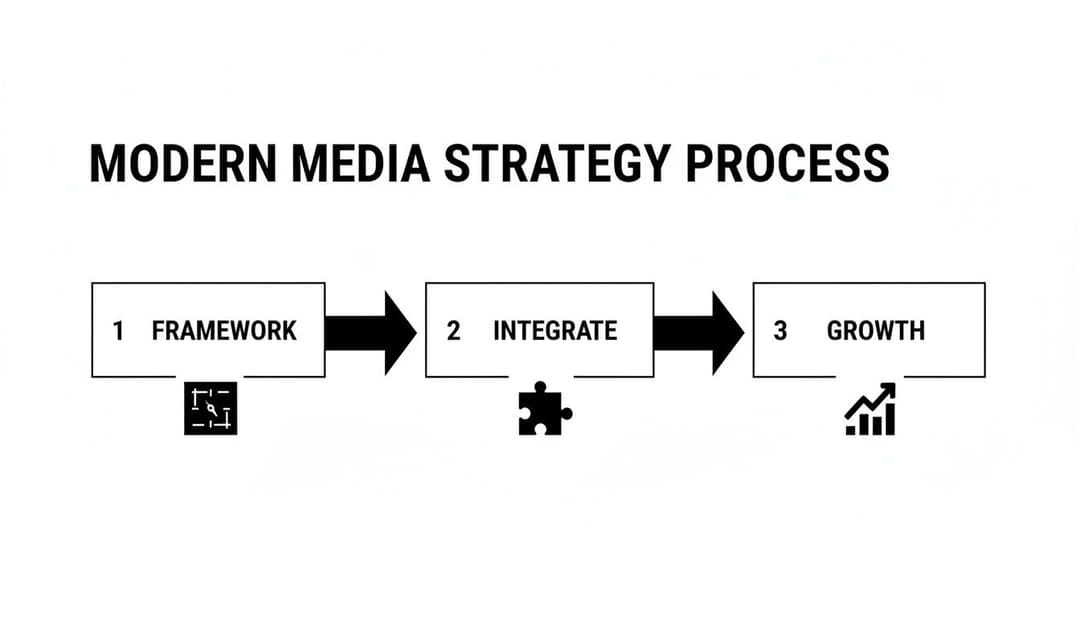
The key takeaway here? Strategy isn't a one-and-done task. It's a continuous cycle of building, integrating, and optimizing for growth.
The Core Components of a Successful Media Plan
A successful media strategy stands on a few core pillars that have to work in sync. It often kicks off with a clearly defined content marketing strategy, which lays the groundwork for everything that follows. This step ensures the messages you're putting money behind are actually valuable and aligned with what your audience wants from the very start.
From there, you need to make sure every dollar spent is accountable and fuels measurable growth. The key components you can't skip include:
- Clear Business Objectives: This means translating high-level company goals into specific, actionable campaign KPIs.
- Audience-First Segmentation: Use data to get a deep understanding of who you're talking to and what they genuinely care about.
- Strategic Channel Mix: Don’t just be everywhere. Choose the platforms where your audience is already active and your message will hit home. If you're looking to level up here, check out our deep-dive on running high-performing paid social ad campaigns.
- Data-Driven Creative: Build a testing roadmap to figure out which visuals and copy actually drive conversions, not just likes.
- Rigorous Measurement: Create a tight feedback loop that allows you to optimize and improve performance on an ongoing basis.
A truly effective media strategy isn't about reaching more people; it's about reaching the right people with a message that resonates, on a channel that converts, and at a cost that makes business sense. This is the shift from just being busy to making a real impact.
Turning Business Goals into Campaign Objectives
A solid media plan starts with one thing: absolute clarity. The entire blueprint for your media strategy and planning rests on your ability to take high-level business goals and distill them into concrete, measurable campaign objectives. It’s the difference between crossing your fingers for results and actually engineering them.
Getting past vague goals like “increase sales” is the first, most important hurdle. You need to zero in on precise metrics that genuinely reflect your company's financial health. These aren't just numbers to make your reports look good; they're the guardrails that ensure your ad spend is both effective and accountable.
For an e-commerce brand trying to grow profitably, the main target might be hitting a 3.5x Return on Ad Spend (ROAS). A B2B SaaS company, on the other hand, might be laser-focused on generating qualified leads with a Cost Per Acquisition (CPA) under $150. And for subscription services, the priority could be acquiring customers with a high Lifetime Value (LTV), even if it means a higher upfront acquisition cost.
The best campaign objectives are business metrics, plain and simple. When your Head of Paid Social and your CFO are speaking the same language—talking about CPA, LTV, and ROAS—you know you've successfully tied your media plan to the company's bottom line.
From Goals to Audiences: The Power of Segmentation
Once you've nailed down your objectives, the conversation shifts from the "what" to the "who." Throwing generic, one-size-fits-all messages at the wall and seeing what sticks is a surefire way to burn through your budget. Smart audience segmentation is your competitive edge, making every dollar you spend work harder by delivering a message that truly connects.
Start by digging into your first-party data. Your CRM, customer purchase history, and website analytics are absolute goldmines. Look for patterns among your best customers. What are their common traits? How often do they buy? What’s their average order value? This information is the bedrock for building powerful lookalike audiences and sharpening your retargeting strategy.
But don’t stop there. Dive into the platform insights from tools like Meta or Google. They offer a wealth of demographic, interest, and behavioral data to flesh out your audience personas. Combine this with broader market research to get a clear picture of your audience's pain points, what drives them, and where they spend their time online. For a closer look at this process, our article on setting the right objective of a campaign breaks down how to align your goals with audience intent.
Matching Your Message to the Funnel
Great audience segmentation isn't just about who people are; it's about where they are in their journey with you. Grouping users by their funnel stage lets you tailor your message and objectives with surgical precision.
This framework helps you map specific goals and audience types to each stage of the marketing funnel, ensuring your paid social efforts are both strategic and efficient.
| Funnel Stage | Audience Type | Primary KPI | Example Tactic |
|---|---|---|---|
| Top of Funnel (TOF) | Cold Audiences (Broad Lookalikes, Interest-Based) | Reach, Impressions, Low CPM | Run engaging video ads to introduce the brand problem/solution. |
| Middle of Funnel (MOF) | Warm Audiences (Website Visitors, Social Engagers) | Link Clicks, Lead Form Fills, Video Views | Retarget with customer testimonials or a downloadable guide. |
| Bottom of Funnel (BOF) | Hot Audiences (Cart Abandoners, Product Viewers) | Conversions, ROAS, CPA | Offer a limited-time discount with a clear call-to-action. |
By aligning your tactics this way, you ensure that you're always delivering the right message at the right time.
Let's break down what this looks like in practice:
Cold Audiences (Top of Funnel): These are fresh faces—people who have likely never heard of your brand. Your job is to introduce yourself and pique their interest. Think awareness and education. Target broad lookalike audiences or interest-based segments with content that's engaging and doesn't ask for a big commitment. Your main KPIs here will be things like reach, impressions, and video view-through rates.
Warm Audiences (Middle of Funnel): These folks have shown some interest. Maybe they visited your site, watched a video, or liked a social post. Now's the time to build consideration and trust. Retarget them with case studies, user-generated content, or benefit-focused ads that nudge them closer to a decision. You'll be tracking metrics like website traffic, lead submissions, or content downloads.
Hot Audiences (Bottom of Funnel): This group is on the verge of converting. They've abandoned a cart, looked at a specific product multiple times, or checked out your pricing page. The goal is simple: close the deal. Use ads that create urgency, highlight a special offer, or provide social proof. Here, your primary KPIs are the ones that directly impact the bottom line: ROAS, CPA, and conversion rate.
Following this structured approach guarantees your messaging stays relevant, which not only boosts efficiency but also sets the stage for more creative and impactful campaigns down the road.
Allocating Your Budget and Channel Mix Strategically

Alright, you’ve nailed down your goals and mapped out your audiences. Now comes the million-dollar question—or maybe the ten-thousand-dollar question, depending on your budget: where do you actually put the money?
Deciding on your channel mix and budget allocation is where the rubber meets the road. It’s a delicate balance of art and science. Get it right, and you’re fueling efficient growth. Get it wrong, and you might as well be setting fire to your ad spend.
The core of a solid channel mix isn't about being everywhere. It's about being on the right platforms where your audience actually lives and breathes. Do they scroll TikTok for a laugh, connect with communities on Meta, or use the Google Display Network to research solutions? Every platform has its own DNA.
Matching Platforms to Your Objectives
The channels you pick have to line up perfectly with what you’re trying to achieve. Are you aiming for broad brand awareness or pushing for immediate sales? The goal dictates the platform.
- Meta (Facebook & Instagram): This is the heavyweight champion for a reason. With its incredibly deep audience data, it's a powerhouse for both top-of-funnel awareness and bottom-of-funnel conversion campaigns. For most B2C brands and a surprising number of B2B players, it’s a non-negotiable part of the mix.
- TikTok: The undisputed king of cultural trends and short-form video. It's a phenomenal channel for generating top-of-funnel buzz, connecting with younger audiences, and showing off your brand's personality through authentic, unpolished content.
- Google Display Network (GDN): Nothing beats the GDN for sheer reach across millions of websites. It’s a workhorse for retargeting, keeping your brand visible to people who’ve already shown interest, and for finding niche audiences based on their browsing habits and purchase intent.
A smart media strategy rarely relies on just one. Picture this: you use TikTok to introduce your brand to a cold audience. Then, you retarget those who watched your videos with more product-focused ads on Instagram and follow them around the web with the GDN. That’s a full-funnel approach.
Choosing a Budget Allocation Model
Okay, so how do you slice the budget pie? There are a few ways to go about it, and the right one for you depends on your team’s experience, data setup, and business objectives.
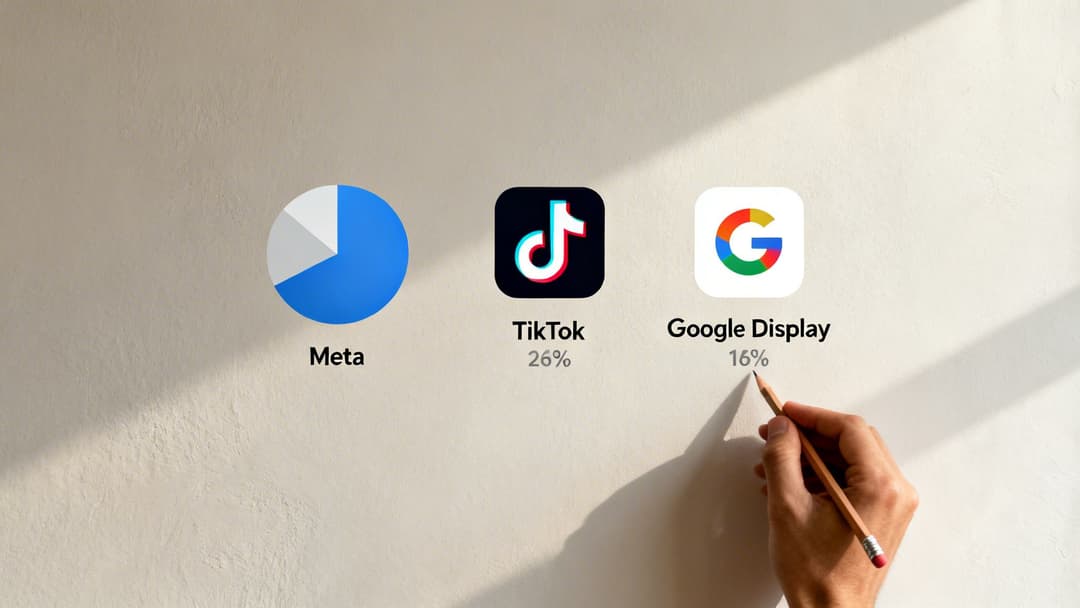
For teams just getting their feet wet, a percentage-split model is a great starting point. You simply assign a fixed percentage of your budget to each channel based on past performance or what you’ve seen work in your industry. A classic example might be 60% to Meta, 25% to Google Display, and a 15% test budget for TikTok.
More seasoned teams, however, usually lean into a performance-driven model. Here, the budget isn't fixed; it fluidly follows the results. If Meta is crushing it with a 4x ROAS while another channel is lagging at 1.5x, you immediately shift funds to Meta to maximize your total return. It requires more hands-on management, but it ensures your money is always working as hard as it can.
The most sophisticated media strategy and planning efforts don't lock budgets in for a quarter. They treat budget allocation as a fluid system, where spend is a reward for performance. The best-performing channel earns the next dollar.
This dynamic approach is more important than ever. The explosion in digital ad spending—projected to hit a staggering $777 billion globally in 2025 and make up 75.2% of all advertising—cements this. For performance marketers, this means doubling down on measurable channels like Meta, where AI tools can automate and test hundreds of creative variations against these massive budgets.
Testing and Scaling New Channels
So, how do you introduce a new channel like TikTok into your tried-and-true mix without blowing your budget? It all comes down to a structured, disciplined testing process.
- Set Aside a Test Budget: Carve out a small, controlled slice of your total budget—usually around 5-10%—specifically for the new channel. This is your "lab" money.
- Define Clear Test KPIs: Decide what success looks like for that specific channel. A top-of-funnel platform like TikTok won't have the same conversion KPIs as a bottom-funnel one. Look at metrics like CPM, video view rate, and outbound click-through rate instead.
- Run a Time-Bound Test: Let the test run for a set period, like 30 days, to collect enough meaningful data. Don't pull the plug too early.
- Analyze and Decide: Once the test is over, stack the results against your benchmarks. If the new channel is showing promise, you can start feeding it more budget and integrating it more deeply into your strategy.
This methodical approach lets you explore new growth avenues without derailing the channels that are already delivering results. For a deeper look at this, check out our guide on how to approach your marketing budget allocation. By constantly using data to back up your spending shifts, you’ll keep your media plan sharp, responsive, and laser-focused on your business goals.
Developing a Creative Strategy and Testing Roadmap
You can have the most sophisticated audience targeting and a perfectly allocated budget, but if your creative is stale, your campaigns are dead on arrival. This is the part of your media strategy and planning where the rubber really meets the road—where you go from just reaching people to actually connecting with them.
Great creative isn't one-size-fits-all. You wouldn't walk up to a total stranger and immediately ask them for a huge favor, right? The same logic applies here. You can't hit a cold audience with a hard-sell "Buy Now" ad and expect results.
Every creative asset you build needs a specific job to do. Are you trying to stop the scroll and introduce your brand to someone new? Or are you giving a warm lead that final nudge they need to convert? The answer changes everything, from your opening hook to your call-to-action.
Tailoring Creative to the Funnel Stage
A smart creative strategy maps your visuals and messaging directly to where your audience is in their journey. This is how you make your ads feel helpful, not annoying.
Top of Funnel (Awareness): For cold audiences, your creative needs a knockout hook. The goal is simple: stop their scroll with something entertaining or educational. Think bold visuals, surprising stats, or a relatable problem. Keep the branding subtle and the CTA low-pressure, like "Learn More."
Middle of Funnel (Consideration): People in your warm audiences know who you are, but they're still on the fence. This is where you build trust. Use customer testimonials, user-generated content (UGC), or mini case studies that crush common objections and show off your value.
Bottom of Funnel (Conversion): Hot audiences are primed to buy. Your creative needs to give them a compelling reason to do it right now. Go for direct calls-to-action, limited-time offers, and benefit-focused copy that dissolves any last-minute hesitation. The value prop should be impossible to resist.
Creative strategy isn't about making one perfect ad. It's about building a library of messaging that can have the right conversation with the right person at exactly the right time.
Building a Systematic Testing Roadmap
Once you have your core creative ideas, the real work starts. A systematic testing roadmap transforms creative development from a subjective guessing game into a data-driven process. It lets you prove what works instead of just hoping you're right.
Think of it as a structured plan for isolating and measuring different creative variables. You're trying to figure out what actually moves the needle on your KPIs. Does a new headline boost your click-through rate? Does a video work better than a static image for a specific audience?
The two main ways to do this are A/B testing and multivariate testing. An A/B test is a straight head-to-head comparison (e.g., Image A vs. Image B). A multivariate test is more complex, evaluating multiple combinations at once (e.g., two headlines, two images, and two CTAs).
Leveraging AI for Creative at Scale
Let’s be honest: manually creating and testing hundreds of ad variations is a nightmare for any performance team. It’s just not feasible. This is where AI-powered tools become a complete game-changer, letting you test at a scale that was impossible just a few years ago.
Social media advertising is a massive piece of the pie, with a projected global spend of $210 billion in 2025. This channel, a key slice of the $740 billion digital ad market, is the perfect playground for AI-driven testing, especially since mobile ads make up 75% of all digital spending.
For growth teams running campaigns on Meta, platforms like AdStellar AI can spin up hundreds of ad variations in minutes. It connects to your ad account, learns from your historical ROAS and CPA data, and helps you scale with precision.
With AI, you can generate dozens of headlines, test them with multiple images, and run them against different audiences automatically. The system then crunches the performance data to pinpoint the winning combinations, so you can double down on what’s proven to work. We dive deep into these strategies in our guide on Meta ads creative testing methods. This data-first approach takes the guesswork out of creative, massively shortens your learning curve, and gives you a serious competitive edge.
Executing and Optimizing Your Media Plan
 A beautiful media strategy is worthless if it just sits in a folder. The real magic happens in the execution and optimization phase—this is where your detailed media strategy and planning finally meets the real world and starts delivering results. Think of this as the operational engine that turns your plan into action and creates a rhythm of constant improvement.
Success here is all about discipline. Before you spend a single dollar, you need a rock-solid system for campaign setup. This means having clear naming conventions that keep your ad account from turning into a chaotic mess. A logical structure for campaigns and ad sets is just as critical, so anyone on your team can immediately understand what’s running and why.
Finding Your Campaign Management Rhythm
Once your campaigns go live, the real work begins. It’s easy to get buried in data or make knee-jerk decisions based on a single day's performance. The key is to establish a consistent management cadence—a structured rhythm for monitoring performance, making smart adjustments, and scaling what works.
Here’s a practical cadence that breaks down into daily, weekly, and monthly tasks:
Daily Health Checks (5-15 minutes): This is your quick, morning coffee check-in. Are all campaigns delivering? Are there any terrifying spikes in CPA or nosedives in ROAS? You’re not doing a deep analysis here; you’re just looking for red flags and critical errors before they burn a hole in your budget.
Weekly Performance Analysis (1-2 hours): Time to zoom out a bit. How did you track against your weekly KPIs? Pinpoint the top-performing creatives and audiences, and start shifting budget toward those winners. This is also when you'll pause the ads that are dragging you down and make some iterative tweaks.
Monthly & Quarterly Strategy Sessions (Half-day): This is your high-level look at the bigger picture. Analyze performance trends over the long term. Are you on track to hit your larger business objectives? Now is the time for bigger swings, like reallocating budget between channels or killing a creative concept that’s gone stale.
The goal of a management cadence is to turn campaign monitoring from a reactive chore into a proactive, strategic advantage. It builds a feedback loop where data from today’s performance directly informs tomorrow’s strategy.
Turning Data Into Actionable Insights
Data is just noise until you find the meaning behind it. True optimization is about digging into your performance metrics and pulling out insights you can actually do something with. This means looking past the fact that one ad had a higher click-through rate and asking why.
Was it the punchier headline? The user-generated visual? The specific audience segment? When you isolate these variables, you start building a library of what actually works for your brand. For example, you might discover that raw, user-generated content (UGC) consistently crushes polished studio photos for your middle-of-funnel audiences. That’s not just a data point—it’s a powerful insight that should reshape your creative strategy.
The process is pretty straightforward:
- Gather the Data: Pull your performance reports, focusing on the main KPIs for each campaign.
- Compare and Contrast: Put your winning ads right next to the losers. What are the key differences?
- Form a Hypothesis: "Our audience seems to respond better to direct, benefit-focused headlines than to vague, 'curiosity gap' ones."
- Test That Hypothesis: Launch new ad variations that specifically test your theory to see if you can replicate the results.
This is how you close the feedback loop, turning raw numbers into a smarter, more effective media plan. For more on this, our guide on Facebook ad optimization has some great tips for refining this process.
The Unstoppable Rise of Retail Media
As you optimize, you have to keep an eye on emerging channels that can supercharge your social and display efforts. One of the biggest shifts happening in media planning right now is the explosion of retail media. This channel is on track to generate $231 billion in ad revenue by 2025, blowing past traditional display and search growth—and even total TV ad revenue. Projections show it climbing to over $190 billion by 2026.
For performance teams, this is a huge opportunity. It means building integrated strategies where a campaign on Meta can be directly linked to promotions on retail sites like Amazon or Walmart. You can read more about these market shifts in recent industry analysis about WPP media trends on wppmedia.com.
Platforms like AdStellar AI are built for this new, integrated world. Our auto-learning models can analyze historical data from your social campaigns to identify your best-performing audiences and creatives. That insight is gold when you're building out a retail media strategy, helping you keep your messaging consistent and optimized for ROAS or CPA across the entire customer journey.
By executing with discipline and optimizing with data-driven curiosity, you’ll transform your media plan from a static document into a powerful engine for predictable, scalable growth.
Common Questions About Media Strategy and Planning
Even the most buttoned-up media plan runs into real-world roadblocks. It's one thing to have a blueprint on paper, but it's another thing entirely when you’re in the trenches, spending real money and watching the data roll in. This is where theory crashes into reality.
Let’s get into some of the most common questions and curveballs that performance marketers have to deal with. Knowing how to handle these situations is what separates a good campaign from a great one.
How Should a New Brand Allocate Its First Budget?
Staring at a blank slate with a fresh budget and no historical data is daunting. The trick is to stop thinking about your first spend as a quest for immediate profit and start treating it as an investment in learning. Don't try to be everywhere at once by spreading a small budget across five channels. It’s a recipe for inconclusive data.
Instead, pick one or two platforms where you’re most confident your audience hangs out. For most D2C brands, that’s almost always Meta (Facebook and Instagram) because of its robust targeting.
I recommend a 70/30 split to get started:
- 70% of your budget should go to bottom-of-funnel tactics. Think retargeting your first website visitors or building lookalikes from any early customer lists. This is about securing quick wins and generating performance data you can actually use.
- 30% can then be used for more exploratory, top-of-funnel plays. This is where you test broader interest audiences or run video view campaigns to build brand awareness.
This approach gives you a safety net. You're capturing the easiest conversions while still planting seeds for future growth. The goal of month one isn't to crush your ROAS target; it's to buy enough data to make smarter decisions in month two.
The goal of your first budget isn't immediate profitability—it's to buy data. Every dollar you spend teaches you something about your audience, your creative, and your channel, setting the stage for future growth.
How Do You Measure Brand Awareness Campaigns?
Measuring top-of-funnel or brand awareness campaigns is a classic marketing headache. Why? Because the goal isn't a direct sale, so metrics like ROAS and CPA are the wrong tools for the job. You’re not trying to get someone to buy right now; you’re trying to earn a spot in their mind for later.
You need to shift your focus to leading indicators that show you're successfully grabbing attention.
Here are the KPIs that actually matter for awareness:
- Reach and Impressions: Simple but crucial. Are you getting in front of enough people?
- Cost Per Mille (CPM): How much is it costing you to reach 1,000 people? This is your efficiency metric.
- Video View-Through Rate (VTR): If you're running video, this is gold. Are people sticking around to watch it? A high VTR is a great sign that your creative is hitting the mark.
- Ad Recall Lift: Many platforms offer brand lift studies that survey users to ask if they remember seeing your ad. It’s the most direct way to measure if you’re becoming memorable.
Don't just live inside the ad platform, either. Look for a "halo effect" on your other channels. Is your branded search traffic going up? Are you seeing a lift in direct traffic to your website? Those are strong signals that your awareness campaigns are working their magic.
When Is It Time to Pivot Your Strategy?
This is one of the toughest calls a marketer has to make. Do you hold the line, or do you blow it up and start over? The answer is always in the data, but you have to give that data enough time to tell you a clear story. Don’t panic and pivot after one bad day.
That said, there are definitely some clear signs that a change is needed:
- Sustained Performance Decline: Your CPA or ROAS has been trending down for weeks, not days. You’ve tried tweaking bids and creative, but nothing is moving the needle. It’s time for a bigger change.
- Audience Saturation: Look at your frequency numbers. If they’re climbing into the double digits while your click-through rates are tanking, you've likely worn out your welcome with that audience. You need to find new people to talk to.
- Creative Fatigue: Those ads that were crushing it a month ago are now falling flat. Performance is dropping off a cliff. Your audience is bored. It’s time for a major creative refresh, not just a new headline.
A "pivot" doesn't have to mean a complete teardown. It might just mean shifting budget from a struggling channel to one that's showing early promise, or it could mean a complete overhaul of your messaging and creative based on what you’ve learned.
Ready to turn your media strategy into action without the manual busywork? AdStellar AI is built to launch, test, and scale your Meta campaigns 10× faster, using AI to find your winning ads and audiences automatically. Learn more at https://www.adstellar.ai.