Your campaign objective is the single, measurable goal you want to hit with your advertising. It’s the "why" behind every dollar you spend, telling platforms like Meta exactly what a “win” looks like for you—whether that’s getting more eyeballs on your brand, pulling in qualified leads, or closing sales.
Without a clear objective, you're just throwing money at the wall and hoping something sticks.
Why Your Campaign Objective Is Your Most Critical Decision

Before you ever think about creative or copy, you have to make one decision that outweighs all the others: choosing your campaign objective. Think of it like plugging a destination into your car's GPS before you start driving. No destination? You’re just burning fuel and going nowhere.
This one choice sets the direction for everything else. It dictates the ad creative you'll need, the copy that will resonate, the audiences you should target, and even how the ad platform's algorithm will bid to spend your budget. Your objective is the North Star that keeps every part of your campaign pointed toward a real business outcome.
A well-chosen objective is a direct command to the ad platform's algorithm. You’re not just saying, “Show my ads.” You’re saying, “Go find me the people most likely to do this specific thing.”
Guiding Customers From Awareness To Action
Every great marketing strategy is about moving customers along a journey. It’s a path we can break down into three fundamental stages, and every campaign objective is built to hit one of them. Nailing this structure is a core part of any solid Meta advertising campaign planning process.
Here’s how it works:
- Awareness: This is your first handshake. It’s all about introducing your brand to people who have no idea you exist and making a memorable first impression.
- Consideration: Now you’re talking to people who’ve heard of you but aren't quite ready to buy. The goal here is to build interest and trust by showing them you have value to offer.
- Conversion: This is the finish line. You’re targeting people with high intent who are ready to take action—like making a purchase or signing up. This is where you drive hard for immediate results.
Aligning Campaign Objectives with the Customer Journey
Every great ad campaign feels like it speaks to you at just the right moment. That’s not an accident. The objective you choose is your secret weapon for making that happen, acting as a translator between your business goals and where a customer is in their own head. It’s the difference between asking for a sale when someone’s just trying to say hello.
Getting this alignment right is the key to spending your ad budget wisely. When you match your objective to a person's path to purchase, you create an experience that feels genuinely helpful, not pushy or out of place.
Let's break down how this works across the three core stages.
Awareness: The First Handshake
The top of the funnel is all about introductions. The audience here is "cold"—they probably have no idea who you are, what you sell, or why they should even care. Your only job is to get on their radar and make a memorable first impression. Pushing for a sale right now is like asking for marriage on a first date. It’s way too much, way too soon.
The objective here is simple: maximize visibility. You want your message seen by the largest possible slice of relevant people your budget can buy.
Key Insight: At the Awareness stage, you are buying attention, not action. Success isn’t measured in clicks or sales, but in reach and recall. Your goal is to plant a seed of familiarity that you can nurture down the road.
Meta Ads objectives built for this stage include:
- Reach: This one’s all about showing your ad to the maximum number of unique people. It’s perfect for big announcements or when you’re breaking into a new market.
- Brand Awareness: This objective goes a step further, focusing on showing your ad to people who are more likely to remember it. The algorithm actually optimizes for "ad recall lift," a metric that estimates how many people would remember seeing your ad after two days.
Consideration: Building Interest and Trust
Okay, so someone knows you exist. Welcome to the Consideration stage. This audience is "warm." They might have clicked over to your website, watched one of your videos, or liked a social post. They’re curious, but they’re still shopping around and aren't quite ready to pull the trigger.
Your objective here shifts to building a relationship and gently guiding them toward a decision. This means offering real value, answering their questions before they ask, and proving you’re credible. This is where you turn passive viewers into an engaged audience. If you want to dive deeper, check out our guide on how effective lead generation ads can grow your audience.
Objectives that are a perfect fit for this stage are:
- Traffic: Does what it says on the tin—it sends people to a destination like a blog post, landing page, or product page. It’s built to find the clickers in the crowd.
- Engagement: This one encourages likes, comments, shares, and event responses. It's fantastic for building social proof and a sense of community around your brand.
- App Promotion: If you have an app, this objective is your go-to for driving installs and specific in-app actions.
- Video Views: Optimizes for getting as many eyeballs as possible on your video content, ideal for storytelling and product demos.
- Lead Generation: A powerful tool for collecting information from potential customers right on the platform using an instant form—no website visit required.
Conversion: Driving Decisive Action
Now we're at the bottom of the funnel, targeting your "hot" audience. These are the people who have shown strong buying signals. Maybe they abandoned a cart, spent time on your pricing page, or repeatedly engaged with your content. They’re right on the edge of making a decision, and your job is to give them that final, confident nudge.
Here, the campaign objective is direct and unapologetic: drive a specific, valuable action. The algorithm isn't looking for just anyone; it’s actively hunting for users with a documented history of making purchases or completing sign-ups.
The primary Meta Ads objectives for this stage are:
- Sales: The ultimate goal. This objective finds people most likely to make a purchase, add an item to their cart, or take another high-value action on your website or app.
- Store Traffic: For businesses with physical locations, this encourages people nearby to visit your brick-and-mortar store.
Meta Campaign Objectives and Their Funnel Stage
To make this crystal clear, here’s a quick-reference table that maps each Meta Ads objective to its place in the marketing funnel and its core business goal.
| Funnel Stage | Primary Goal | Meta Ads Objective |
|---|---|---|
| Awareness | Introduce your brand & maximize visibility | Reach, Brand Awareness |
| Consideration | Build interest, trust & engagement | Traffic, Engagement, App Promotion |
| Consideration | Capture leads & gather information | Video Views, Lead Generation |
| Conversion | Drive a specific, valuable action | Sales, Store Traffic |
Think of this table as your playbook. When you know what you want to achieve (your goal) and who you're talking to (their funnel stage), picking the right Meta objective becomes second nature.
How to Choose the Right Objective for Your Business Goals
Knowing what each objective does is one thing. Picking the right one for your business? That’s where the magic happens. The golden rule is simple but absolute: your campaign objective must be a direct mirror of a specific, measurable business goal.
Think of it as a one-to-one match. If the C-suite says, "We need to boost Q3 online sales by 15%," your only real choice is a Sales objective. Trying to hit a sales number with a Traffic objective is like trying to catch a shark with a fishing net meant for minnows—you’ll see a lot of splashing, but you won’t land the prize you actually need.
Match Your Objective to Your Audience Temperature
A huge piece of this puzzle is your audience's relationship with your brand—what we call their "temperature." You wouldn't walk up to a total stranger and ask them to buy a complex, high-ticket item, right? The same logic applies to your ads. Your objective has to align with whether your audience is cold, warm, or hot.
- Cold Audiences: These are people who have no idea who you are. Your job is to introduce yourself. Start with Awareness or Reach to make a great first impression without asking for anything in return.
- Warm Audiences: These folks know you. They've visited your site, liked a post, or signed up for your newsletter. Use Traffic, Engagement, or Lead Generation to build on that initial connection and pull them deeper into your world.
- Hot Audiences: These are your VIPs—the people who are ready to buy. They’ve abandoned a cart or keep coming back to a specific product page. This is the moment to deploy a Sales objective and give them that final nudge to convert.
This diagram shows you exactly how a customer moves from that first hello to the final purchase.
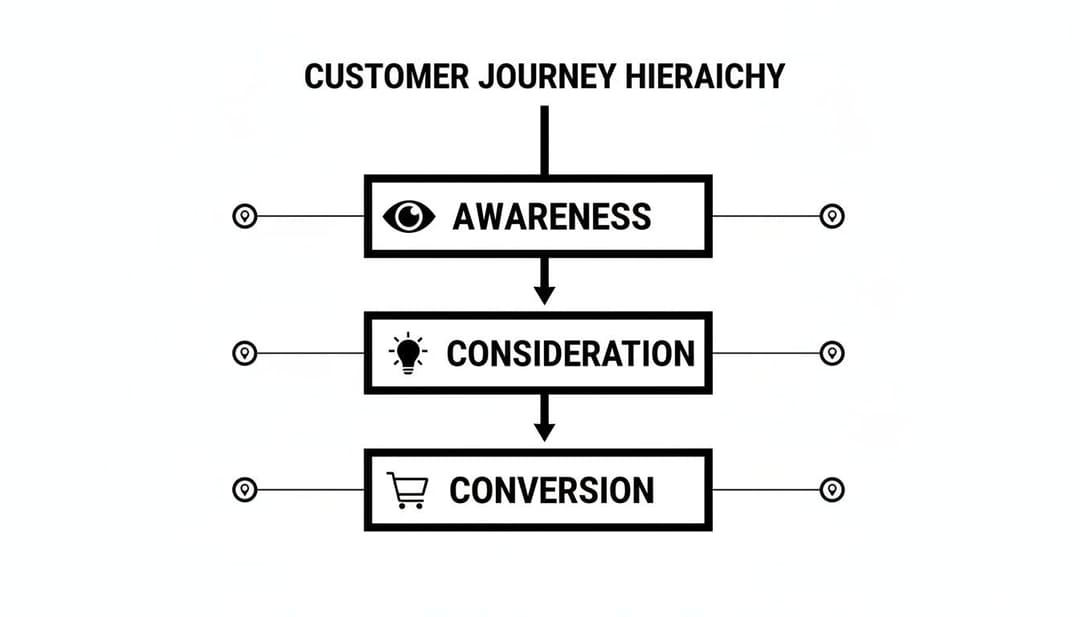
It’s all about meeting people where they are in their journey with you.
Let Your Budget and Business Maturity Guide You
Your company’s stage of growth and the size of your budget are also critical factors. If you’re a brand-new e-commerce store with a shoestring budget, jumping straight into expensive conversion campaigns is a recipe for disaster. You’re better off investing that money in building an audience first.
The objective you choose is a direct instruction to Meta's algorithm. It tells the system precisely who to find, what action to optimize for, and how to define success, turning your ad spend into a goal-seeking missile.
This precision is exactly how these platforms make their money. Meta’s ad revenue hit a staggering $58.1 billion in a recent quarter—a 24% jump year-over-year—because advertisers lined up their objectives with real-world outcomes, like holiday sales. When optimizations can boost conversion rates by even 3%, it shows how a crystal-clear objective helps the algorithm deliver exactly what you need.
A more established business with a solid list of past customers, on the other hand, can and should run Sales campaigns targeting that warm, high-intent audience. Nailing these decisions is the bedrock of any solid data-driven marketing strategy.
At the end of the day, your business goals, audience temperature, and company maturity create a simple but powerful framework that points you to the perfect campaign objective, every single time.
Measuring Success with the Right KPIs

Choosing the right objective of campaign is only half the battle. If you don't pair it with the right Key Performance Indicators (KPIs), you're flying blind.
Think of it this way: you wouldn't use a thermometer to measure your car's speed. So why would you judge an Awareness campaign by its sales figures? That's a classic recipe for disappointment and wasted ad spend.
Every objective has its own "language" of success. Your KPIs are how you become fluent in it. Aligning them correctly helps you build dashboards that tell the true story of your performance, not just the one you want to see.
Matching KPIs to Awareness and Traffic Objectives
When your goal is simply to get on people's radar, your metrics need to reflect that. You're playing the long game here.
For an Awareness objective, you're focused on eyeballs, not clicks. The right KPIs are all about scale and recall:
- Reach: How many unique people saw your ad? This is your total audience footprint.
- Impressions: How many times was your ad actually shown? This speaks to frequency.
- Ad Recall Lift: An estimate of how many people are likely to remember your ad if you asked them two days later.
Switching to a Traffic objective changes the game slightly. The goal is to get people to a specific destination—your website, a landing page, an app store. Your focus shifts from pure visibility to action.
Here, you'll want to measure the efficiency of your clicks:
- Link Clicks: The raw number of clicks on your ad. Simple, but not the whole story.
- Landing Page Views: A much better metric. It tracks how many people actually stuck around for your page to load.
- Cost Per Click (CPC): How much are you paying, on average, for each click? This is your core efficiency metric.
KPIs for Lead Generation and Sales Objectives
As you move down the funnel, your KPIs need to get laser-focused on the bottom line.
For a Lead Generation objective, success isn't just about getting form fills—it's about getting the right ones efficiently. It’s also important to understand essential influencer marketing KPIs if you’re using creators to drive these leads.
Your critical metrics are:
- Leads: The total number of contacts you've captured.
- Cost Per Lead (CPL): The average cost to acquire one new lead. Is it sustainable?
- Lead Quality: This is the often-overlooked metric. Are these leads actually good fits who are likely to convert?
Finally, we arrive at the Sales objective. The KPIs here are purely financial. The only questions that matter are: are we making money, and is it profitable? If you want to dive deeper, check out the performance marketing metrics you should be tracking.
The Bottom Line: For Sales campaigns, every dollar must be accountable. The goal is not just to make sales, but to do so profitably and at a scale that grows the business.
Your dashboard should be built around these numbers:
- Return on Ad Spend (ROAS): The king of sales metrics. How much revenue did you generate for every dollar spent?
- Cost Per Acquisition (CPA): What's your average cost to acquire a paying customer?
- Purchase Conversion Value: The total dollar value of all sales driven by your campaign.
Common Mistakes to Avoid with Campaign Objectives
Even seasoned marketers can fall into traps that drain ad spend and deliver lackluster results. Nailing your objective of campaign is half the battle, but it's just as important to sidestep the common errors that can sink your strategy before it even sets sail.
These mistakes might seem minor on the surface, but they create a fundamental disconnect between what you want and what you’re telling the ad platform’s algorithm to do. Let's break down the most frequent pitfalls and how to steer clear of them.
The Objective and KPI Mismatch
This is, without a doubt, the most common mistake in the book: choosing one objective but measuring success with metrics from another.
Picture this: you run a Traffic campaign to send a flood of affordable clicks to a new blog post. The algorithm does its job perfectly, delivering a high volume of low-cost clicks. But a week later, you’re in a meeting asking, "Why didn't we get any sales from all that spend?" You asked for cheap traffic but judged the campaign on expensive conversions.
The Fix: Your KPIs must be a direct reflection of your chosen objective. If you pick "Traffic," your North Star metrics are Cost Per Click and Landing Page Views. If you want sales, you have to choose the "Sales" objective and live and die by your Return on Ad Spend (ROAS).
Targeting the Wrong Funnel Stage
Another classic blunder is aiming a bottom-of-funnel objective at a top-of-funnel audience. Think about running a high-stakes "Sales" campaign targeting a cold audience of people who have never even heard of your brand.
It's the digital equivalent of asking a complete stranger for their credit card number. It’s too aggressive, too soon. You haven’t built any trust or shown them any value, so they just keep scrolling, and your ad spend gets torched trying to convert people who aren't ready. To run this play effectively, you first need to be sure you can track what users do after the click by implementing tools like the Meta Conversions API.
Sticking to a Single Objective
Finally, a static strategy is a failing one. So many marketers find an objective that works—maybe Lead Generation—and then they run it into the ground, exclusively, forever. They get great at capturing leads but never build campaigns to nurture them toward a sale or run awareness plays to refill the top of the funnel.
This one-dimensional approach creates a leaky bucket. You might be filling it, but you aren't guiding anyone through the full journey from seeing your brand for the first time to becoming a loyal customer.
A much smarter approach is to think in sequences:
- Start with Awareness: Run a Reach campaign to introduce your brand to a new, cold audience. Make a first impression.
- Nurture with Consideration: Retarget people who engaged with that first ad using a Traffic or Video Views campaign to build familiarity and trust.
- Drive Action with Conversion: Finally, hit that warm, high-intent audience with a Sales campaign to close the deal.
This layered strategy respects the customer journey, ensuring each marketing dollar builds on the last for a much greater impact.
Your Objective-Driven Campaign Checklist
Now, let's bring this all together. With the right framework, you can move from just spending money on ads to making strategic investments. This isn't about theory; it's about a repeatable process that connects every click and impression back to a real business outcome.
Think of this as your pre-flight checklist before launching any campaign. It’s designed to eliminate the guesswork and make sure your ad spend is always working toward a measurable goal.
The Five-Step Process
Follow these steps every single time you set up a new campaign in Meta Ads Manager. This simple sequence keeps you focused on what actually matters.
Define One Primary Business Goal Before you even think about creative or copy, stop and ask: What do we need to accomplish? Is it generating 100 qualified leads this month? Boosting online sales by 15% this quarter? Get specific and write it down. This is your north star.
Select the Aligned Meta Objective With your goal clearly defined, this step becomes easy. You simply choose the Meta Ads objective that directly maps to it. If your goal is sales, your objective is "Sales." Don't overthink it. This is a non-negotiable step that tells the algorithm exactly what you want.
Identify 2-3 Core KPIs How will you know if you've succeeded? Pick the Key Performance Indicators that measure your objective. For a Sales campaign, that’s almost always ROAS and CPA. For a Traffic campaign, you're looking at CPC and Landing Page Views. These are your real metrics for success.
Remember, the objective you choose sets the rules of the game. You can't run a Traffic campaign and then get frustrated when it doesn't drive sales. That's like bringing a basketball to a soccer match—you're playing the wrong sport.
Match Creative and Copy to Intent Your ad's message has to match its job. An ad designed for "Sales" needs a direct offer and a clear call-to-action—think "Shop Now" or "Get 20% Off." An "Awareness" ad, on the other hand, should be telling your brand's story or introducing a new idea, not pushing for an immediate purchase.
Review Performance Against KPIs Once the campaign is live, the final step is to analyze the results based only on the KPIs you chose in step three. Tune out the vanity metrics. If the campaign is hitting its core KPI targets, it’s a win. If it's not, you know exactly where to start optimizing.
Frequently Asked Questions
When it comes to campaign objectives, a few questions pop up time and time again. Let's clear the air on some of the most common ones marketers run into.
Can I Use Multiple Objectives in One Campaign?
In a word, no. Each campaign is locked into a single objective, and that’s a good thing. Think of it as giving your GPS one clear destination—the ad platform’s algorithm needs a single, specific command to know exactly what it should be optimizing for.
However, you absolutely can (and should) run multiple campaigns in parallel to build a full-funnel strategy. You might start with an Awareness campaign to get your brand on the radar, then follow up by retargeting that same audience with a separate Conversion campaign to drive sales. This layered approach is how you guide people through their entire journey with your brand.
How Often Should I Change My Campaign Objective?
Here’s the thing: you can’t. Once a campaign is live, its objective is set in stone. Trying to switch it mid-stream would be like changing the rules of a game halfway through—it would completely throw off the algorithm's learning process and tank your performance.
If you realize you need a different outcome, the right move is to launch a new campaign with the appropriate objective. This gives the algorithm a clean slate for optimization and keeps your funnel strategy logical and effective.
A campaign's objective is its foundation. If you need a different outcome, you need to build a new structure. Treat each campaign as a specialized tool for a specific job.
What Is the Best Objective for a Small Budget?
If you're working with a smaller budget, you want every dollar to count. It's smart to start with objectives like Traffic or Engagement. These are typically much more cost-effective and let you start gathering valuable data and building an initial audience without the higher price tag that often comes with conversion-focused ads.
Once you’ve got some momentum and have a better sense of which audiences are responding, you can launch a separate, laser-focused Conversion campaign. This methodical approach ensures your limited budget is put to work driving sales as efficiently as possible.
Ready to stop guessing and start scaling? AdStellar AI automates campaign creation, testing, and optimization, letting you launch hundreds of data-backed ad variations in minutes. Discover how AdStellar can help you unlock more revenue from Meta.