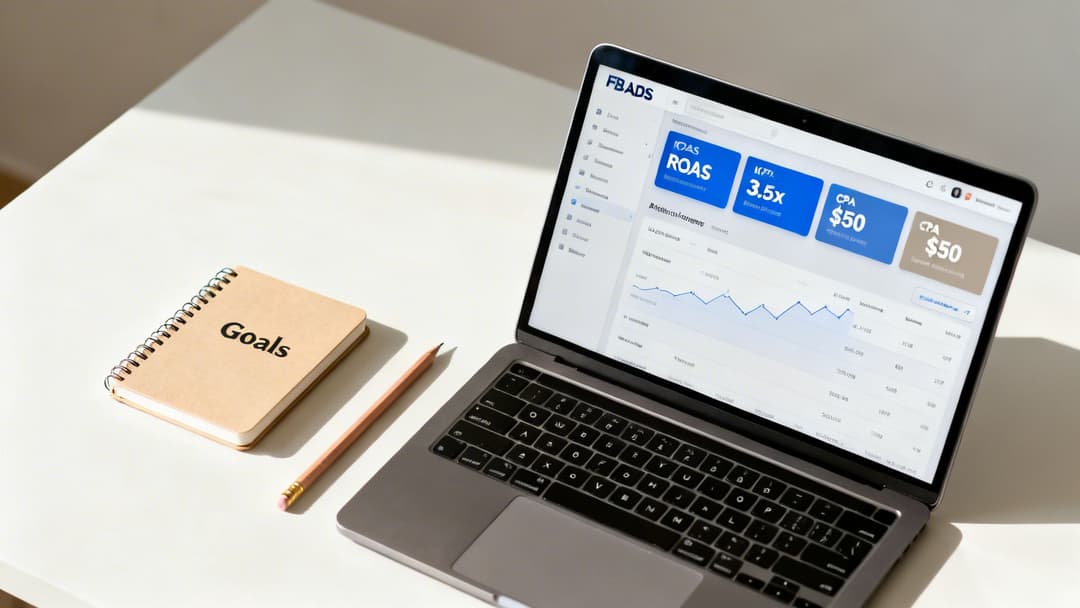
A winning FB ads strategy isn't built on wishful thinking. It's built on cold, hard data. Instead of chasing vague goals like "more sales," a real strategy focuses on specific Key Performance Indicators (KPIs) that actually move the needle—like hitting a 3.5x Return on Ad Spend (ROAS) or keeping your Cost Per Acquisition (CPA) under a certain dollar amount.
This data-first mindset makes every ad dollar accountable. It’s the only way to know you’re driving real, tangible growth.
Defining the Goals of Your FB Ads Strategy
Before you even think about writing ad copy or choosing an image, you have to define what success looks like for your business. A solid FB ads strategy starts by translating your big-picture business ambitions into the specific metrics you'll track inside Ads Manager.
This first step is the bedrock of your entire plan. It dictates your targeting, your creative, and your budget. Skip it, and you’re basically flying blind, burning cash without knowing if you're winning or losing.
For some industries, like e-commerce marketing, this is non-negotiable. Your ad performance is directly tied to sales revenue and even inventory management, so there's no room for guesswork.
From Vague Targets to Concrete KPIs
The first order of business is to get specific. "Getting more website traffic" isn't a strategy; it's a hope. You need to anchor your campaigns to concrete KPIs that serve as your North Star.
Make sure your metrics are:
- Specific: Nail down exactly what you want. Instead of "more leads," your goal should be "generate 150 qualified leads this month."
- Measurable: Pick something you can actually track in Meta Ads Manager. Think ROAS, CPA, and Click-Through Rate (CTR).
- Actionable: Your KPIs should tell you what to do next. If your CPA is climbing, you know it's time to test new creative or audiences.
- Realistic: Base your targets on industry benchmarks and your own past performance. A 10x ROAS is a unicorn for most, but a solid 2.5x ROAS could be a massive win for your business.
I see so many advertisers fall into the trap of chasing vanity metrics like likes, comments, or reach. While engagement is nice, it doesn't pay the bills. The numbers that truly matter are the ones tied directly to your bottom line.
Mapping Business Goals to Ad Objectives
Your overarching business goal should directly inform which Facebook campaign objective you select. This is critical because the platform's algorithm optimizes delivery based on that objective. Get this wrong, and you're fighting the algorithm from day one. For a more detailed look, check out our guide on how to pick the right campaign objectives.
To make it tangible, here’s a quick-and-dirty framework I use to connect business goals to the core KPIs you should be obsessing over.
Mapping Business Objectives to Core Facebook Ad KPIs
| Business Objective | Primary Ad KPI | Secondary Metrics to Monitor |
|---|---|---|
| Increase Online Sales | Return on Ad Spend (ROAS) | Cost Per Purchase, Average Order Value (AOV), Conversion Rate |
| Generate Leads for a Service | Cost Per Lead (CPL) | Lead-to-Customer Rate, Cost Per MQL, Landing Page Conversion Rate |
| Drive Brand Awareness | Ad Recall Lift or Reach | Cost Per Mille (CPM), Frequency, Video View-Through Rate |
| Boost App Installs | Cost Per Install (CPI) | Cost Per Action (in-app), App Open Rate, User Retention |
| Drive Foot Traffic to Stores | Store Visits or Reach (local) | Cost Per Store Visit, Impression Share in a geo-fenced area |
This framework isn't exhaustive, but it provides a clear starting point. For instance, if you’re trying to grow online sales, your primary KPI is ROAS. You’ll select the "Sales" objective and keep a close eye on your Cost Per Purchase and Average Order Value (AOV) to make sure things are headed in the right direction.
On the other hand, if you're generating leads for a service-based business, your focus shifts to Cost Per Lead (CPL). Here, you'd use the "Leads" objective, optimizing for actions like form submissions or phone calls.
By starting with a clear, data-informed framework, your entire FB ads strategy becomes more intentional. You'll know exactly what you’re aiming for, how to measure it, and when to pivot, ensuring your ad spend is a smart investment, not just another expense.
Building High-Intent Audiences That Convert
A brilliant ad shown to the wrong person is a wasted dollar. We've all seen it happen. The real power behind a profitable FB ads strategy isn't just a killer creative; it's the ability to connect with the right people at the exact moment they’re ready to act.
This means we have to move past broad, assumption-based targeting. It's time to build audiences grounded in real user data and clear intent signals.
The best place to start? Your own first-party data. These are the people who already know you—your website visitors, email subscribers, and past customers. They're your warmest leads and the most valuable blueprint for finding new ones.
Harnessing Your First-Party Data with Custom Audiences
The most powerful audiences you'll ever build come straight from your own data sources. Forget generic interest groups. We're talking about segments of people who have already engaged with your brand, making them exponentially more likely to convert.
Get started by creating Custom Audiences from these core sources:
- Website Visitors: Use the Meta Pixel to create audiences based on specific actions. A classic, high-performing example is targeting users who viewed a product page in the last 14 days but never made it to checkout.
- Customer Lists: Upload a list of your past customers (email addresses or phone numbers work great). You can use this to run loyalty campaigns, bring back dormant customers, or—just as importantly—exclude them from prospecting campaigns to avoid burning ad spend.
- Engagement Audiences: Build audiences of people who’ve interacted with your Facebook or Instagram content. This includes users who watched a chunk of your videos or engaged with your posts, signaling a clear interest in what you're doing.
When you focus on these data-driven segments, you stop guessing who your customer is and start knowing who they are. You can get more advanced techniques in our detailed guide to audience segmentation strategies.
Expanding Your Reach with Lookalike Audiences
Once you've built those high-quality Custom Audiences, you can use them as a launchpad to find millions of new people who share similar traits. This is where Lookalike Audiences come in, and they're one of Meta’s most effective tools for scaling.
The concept is straightforward: you provide a source audience (like your best customers), and Meta’s algorithm crunches thousands of data points to find new users who "look like" them. The secret sauce here is the quality of your source.
A Lookalike Audience is only as good as the data you feed it. A Lookalike built from your top 10% highest lifetime value (LTV) customers will absolutely outperform one built from all website visitors.
For instance, a SaaS company could create a Lookalike from users who finished a free trial and upgraded to a paid plan. This move targets new prospects who mirror the behavior of their most valuable users, making their prospecting campaigns dramatically more efficient.
Structuring Audiences for the Full Funnel
A truly effective FB ads strategy doesn't throw the same message at everyone. It intelligently segments audiences based on where they are in their journey and delivers a tailored message designed to nudge them to the next stage. It’s about not asking for the sale from someone who just met you.
Here’s a practical, three-tiered structure that works:
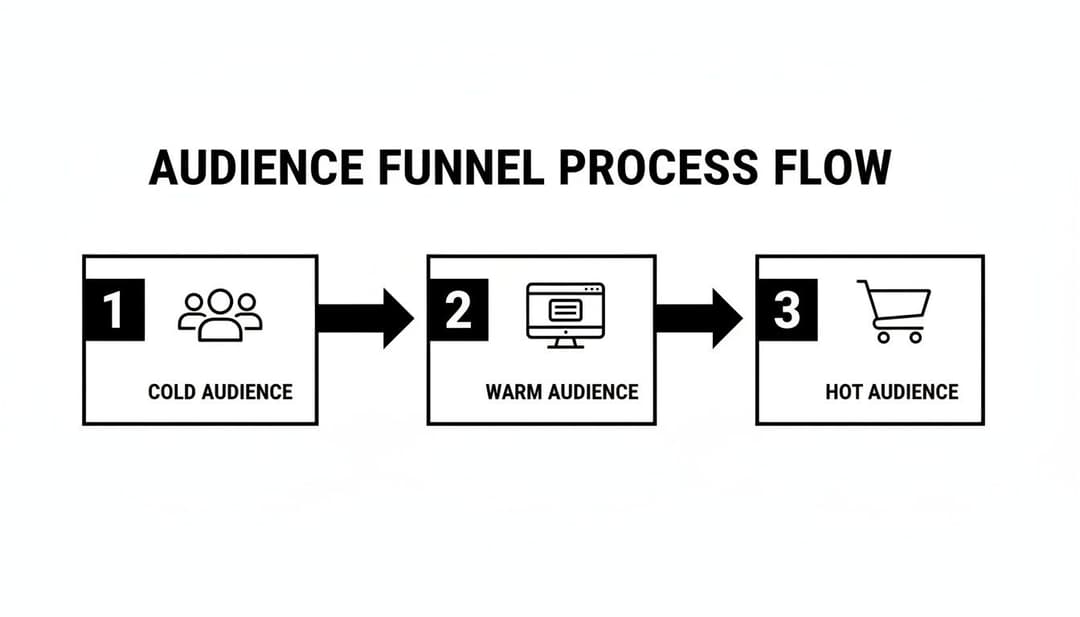
- Top of Funnel (TOFU) - Cold Audiences: These are new prospects who have likely never heard of you. Your best bet here is to target broader Lookalike Audiences (1-5%) and well-researched interest layers. The goal is awareness and education, not a hard sell.
- Middle of Funnel (MOFU) - Warm Audiences: This tier is for people who've shown interest but haven't pulled the trigger. Think website visitors, video viewers, and social media engagers. Your messaging should focus on building trust, handling objections, and showcasing what makes you different.
- Bottom of Funnel (BOFU) - Hot Audiences: These are your hottest prospects, the ones on the verge of buying. This includes users who added an item to their cart, initiated checkout, or checked out your pricing page. Your ads need to be direct, often featuring strong offers, testimonials, or a bit of urgency to get them across the finish line.
By segmenting your campaigns this way, you create a cohesive system that nurtures people from first glance to final conversion. This structured approach is what separates the chaotic, money-pit ad accounts from the scalable, high-ROI machines. It guarantees every dollar is spent with intention, speaking to users in a way that actually resonates with their current relationship with your brand.
Developing a High-Velocity Creative Testing System
Creative fatigue is the silent killer of an otherwise solid FB ads strategy. That ad that was crushing it last month? This month, it’s flatlining. Why? Your audience has seen it too many times. The only real defense against this is a systematic, high-velocity creative testing system that constantly feeds your campaigns fresh, winning assets.
This isn’t about guesswork or waiting for a spark of genius. It’s about turning creative development into a data-driven machine. By isolating and testing one element at a time—the hook, the visual, the headline, the call-to-action—you can gather clean data on what actually works with your audience and iterate with incredible speed.
The opportunity here is massive. Facebook ads can reach a mind-boggling 2.28 billion users globally, a number that's growing by 4.3% every year. For performance marketers, this huge audience is a playground for rapid testing and scaling. The real challenge is managing the sheer volume of creative variations you need to test effectively. That's where platforms like AdStellar AI come in, automating bulk ad creation so you can launch hundreds of creative tests in minutes. You can dig into the latest Facebook user statistics on Datareportal for more on this.
The Foundation: Isolate and Test
The golden rule of creative testing is simple: change only one key variable at a time within an ad set. It's the only way to know for sure what caused a change in performance. If you switch up the image, headline, and body copy all at once, you’ll have no clue which element was the hero (or the villain).
Start by picking a "control" ad—your current best performer. From there, create variations that test just one of these core components:
- The Hook: Test the very first sentence of your copy. Try posing a question, dropping a shocking statistic, or hitting on a relatable pain point.
- The Visual: Pit a static image against a short video. Or maybe test a raw, user-generated content (UGC) style creative against a polished studio graphic.
- The Angle: Try out different value propositions. Does a "convenience" angle pull better numbers than a "cost-saving" one?
- The Call-to-Action (CTA): Experiment with the button text ("Shop Now" vs. "Learn More") and the final sentence of your ad copy that pushes for the click.
This methodical approach takes the emotion and guesswork out of the equation. Let the data—not your gut—tell you where to go next.
The goal isn't just to find a single 'winning' ad. It's to build a library of winning components—hooks, images, angles, and CTAs—that you can mix and match to consistently pump out high-performing creative.
Accelerating Production with AI
Manually building dozens of ad variations is a serious bottleneck. It kills momentum and drains resources. This is where AI-powered tools become an absolute game-changer for any serious FB ads strategy, unlocking a testing velocity that’s just not humanly possible otherwise.
The funnel diagram below shows how you can think about matching different creative to audiences at different stages of their journey.
Using tools like AdStellar AI, you can generate hundreds of unique ad combinations from just a handful of core assets. This lets you launch comprehensive multivariate tests across different audience segments all at once, gathering performance data way faster than you could before. To get deeper on this, check out our guide on creating effective digital marketing creatives.
Structuring Your Testing Campaigns
How you structure your tests inside Ads Manager is critical for getting clean, reliable data. For most scenarios, I’m a big fan of using a dedicated A/B testing campaign with Ad Set Budget Optimization (ABO). This ensures each ad set—and the single variable you're testing within it—gets a fair, predetermined budget to work with.
You can see that a cold audience (Top of Funnel) might respond best to educational or entertaining content, while a hot audience (Bottom of Funnel) is ready for direct-response ads with a clear offer.
A clean testing structure might look something like this:
- Campaign: "Creative Test - Q3 Video Hooks" (Objective: Sales)
- Ad Set 1: "Hook Test - Question" (Budget: $50/day)
- Ad 1A: (Video A + Question Hook + Headline X + Body Y)
- Ad Set 2: "Hook Test - Statistic" (Budget: $50/day)
- Ad 2A: (Video A + Statistic Hook + Headline X + Body Y)
- Ad Set 3: "Hook Test - Pain Point" (Budget: $50/day)
- Ad 3A: (Video A + Pain Point Hook + Headline X + Body Y)
In this setup, the only thing that's different between the ad sets is the hook. Let it run for 3-4 days or until you have statistically significant data (like enough purchases or leads to make a call). Then, you can confidently declare a winner and roll that winning element into your main scaling campaigns. This disciplined process turns creative optimization from a random shot in the dark into a repeatable system that fuels long-term growth.
Smart Budgeting, Bidding, and Scaling Tactics
A brilliant creative paired with laser-focused targeting is a great start, but it means very little without a smart financial framework. This is where a good FB ads strategy evolves into a profitable one. Your approach to budgeting, bidding, and scaling is what ultimately determines whether your campaigns become a predictable growth engine or just a costly experiment.
Think of your budget and bid strategy as the engine and transmission of your campaign. They control the power and efficiency, making sure the fuel—your ad spend—is used to its maximum potential. Getting this right is what separates campaigns that sputter out from those that accelerate toward your goals.
Matching Your Bid Strategy to Your Goals
Meta's bidding options can seem complex at first glance, but they're really just different tools for different jobs. Choosing the right one comes down to what you want the algorithm to prioritize.
Let's break down the main players with real-world scenarios.
- Highest Volume (or Lowest Cost): This is the default setting for a reason. It basically tells Meta, "Get me the most results possible within my budget." It’s perfect for the early days of a campaign when you need to gather data quickly and establish a baseline performance. A new e-commerce store launching a product would use this to drive as many initial sales as possible, understanding that the cost per sale might fluctuate.
- Cost Per Result Goal: With this option, you're giving Meta a bit more direction: "I want to get results, and I'd ideally like to keep my average cost around this specific number." If you know your breakeven CPA is $50, you can set a goal around that figure. The algorithm will then work to hit that average over time, sometimes paying more and sometimes less for a conversion. It's a great balance between volume and cost control.
- Bid Cap: This is the most hands-on approach. You're telling Meta, "Do not bid more than this specific amount for any single result in the auction." It gives you maximum control over cost but can severely limit your ad delivery if your bid is too low to win auctions. This is best used by experienced advertisers who need to protect their margins aggressively and truly understand the competitive landscape.
A core part of managing your Facebook ad budget and evaluating efficiency involves knowing how to calculate Cost Per Click (CPC). This foundational metric is key to setting intelligent bids and understanding your auction performance.
CBO vs. ABO: When to Use Each
The debate between Campaign Budget Optimization (CBO) and Ad Set Budget Optimization (ABO) is a classic for a reason. The right choice really just depends on the phase of your campaign.
Use ABO (Ad Set Budget) for Testing: When you're testing new creatives, audiences, or offers, ABO is your best friend. It lets you assign a specific, fixed budget to each ad set. This ensures each variable gets a fair chance to perform without one ad set hogging all the spend, giving you clean, comparable data to make decisions.
Use CBO (Campaign Budget) for Scaling: Once you've identified your winning ad sets from your ABO tests, you consolidate them into a CBO campaign. Here, you set the budget at the campaign level, and Meta’s algorithm dynamically allocates more spend to the top-performing ad sets in real time. This is where you maximize efficiency and drive results at the lowest possible cost.
The Rules of Smart Scaling
Scaling a successful campaign is a delicate process. Just pumping more money in too quickly can shock the algorithm, tanking your performance and jacking up your costs.
The key is to scale methodically and let the data guide you.
A proven method is the "15-20% rule." When you see a campaign performing well for 3-4 consecutive days, it's a solid signal that it's stable and ready for more spend. You should increase the budget by no more than 15-20% at a time, once per day. This gradual increase allows the algorithm to adjust without resetting its learning phase, maintaining efficiency as you grow.
The signs that a campaign is ready to scale are clear and data-driven:
- Stable CPA/ROAS: Your key performance metrics are consistent and hitting your targets.
- Sufficient Conversions: The campaign has exited the learning phase (typically ~50 conversions in a 7-day window).
- High Ad Relevance: Your ads have positive feedback and are clearly resonating with the audience.
By combining the right bid strategy with a structured approach to budget allocation and scaling, you turn ad spend from an expense into a strategic investment. For a deeper dive into controlling your expenses, our guide on ad spend optimization offers even more advanced tactics.
Analyzing Performance to Continuously Refine Your Strategy
A winning FB ads strategy is never a "set it and forget it" plan. It's a living, breathing system that gets smarter with every new data point you feed it. Building this continuous feedback loop is the real secret separating campaigns that plateau from those that deliver sustained, long-term growth.
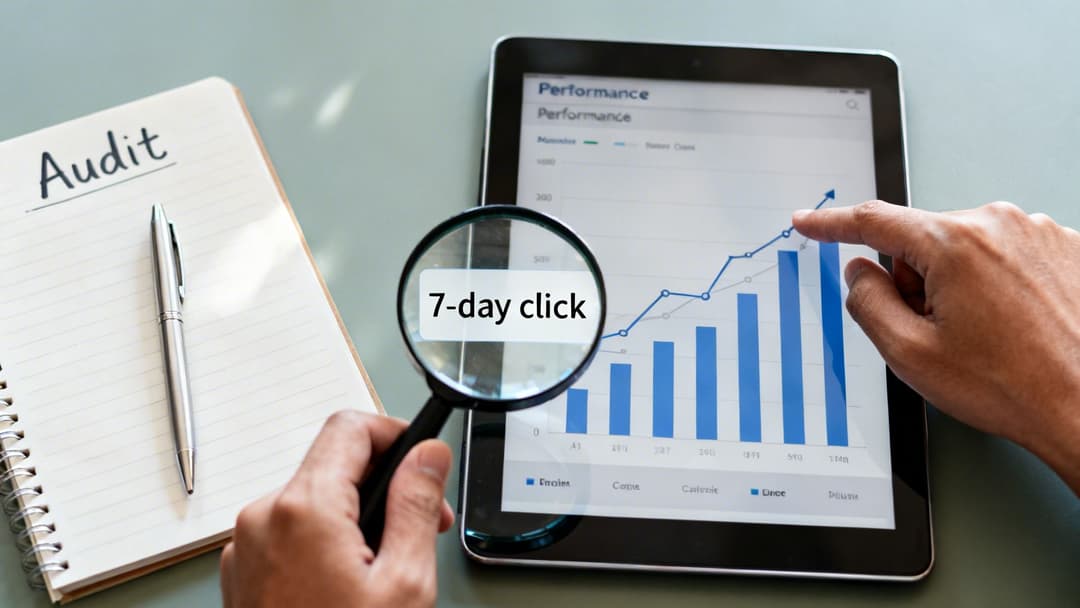
This all comes down to regularly auditing your performance and turning those insights into concrete actions. We’re moving beyond just looking at ROAS and instead diagnosing the why behind your results. That’s how you double down on what works and cut what doesn't with total confidence.
Navigating Attribution in a Post-iOS World
Let's be real: the days of perfect, one-to-one attribution are over. In today's privacy-first world, you have to understand Meta's attribution models to make smart decisions.
The default setting you’ll see most often is the "7-day click or 1-day view" window. This just means Meta credits a conversion to your ad if someone clicks it and converts within seven days, or if they simply see it (no click) and convert within one day.
The most important thing is to stay consistent. Never compare a campaign using a 7-day click window to one using a 1-day click window—you're looking at two completely different stories. Consistency is the bedrock of any accurate analysis.
Conducting Regular Performance Audits
Think of a performance audit as a routine health check-up for your ad account. Instead of just glancing at your main KPI, you need to dig deeper to see what’s really driving the numbers.
I've found a weekly audit rhythm works best. Here’s what to focus on:
- Creative Performance: Which ads are actually driving results? Is there a common theme? Maybe user-generated videos are consistently crushing your polished static images. If so, your strategy needs to pivot toward producing more of what's winning.
- Audience Insights: Are your prospecting campaigns hitting a sweet spot with specific Lookalike percentages? Are your retargeting audiences getting tired of seeing the same ads? These questions point you to where your budget should go next.
- Funnel Drop-off: Check your click-through rate (CTR), landing page conversion rate, and cost per unique outbound click. A high CTR but a low conversion rate is a classic red flag that your ad's promise doesn't match the landing page experience.
Breaking down the data this way helps you move from knowing what happened to understanding why it happened. This is where the gold is.
The best insights often pop out when you compare your winners and losers side-by-side. If one ad has a 3x higher ROAS than another, systematically break down what’s different—the hook, the visual, the offer—to find the single element that's making the real impact.
Turning Data Into Decisive Action
Analysis without action is just an expensive hobby. The final, and most critical, step is translating what you’ve learned into your next strategic move.
This is where a clear decision-making framework is a lifesaver. For example, you might create a rule: if a creative's performance drops by 20% for three consecutive days, that’s the trigger to kill it and swap in a new variation from your testing pipeline.
The sheer scale of Meta’s platform—with ad revenue hitting $156.8 billion and over 10 million active advertisers monthly—makes this process non-negotiable. The advertisers who win are the ones who adapt the fastest.
This is also where automation platforms like AdStellar AI become incredibly powerful. Instead of you manually sifting through endless rows of data, the system’s AI can automatically pinpoint top-performing creatives and audiences, flagging them for you to scale. It essentially puts the feedback loop on autopilot, letting you make smarter decisions, faster.
To really get this down, you can dive deeper in our comprehensive guide to FB ads reporting. Mastering this transforms your FB ads strategy from a reactive chore into a proactive growth engine.
Common Questions About FB Ads Strategy
Even with the best-laid plans, a few nagging questions always seem to pop up and slow down execution. It happens to everyone. Marketers and founders constantly run into the same practical hurdles when it comes to their FB ads strategy.
Let's tackle some of the most frequent questions we hear from performance marketers. Think of this as a quick-reference guide to help you fine-tune your approach and move forward with confidence.
How Much Should I Spend on Facebook Ads?
There's no magic number here, but you can get to a smart starting point by working backward from your goals. First, you need to know your target Cost Per Acquisition (CPA). If your product sells for $100 and you need a 50% profit margin to make the numbers work, your absolute maximum CPA is $50.
From there, figure out your monthly sales target. Need 100 sales this month? The math is pretty simple:
100 sales x $50 CPA = $5,000 per month
When you're testing new campaigns, a solid rule of thumb is to budget enough to get at least 50 conversions per ad set within a 7-day window. This is the magic number that gives Meta’s algorithm enough data to climb out of the dreaded "learning phase" and actually start optimizing for you.
So, if your target CPA is $50, you'll want to spend at least $350-$400 per week on that specific ad set to give it a fair shot.
One of the biggest rookie mistakes is spreading a small budget too thin across too many campaigns. It’s far better to properly fund one or two tests than to underfund ten and get zero meaningful data from any of them.
How Long Should I Run an Ad Before Turning It Off?
Patience is probably the most underrated skill in advertising. It is so tempting to kill an ad after a day or two if the numbers look ugly, but that's almost always a mistake. You have to give the algorithm—and your ad—time to find its footing.
A good guideline is to let an ad run for at least 3-4 days before you even think about making a kill-or-keep decision. This helps smooth out the natural ups and downs of the week. Your audience might be all-in on a Tuesday but completely disengaged on a Saturday; looking at a single day's performance is just misleading.
Before you pause anything, check these boxes:
- Sufficient Impressions: Has the ad reached at least 1,000-2,000 people? If not, you don't have enough data.
- Meaningful Data: Do you have enough clicks or conversions to make a statistically sound call? A handful of clicks means nothing.
- Consistent Underperformance: Is the ad consistently missing your target KPI (like ROAS or CPA) over that entire 3-4 day period?
If you can answer "yes" to all three, then you can confidently pause the ad and move that budget to a winner or a fresh test.
Why Is My Ad Not Getting Any Impressions?
This is easily one of the most frustrating problems to have. Your campaign is approved, it's "active," but the impression count is stuck at a big fat zero. The issue usually boils down to one of three things.
First, check your bid and budget. If you're using a Bid Cap strategy, your bid might simply be too low to even get you into the auction. The algorithm can't find anyone to show your ad to at the price you've set. As a quick diagnostic, try switching to a Highest Volume bid strategy to see if that jump-starts delivery.
Another common culprit is a tiny audience. If your targeting is super-niche and your audience size is dipping below 50,000 people, Meta might struggle to serve your ad, especially if a lot of other advertisers are vying for the same eyeballs.
Finally, take a hard look at your ad creative. Sometimes an ad gets approved but is borderline on a policy, which causes Meta to quietly throttle its distribution. Look for anything that could be a red flag, like too much text on your images or claims that could be interpreted as misleading.
Ready to stop the guesswork and build a scalable, data-driven FB ads strategy? AdStellar AI is your co-pilot for launching, testing, and scaling Meta campaigns 10x faster. Our platform automates bulk ad creation, identifies winning creatives with AI-powered insights, and centralizes your entire workflow so you can focus on what matters most—growth.
Discover how performance marketing teams are unlocking more revenue from Meta with less time and spend. Learn more about AdStellar AI.