At their core, lead gen ads are a marketer's secret weapon for capturing customer info right inside the platform they're already using, like Meta or LinkedIn. Instead of booting users off to a separate landing page, these ads use an instant, pre-filled form. This slick, one-click experience dramatically simplifies the sign-up process and can send your conversion rates through the roof. It’s the key to growing your lead list without the usual friction.
Understanding How Lead Gen Ads Work
Think about the traditional ad experience for a second. It's like seeing a flyer that tells you to drive across town to a physical store. The user sees an ad, clicks it, waits for a new website to load, and then has to fill out a form from scratch. Every single step is a chance for them to lose interest and bounce.
Lead gen ads completely flip that script. Imagine you’re at a trade show, and instead of being directed to a booth, someone hands you a clipboard right then and there. That's a lead gen ad. A user clicks the call-to-action, and a form pops up instantly within the app, already filled with their name and email from their profile. All they have to do is hit "submit."
The entire concept is built on one simple, powerful idea: reduce friction to increase conversions. By keeping the whole interaction inside the app, you make it ridiculously easy for someone to raise their hand and say, "I'm interested."
The Core Purpose of Lead Gen Ads
The main goal here is to shorten the distance between someone seeing your ad and becoming a lead. By cutting out the landing page, you create a direct pipeline from user interest to your CRM. This simple change helps you hit several key business goals:
- Accelerate List Growth: Quickly pack your email or SMS lists with people who are genuinely interested.
- Lower Acquisition Costs: Better conversion rates often mean a lower Cost Per Lead (CPL) compared to your standard traffic campaigns.
- Improve Mobile Experience: They are a dream for mobile users, who have little patience for slow-loading external sites.
- Fuel the Sales Pipeline: Keep your sales team busy with a steady stream of fresh leads to follow up with.
This direct impact on the sales pipeline is exactly why lead generation has become a top priority for so many businesses. A staggering 53% of marketers now pour more than half of their budget into lead generation efforts. The market shows it, too—marketers spent $3.2 billion on paid lead gen ads in 2023. If you want to see where things are headed, check out the latest lead generation statistics; the market is projected to hit $15.55 billion by 2031.
A lead gen ad is essentially a promise of value in exchange for information. The ad says, "Give us your contact details, and we'll give you this valuable e-book, webinar seat, or discount code instantly."
Ultimately, whether you're in e-commerce, B2B services, or running a local business, these ads are an essential tool. They’re the bridge between a user's passive scrolling and their active engagement, turning casual interest into the measurable, actionable leads that actually grow your business.
Choosing The Right Platform For Your Goals
Picking the right platform for your lead gen ads is a bit like choosing the right tool for a job. You wouldn't use a sledgehammer to hang a picture, right? In the same way, the platform you choose has everything to do with who you're trying to reach and what you want them to do. It’s a strategic call that will make or break your campaign's success.
The two heavyweights in this arena are Meta (Facebook and Instagram) and LinkedIn. While both let you capture leads with slick in-app forms, they cater to fundamentally different audiences and shine in different scenarios. Getting these distinctions right is the first step to building a lead generation machine you can count on.
This map breaks down the simple, powerful flow of lead gen ads—from that first click all the way to business growth.
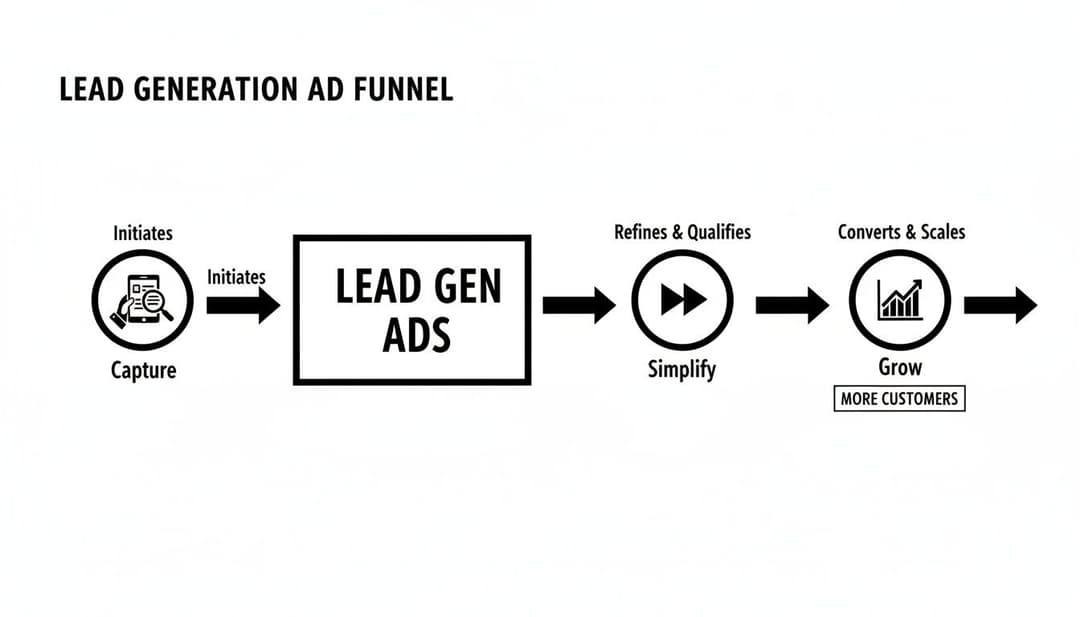
As you can see, the whole process is designed to be seamless: capture user info, make it dead simple to submit, and grow your customer base.
Meta Lead Ads for B2C Volume
Think of Meta's universe as a massive, bustling digital city square. It’s packed with people sharing their interests, hobbies, and shopping habits. This makes Meta Lead Ads, which run on Facebook and Instagram, an absolute powerhouse for Business-to-Consumer (B2C) marketing. Their real magic is in pulling in high volumes of leads for offers that are easy to say "yes" to.
Meta is your go-to for things like:
- Newsletter Sign-ups: Grow your email list effortlessly by dangling valuable content.
- Discount Codes & Promotions: Snag leads by offering an immediate reason to buy.
- Event Registrations: Fill up free local events or broad-appeal webinars.
- Contest Entries: Engage a huge audience and gather contact details with a giveaway.
The platform’s Instant Forms are built for mobile, pre-filling user info to make signing up almost a reflex. It's a frictionless experience that turns a casual scroll into a hot new lead in just two taps.
LinkedIn Lead Gen Forms for B2B Precision
If Meta is the city square, LinkedIn is the corporate conference hall. It's where professionals go to network, learn, and make deals. This makes LinkedIn Lead Gen Forms the undisputed champ for Business-to-B2B (B2B) marketing, where the quality of a lead almost always trumps sheer quantity.
LinkedIn’s targeting is second to none for zeroing in on specific industries, job titles, company sizes, and skill sets. That precision is perfect for high-value offers aimed at a qualified audience. For a deeper look at this, check out our guide on targeted advertising on social media.
LinkedIn’s greatest asset isn’t just its data, but its context. Users are in a professional mindset, making them more receptive to business-related offers like product demos, industry reports, or webinar invitations.
The numbers don't lie. LinkedIn Lead Gen Forms hit an average conversion rate of 13%, which is over five times the industry average for landing pages. Even better, audiences who see both brand and acquisition ads on LinkedIn are six times more likely to convert. Meta is no slouch either, with 16.7% of marketers naming Facebook Ads as their top source for paid traffic conversions.
A Head-to-Head Comparison
To help you decide, let's put the two platforms side-by-side and see how they stack up for lead generation.
Meta Lead Ads vs LinkedIn Lead Gen Forms
| Feature | Meta (Facebook/Instagram) Lead Ads | LinkedIn Lead Gen Forms |
|---|---|---|
| Primary Audience | B2C (Broad consumer interests, demographics) | B2B (Job titles, industries, company size) |
| Ideal Use Case | High-volume lead capture (newsletters, discounts) | High-quality lead capture (webinars, demos) |
| Typical Cost | Lower Cost Per Lead (CPL) | Higher Cost Per Lead (CPL) |
| Targeting Strength | Interest, behavior, and demographic targeting | Professional data and firmographics |
| Lead Quality | Varies; can be lower intent | Generally higher intent and more qualified |
Ultimately, your choice has to line up with your business goals. Need to build a massive email list for your e-commerce store fast? Meta is your best bet. Need to book demos with VPs of Marketing at enterprise tech companies? LinkedIn is the only game in town.
Designing Ad Creative That Captures Attention
Great targeting gets your ad in front of the right people, but that’s only half the battle. If your creative doesn't stop them mid-scroll and give them a reason to care, even the most perfect audience strategy will fall flat.
Your creative is the first handshake. Your copy is the conversation starter. It’s a one-two punch, and mastering both is what separates a forgettable ad from one that actually fills your pipeline. The visuals have to grab their attention, and the words need to make a promise that's worth trading their contact info for.
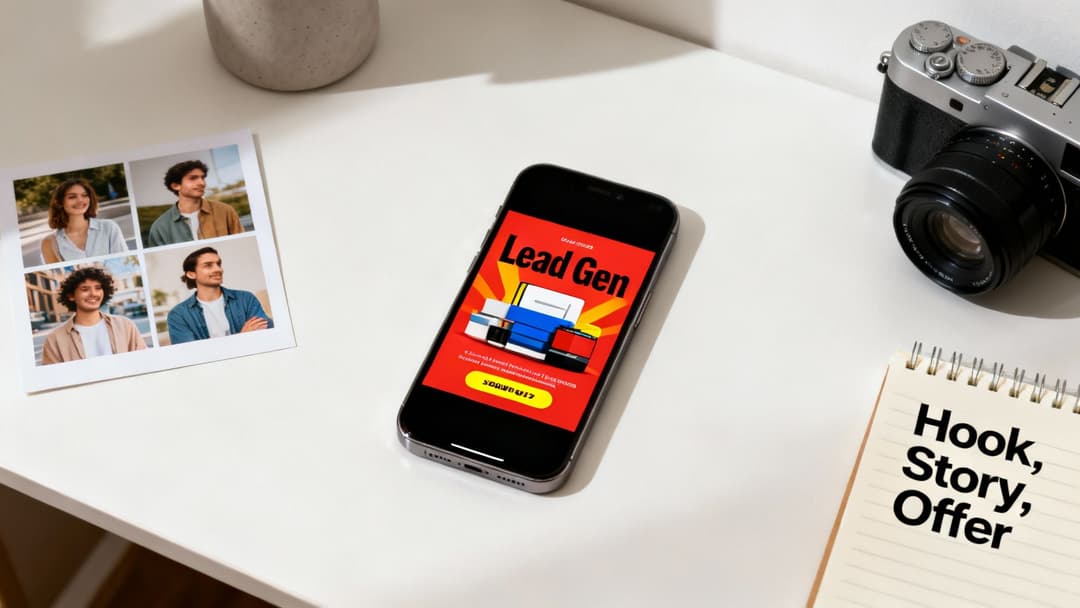
Visuals That Stop the Scroll
Let's be honest, you have less than a second to make an impression in a crowded social feed. Generic stock photos and bland graphics are invisible. To stand out, your visuals need to feel real and offer a glimpse of value right away.
Embrace User-Generated Content (UGC): Nothing builds trust faster than seeing real people using and loving your product. UGC feels genuine and relatable, cutting through the polished noise of typical ads. It’s powerful social proof that your offer actually delivers.
Use Bold and Contrasting Imagery: Think bright colors, striking compositions, and high-contrast visuals that practically jump off the screen. Your goal isn't just to be seen—it's to be disruptive enough to break someone's scrolling habit.
Create Clear Video Demos: If you’re promoting a product or a service, just show it in action. A short, no-fluff video that demonstrates the core value can answer questions before they’re even asked, making the decision to sign up that much easier.
Crafting Copy with the Hook, Story, Offer Framework
Once your visual has bought you a moment of their time, your copy needs to seal the deal. One of the most powerful and reliable ways to structure your message is the Hook, Story, Offer framework. It’s a simple, three-part formula that guides a reader from initial curiosity straight to taking action.
This framework isn't just about writing; it's about engineering a persuasive argument. It builds a logical and emotional bridge between a user's problem and your solution, making the call-to-action feel like the natural next step.
Let's break down how each piece works for lead gen ads.
The Hook
The first line of your ad is everything. Its only job is to get the second line read. The hook needs to grab your target audience by calling out a specific pain point, a deep-seated ambition, or a surprising fact they can't just scroll past.
Example Hook: "Tired of spending hours creating ad variations that don't convert?" This hits a nerve with performance marketers, making sure the right people immediately lean in.
The Story
Next, you need a quick story to build on that hook. This isn't a long-winded tale; it’s a sentence or two that connects their problem directly to your solution. It has to resonate with their experience and show them you get it.
Example Story: "Our AI platform helps growth teams launch hundreds of data-backed ad combinations in minutes, eliminating guesswork and finding winning campaigns faster." This bridges the gap, showing exactly how their problem gets solved. If you want to dive deeper, we have a whole guide on what makes for genuinely good ad copy.
The Offer
Finally, you hit them with a clear, compelling, and irresistible offer. This is your call-to-action, the thing that gets them to fill out the lead form. It must be valuable, easy to understand, and directly tied to the story you just told.
Example Offer: "Sign up for a free demo and see how you can 10x your campaign output this week." The offer is specific, has a sense of urgency, and promises a massive benefit—a powerful incentive to click "Submit."
By combining scroll-stopping visuals with a persuasive copy framework, your lead gen ads can do more than just get clicks. They can attract high-quality leads who are actually interested in what you have to say, building trust from the very first impression.
Mastering Audience Targeting for Quality Leads
You can have the most brilliant, eye-catching ad in the world, but if you show it to the wrong people, you’re just throwing money away. It’s that simple. Think of it like a key and a lock: no matter how perfectly crafted your ad (the key) is, it’s useless if it doesn’t fit your audience (the lock). Real success in lead gen comes from finding the exact people who are already looking for what you have to offer.
This isn’t about casting a wide net and hoping for the best. It’s about precision. We want to reach the users who are not just likely to click, but who are primed to become valuable, long-term customers. On platforms like Meta and LinkedIn, this is done through a powerful, layered approach that lets you connect with people at every single stage of their journey.
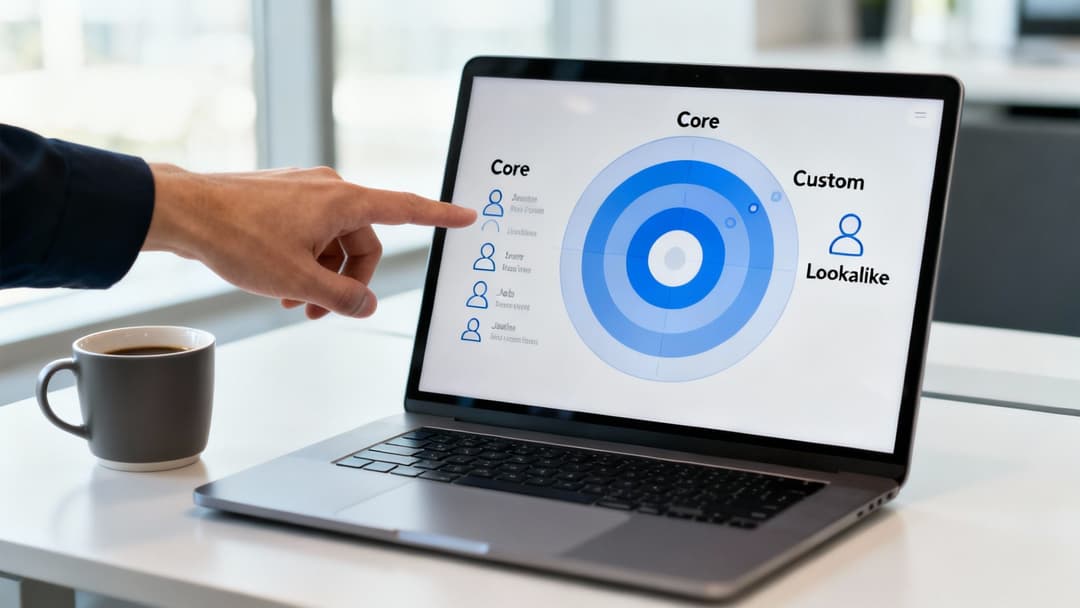
The Three Pillars of Audience Targeting
Modern ad platforms give us three core ways to build audiences. The real magic happens when you stop thinking of them as separate options and start using them together to move from broad prospecting to capturing high-intent leads. For a complete breakdown, you can learn more about how to identify a target audience in our detailed guide.
Core Audiences (Prospecting the Field): This is ground zero. Core audiences are built using the platform's native data—demographics, interests, behaviors. It’s your opportunity to define your ideal customer from scratch based on who they are and what they’re into.
Custom Audiences (Retargeting Warm Leads): This is where you re-engage people who already know you. Custom audiences are created from your own data, like lists of website visitors, customer emails, or people who’ve liked your posts.
Lookalike Audiences (Scaling Your Success): This is how you find new people by cloning your best customers. The platform analyzes a source audience (like your top buyers) and builds a new audience of users with shockingly similar characteristics.
Building Your Targeting Strategy from Scratch
The most effective lead gen campaigns don't just pick one of these and call it a day. They weave them together to create a full-funnel experience, guiding users from initial awareness right through to conversion.
Start Broad with Core Audiences
When you need to find brand new customers, you always start with Core Audiences. This is classic top-of-funnel prospecting. For instance, a B2B SaaS company might target users on LinkedIn based on:
- Job Titles: "Marketing Manager," "Director of Sales"
- Industry: "Computer Software," "Information Technology and Services"
- Company Size: "51-200 employees," "201-500 employees"
This ensures your first ads are seen by a relevant professional audience, even if they’ve never heard of you. The goal here is simple: introduce your solution to a well-defined slice of the market.
Strategic layering is key. Don't just target 'Marketing Managers.' Target Marketing Managers who also have 'SaaS' listed as a skill and work at companies with over 100 employees. This kind of precision weeds out irrelevant leads from the very start.
Nurture Interest with Custom Audiences
Once people start interacting with your brand, it’s time to move them into Custom Audiences for retargeting. This is your mid-funnel play, designed to nurture warm leads who've shown interest but haven't pulled the trigger yet.
A powerful Custom Audience strategy includes targeting people who:
- Visited your pricing page in the last 30 days.
- Watched at least 50% of your product demo video on Meta.
- Downloaded a previous e-book (so you can offer them a product demo next).
These ads can be much more direct because the audience is already familiar with you. The message shifts from a gentle, "Here's what we do," to a more pointed, "Here's the next step you should take."
Expand Your Reach with Lookalike Audiences
Finally, once you have a solid list of high-quality leads or customers, you can unleash the awesome power of Lookalike Audiences to scale your campaigns. You give the platform a source audience—say, a list of your 1,000 best customers—and its algorithm goes out and builds a new, much larger audience of users who share similar digital DNA.
This is the most efficient way to find thousands of new prospects who are statistically likely to be interested in your offer. It turns the data from your past successes into a powerful engine for future growth, letting you expand your reach without sacrificing relevance.
How to Measure and Optimize Campaign Performance
Launching your lead gen ads is just the starting line. The real work—and where you find the real wins—starts when you dig into the data. In performance marketing, data isn't just a report card; it's a treasure map pointing you straight to where the gold is buried. If you’re not tracking clear metrics, you're flying blind, and you’ll never be able to tell a winning campaign from a money pit.
To get any real traction, you have to understand what your numbers are telling you. That means tracking the right Key Performance Indicators (KPIs) and, more importantly, understanding the story they tell together.
Decoding Your Key Performance Indicators
Not all metrics carry the same weight. Some give you a hint about your campaign's efficiency, while others show you the cold, hard impact on your bottom line. Let's break down the must-haves for any lead gen campaign.
Here’s a look at the essential metrics you need to keep a close eye on to understand what’s really happening with your campaigns.
Key Performance Indicators (KPIs) for Lead Gen Ads
A breakdown of essential metrics to track for optimizing your lead generation campaigns, including definitions and industry benchmarks.
| Metric | What It Measures | Why It's Important | Typical Benchmark (Varies by Industry) |
|---|---|---|---|
| Cost Per Lead (CPL) | The average cost to acquire a single lead from your ad campaign. | Your primary efficiency metric. It tells you how much each potential customer is costing you. | $20 - $150+ |
| Form Completion Rate | The percentage of users who start filling out your form and actually submit it. | A key diagnostic metric. A low rate can signal issues with your form (too long, confusing) or a mismatch between ad and offer. | 30% - 60% |
| Lead Conversion Rate | The percentage of leads that become paying customers or take a desired action (e.g., booking a demo). | Connects your advertising efforts directly to business results. It measures the quality of your leads. | 2% - 10% |
| Cost Per Acquisition (CPA) | The total cost to acquire one new customer through your campaign. | The ultimate measure of acquisition efficiency. It answers, "How much did we pay to win this customer?" | $50 - $500+ |
| Return on Ad Spend (ROAS) | The total revenue generated for every dollar spent on advertising. | The king of all metrics. It tells you if your campaign is actually profitable. A 5:1 ROAS means you made $5 for every $1 you spent. | 4:1 is often considered a strong baseline. |
Tracking these metrics gives you a complete picture, moving you beyond simple lead numbers to understand true profitability and campaign health.
Moving Beyond Surface-Level Metrics
One of the most common traps marketers fall into is obsessing over a low Cost Per Lead (CPL) while completely ignoring lead quality. Sure, it’s easy to get cheap leads by dangling a generic offer in front of a massive audience, but those leads rarely, if ever, turn into paying customers.
The goal isn't just to get the cheapest leads; it's to get the most profitable customers. A $100 CPL that results in a $5,000 customer is infinitely better than a $5 CPL that never converts.
This is where your metrics have to work together. If your CPL looks great but your CPA is through the roof, you've got a problem. It’s a classic sign that you're attracting the wrong crowd—people who are happy to grab your freebie but have no intention of buying. That insight is your cue to refine your audience targeting or tweak your ad copy to better qualify prospects before they even click.
The Simple Loop of Optimization
Getting better results over time doesn't have to be some overly complex process. It all comes down to a simple, repeatable cycle that turns raw data into smart decisions. Think of it as a feedback loop for your ads.
1. Analyze the Data: First, look at your KPIs. Where are the weak spots? Is your Form Completion Rate tanking? Is your CPA slowly creeping up? Pinpoint the problem.
2. Form a Hypothesis: Next, make an educated guess about why it's happening. For example: "I think my CPL is high because this new ad creative just isn't connecting with my target audience."
3. Test a Change: Now, test that theory. Isolate a single variable—like the ad copy, the visual, or the audience—and run an experiment. A structured approach here is non-negotiable. For a deep dive, check out our complete guide on what A/B testing is in marketing.
4. Measure and Repeat: Once the test has run its course, compare the results. Did the change move the needle on your target KPI? Whether it worked or not, you just learned something valuable. Use that new insight to shape your next hypothesis and kick off the loop all over again.
By running through this cycle again and again, you stop guessing and start making data-backed decisions that methodically improve your campaign performance, driving down costs and pushing your returns higher.
Scaling Your Campaigns with Automation and AI
If you've ever managed lead gen ads manually, you know the grind. Creating ad variations, launching tests, poring over the results, and shifting budgets—it's a never-ending cycle that quickly hits a wall. To really grow, you have to find a way to move beyond what one person can physically handle and embrace a system that scales with you.
This is where automation and AI come in. Think of an AI platform as a tireless co-pilot for your ad campaigns. While you focus on the big picture strategy, like nailing down your ideal customer or crafting a killer offer, the AI takes over the repetitive, data-heavy lifting that bogs you down. It’s the only way to break through the manual bottleneck and find predictable, scalable growth.

Replacing Guesswork with Data-Driven Decisions
Modern AI platforms don't just automate tasks; they supercharge your decision-making. By plugging directly into your ad accounts, these systems analyze your historical performance data to spot patterns you’d likely miss. They can see precisely which ad creatives, copy hooks, and audience segments consistently deliver the lowest CPL or highest ROAS.
So, instead of launching campaigns based on a gut feeling, you can build them from a foundation of proven winners. For instance, an AI tool like AdStellar can instantly generate hundreds of ad combinations by pairing your best-performing images with your most effective headlines. This approach dramatically stacks the odds of success in your favor from day one. You can read more about how this works in our article on AI for Facebook ads.
AI-powered advertising isn't about replacing the marketer; it's about empowering them. It automates the 'what' and 'how' so you can focus on the 'who' and 'why'—your customer and your strategy.
Automating the Entire Campaign Lifecycle
The real power of AI goes way beyond just creating ads. True campaign automation means streamlining the entire process, from launch to optimization and beyond. This systematic approach brings several key functions together to drive much better results.
- Bulk Ad Creation: Forget spending days building out campaigns. AI can generate countless ad variations in minutes, mixing and matching creative elements to produce a massive volume of testable assets instantly.
- Intelligent Testing: Automatically launch campaigns that test multiple variables at once. This helps you quickly pinpoint the winning combinations of creative, copy, and audience targeting without the manual setup.
- Performance-Based Scaling: The system constantly monitors campaign results and can automatically shift your budget toward the ads that are performing best. This ensures your ad spend is always working as hard as possible for you.
- Proactive Lead Nurturing: Beyond the ad platform, you can bring in intelligent tools that capture and qualify leads 24/7. To see how this works, check out a comprehensive guide to lead generation chatbots.
When you adopt this kind of automated workflow, you free up your team to think bigger. All those hours spent on tedious campaign setup and budget tweaks are replaced with high-level strategic analysis and creative development. It’s how you scale your lead generation efforts efficiently and, most importantly, profitably.
Frequently Asked Questions About Lead Gen Ads
Even when you've got a solid plan, the real world of running lead gen ads always throws a few curveballs. Here are a few of the questions that come up time and time again, with practical answers to help you make smarter moves in the trenches.
What Is a Good Cost Per Lead
Honestly, a "good" Cost Per Lead (CPL) is all about context. If you're a B2C company, a CPL under $20 could be a fantastic result. But if you're a B2B service selling high-ticket software, a $150+ CPL for a qualified demo request might be a steal.
The only number that truly matters isn't the CPL itself—it's how it stacks up against your Customer Lifetime Value (LTV). The whole point is to make sure your final Cost Per Acquisition (CPA) is way, way lower than the revenue you'll eventually make from that new customer.
How Can I Improve Lead Quality
Getting better leads isn't about one magic fix; it's a combination of smart adjustments. Your first line of defense is always your targeting. Get tighter and more specific with your audience to stop attracting the wrong people from the start.
Next, look at your ad. Is the copy and the offer crystal clear about who this is for and what problem it solves? You want to pre-qualify people before they even click. Lastly, don't be afraid to add a bit of friction to your form. A simple qualifying question like "What's your company size?" or "What's your biggest challenge?" can work wonders for weeding out casual browsers.
Adding a question or two to your form will probably make your CPL go up. That's okay. It's a trade-off worth making for higher-quality leads who are actually serious about becoming customers.
Should I Use Lead Ads or Landing Pages
This is a classic "it depends" situation. The right choice comes down to what you're trying to accomplish.
Lead Gen Ads are your go-to for low-friction, high-volume campaigns. Think newsletter sign-ups or simple ebook downloads where you just need a name and email. They're brilliant on mobile because the user never leaves the app.
Landing Pages are the better play when you need to do more selling. If you need to build trust with more information or ask for more detailed data for something like a quote or an application, a dedicated landing page gives you the space to do that.
Many of the best strategies use both. Test lead ads for your top-of-funnel offers to build your list, and send your more serious, ready-to-buy traffic to a detailed landing page to close the deal.
Ready to stop the guesswork and scale your Meta campaigns faster? AdStellar AI automates ad creation, testing, and optimization, so you can focus on strategy while our AI finds your winning combinations. Unlock more revenue from your ad spend today.