Good ad copy isn't just about stringing together clever words for an ad campaign. It’s the art of starting a strategic conversation that turns someone casually scrolling through their feed into an actual paying customer.
Forget about winning creative awards or crafting the perfect, witty tagline. The only thing that matters is driving measurable action. Great copy does this by showing clear value, tapping into a reader’s core problem, and giving them a compelling reason to take that next step.
What Is Good Ad Copy Really

Let's ditch the idea that ad copy is just text on a screen. A better way to think about it is like an expert salesperson who can, in a single glance, understand exactly what someone is struggling with and offer them the perfect solution right on the spot.
The best copy never just describes a product; it sells a transformation. This skill is built on a foundation of four key pillars. Nail these, and you're on your way to creating ads that actually work. Miss them, and even the biggest ad budgets will fall flat.
Let’s take a closer look at these core components. The table below breaks down the four pillars that separate mediocre ads from high-converting ones.
The Four Pillars of Good Ad Copy
| Pillar | Description | Why It Matters |
|---|---|---|
| Clarity | Communicating your offer and value in simple, direct language that is instantly understood. | Your audience is scrolling fast. If they have to re-read your ad to get the point, you’ve already lost them. Clarity cuts through the noise and grabs attention immediately. |
| Empathy | Showing a deep understanding of the customer's problems, frustrations, and desires. | People don't connect with products; they connect with solutions to their problems. Empathetic copy builds trust and makes your offer feel personally relevant. |
| Persuasion | Guiding the reader toward a specific action with a compelling reason and a clear call-to-action (CTA). | An ad without a persuasive CTA is just an announcement. Persuasion creates momentum and makes clicking feel like the obvious, most logical next step for the reader. |
| Relevance | Aligning your message, offer, and creative with the specific audience segment you're targeting. | A generic message resonates with no one. Relevant copy speaks directly to a specific person's context, making them feel like the ad was made just for them. |
Mastering these four elements is the key to unlocking consistent performance. Let's dig a bit deeper into what each one looks like in practice.
Clarity Over Cleverness
Your audience is swimming in a sea of information. Your ad has just milliseconds to make an impression, which is why clarity is everything. If someone has to pause and figure out what you're offering, you've lost the battle. Good ad copy uses simple language to land a powerful message—instantly.
For example, instead of saying, "Our platform integrates synergistic machine-learning protocols," try this instead: "Our AI finds your best customers automatically." The second option is direct, benefit-focused, and takes zero mental energy to understand.
The Power of Empathy
Great ad copy speaks directly to the reader's world. It proves you understand their frustrations, their daily challenges, and what they truly want. This doesn’t come from guesswork; it comes from digging deep into customer research.
Good ad copy enters the conversation already happening in the customer's mind. It acknowledges their problem and positions your product not as a feature-rich tool, but as the obvious solution they've been searching for.
This connection builds instant trust and makes your message hit home on a personal level. When you truly know your audience, you know precisely what to include in ad copy to make it resonate.
Persuasion That Drives Action
Finally, good ad copy has to persuade. This isn't about being pushy or using aggressive sales tactics. It's about expertly guiding the reader toward a specific action with a strong, clear call-to-action (CTA).
Every single element, from the headline down to the last word, should work together to build momentum. The goal is to make clicking that button feel like the most natural and logical next step they could possibly take.
This guide will break down exactly how to master these principles, from understanding psychological triggers to using proven formulas and AI to create winning ads at scale.
Psychological Triggers That Drive Clicks
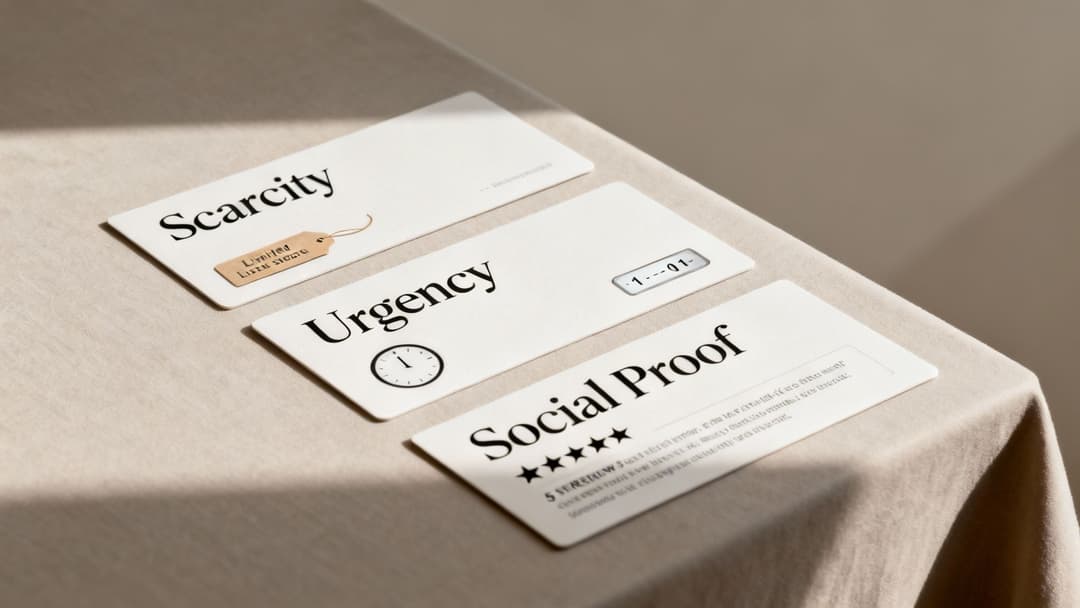
Ever scroll through your feed and find an ad that just stops you in your tracks? One that you can't seem to ignore? That’s not an accident. It’s psychology. The best ad copy doesn’t just sell a product; it taps into the deep-seated human emotions and cognitive biases that quietly guide our decisions.
Think of these psychological triggers as mental shortcuts. Our brains rely on them to make choices faster, and when you understand how they work, you can write messages that connect on a much deeper, subconscious level. You’re no longer just talking about features—you’re speaking directly to your audience’s desires and fears, compelling them to act.
Harnessing Scarcity and Urgency
Scarcity and urgency are two of the heavy hitters in any copywriter’s playbook. Why? Because they both trigger our Fear of Missing Out (FOMO), a primal instinct that pushes us to act now instead of putting it off. Scarcity signals a limited supply, while urgency points to a limited time.
For instance, a skincare brand could use scarcity with an Instagram ad headline like, "Only 50 of our Vitamin C Serums left at this price." Suddenly, that serum feels more valuable and exclusive simply because it’s running out.
An e-commerce store does the same thing with urgency when it flashes a banner reading, "Flash Sale: 50% off ends at midnight." That ticking clock creates pressure, short-circuiting the "I'll think about it" impulse that kills so many sales.
The driving force here is loss aversion. We’re wired to feel the pain of a loss more intensely than the pleasure of an equivalent gain. When you frame an offer as something people might miss out on, you create a powerful incentive to click.
Building Trust with Social Proof
Why do we immediately check the reviews before trying a new restaurant or buying a gadget online? We're hunting for social proof. This is the simple idea that if a lot of other people are doing something, it must be the right thing to do. It’s a shortcut our brain takes: "If it worked for them, it'll probably work for me, too."
Great ad copy uses this principle to build instant trust and show that a product is popular and well-loved. You see it everywhere.
Here’s how it looks in the wild:
- SaaS Companies: "Trusted by over 100,000+ businesses worldwide."
- E-commerce Brands: "Join 50,000 happy customers who gave us a 5-star rating."
- Local Services: Featuring a direct quote from a real customer, complete with their name and photo.
This isn't just bragging; it's a strategic move to lower the perceived risk for a new customer. You’re letting a crowd of happy buyers do the selling for you.
Tapping Into Authority and Reciprocity
Authority is another powerful psychological lever. From a young age, we're taught to trust experts and authority figures. When your ad copy borrows credibility from a respected source, that trust transfers to your brand.
This might be an ad for a new financial app that mentions it was "Featured in Forbes." Or a fitness program highlighting that its routines were "Designed by Olympic trainers." That seal of approval makes the offer feel safer and more legitimate.
Then there’s reciprocity—the social rule that if someone gives you something, you feel an unspoken need to give something back. In marketing, this usually means providing value upfront, for free.
You've definitely seen this in action:
- Offering a free e-book when someone signs up for a newsletter.
- Providing a free template or checklist that solves a small, nagging problem.
- Hosting a free webinar that teaches a valuable new skill.
By giving first, you build goodwill and make your audience far more receptive when you eventually ask for the sale. It’s a powerful way to build a foundation of trust. To see how these principles all work together, check out our deep dive into the psychology of advertising.
Proven Frameworks For High-Converting Ads
We’ve all been there—staring at a blank page, the cursor blinking mockingly. You know your audience inside and out, you’ve got the psychological triggers down, but turning those insights into words that sell feels impossible. This is where most marketers get stuck. The solution? Stop trying to reinvent the wheel with every ad.
Copywriting frameworks are your blueprints for persuasion. They give you a proven, repeatable structure that guides a customer from initial curiosity all the way to a confident click. Think of them as battle-tested formulas that take the guesswork out of writing good ad copy that actually performs.
AIDA: The Classic Path to Conversion
One of the oldest and most trusted frameworks in the book is AIDA: Attention, Interest, Desire, and Action. It maps out a clean, four-step journey for your customer, much like a skilled salesperson guiding a prospect through a natural conversation.
First, you grab their Attention with a scroll-stopping headline or visual. Then, you hook their Interest by zeroing in on a compelling problem or benefit. From there, you build Desire by painting a picture of what their life looks like with your solution in it. Finally, you drive Action with a crystal-clear call-to-action (CTA).
Let’s see how this plays out for a project management software on Meta:
- Attention (Headline): Stop Juggling Tasks. Start Dominating Your Day.
- Interest (Body Copy): Tired of endless spreadsheets and missed deadlines? Our intuitive platform brings all your projects, tasks, and team communication into one place. See everything at a glance.
- Desire (Body Copy): Imagine finishing projects 25% faster and leaving work on time, every time. That’s the reality for teams who switch to our system.
- Action (CTA): Start Your Free Trial
This structure just works. It follows a logical decision-making path, which makes it a reliable go-to for almost any campaign.
PAS: For Problem-Focused Audiences
The Problem, Agitate, Solution (PAS) framework is wickedly effective because it dives straight into a customer's biggest pain points. It’s a simple three-step knockout punch designed to make the reader feel completely understood before you even whisper the name of your product. This is your weapon of choice for audiences who know they have a problem and are desperate for a fix.
First, you state the Problem in a way that makes them nod their head. Then, you Agitate it—pour a little salt on the wound by digging into the frustration, cost, or sheer inconvenience it causes. Only then do you swoop in and present your product as the clear Solution.
By validating the customer's struggle first, you build instant rapport. When you introduce your solution, it doesn't feel like a sales pitch; it feels like a rescue.
Here’s a PAS example for a DTC meal kit service on Meta:
- Problem (Headline): Another Night of "What's For Dinner?"
- Agitate (Body Copy): You spend hours scrolling for recipes, fight the crowds at the grocery store, and still end up ordering takeout. Healthy eating feels impossible when you’re this busy.
- Solution (Body Copy): Get delicious, chef-designed meals delivered to your door. Everything you need is pre-portioned, so you can cook a healthy dinner in under 20 minutes.
- Action (CTA): Get 50% Off Your First Box
The PAS framework is a conversion powerhouse because it taps into the most fundamental driver of any purchase: the desire for pain relief.
BAB: The Transformation Framework
The Before, After, Bridge (BAB) framework is all about selling one thing: a transformation. You paint two vivid, contrasting pictures for your audience—the frustrating "Before" state they're currently stuck in, and the ideal "After" state they dream of. Your product, of course, is the "Bridge" that gets them there.
This approach is incredibly emotional and visual. It helps the customer mentally step into their desired future, making your offer feel less like a product and more like a destination. The structure is simple, but it’s a masterclass in inspiring action.
Let's look at how BAB could work for a personal finance app:
- Before: Right now, you're stressed about money. You have no idea where it all goes, and saving feels impossible.
- After: Imagine feeling in complete control of your finances. You know exactly where every dollar is, you’re hitting your savings goals effortlessly, and you finally feel financially secure.
- Bridge: Our app is the bridge to get you there. It automatically tracks your spending, finds savings opportunities, and gives you a simple plan to build wealth.
- Action (CTA): Download for Free
By framing your offer as the key to a better life, BAB turns a simple product into an aspirational goal, making it a cornerstone for writing genuinely good ad copy.
Adapting Your Copy for Meta Ads
Writing copy for a landing page is one game. Writing for the chaos of a social media feed? That’s a completely different sport.
On platforms like Meta (think Facebook and Instagram), your ad isn’t just up against other brands. It’s fighting for eyeballs against your cousin's wedding photos, your friend's vacation reel, and that viral cat video everyone is sharing. This is a blink-and-you'll-miss-it environment, and your copy has maybe three seconds to make an impact.
Your goal isn't just to be seen; it's to stop the scroll. Your words need to be a speed bump in an otherwise frictionless stream of content. What works here is direct, punchy, and built for the way people actually use these apps.
Crafting a Scroll-Stopping Headline
Your headline is your first, and often only, shot. It needs to be sharp, benefit-driven, and designed to grab a user who is mindlessly thumbing through their feed. A vague or overly clever headline is just digital noise.
Think of it as the opening scene of a movie trailer—it has to spark immediate curiosity. One of the most data-backed ways to pull this off is by using numbers. Did you know headlines that pack a numerical punch can boost your ad clicks by a staggering 36%? This isn't just a guess; one study analyzing over a million ad variations found that headlines with numbers consistently outperformed those without. Find out more about the impact of numbers in copywriting from this research.
A headline like "Get Fit Faster" is fine. But "Get Fit in Just 20 Minutes a Day"? That’s specific, tangible, and a whole lot more compelling.
Tailoring Copy for Different Placements
Not all Meta placements are created equal. How someone engages with a Feed ad is worlds apart from how they view an Instagram Story. Your copy has to reflect that.
Feed Ads (Facebook & Instagram): You have a little more breathing room here. The primary text can be longer, letting you weave a narrative using frameworks like AIDA or PAS. The trick is to hook them with the very first line, since it’s often all they’ll see before having to tap "See More."
Stories & Reels Ads: These are fast, full-screen, and often watched with the sound off. Copy here must be short, sweet, and baked right into the visual. Think punchy text overlays that get the main point across in a handful of words. Anything resembling a paragraph will be completely ignored.
A rookie mistake is to copy-paste the same text across all placements. Great ad copy is contextual. The compelling story you wrote for the Feed will feel clumsy and out of place in a 15-second Story. Always customize.
Writing Body Copy That Builds Intrigue
Once the headline has done its job, the body copy needs to deliver on the promise. For Feed ads, that first line is everything. It has to flow seamlessly from the headline and give the reader a powerful reason to stick around.
Lead with your most important benefit. Don't bury the good stuff under paragraphs of fluff.
Let's look at an example for a SaaS product:
- Weak Opening: Our company is excited to announce the launch of our new, innovative software solution designed to help teams collaborate more effectively.
- Strong Opening: Stop wasting hours in meetings. Our new tool cuts project update meetings by 50% so your team can focus on what matters.
The second one is direct, hits a major pain point, and uses a hard number to quantify the value. It creates instant curiosity and makes you wonder how they do it. For more ideas, you can check out a ton of high-performing advertising copy examples to see these principles in action.
Creating a Clear and Urgent CTA
Finally, every great ad needs a powerful call-to-action (CTA). On Meta, your CTA should feel like a natural, low-effort next step. It also needs a touch of urgency.
Ditch the generic "Click Here." Get specific and connect the action directly to the benefit.
- Instead of "Learn More": Try "Get Your Free Marketing Plan"
- Instead of "Sign Up": Try "Start Your Free 14-Day Trial"
- Instead of "Buy Now": Try "Get 50% Off Your First Order"
These CTAs tell the user exactly what they're getting when they click. This reduces hesitation and makes the decision to act feel like an obvious win.
How To Measure Ad Copy Performance
Even the most creative, psychologically-driven ad copy is just a well-written opinion until data proves it works. To consistently write good ad copy, you have to stop thinking like an artist and start thinking like a scientist. It’s about moving beyond vanity metrics like likes and shares and zeroing in on the numbers that actually move the needle for your business.
Opinions are fleeting, but data is definitive. The only real way to know if your copy is hitting the mark is to measure its performance against cold, hard business goals. This data-driven approach turns copywriting from a guessing game into a predictable system, empowering you to make confident decisions based on what your audience actually responds to, not what you think they will.
Defining Your Key Metrics
Before you can improve anything, you need to know what you’re tracking. Different campaigns have different goals, which means you’ll be watching different metrics. A brand awareness campaign has entirely different success signals than a lead generation or e-commerce campaign.
For most performance-focused advertisers, it boils down to three critical metrics:
- Return on Ad Spend (ROAS): This is the king of e-commerce metrics. It tells you exactly how much revenue you’re generating for every single dollar you spend on ads. A high ROAS means your copy isn't just getting clicks—it's driving profitable sales. Simple as that.
- Cost Per Lead (CPL): If you're in the business of generating leads (think B2B SaaS, local services, or high-ticket sales), CPL is your north star. It measures how much it costs to acquire one new lead, giving you a clear picture of how efficiently your copy is attracting qualified prospects.
- Cost Per Acquisition (CPA): This metric takes it a step further and measures your total cost to acquire one new customer. It’s a crucial indicator of profitability and lets you know if your ad copy is successfully converting prospects into paying customers at a sustainable cost.
Getting a handle on these is the first step. For a deeper dive into the numbers that matter, check out our guide on how to measure ad effectiveness.
To help you choose the right metrics for your goals, here’s a quick-reference table that breaks down what to track and why.
Key Metrics for Ad Copy Evaluation
| Metric | What It Measures | When to Use It |
|---|---|---|
| ROAS | Revenue generated per dollar spent on ads. | E-commerce & direct sales campaigns where the primary goal is immediate revenue. |
| CPL | The cost to generate a single new lead. | Lead generation campaigns for B2B, service businesses, or long sales cycles. |
| CPA | The total cost to acquire a new paying customer. | Any campaign focused on customer acquisition; it's the ultimate profitability metric. |
| CTR | The percentage of people who click your ad after seeing it. | Top-of-funnel campaigns to gauge initial interest and creative appeal. |
| CVR | The percentage of clicks that result in a desired action (e.g., sale, signup). | Bottom-of-funnel campaigns to measure how persuasive your landing page and copy are. |
Tracking the right metrics transforms your ad copy from a creative exercise into a predictable growth engine.
Building a Reliable Testing Process
Once you know what to measure, you need a reliable system for gathering clean data. The gold standard here is A/B testing, also known as split testing. The core principle is simple but completely non-negotiable: test only one variable at a time.
If you change the headline, the body copy, and the CTA all at once, you’ll have no clue which element was responsible for the lift (or dip) in performance. Was it the slick new headline or the urgent CTA that boosted conversions? You'll never know for sure.
By isolating a single variable—like pitting two different headlines against each other while keeping everything else identical—you can attribute any performance difference directly to that one change. This methodical approach is the only way to build a true understanding of what actually resonates with your audience.
Start by testing the big, impactful elements first. Don't waste time A/B testing the color of a button if you haven't even found a winning message yet.
Here’s a practical testing hierarchy to get you started:
- Test Different Angles: First, pit a benefit-driven angle against a pain-point-driven one.
- Test Headlines: Once you have a winning angle, test 2-3 different headlines that communicate it.
- Test Body Copy: With a winning headline locked in, try different lengths or tones for the body text.
- Test CTAs: Finally, optimize your call-to-action to see if a different phrase can squeeze out more clicks.
This structured process removes emotion and bias from your decision-making. You're no longer guessing what works; you're letting your audience tell you directly through their actions. This is how you systematically build and scale good ad copy that drives real, measurable growth.
Using AI To Scale Your Winning Ad Copy
Finding a winning ad feels amazing. Your ROAS is climbing, CPL is dropping, and you’ve finally cracked the code. But then a new challenge pops up: how do you scale that success without spending all day manually creating and testing dozens of tiny variations?
This is where manual A/B testing hits a wall.
Trying to scale with traditional testing methods is like building a skyscraper one brick at a time—it’s slow, tedious, and you’re bound to make mistakes. You might test a few headlines or CTAs, but you can never hit the volume needed to truly optimize your performance across every audience and creative combo. This manual grind throttles your potential and leaves money on the table.
This workflow shows the old-school cycle of creating and measuring ad copy, a process that AI can now automate and seriously speed up.
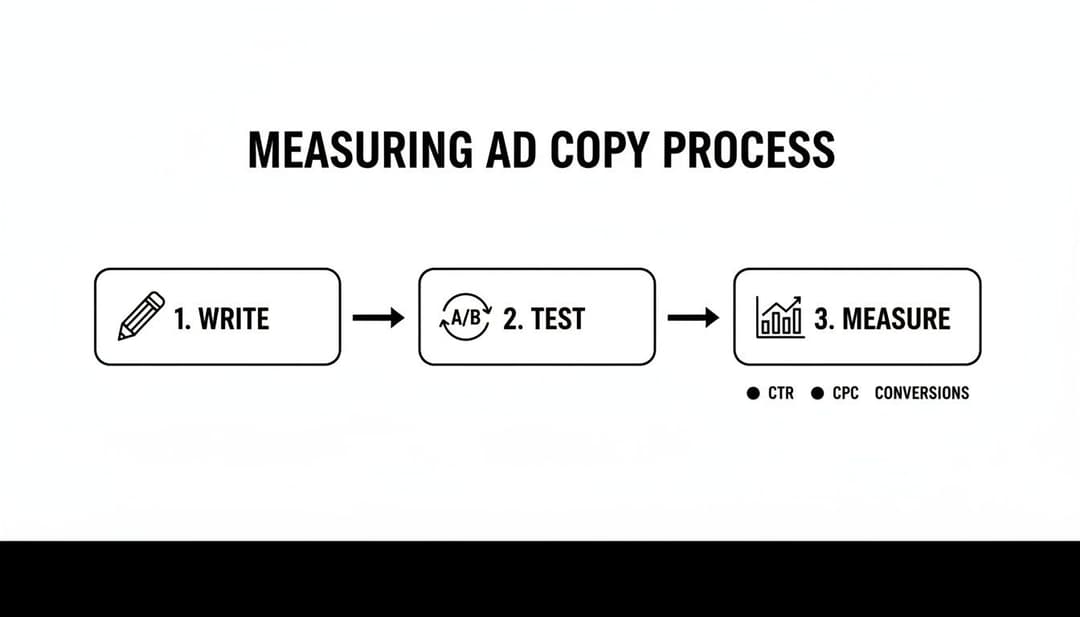
As you can see, writing, testing, and measuring are separate, time-sucking steps. Smart automation can merge them into one seamless, rapid-fire workflow.
From Manual Effort To Intelligent Automation
This is where AI becomes your new best friend. Imagine taking your best-performing ad framework and instantly generating hundreds of unique variations. Each one can be tweaked with different hooks, body copy, and creative assets, all ready to test against specific audiences. This isn’t some far-off fantasy; it's exactly what platforms like AdStellar are built for.
AI completely changes your workflow, replacing hours of boring tasks with smart automation. Instead of being a copy-and-paste machine, you get to be the strategist. You feed the AI your winning concepts and let it handle the high-volume grunt work, freeing you up to focus on the big picture: finding that next breakthrough message.
The real magic of AI in advertising isn't just writing faster; it's about learning faster. AI can analyze performance data in real time, pinpointing which combinations of copy, creative, and audience are actually making you money.
This process allows for much bigger and better campaigns. For more on using artificial intelligence to create content that really performs, you can learn how to AI generate social media posts that drive traffic.
How AdStellar Automates Winning Campaigns
Platforms like AdStellar take this a step further by creating a closed-loop system for optimization. The AI doesn’t just spit out ads; it actively manages them based on live performance data.
Here’s a look at how it works:
- Bulk Generation: You give it a winning ad framework, and the AI generates hundreds of variations in minutes.
- Automated Launch: All variations are pushed live to Meta with a single click, each targeting different audience segments.
- Real-Time Analysis: The AI constantly watches key metrics like ROAS and CPA.
- Intelligent Budget Shifting: As soon as winners emerge, the system automatically shifts the budget to the top-performing ads and cuts the losers.
This intelligent automation makes sure your ad spend is always working as hard as it can. It pulls human bias and hesitation out of the decision-making process, letting you scale winning good ad copy faster than ever. To see more on this approach, check out our complete guide on using AI for Facebook Ads.
Frequently Asked Questions About Good Ad Copy
As you start writing more ad copy, some common questions always seem to pop up. Let's run through a few of them. Getting these fundamentals right will give you a ton of confidence as you start applying everything you've learned.
How Long Should My Ad Copy Be?
Honestly, there's no magic word count. On a fast-scrolling platform like Meta, shorter, punchier copy is often king. You have a split second to grab someone's attention in their feed, and sometimes a killer headline with one great sentence is all it takes to earn the click.
But that's not a universal rule. For more complex or expensive products—things people really need to think about—longer copy can work wonders. You have more space to build trust and make your case. The only way to know for sure is to test different lengths relentlessly. Your audience's behavior is the only data that matters, so let them tell you what works.
The right length is whatever it takes to be clear, empathetic, and persuasive without wasting a single word. If a sentence doesn't serve one of those three purposes, cut it.
What Is the Biggest Mistake to Avoid?
This one is easy, because it’s the most common trap people fall into: focusing on features instead of benefits. Nobody really cares that your software has "AI-driven analytics." What they care about is that it will "save them 10 hours of work every week."
See the difference? Always translate what your product is into what it does for the customer. Features are about you; benefits are about them. Great ad copy is always, always about them.
How Often Should I Test New Ad Copy?
The short answer? Always be testing. Your best-performing ad today won't be your best-performing ad forever. Audiences get tired of seeing the same thing, a phenomenon known as ad fatigue, and performance will inevitably drop off. Consistent testing is your only defense.
A good way to start is with big, conceptual tests. Pit one framework against another, like PAS versus AIDA. Once you see a clear winner emerge, you can start testing the smaller details—tweaking headlines, trying out different calls-to-action, or even swapping out a single powerful word.
Ready to stop the guesswork and start scaling your winning ads? With AdStellar AI, you can generate hundreds of high-performing ad variations, automate testing, and let AI shift your budget to the winners in real time. Launch, test, and scale your Meta ads 10x faster.