Let's be honest—if you're a marketer, you're all too familiar with the grind. The constant battle against creative burnout, the headache of setting up complex campaigns, and the sheer guesswork involved in trying to scale what works. An AI-powered marketing platform isn't just another tool; it’s a fundamental shift in how we work, acting like a fully automated assembly line for your ad campaigns. It swaps out the slow, manual slog for speed and data-backed precision.
The New Edge in Digital Marketing

Think about it like this: trying to build a fleet of cars by hand, one part at a time. It’s painstakingly slow, draining, and you're bound to get inconsistencies. Now, imagine a modern factory floor where intelligent robots handle the repetitive work with flawless accuracy. That’s exactly the kind of leap an AI-powered marketing platform brings to the world of advertising.
This guide is built for the performance marketers, DTC brands, and growth agencies on the front lines—the ones who need to move faster and make smarter calls every single day. We'll unpack how these platforms are completely changing workflows, pulling teams away from mind-numbing manual tasks and into a much more strategic, AI-assisted future.
From Manual Labor to Intelligent Automation
The real problem these platforms are designed to fix is operational friction. We’ve all been there, spending way too much of our day on low-impact tasks: endlessly duplicating ad sets, swapping out images and headlines by hand, and getting lost in spreadsheets just to figure out which creative combo is actually working.
An AI-powered marketing platform cuts through that noise. It lets you:
- Generate hundreds of ad variations in minutes, mixing and matching creatives, copy, and audiences automatically.
- Launch high-volume tests across different channels with a single click, saving you hours of tedious setup.
- Analyze performance data on the fly, instantly spotting winning patterns without you having to pull a single report.
This isn’t just about getting time back in your day. It’s about freeing up brainpower. When you’re not buried in the mechanics of campaign setup, your team can finally focus on what really moves the needle: creative strategy, deep audience insights, and scaling the wins. To see how this plays out in practice, check out our guide on how to use AI to elevate your advertising strategies.
A Market Experiencing Explosive Growth
The shift to these platforms isn't just a trend; it's a tidal wave. The global AI in marketing market hit $20.44 billion in 2024 and is on track to reach nearly $27 billion by the end of 2025.
Looking ahead, industry forecasts are even more dramatic, predicting the market will quadruple to $82.23 billion by 2030. That’s a staggering 302% increase from 2024, signaling that AI platforms are becoming non-negotiable for any serious marketing team. You can find more details on the rapid growth of AI in marketing in this report.
This growth points to a simple truth: teams stuck in manual mode are going to be left behind. The rest of this guide is designed to make sure you're on the right side of that shift, ready to compete and win.
What an AI Powered Marketing Platform Actually Does

It’s easy to get lost in the buzz around artificial intelligence. But let’s get real—what does an AI powered marketing platform actually do for a busy performance marketer on a Tuesday afternoon? Simply put, it automates the most grueling, time-sucking parts of your job so you can finally focus on strategy.
Think of it less as a replacement for you and more like a team of tireless digital assistants. These platforms are built around a few core functions that completely change how you build, test, and grow your campaigns. Let's look at the four key areas where these tools turn abstract AI concepts into concrete results.
Creative Automation at Scale
Imagine you're a chef trying to invent a new signature dish. Instead of chopping every single vegetable and mixing every sauce by hand, you have a crew of helpers instantly preparing every possible ingredient combination. Your job shifts from manual labor to tasting, refining, and perfecting the final plate. That's exactly what creative automation does for your ads.
An AI powered marketing platform takes your raw assets—images, videos, headlines, and copy—and instantly assembles them into hundreds or even thousands of unique ad variations. A process that would take your team days to do manually gets done in minutes. This frees you up to test a massive volume of creative angles without getting bogged down in operations.
Intelligent Audience Generation
Good AI doesn’t just stop at mixing and matching creatives; it also brings a whole new level of smarts to building audiences. Instead of just guessing or relying on broad targeting categories, the AI digs through your historical data to find hidden pockets of high-performing users you might have missed entirely.
It’s like having a sonar system for your customer base. You might only see what’s on the surface, but the AI pings the depths of your ad account data to map out untapped clusters of potential buyers. It spots patterns in demographics, interests, and behaviors tied to conversions, then automatically suggests new audiences based on what it finds.
Key Insight: The real magic happens when an AI platform connects creative performance to audience behavior. It doesn't just tell you which ad worked; it shows you which ad worked for which specific group, giving you a clear roadmap to scale your winners.
The financial impact here is undeniable. More than half of all corporate AI budgets are now aimed at sales and marketing automation, which shows just how much value businesses are getting from automating personalization and campaign workflows. For marketers, this means using an AI powered marketing platform is no longer just a nice-to-have—it’s essential for getting the best performance.
Auto-Learning for Performance Optimization
Once your campaigns are live, the AI’s work is just getting started. This is where auto-learning kicks in. The platform constantly watches your performance data in real time, figuring out which combinations of creatives, audiences, and messages are hitting your goals, whether that’s ROAS, CPA, or CPL.
It’s like having an analyst glued to your campaigns 24/7. When the AI spots a high-performing ad, it can automatically shift more budget toward it. At the same time, it can pause or pull spend from underperforming ads, stopping budget waste before it happens. This turns campaign management from a reactive chore into a proactive, self-improving system.
Performance Ranking and Insights
Finally, any good AI powered marketing platform cuts through the noise to give you clear, actionable insights. Instead of dumping a spreadsheet of raw data on your desk, it boils everything down into a simple, ranked list. You can instantly see your top-performing:
- Creatives: Which images or videos are bringing in the highest return?
- Audiences: Which customer groups are responding best to your ads?
- Messaging: What headlines and copy are actually driving clicks and sales?
This kind of clarity is a game-changer. It takes the guesswork and arguments out of your strategy meetings. The data gives you a straight answer to "what's working," so your team can make faster, more confident decisions about where to put your energy and budget. To get a better handle on what to look for, you can explore the top features of AI ad platforms in more detail.
Real-World Use Cases for Performance Marketers
All the theory in the world doesn’t mean much until you see how an AI powered marketing platform actually holds up in the wild. It’s time to move past the concepts and look at how real marketing teams are using these tools to completely change their day-to-day and crush their goals.
These stories come straight from the trenches. They show what happens when you swap manual grunt work for smart automation. We’ll follow an agency media buyer, a direct-to-consumer (DTC) brand, and a B2B SaaS marketer to see how they turned this tech into real, measurable wins.
The Agency Media Buyer Who Multiplied Capacity
You know the typical agency grind. A single media buyer is drowning in client work, spending hours meticulously setting up campaigns, duplicating ad sets, and wrestling with tracking parameters. Just getting one big campaign out the door for a single client can eat up a whole day, making it impossible for the agency to grow.
Now, imagine that same media buyer with an AI-powered marketing platform. Instead of building everything by hand, they upload their creative assets and define their audience strategy just once. The platform takes it from there, generating hundreds of ad variations on its own.
The Result: That media buyer is now launching campaigns for five clients in the same amount of time it used to take for one. This isn't just a small tweak to their workflow; it's a 5x increase in team capacity without adding headcount. The agency can take on more clients with the same team, directly boosting profits and letting its experts focus on high-level strategy instead of repetitive busywork.
The DTC Brand That Found a Winner in 48 Hours
For a DTC e-commerce brand dropping a new product, those first few days are everything. The real challenge is finding the perfect creative angle that clicks with your audience on crowded platforms like Meta before you burn through your entire ad budget. The old way? Guess a few concepts and pray one of them sticks.
One DTC brand recently took a totally different route using an AI powered marketing platform. They uploaded a dozen images, five video clips, ten headlines, and five calls to action for their new product. In minutes, the platform spun up over 100 unique creative variations and launched a massive test campaign.
- Automated Testing: The AI system spread the budget across all the variations to get initial performance data, fast.
- Rapid Learning: Within just 48 hours, the platform’s auto-learning model pinpointed the top-performing mix of image, headline, and copy based on click-throughs and add-to-cart actions.
- Informed Scaling: The team immediately shut off the losers and pushed their entire budget to the statistically proven winner. They were maximizing their ad spend from day one. If you want to see how this works on specific platforms, you can learn more about using AI to improve Facebook ad campaigns.
This kind of rapid testing—finding a winning creative in two days—is simply out of reach with manual methods. It’s a perfect example of how AI shrinks timelines and takes the guesswork out of creative optimization.
The B2B SaaS Marketer Who Slashed Lead Costs
In the world of B2B SaaS, cost per lead (CPL) is king. Marketers are constantly trying to find fresh, high-quality audiences without sending their acquisition costs through the roof. The usual process involves building a few lookalike audiences, testing them one by one, and slowly making changes over weeks.
One B2B marketer flipped this process on its head with an AI platform. After connecting their ad account, they let the AI dig into their historical conversion data. The platform’s audience generation tool found hidden patterns among their best leads and recommended a dozen new audience segments built from a mix of interests, behaviors, and lookalike models.
Instead of testing these one at a time, the marketer launched a campaign targeting all of them at once with their top creatives. The AI managed the budget in real-time, automatically shifting spend to the audiences that were bringing in leads at the lowest cost. The result was a 30% reduction in their average CPL in less than a month—a huge win that went straight to the company's bottom line.
How to Integrate an AI Platform into Your Workflow
Bringing an AI-powered marketing platform into your team is more than just adding another tool to your tech stack. Think of it as a fundamental upgrade to your entire operation—a shift from getting bogged down in manual tasks to steering the ship with high-level strategy. The real goal here is to let the AI handle the repetitive, time-draining work so you can focus on the big-picture thinking that actually drives growth.
This guide will walk you through, step-by-step, how to get an AI platform up and running. We'll cover everything from securely connecting your accounts to launching your first massive test campaign and, most importantly, making sense of the results.
Phase 1: Set Up and Connect Your Accounts
First things first, you need to get your ad accounts hooked up to the platform. Any trustworthy AI platform will use official, secure APIs and protocols like OAuth to connect with your ad managers, like the one from Meta. This isn’t just a technical detail; it's a critical security feature.
Why this matters: Using official APIs means the platform never sees or stores your actual password. You’re simply granting it specific permissions to manage campaigns for you, and you can pull that access at any time. This keeps your account data safe and ensures you stay compliant with the ad network’s policies.
Once you’re connected, the AI gets to work. It starts by pulling in your historical performance data. This is the fuel for its learning models, giving it the context it needs to understand what has worked for your brand in the past—which creatives, audiences, and messages got you the best results.
Phase 2: Define Your Goals and Launch a Test
With your accounts linked and the AI learning from your history, it's time to tell it what you want to achieve. A good AI-powered marketing platform won't just ask you to start a campaign; it will make you define what success actually looks like for your business.
Are you trying to achieve:
- Lower Cost Per Acquisition (CPA)? The AI will hunt for the ad combinations that generate conversions most efficiently.
- Higher Return On Ad Spend (ROAS)? The system will focus on the ads that bring in the most revenue for every dollar you spend.
- Increased Lead Volume? The AI will optimize for generating the maximum number of qualified leads.
After you’ve set your primary goal, you’re ready for the fun part: launching your first high-volume test. This is where you really see the automation kick in. You’ll upload your creative assets—all your images, videos, headlines, and ad copy—and the AI will automatically generate hundreds, or even thousands, of unique ad variations. You can then push this massive test live with a single click, a process that would have taken a human marketer days to do manually.
The flowchart below breaks down how different types of businesses can get immediate wins from this kind of streamlined, AI-driven process.
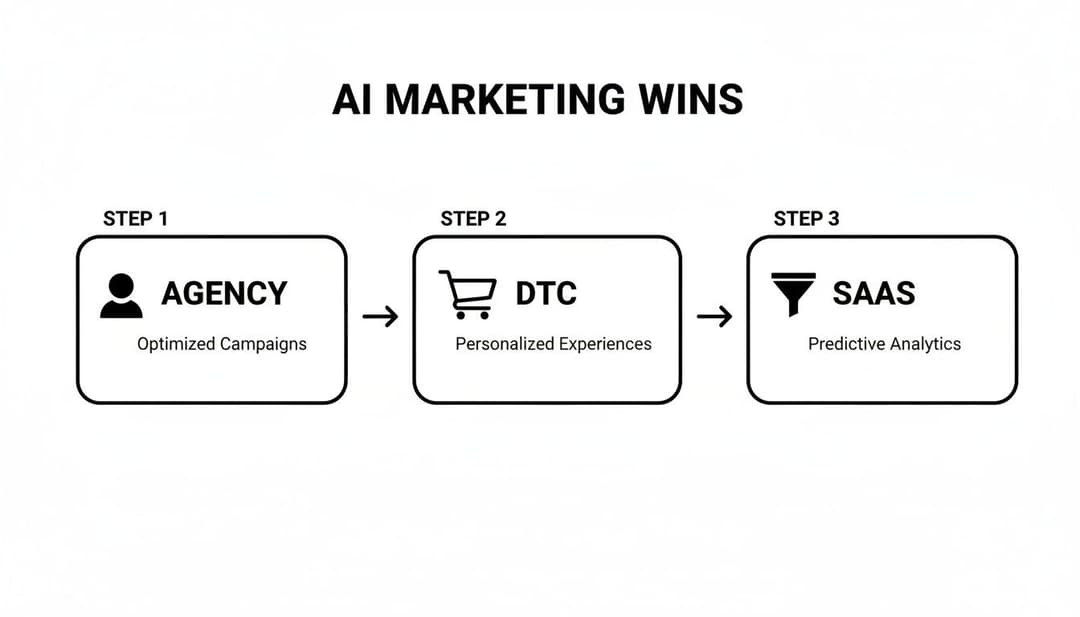
As you can see, the AI adapts to different business needs, whether it's an agency optimizing client campaigns, a DTC brand personalizing customer experiences, or a SaaS company fine-tuning its user acquisition funnel.
Phase 3: Monitor Insights and Automate Scaling
Once your test campaign is live, the platform's auto-learning engine takes the wheel. The AI is constantly watching your campaign's real-time performance, figuring out which ad combinations are crushing your goals and which are falling flat. Instead of you having to dig through endless reports, the platform brings these winning patterns right to you in a simple, easy-to-read dashboard.
You’ll get a clear, ranked list of your top-performing creatives, audiences, and ad copy. This data-driven feedback is where the real strategic value pops. You can quickly see what’s working and, just as importantly, start to understand why certain ads are resonating with your audience.
The final piece of the puzzle is turning on the automation to scale your winners. A sophisticated AI-powered marketing platform like AdStellar lets you create rules that automatically move your budget toward the best-performing ads. This means your ad spend is always being put to work where it can deliver the best results, maximizing your ROI without you having to make constant manual tweaks.
It all comes down to a simple principle: automate the 80% of manual work that drains your team's time, so you can pour your energy into the 20% of strategic thinking that truly moves the needle.
How to Choose the Right AI Marketing Platform
Picking an AI-powered marketing platform feels a lot like hiring a key new team member. You’re not just buying another piece of software; you're fundamentally changing how your team operates. The right choice can unlock incredible speed and performance, but the wrong one can lead to months of frustration and wasted budget.
With every company shouting about "AI," it's easy to get lost in the noise. To find a platform that actually delivers, you need to cut through the marketing fluff and run a disciplined evaluation. It’s the only way to find a tool built for teams that live and die by their performance metrics.
H3: Dig Into Core Functionality and Specialization
Before you even book a demo, your first filter should be specialization. Many tools claim to do it all, but a platform designed for email marketing will never have the deep, granular controls a performance marketer needs to scale campaigns on a channel like Meta Ads.
You need a precision instrument, not a Swiss Army knife. Ask these direct questions right away:
- Is this tool actually built for performance marketing? The features should be all about ROAS, CPA, and creative testing, not just general workflow automation.
- How deep do the channel integrations go? It needs a secure, official API connection that can manage complex campaign structures, not just a surface-level creator.
- Can it handle creative testing at a high volume? For a top-tier AI-powered marketing platform, the ability to generate and test hundreds or thousands of ad variations isn't a bonus feature—it's the main event.
If a platform doesn't have clear, confident answers to these questions, it’s not built for you.
Key Takeaway: A general-purpose AI tool is like a multi-tool—it can do a lot of things okay, but it's no substitute for a specialized instrument. Performance marketing demands a precision tool built specifically for the job.
H3: Prioritize Usability and Team Adoption
Even the most powerful platform is worthless if your team finds it clunky or confusing. The user interface has to be intuitive and designed for the way marketers think, not how data scientists build models. Pay close attention during demos.
How many clicks does it take to do something basic? Can you build a new campaign, upload creatives, and pull performance insights without needing a four-hour tutorial? A smooth user experience is what separates a tool that gets used from one that just gathers dust. That’s how you get a fast return on your investment.
Also, don't overlook customer support and training. A true partner provides solid onboarding and ongoing help to make sure you're squeezing every last drop of value from their system. For a deeper look at how various options compare, you can review our guide on the best AI ad platforms to see how different tools stack up.
Choosing the right platform is crucial, and having a clear set of evaluation criteria is the best way to make a confident decision. We've put together a checklist to help you compare your options and focus on the features that truly matter for performance-driven teams.
AI Marketing Platform Evaluation Checklist
| Feature/Criteria | What to Look For | Why It Matters for Performance Teams |
|---|---|---|
| Channel Specialization | Deep, native API integrations with key ad networks (e.g., Meta, Google, TikTok). | Ensures access to all campaign controls and accurate data, avoiding limitations of generic connectors. |
| Creative Automation | Ability to generate hundreds of ad variations from a few core assets and copy lines. | Massively accelerates testing, allowing you to find winning creative combinations faster than any manual process. |
| Audience Generation | AI-driven suggestions for new audience segments based on your first-party and pixel data. | Moves beyond basic lookalikes to uncover untapped high-value audiences you might have missed. |
| Predictive Analytics | Features that forecast creative or audience performance before you spend money. | Helps you allocate budget more intelligently by prioritizing assets with the highest probability of success. |
| Learning Model | A system that learns from your specific account history to improve its recommendations over time. | A generic model is a start, but a personalized one delivers tailored insights that get smarter with every campaign. |
| Usability & UX | An intuitive interface designed for marketers, not engineers. Quick and easy campaign setup. | High adoption is key to ROI. If your team can't use it easily, you won't get the promised benefits. |
| Reporting & Insights | Clear, actionable reports that rank creatives and audiences by performance, not just data dumps. | The goal isn't more data; it's faster decisions. The platform should tell you what's working and why. |
| Support & Onboarding | A dedicated success manager, structured onboarding, and responsive technical support. | An AI platform is a partnership. Strong support ensures you overcome hurdles and maximize the tool's value. |
This checklist isn't exhaustive, but it covers the non-negotiable elements that separate a truly effective AI platform from a simple automation tool. By focusing on these criteria, you can ensure the partner you choose is equipped to handle the unique demands of high-stakes performance advertising.
H3: Assess the AI and Its Learning Model
Finally, you need to look under the hood at the "AI" itself. This is what will ultimately drive your performance gains. You don't need a computer science degree to evaluate it, but you should ask some pointed questions about how it learns.
How does the model actually identify a winning creative? Does it learn from your account’s unique historical data, or is it just applying generic rules?
A powerful platform will be transparent, showing you why it’s recommending a certain creative or audience. It gives you clear, ranked insights that make you smarter. It should feel like a strategic advisor, not a black box you just hope is working. By focusing on these three core pillars—specialization, usability, and the AI model itself—you can make an informed choice that will genuinely accelerate your growth.
How to Measure and Prove Your AI Marketing ROI
So you've found an incredible AI-powered marketing platform, but now comes the tough part: getting budget approval. Just telling your leadership team you're saving time on tasks isn't going to cut it anymore. They want to see cold, hard numbers.
To get buy-in, you need to connect the dots between automation and real business growth. It's about building a business case that transforms your AI tool from a line-item expense into a revenue-generating machine that any stakeholder can get excited about.
Focus on Core Business Metrics
To prove the platform’s financial impact, your reporting needs to speak the language of the C-suite. That means focusing on the metrics that directly reflect the health and growth of the business. Let's shift the conversation to these three key outcomes:
- Lower Cost Per Acquisition (CPA): Show exactly how the AI finds winning ad combinations and audiences to acquire customers more cheaply. You can point to a month-over-month drop in CPA as the platform's auto-learning models intelligently shift spend away from ads that aren't working.
- Higher Return On Ad Spend (ROAS): This is the ultimate proof of value. Track how the platform’s rapid-fire testing and automated budget shifts generate more revenue for every dollar you put in. A rising ROAS is a clear, undeniable signal that the AI is finding and scaling your most profitable campaigns.
- Increased Creative Win Rate: Start quantifying how many of your new creative concepts actually become top performers. A higher win rate proves the AI isn’t just making more ads, it’s helping you make better ads by giving you clear insights into what your audience truly wants.
Building Your Business Case for AI
However, the industry is hitting a measurement wall. While 49% of marketers felt they could prove AI ROI in the past, that number is expected to fall as leadership demands more than just productivity metrics. The good news? Teams that are adapting their measurement are seeing incredible results, with 60% of AI users reporting returns of 2–3× or higher on their investment. You can find more data on this in a recent state of AI marketing report.
Expert Tip: To build an airtight business case, benchmark everything before you flip the switch on the new platform. Get a clear baseline for your current CPA, ROAS, and how long it takes to test new creative. After 30 or 60 days, compare the new AI-driven results to create a powerful "before and after" story of the platform's direct impact.
Ultimately, proving the value of an AI-powered marketing platform comes down to translating its day-to-day operational wins into real financial outcomes. When you focus on metrics like CPA and ROAS, you create a compelling narrative that shows not just efficiency, but a measurable and undeniable return on investment. If you need a refresher on the basics, you might find value in our guide on how to calculate marketing ROI.
Answering the Tough Questions About AI Marketing Platforms
Jumping into any new tech, especially one as powerful as an AI-powered marketing platform, is bound to raise a few eyebrows. It’s smart to be skeptical. Let's tackle the most common questions and concerns we hear from marketers head-on, so you can move forward with clarity and confidence.
Is an AI-Powered Marketing Platform Secure for My Ad Accounts?
This is the big one, and for good reason. The short answer is yes, absolutely. Any reputable platform connects to your ad accounts, like Meta Ads Manager, using official, secure APIs and protocols like OAuth.
What this means in plain English is that the platform never actually sees or stores your password. You're simply granting it specific, controlled permissions to manage campaigns on your behalf. Think of it like giving a valet a key that only starts the car, not one that opens the glove box or trunk. You can also revoke that access at any time, directly from the ad network’s settings.
Always insist on platforms that use these official API integrations. It’s the gold standard for security and ensures you’re fully compliant with network policies, keeping your accounts and data locked down.
Will AI Platforms Replace My Job as a Performance Marketer?
No. The goal isn’t to replace you; it's to supercharge your skills. These platforms are designed to take over the most mind-numbing, repetitive parts of the job—like manually building hundreds of ad variations or getting lost in spreadsheets just to pull performance data.
Think of it as a force multiplier. The AI is your tireless assistant, handling the tedious execution. This frees you up to do the high-value work only a human can do: crafting strategy, guiding creative direction, interpreting nuanced insights, and making the big-money budget decisions.
How Long Does It Take to See Results?
You'll feel some effects immediately. The most obvious "first win" is the dramatic reduction in campaign build time. Going from a creative idea to hundreds of live, structured ad variations in minutes instead of days is a game-changer for operational speed.
As for performance gains, like a better Return on Ad Spend (ROAS) or a lower Cost Per Acquisition (CPA), you'll typically start seeing those move in the right direction within the first few weeks. The AI model gets smarter as it ingests your account’s performance data and starts to spot patterns. The more data it has to learn from, the faster it can deliver those meaningful lifts you're looking for.
Do I Need to Be a Data Scientist to Use These Platforms?
Not even close. The best AI marketing platforms are built by marketers, for marketers. They are designed with intuitive interfaces, clear dashboards for managing creative, and straightforward tools for building audiences and analyzing performance.
Sure, there are complex algorithms humming away in the background, but the experience you see is built for seamless campaign execution. If you can find your way around a tool like Meta Ads Manager, you’ll feel right at home on these platforms.
Ready to stop wasting time on manual ad creation and start focusing on strategy? AdStellar AI is the AI-powered marketing platform that helps you launch, test, and scale Meta campaigns 10x faster. Discover how AdStellar AI can transform your workflow today.