AI-driven marketing insights are the actionable, AI-generated recommendations that tell you exactly what to do to improve your campaigns. It’s all about turning a mountain of data into clear, confident decisions that directly move the needle on your KPIs.
From Data Overload to Decisive Action
Welcome to the new reality of performance marketing. Winning is no longer about who has the most data, but who has the clearest insights. If you're managing campaigns on platforms like Meta Ads, you know the feeling of data overload and decision fatigue all too well. You're swimming in metrics, but are you making the right moves?

This is where AI-driven marketing insights change the game. Think of it like having a dedicated co-pilot working for you 24/7. This AI assistant tirelessly sifts through your campaign data, spotting winning patterns, flagging underperforming assets, and surfacing growth opportunities a human could easily miss in all the noise.
An AI co-pilot doesn't just show you data; it interprets it. It turns chaotic spreadsheets into a prioritized to-do list designed to boost your most important metrics, like Return On Ad Spend (ROAS) and Cost Per Lead (CPL).
The Promise of Clarity and Confidence
The whole point of this guide is to give you a clear roadmap for using AI to find, interpret, and act on insights that actually fuel growth. Instead of guessing which creative is hitting the mark or which audience to scale, you get definitive, data-backed answers.
The industry's rapid adoption tells the story. The marketing automation market was valued at $6.65 billion in 2024 and is projected to skyrocket to $15.58 billion by 2030. With 64% of marketers already using automation and AI, it’s clear these aren't just nice-to-haves; they're essential.
This guide will show you exactly how to:
- Identify Winning Patterns: Pinpoint which ad creatives, copy, and audience segments consistently bring in the best results.
- Optimize Spending: Reallocate your budget with confidence, shifting funds from losing ads to your proven winners.
- Scale with Precision: Understand exactly when and how to scale your campaigns without torching your efficiency.
Introducing AdStellar AI
Throughout this guide, we'll use AdStellar AI as a real-world example of a solution built to deliver this kind of clarity. It’s designed to turn your complex Meta Ads data into a source of confident, growth-focused decisions. By connecting your ad accounts, it surfaces the insights you need to move from analysis paralysis to decisive action.
This is a massive shift from traditional data-driven marketing, where the burden of analysis falls squarely on the marketer's shoulders. With AI, the system does the heavy lifting, freeing you up to focus on strategy and execution. This guide will equip you with the knowledge to make AI your most powerful marketing ally.
Decoding AI-Driven Marketing Insights
To really get what AI can do for your marketing, we need to pull back the curtain on what an AI-driven marketing insight actually is. These aren't just extra numbers on your dashboard. They're clear, direct recommendations that come from the AI spotting patterns you’d never see on your own.
Think of your campaign data like a massive crime scene with thousands of scattered clues. As a human marketer, you can spot the obvious ones—an ad that’s clearly a winner, for example. But an AI is like a master detective, connecting clues that seem totally unrelated: a certain headline, a specific audience, the time of day, and even the colors in your creative, all to solve the case of "what truly works."
This is how you move from just seeing a correlation to understanding causation. It’s the difference between knowing an ad did well and knowing exactly why it did well, giving you a formula you can use again and again.
From Raw Data to Actionable Recommendations
So, how does this detective do its job? The AI digs through multiple layers of data from your ad accounts, piecing together a complete performance picture. It’s not just looking at surface-level metrics; it goes much, much deeper.
The engine driving these insights is built on predictive analytics. In plain English, these models comb through your historical campaign data to predict which combinations of creative, copy, and audience are most likely to crush your goals in the future.
The system crunches several types of data, including:
- Historical Ad Performance: All the clicks, conversions, spend, and engagement data for every ad you've ever launched.
- Conversion and Funnel Data: Who converted, when they did it, and which specific ad variation sealed the deal.
- Creative Assets: The actual images, videos, headlines, and body copy you're using.
- Audience Demographics & Behavior: Details on the age, location, interests, and online habits of your target segments.
By analyzing all of these inputs together, the AI finds hidden connections that are the real drivers of performance. This allows it to generate insights that are far more specific and powerful than anything you could find by hand. For a closer look at how this works, you can learn more about applying AI to your ad campaigns in our detailed guide.
An AI-driven insight is an automated recommendation, derived from performance data, that tells you the specific action to take to improve a key marketing outcome.
For instance, a traditional report might just tell you, "Ad A has a high ROAS." That's data, but it's not an insight. An AI-driven insight, on the other hand, would say something like: "Ad A's ROAS is 35% higher when shown to 'Lookalike Audience X' between 6-9 PM. Recommendation: Increase budget for this combination by 20% to capture more high-value conversions."
The Power of Predictive Analytics
This ability to predict what's coming is what makes these insights so incredibly valuable. AI isn't just looking in the rearview mirror; it's actively anticipating what's going to happen next. It can spot an ad showing the early signs of creative fatigue and tell you to pause it before it burns through more of your budget.
On the flip side, it can identify a brand-new creative that's outperforming everything else with a particular audience and recommend you scale its budget immediately to ride the wave. This is how AI-driven marketing insights turn guesswork into confident, real-time decisions, closing the gap between theory and action for any performance marketer.
An insight is only as good as the action it inspires. When it comes to AI-driven marketing insights, the real magic isn't just knowing what went wrong; it's getting a clear, actionable roadmap on how to fix it and improve the numbers that actually matter. This is where we connect the dots between an AI recommendation and your core Key Performance Indicators (KPIs).
For any performance marketer, the metrics that keep you up at night are usually Return on Ad Spend (ROAS), Cost Per Lead (CPL), and Cost Per Acquisition (CPA). A platform like AdStellar AI doesn’t just show you these numbers on a dashboard. It draws a straight line from a specific insight to its direct financial impact, giving you the data-backed confidence to make your next move.
Let's break down how this actually works for each of those critical metrics.
Improving Your Return On Ad Spend
ROAS is the ultimate bottom line for profitability. When it starts to dip, you know there’s a problem, but finding the source can feel like searching for a needle in a haystack. This is a classic scenario where AI steps in to provide immediate clarity.
Think about the "before" situation: You spot a drop in your overall ROAS. Your first instinct is to start manually digging through every campaign, ad set, and creative, trying to hunt down the offender. It's a painful process of elimination that burns through both your time and your budget.
Now, let's look at the "after" with AI: The platform automatically flags that a specific ad creative has hit audience saturation. While it was a top performer last week, its frequency has shot up, and its click-through rate is now in a nosedive.
AI-Driven Insight: Your best-performing creative from last month has saturated its primary audience, causing a 25% drop in its ROAS over the past seven days.
Actionable Recommendation: Test this winning creative against a new, high-intent lookalike audience to recapture growth and protect your overall ROAS.
This single insight gives you a precise, strategic pivot instead of a wild guess. You’re not just stopping the bleed; you’re unlocking a fresh pocket of performance to get your ROAS climbing again.
Lowering Your Cost Per Lead
For many businesses, the name of the game is generating a steady flow of high-quality leads. Your Cost Per Lead is the scorecard for how efficiently you’re doing that. AI is incredibly good at pinpointing the subtle friction points in your funnel that are quietly driving your CPL up.
Let's say your CPL has been creeping upward, but you aren't sure why. You might start assuming it's a wider market trend or that your offer has gone stale.
An AI analysis, however, might uncover something far more specific. It could identify that one of your headlines, which you thought was a solid performer, is actually falling flat with a key demographic.
- Before AI: You see a rising CPL and assume your audience is just getting more expensive. You might even consider pausing the whole campaign to cut your losses.
- After AI: The system highlights that "Headline A" has a 40% higher CPL among users aged 25-34 compared to "Headline B." It recommends pausing all ads using Headline A for just that specific age group.
This is the kind of surgical AI-driven marketing insight that’s almost impossible to spot on your own. It lets you make smart, targeted optimizations that bring down your CPL without killing the parts of your campaign that are still firing on all cylinders. If you want to dive deeper, you can explore more about the essential performance marketing metrics you should be tracking in our complete guide.
Reducing Your Cost Per Acquisition
Finally, let’s talk about Cost Per Acquisition (CPA)—the total cost to land a new paying customer. This metric is tied directly to your business's health. An AI platform can move beyond surface-level clicks and analyze which ad elements are truly convincing people to buy.
Imagine you've launched a campaign with a few different video ads, all pushing the same product. On the surface, their click-through rates look pretty similar. But the AI digs deeper.
By analyzing actual purchase data, the platform discovers that videos with a user-generated content (UGC) style have a 30% lower CPA than your polished, studio-shot videos. The insight here is powerful: authenticity is driving conversions far more effectively than high production value. This clarity allows you to confidently reallocate your budget to the creative style that delivers actual sales, directly lowering your CPA and boosting profitability.
This table neatly summarizes how these AI-driven insights can be put into practice to directly influence your KPIs.
From AI Insight to KPI Improvement
| AI-Driven Insight | Affected KPI | Actionable Strategy |
|---|---|---|
| Creative Fatigue: A specific ad creative has a high frequency and declining CTR with its current audience. | ROAS | Pause the fatigued ad with the current audience and test it against a new, untapped lookalike audience. |
| Demographic Mismatch: A headline performs poorly with a specific age group, driving up lead costs. | CPL | Exclude the underperforming headline from ad sets targeting the identified age group, reallocating budget to winning copy. |
| Conversion Driver Identified: UGC-style videos convert customers at a lower cost than polished studio videos. | CPA | Shift creative budget towards producing and promoting more authentic, UGC-style video content. |
As you can see, the goal isn't just to get more data. It's to get clear, direct answers that tell you exactly what to do next to make your campaigns more profitable.
How AI Platforms Uncover Actionable Insights
Moving from theory to practice is where you see the real power of AI-driven marketing insights. A smart platform like AdStellar AI doesn’t just show you data; it puts that data to work. It follows a clear workflow built for performance marketers, turning your campaign history into a prioritized list of things you can actually do to get better results.
The process kicks off the second you give the platform secure access to your ad accounts. It immediately starts pulling in your historical campaign data—every click, conversion, creative, and audience segment you’ve ever run. This builds a foundational "brain," giving the AI a baseline understanding of what has historically worked for your brand.
This is a massive departure from the days of dreaded spreadsheet analysis. Instead of wasting hours exporting CSVs and wrestling with pivot tables just to find your best headline, the AI does all the heavy lifting for you. It then serves up its findings in a simple, easy-to-digest format.
The AI Insights Dashboard
This is where the magic really happens. A dedicated AI Insights dashboard, like the one in AdStellar AI, doesn’t just spit out more charts. It visualizes and ranks your campaign elements against a specific goal, whether that’s boosting ROAS or slashing your CPL. It's designed to give you answers, not more data to sift through.
Think of it as a command center that prioritizes recommendations based on their potential impact on your bottom line.
The dashboard instantly flags which creative-and-audience combinations are punching above their weight and which ones are just burning cash. It gives you a clear, data-backed path to optimization.
Instead of some vague report, the platform delivers incredibly specific directives.
AI-Driven Insight: "Headline X drives a 30% lower CPL with Audience Y compared to all other headlines. However, its budget allocation is only 5% of the campaign total."
Actionable Recommendation: Shift budget away from underperforming headlines and increase spend on the Headline X and Audience Y combination to maximize lead generation efficiency.
This kind of granular detail allows you to make confident, surgical tweaks that have a direct, measurable effect on your KPIs. As you explore how different AI platforms work, checking out the leading AI tools for ecommerce can offer a practical look at their different applications.
Creating a Virtuous Cycle of Improvement
These insights don't just sit there; they fuel a powerful feedback loop. You get into a rhythm of testing, learning, and scaling that continuously pushes your campaign performance higher and higher. The recommendations from the AI Insights engine directly inform other features, like automated campaign creation and optimization.
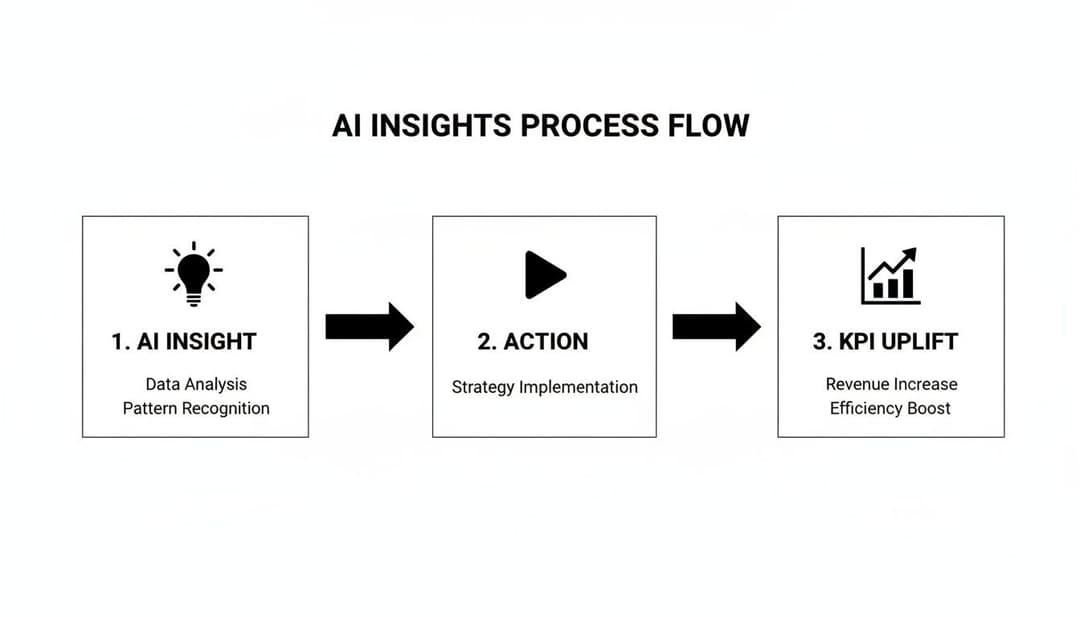
The flow chart below breaks down this simple but powerful cycle, from insight to action to real results.
This visual makes it clear: an AI-driven insight prompts a specific action, which in turn delivers a measurable lift in your key performance indicators.
Here’s how this cycle plays out in the real world:
- Insight Generation: The AI spots a winning combination, like a top-performing video ad paired with a specific lookalike audience.
- Automated Action: With a click, you can use this insight to launch new campaigns, using that proven winner as the foundation for your next round of tests.
- Continuous Learning: As new data from these campaigns pours in, the AI refines its understanding, uncovers fresh patterns, and generates even sharper insights for the next go-around.
This level of automation is a game-changer for speed and efficiency. With AI tools handling the data analysis and campaign adjustments, marketers can get campaigns live up to 75% faster. For growth teams juggling multiple campaigns, that acceleration is huge.
By turning your past results into a predictive engine for future success, AI platforms like AdStellar AI completely change the game. To better understand how to read these results, you can dive into our guide on marketing campaign analytics. This shifts marketing from a reactive, rear-view-mirror activity into a proactive, data-driven growth engine.
Real-World Examples of AI Insights Driving Growth
It’s one thing to talk about AI in theory, but it’s another thing entirely to see it deliver in the real world. After all, results are what really count.
Let’s move past the abstract and look at three stories from the trenches. Each one shows how a business used AI to turn raw data into a clear-cut action plan for growth. They all follow a simple, powerful arc: Problem > AI Insight > Action > Result.
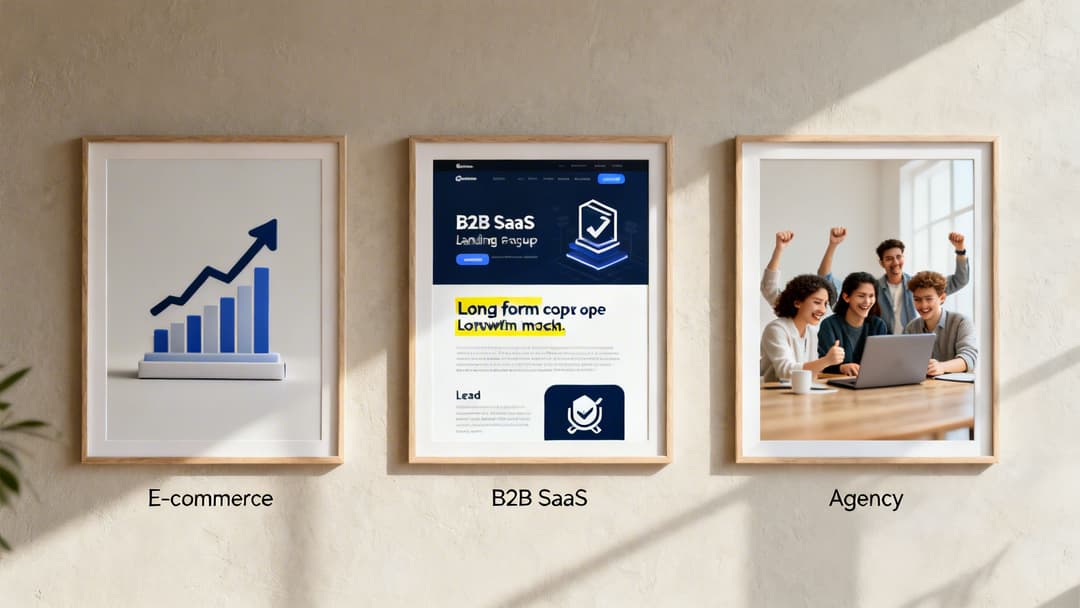
These aren't just stories about massive corporations, either. They show how AI is a game-changer for e-commerce stores, B2B companies, and marketing agencies trying to get an edge.
E-commerce Brand Achieves 50% ROAS Uplift
An online apparel brand found itself in a performance marketer's worst nightmare. Their Return on Ad Spend (ROAS) was in a freefall, and they couldn’t pinpoint why. The video ad that had been their star performer just a month ago was suddenly bleeding money. The team was scrambling, burning through the budget trying to guess their way back to profitability.
The Problem: A once-winning campaign was now a money pit, and the team was stuck playing whack-a-mole with potential fixes.
The AI Insight: Instead of spending days buried in spreadsheets, they connected their ad account to an AI platform. Within hours, they had a clear diagnosis. The AI showed their star video creative was hitting severe ad fatigue with its main audience. But it also uncovered something else: an older static image ad was quietly delivering a fantastic ROAS from a completely different audience segment they'd mostly overlooked.
The Action: With this insight in hand, the team took decisive action. They immediately shut off the fatigued video ad. They then shifted 80% of that ad’s budget to the underperforming static image, scaling it up to target the hidden gem of an audience the AI had found.
The Result: The turnaround was incredibly fast. Within just two weeks, the campaign's overall ROAS shot up, hitting a 50% uplift from the previous period. They stopped wasting cash and tapped into a new vein of profit, all because of one powerful, data-driven insight.
B2B SaaS Company Unlocks High-Quality Leads
A B2B SaaS company was running into a wall. They were generating leads, but very few were turning into qualified demo requests. The marketing team was convinced that short, punchy ad copy was the only way to grab the attention of busy executives. But lead quality stayed stubbornly low, and the sales team was burning out chasing prospects who were never going to convert.
AI-Driven Insight: The AI platform dug into their conversion data and found something completely counterintuitive. While the short copy got more clicks, it was a specific long-form ad—one that went deep on a niche pain point—that was driving leads with a 70% higher qualification rate.
The team’s core assumption was flat-out wrong. The prospects who actually became customers were the ones willing to read the detailed, problem-focused copy. This lines up with a broader trend where top marketing automation platforms use unified data for real-time messaging, making decisions based on solid insights instead of guesswork. You can explore how deep context is redefining marketing automation to see how this works.
Armed with this new understanding, the team flipped their entire content strategy. They paused the short-copy ads and rolled out new variations built around the successful long-form angle. Their lead quality went through the roof, and the sales cycle shortened dramatically as a result.
Digital Agency Scales Client Success 10x Faster
A busy digital marketing agency was juggling ad accounts for a dozen e-commerce clients. Their single biggest bottleneck was the soul-crushing manual work of finding the winning combination of audience and creative for each one. Every new campaign launch meant hours of spreadsheet analysis—a slow, tedious process that was easy to get wrong.
The agency decided to integrate an AI platform to automate this analysis across their entire client portfolio. The AI immediately started surfacing the top-performing combinations, letting the team skip the grunt work and jump straight to scaling what was already working.
For one client, the AI flagged that a specific UGC-style video paired with a "Lookalike of Past Purchasers" audience was producing a 40% lower CPA than any other ad set. The agency instantly applied this winning formula to similar client accounts, replicating the success almost overnight. This one workflow tweak saved them hundreds of hours and allowed them to scale client results 10x faster, cementing their value and fueling the agency's own growth.
You can find more tools to help with this by checking out our guide on the best AI tools for marketing.
Common Mistakes to Avoid When Using AI Insights
Jumping into AI-driven marketing is exciting, but it’s easy to stumble. I've seen even the sharpest marketers fall into a few common traps that sabotage their results before they even get started.
The secret isn't just using the AI; it's about knowing how to work with it. Think of it as a partnership. Let's walk through the three biggest mistakes marketers make and, more importantly, how you can sidestep them completely.
Trusting the AI Blindly
The most common mistake? Treating AI like a "set it and forget it" solution. While the recommendations are rooted in data, they can’t possibly grasp the full picture—the nuances of your brand, the subtle shifts in your market, or your company's big-picture goals. That's where you come in.
Think of the AI as an incredibly skilled co-pilot, not the pilot. It can flag a sudden drop in performance and suggest a fix, but you're the one who knows a competitor just launched a huge sale or a news story is skewing public sentiment.
The AI tells you what is happening; your job is to figure out why. Always run every recommendation through your own strategic filter. Question the insights, understand the logic, and make sure any action aligns with your broader strategy.
Feeding the AI Poor-Quality Data
An AI model is only as smart as the data it’s fed. It's the classic "garbage in, garbage out" scenario. If your conversion tracking is buggy, your data is a mess, or your account structure is pure chaos, the insights you get back will be unreliable at best.
To get recommendations you can actually trust, you have to get serious about data hygiene. That means making sure your:
- Tracking Pixels are Firing Correctly: This is non-negotiable. Without accurate conversion data, the AI is just guessing what works.
- Naming Conventions are Consistent: A clear, logical naming system for your campaigns, ad sets, and ads is crucial. It helps the AI correctly categorize and analyze performance across the board.
- Data is Clean and Up-to-Date: Get in the habit of auditing your data sources regularly to catch and fix any inaccuracies.
The quality of your insights is a direct reflection of the quality of your data. Putting in the work to build a clean data foundation is the single most important thing you can do to set yourself up for success.
Stifling Creative Diversity
Finally, it’s easy to get comfortable. Once the AI identifies a few winning ads, many marketers make the mistake of narrowing their focus and stop feeding the system new ideas. This starves the algorithm and creates a stale feedback loop where performance inevitably flattens.
An AI thrives on variety. It needs a constant stream of new creative concepts, fresh headlines, and different ad copy to analyze. The more diverse your inputs are, the more patterns it can spot and the more powerful its recommendations become. Use platform features, like the creative tools in AdStellar AI, to generate and launch creative variations with ease. This constant testing is what keeps the data pipeline rich, your insights sharp, and your campaign performance on an upward trend.
Frequently Asked Questions About AI-Driven Marketing
As performance marketers start looking into new tools, a few common questions always come up. Bringing AI into your workflow is a big move, and it's smart to get a clear picture of what that really means for your data, your role, and your day-to-day. Let's dig into some of the most common queries we hear about AI-driven marketing insights.
How Much Campaign Data Do I Really Need for This to Work?
There's a persistent myth that you need years of historical data before an AI can do anything useful. While more data is never a bad thing, modern AI platforms are built to start generating meaningful insights with just a few weeks of consistent campaign history.
The real secret isn't the sheer volume; it's the quality and consistency of that data. As long as your tracking is buttoned up and performance data is flowing in correctly, the AI has what it needs to start its learning process. From that point on, the system is constantly learning and refining its models, which means the insights only get sharper and more accurate over time.
Will AI Take My Job as a Performance Marketer?
This is the big one, but the answer is a firm no. Think of AI as a powerful force multiplier, not a replacement for your expertise. It’s brilliant at handling the mind-numbing, tedious parts of the job—like digging through endless spreadsheets to spot a performance trend.
Your job won't be taken by AI. It will be taken by a person who knows how to use AI.
By automating the grunt work, you’re freed up to focus on the high-impact strategic tasks that a machine simply can't touch. Your role shifts from being a data cruncher to a true strategy driver. You'll find yourself spending far less time on manual analysis and more time on:
- Interpreting Insights: Going beyond the numbers to understand the "why" and connecting it to bigger business goals.
- Creative Direction: Brainstorming fresh angles, new hooks, and innovative concepts for the AI to test.
- Strategic Planning: Making the high-level calls on budget allocation, market positioning, and overall campaign direction.
Ultimately, AI is there to handle the "what" so you can own the "so what."
Is It a Pain to Integrate an AI Platform?
Getting an AI platform up and running is much simpler than you probably think. The whole integration process is designed to be quick and painless, with no coding or deep technical skills required from you.
Most modern platforms, AdStellar AI included, rely on a secure, one-click OAuth connection. You've already used this—it’s the same familiar and secure process you go through when logging into a new app with your Google or Meta account. Once you authorize the connection, the platform starts pulling in your data almost right away, often within minutes. This seamless setup gets you from zero to valuable AI-driven marketing insights without a long, drawn-out onboarding.
Ready to stop guessing and start scaling with data-backed confidence? Discover how AdStellar AI can turn your campaign data into your most powerful growth asset. Get started with AdStellar AI today!