At its core, the psychology of advertising is all about understanding why people click, buy, and connect with brands. It’s the art and science of using proven principles of human behavior to make your marketing hit home, turning predictable mental triggers into real, measurable campaign performance.
Your Unfair Advantage in a Crowded Ad Market

Let's face it: the digital world is saturated with ads. The line between an ad that converts and one that gets scrolled past is razor-thin, and it almost always comes down to a deep grasp of human behavior.
Every single click, share, and purchase is driven by an underlying psychological principle—a cognitive bias, an emotional trigger, or a social cue. Knowing this isn't just interesting; it's a critical advantage that lifts your marketing from guesswork to a data-backed science.
Instead of just randomly testing colors or images, you can build hypotheses based on what we know makes people tick. This means you're not just designing campaigns to be seen—you're designing them to be felt and remembered.
From Information to Influence
This isn't some new-age marketing fad; applying psychology to advertising has been evolving for over a century. Early on, from the late 1890s to around 1910, ads were treated as simple, informational tools. Just the facts.
But a huge shift happened between 1910 and 1930. Advertisers started to realize they could tap into consumers' emotional impulses and irrational desires. That pivotal change laid the foundation for the marketing we still use today.
This foundational understanding is your first step. By tapping into these core human drivers, you can build campaigns that connect on a much deeper level, creating a powerful bond that your competitors simply can't match.
By mastering the psychology of advertising, you stop interrupting what people are interested in and start becoming what they are interested in. This is the key to winning attention and driving action in any competitive market.
Putting Psychology into Practice
Knowing the principles is one thing, but applying them is what separates the winners from the rest. It all starts with knowing exactly who you're talking to. If you haven't defined your audience, even the most brilliant, psychologically-tuned message will fall on deaf ears. If you need a refresher, our guide on how to https://www.adstellar.ai/blog/how-to-identify-a-target-audience is a great place to start.
Once you know your audience, you can start weaving these principles directly into every element of your ad, from the headline right down to the call-to-action button. For example, instead of just highlighting what a user stands to gain, you could frame the offer around what they stand to lose by not acting now (a classic use of loss aversion).
Ultimately, this whole process is about one thing: driving conversions more efficiently. To really maximize the impact of your campaigns, consider applying actionable conversion rate optimization tips for forms. After all, turning clicks into customers is the final, crucial step. This strategic approach ensures every ad dollar works harder, delivering a much stronger return on ad spend (ROAS).
Core Psychological Principles in Advertising
To give you a clearer picture, let's break down some of the core concepts we'll be exploring. This table provides a quick look at the psychological principles and how they translate directly into ad tactics you can use on platforms like Meta.
| Psychological Principle | Core Concept | Meta Ad Application Example |
|---|---|---|
| Social Proof | People are influenced by the actions and approval of others. | Use ad copy like "Join 25,000+ happy customers!" and feature user-generated content or testimonials in your ad creative. |
| Loss Aversion | The pain of losing something is psychologically twice as powerful as the pleasure of gaining something. | Frame offers with countdown timers ("24 hours left!") or scarcity ("Only 3 left in stock!") to create urgency. |
| Reciprocity | People feel obligated to give back after they've received something of value. | Offer a free, valuable resource (e.g., an ebook or template) in a lead generation ad to build goodwill before asking for a sale. |
| Cognitive Dissonance | The mental discomfort experienced when holding conflicting beliefs or attitudes. | Create ads that challenge a common industry misconception your product solves, prompting viewers to reconsider their current solution. |
| Anchoring Bias | People rely too heavily on the first piece of information offered when making decisions. | Show a higher "original" price crossed out next to the sale price ($99 |
Think of these principles as the building blocks for creating ads that don't just sell a product, but also speak directly to the fundamental drivers of human decision-making.
How to Make Your Ads Unforgettable

Let's be honest: in a social media feed, you're fighting a losing battle for attention. Users fly past dozens of posts every minute, and you don't have time to build a slow, compelling case for your brand. You have maybe three seconds to stop the thumb, grab their focus, and earn a few more moments of their time.
This initial fight isn't won with complicated messages or a long list of features. It's won by understanding the fundamental wiring of the human brain—specifically, how we pay attention and what we remember. The psychology of advertising shows us our brains are built to notice what's different and process what's simple. To make an ad unforgettable, you first have to make it noticeable.
Grabbing Attention with the Isolation Effect
There's a powerful cognitive bias called the Von Restorff effect, or the isolation effect. It’s a fancy way of saying that when one thing is not like the others, it gets remembered. Picture a single red apple in a bowl of green ones. Your eyes go right to it. This simple principle is a goldmine for ad creative.
In a sea of blue and white app interfaces and neutral-toned user content, a sudden splash of unexpected color can physically halt a user's scroll. It’s no surprise that up to 90% of snap judgments about products are based on color alone. While people might say they prefer harmonious color schemes, their attention is actually captured by palettes with a single, highly contrasting accent color.
This doesn't just mean picking the loudest color you can find. It’s about being strategically different from your competitors and the platform's native look and feel.
- High-Contrast Visuals: Make your call-to-action button or a key visual element a bold, contrasting color. If the feed is full of soft pastels, a shot of electric yellow or deep magenta will pop right off the screen.
- Surprising Opening Hooks: The first frame of your video ad is everything. Kick it off with an unexpected visual or a question that shatters the pattern of typical "day in the life" content.
- Minimalist Typography: Sometimes, the most disruptive thing you can do is go simple. Bold, clean, oversized text cuts through the visual noise and delivers a message with blunt clarity.
Making Your Message Stick with Cognitive Fluency
Once you've snagged their attention, the next hurdle is getting your message to actually sink in. This is where cognitive fluency comes into play. The concept is simple: our brains prefer things that are easy to process. When a message is clear, simple, and feels familiar, we don't just understand it better—we trust it more.
Complicated jargon, cluttered visuals, or confusing offers all create friction. They make the brain work harder, and in a fast-scrolling environment, people will just move on rather than spend the mental energy to figure you out.
An ad that is easy to understand is more likely to be perceived as true and trustworthy. Simplicity isn't just a design choice; it's a direct path to building credibility and improving recall.
To nail cognitive fluency, obsess over clarity. Every single element, from the image to the headline, should make your message effortless to digest. This is especially true for your ad copy, which is your brand's direct line to the customer. If you want to really sharpen your writing, our guide on how to write great ad copy is packed with practical tips for crafting messages that stick.
From Fleeting Glance to Lasting Impression
So, making an ad unforgettable is really a one-two punch. First, you have to break through the visual clutter. Use the isolation effect—contrast, surprise, and simplicity—to make your ad the "red apple" in the feed.
Second, once you have that brief moment of attention, make your message incredibly easy to process by leaning into cognitive fluency. A clear, straightforward idea lodges itself in the mind long after the user has scrolled away. When you combine these two psychological pillars, you create ads that don't just stop the scroll, but actually start building brand memory.
Getting the Click Without Being Pushy
Persuasion isn't about twisting someone's arm to make a sale. It's the art of guiding them to a decision that actually benefits them. In the world of advertising, that means showing your value in a way that connects with real, fundamental human motivations. This is where the psychology of advertising gives you a powerful toolkit, helping you earn clicks without ever feeling aggressive or desperate.
The secret is tapping into foundational principles of influence, famously laid out by Dr. Robert Cialdini. These aren't manipulative tricks. Think of them as a map to the mental shortcuts people naturally use to make decisions every day. When you align your ads with these principles, you create a much smoother and more compelling path for your audience to follow.
The Power of the Crowd with Social Proof
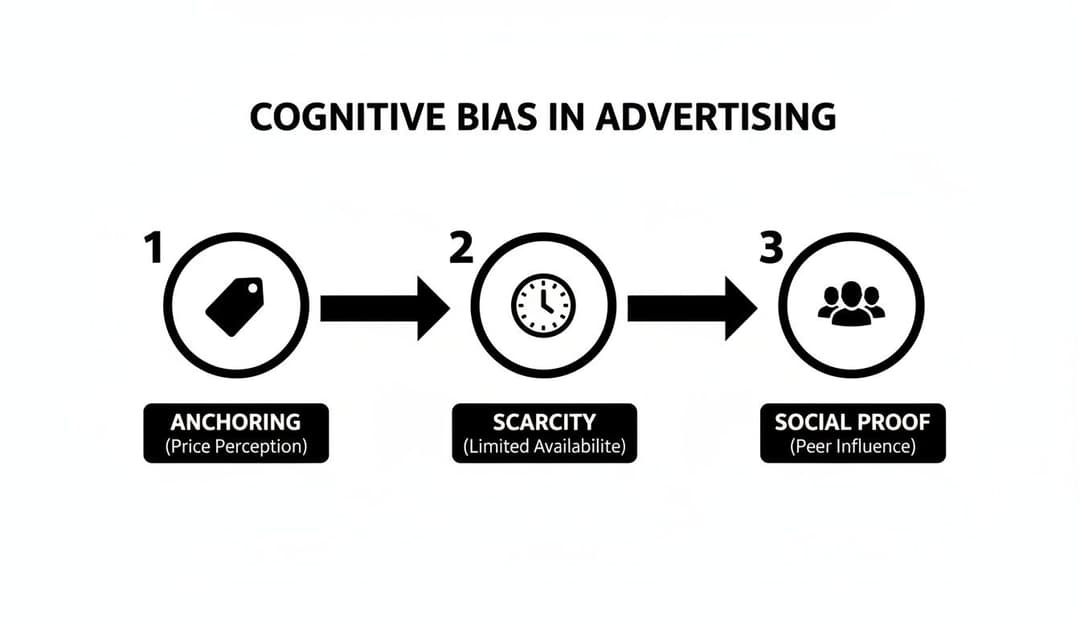
One of the most potent psychological drivers is Social Proof. The core idea is simple: when people are unsure what to do, they look to see what everyone else is doing. We're wired to follow the crowd.
Think about it in the real world. Are you more likely to try a restaurant with a long line snaking out the door or the one next to it that’s completely empty? That line instantly signals quality and desirability. You can create the exact same effect digitally in your Meta ads.
- User-Generated Content (UGC): There's nothing more authentic than featuring videos or photos of real customers using and loving your product. This is social proof in its purest form.
- Testimonials and Reviews: Pull the best lines from your five-star reviews and splash them across your creative as headlines or overlay text. Let your customers do the selling for you.
- Data-Driven Copy: Use hard numbers that show just how popular your product is. Phrases like "Join over 50,000 happy customers" or "The #1 choice for marketers in 2024" build immediate trust.
This entire approach shifts the dynamic. It's no longer you telling people your product is great—it's their peers showing them.
Creating Urgency with Scarcity
Another incredibly effective principle is Scarcity. We humans place a higher value on things we believe are in limited supply. That fear of missing out (FOMO) is a powerful kick that can jolt people into taking immediate action.
Used correctly and ethically, scarcity helps potential customers get over their natural tendency to procrastinate. You're simply giving them a clear, compelling reason to act now instead of "later." It’s not about manufacturing false pressure, but about framing a genuinely limited opportunity. This is a crucial tactic for boosting your click-through rates. You can find more strategies like this in our guide on how to improve click-through rate.
By highlighting what someone stands to lose by not acting, you tap into a psychological trigger that is twice as powerful as highlighting what they stand to gain. This is the essence of loss aversion, a close cousin of scarcity.
Here’s how you can translate scarcity into concrete ad tactics:
- Limited-Time Offers: A countdown timer ticking away in your ad creative or a headline like "Flash Sale Ends Tonight" creates a hard, undeniable deadline.
- Low Stock Alerts: For physical products, copy like "Only 7 left!" or "Selling out fast" is incredibly effective at signaling high demand.
- Exclusive Access: Make your offer feel special by framing it for a select group. "Exclusive offer for our newsletter subscribers" makes the deal feel more valuable and less public.
Leaning into Emotion Over Logic
While principles like scarcity and social proof are vital, never forget the most important rule: decisions are driven by feelings, not just facts. In the psychology of advertising, appealing to emotion almost always beats a purely rational argument.
The research on this is staggering. Ads that focus on building an emotional connection succeed nearly twice as often as those that just stick to logic. While a mere 16% of ads with a rational focus perform well, an impressive 31% of emotionally-driven ads deliver strong business results. They do this by tapping into feelings like pride, love, achievement, or even nostalgia. This emotional connection is what elevates a simple ad into a memorable brand experience, and platforms like AdStellar are designed to help teams test these emotional angles at scale.
The Hidden Drivers of Consumer Choice
Ever wonder why a perfectly logical ad falls flat, while another, seemingly simple one, knocks it out of the park? The answer often lies beneath the surface of conscious thought. Our brains are constantly bombarded with information, so they create mental shortcuts—cognitive biases—to make decisions faster.
For savvy marketers, these aren't tricks. They're a roadmap to how the human mind actually works. When you understand the psychological currents driving decisions, you can build campaigns that feel less like a sales pitch and more like a helpful nudge in the right direction. It’s about aligning your message with these deep-seated instincts.
The Power of Not Missing Out
One of the most powerful motivators isn't what you stand to gain, but what you stand to lose. This is Loss Aversion in action. Psychologically, the sting of losing something is about twice as powerful as the pleasure of gaining the exact same thing. A customer is far more motivated to avoid losing $20 than they are to gain $20.
This simple fact should completely change how you frame your offers. Instead of only talking about benefits, shift the focus to what they’ll miss if they don't act now. This creates a natural, powerful urgency that a "gain-focused" message just can't match. For a deeper dive, check out more real-world examples of the psychology in commercials.
Here's how that small shift plays out:
- Before: "Get 20% off your first order."
- After: "Don't miss out on 20% off your first order."
See the difference? The second version triggers that fear of missing a great deal, pushing them to act now.
Setting the Stage with Anchoring
Our brains love a good reference point. The Anchoring Effect describes our tendency to latch onto the very first piece of information we see (the "anchor") and use it to make all subsequent judgments. Once that anchor is set, everything else is viewed in relation to it.
In advertising, you see this constantly with pricing. Show a higher "original" price, and the sale price suddenly looks like an incredible bargain. That first number anchors the customer's perception of the product's value, making the discount feel much more significant.
A price is never just a number; it's a signal of value. By establishing a high anchor, you frame the actual price not as a cost, but as an opportunity.
Let's translate that into ad copy:
- Before: "Buy our software for $49."
- After: "Get our premium software for just $49 (was $99)."
The second version instantly anchors the value at $99, making the $49 feel like a smart, can't-miss opportunity.
Following the Crowd with the Bandwagon Effect
We are social creatures, and we often look to others for cues on what to do. The Bandwagon Effect, a close cousin of social proof, is our instinct to adopt certain behaviors or beliefs because lots of other people are doing it. If something looks popular, we automatically assume it must be good.
This isn't just a fad—it's a mental shortcut our brains use to make safe choices. Understanding the psychological reasons consumers choose one brand over another often comes down to this simple principle. Showcasing your product's popularity is one of the quickest ways to build trust.
- Before: "Try our new project management tool."
- After: "Join the 100,000+ teams who trust our project management tool."
That simple tweak transforms your ad. You're no longer just pitching a product; you're inviting someone to join a successful, growing movement. It feels less like a risk and more like joining a winning team.
Applying Cognitive Biases to Ad Creatives
Knowing these biases is one thing, but putting them into practice is what gets results. The table below breaks down how you can translate these psychological principles directly into your Meta ad copy and visuals.
| Cognitive Bias | What It Means | Ad Copy Tactic | Visual Tactic |
|---|---|---|---|
| Loss Aversion | The pain of losing is felt more strongly than the pleasure of gaining. | Use words like "Don't miss out," "Last chance," or "Offer ends soon" to create urgency. | Feature a countdown timer GIF or a visual showing a limited stock quantity (e.g., "Only 3 left!"). |
| Anchoring Effect | We rely heavily on the first piece of information offered. | Always show the original price crossed out next to the sale price (e.g., "$99 $49"). | Create a simple graphic that visually contrasts the "Was" price with the "Now" price, making the discount pop. |
| Bandwagon Effect | We are more likely to do something if we see others are doing it. | Mention specific numbers of customers, five-star reviews, or press mentions (e.g., "Join 50,000 happy customers"). | Use user-generated content (UGC), show testimonials with faces, or display logos of well-known clients. |
These aren't complicated tricks—they're just practical ways to speak your customer's language. By tapping into these natural decision-making patterns, you can make your ads more intuitive, persuasive, and effective.
A Framework for Psychologically-Informed Campaigns
Knowing the psychological principles behind great ads is one thing. Turning that knowledge into a repeatable, scalable process that actually drives growth? That’s the real goal.
This framework is a step-by-step playbook for plugging psychological insights directly into your paid social workflow. It’s designed to move you from educated guesses to data-backed decisions that compound over time. The whole process starts not with creative, but with a sharp, testable hypothesis. Think of it as running a scientific experiment for your marketing.
Start With a Strong Hypothesis
Instead of the vague, "Let's test new ads," you need to formulate a specific, psychology-driven question. This forces you to be deliberate and ensures every ad you create has a distinct purpose. A strong hypothesis is the bedrock of any meaningful test.
Here’s what that looks like in practice:
- Loss Aversion Hypothesis: "We believe ad copy framed around what customers will miss out on will get a higher click-through rate than copy focused on what they'll gain."
- Social Proof Hypothesis: "We believe featuring user-generated video content will lead to a lower Cost Per Acquisition (CPA) compared to our polished, studio-shot videos."
- Anchoring Hypothesis: "We believe showing a crossed-out 'original' price next to the sale price in our ad creative will increase our conversion rate by at least 15%."
These aren't just fuzzy ideas; they're measurable questions. Each one sets a clear benchmark for success before you spend a single dollar, turning your ad creation from a purely creative exercise into a targeted experiment designed to figure out what truly makes your audience tick.
From Hypothesis to High-Volume Testing
With a solid hypothesis in hand, the next job is to generate enough creative variations to test it properly. Manually creating dozens of ads is a surefire way to kill momentum. This is where AI-powered platforms become indispensable for teams that need to move fast and test broadly.
Platforms like AdStellar AI allow you to build and manage hundreds of ad variations in minutes—a task that would otherwise take days.
Automating the grunt work of campaign setup lets you focus your energy on the strategy behind the test, not the mechanics of launching it.
The point of rapid testing isn't just to find one "winner." It's to build a continuous learning system where every campaign delivers clear, actionable data that makes the next one even smarter.
Once the ads are live, the right tools can automatically monitor performance, spot the statistically significant winners, and shift budget toward the top performers. This takes human bias and emotion out of the equation, ensuring your money is always flowing to the creative that's actually proven to work based on the metrics you care about, whether that’s ROAS, CPL, or CPA.
The Continuous Improvement Loop
This isn't a one-and-done setup; it's a cycle. You start with a hypothesis, pump out variations to test it, and use automated tools to find what works. The insights from that test then become the fuel for your next hypothesis, creating a powerful feedback loop of continuous improvement.
By moving from one psychological principle to the next—testing an anchoring strategy, then a scarcity angle, then a social proof message—you systematically build a deep, nuanced understanding of your audience's motivations. This framework turns the abstract concepts of advertising psychology into a practical, repeatable, and incredibly effective engine for scalable growth.
Using Psychology Responsibly and Measuring Impact
Understanding what makes people tick is an incredibly powerful tool for any advertiser. But like any powerful tool, it comes with a responsibility to use it wisely. The real goal isn't just to score a quick, fleeting conversion by pushing a few psychological buttons. It's about building genuine, long-term relationships with customers.
This is where we draw a bright line between persuasion and manipulation. Persuasion is all about clearly communicating your value and connecting your message to a customer's real needs and wants. Manipulation, on the other hand, preys on insecurities or manufactures false urgency to back someone into a decision that isn't truly in their best interest.
Ethical marketing uses the psychology of advertising to help, not to exploit. It’s about being transparent, delivering on your promises, and making sure the customer feels great about their decision long after they’ve clicked "buy."
Looking Beyond the Click
So, how do you know if you're getting it right? The first step is to look past simple vanity metrics. Clicks and impressions don't tell the whole story. Sure, a campaign using intense loss aversion might spike your click-through rate, but is it actually building any lasting brand affinity? Or is it just creating a string of transactional, one-off sales?
To truly measure the impact of these strategies, you need a more sophisticated approach. You have to track the metrics that reflect deeper engagement and long-term value.
- Brand Recall and Lift: Are people actually remembering your brand after seeing your ads? Platforms like Meta offer brand lift studies to measure this directly, giving you a real sense of your mental real estate.
- Sentiment Analysis: How are people talking about you online? A rising tide of positive sentiment is a powerful signal that you’re building a healthy, authentic connection with your audience.
- Customer Lifetime Value (CLV): This is the big one. Are the customers you acquire through these campaigns sticking around? A high CLV is proof positive that you’re attracting the right people for the right reasons.
Tracking these deeper metrics is non-negotiable for building a sustainable brand. For a complete playbook, you can learn all about how to measure ad effectiveness in our detailed guide, which covers everything from attribution models to brand lift studies.
The most sustainable advertising doesn't just win a click; it wins trust. By focusing on genuine value and transparent communication, you turn psychological principles into tools for building lasting customer loyalty, not just short-term gains.
The Foundation of Trust
At the end of the day, the most powerful and effective use of advertising psychology comes down to one thing: empathy. It’s about understanding your audience on such a deep level that you can present your product as the perfect solution to a real problem they’re facing.
When you use principles like social proof to show how others have found success, or scarcity to highlight a genuinely great opportunity, you’re serving the customer. This approach transforms your advertising from an unwelcome interruption into a helpful piece of guidance.
By prioritizing ethical strategies and measuring what truly matters, you build a brand that people don't just buy from—they believe in it. And that foundation of trust? That’s the ultimate competitive advantage.
Your Questions, Answered
Alright, we've covered a lot of ground. Even with a solid framework, putting these psychological principles into practice can bring up some questions. Let's tackle a few of the most common ones I hear from marketers.
How Do I Even Start Applying This Stuff?
The key is to start small. Don't try to cram every single principle into your next campaign—that’s a recipe for confusing data and a massive headache.
Instead, pick just one. Focus on a single concept like Social Proof or Loss Aversion and design a simple, clean A/B test around it. For instance, you could pit a scarcity-driven headline ("Last chance: 50% off ends at midnight!") against your usual benefit-focused one. This way, you get clear, actionable results and start building a playbook of what actually works for your audience.
The goal isn't to use every psychological trick at once. It's to find the specific emotional and cognitive triggers that resonate most powerfully with your unique customers. Start small, test rigorously, and build from there.
This Feels a Bit... Manipulative. Is It Ethical?
That’s a critical question, and one you should always be asking. The line between ethical persuasion and unethical manipulation really comes down to two things: intent and transparency.
Ethical marketing uses these principles to communicate real value more effectively. It helps customers see why your product is a great fit for them and empowers them to make an informed choice that they'll feel good about later.
Manipulation is different. It’s about creating false urgency, preying on insecurities, or misleading people just to get a sale they'll probably regret. Always be honest in your offers. You’re here to guide customers, not trick them. Long-term, sustainable growth is always built on trust, not deception.
So, Which Principle is the Most Powerful One?
There’s no magic bullet. The "most powerful" principle depends entirely on your product, who you're talking to, and the market you're in.
If you're selling high-ticket B2B software, leaning into Authority and Social Proof with strong case studies and expert testimonials is probably your best bet. But if you’re a DTC brand selling the latest must-have gadget, Scarcity and Loss Aversion will likely create more of that immediate "buy now" impulse.
Think of these principles as a toolkit, not a ranked list. The only way to know which tool works best for a specific job is to test it yourself. Your own data will always give you the right answer.
Ready to stop guessing and start scaling? With AdStellar AI, you can launch, test, and optimize hundreds of psychologically-informed ad variations in minutes, not days. Let our AI uncover the winning messages that drive real revenue. Unlock Your Meta Ad Performance with AdStellar AI.