In the competitive SaaS landscape, scaling your marketing efforts without burning out your team is a constant challenge. Repetitive tasks like lead nurturing, user onboarding, and campaign management can consume valuable hours that are better spent on strategy and creative work. This is where the right SaaS marketing automation tools become less of a luxury and more of a necessity for sustainable growth. These platforms are designed to streamline complex workflows, personalize customer communication at scale, and provide the data needed to make smarter, faster decisions.
This comprehensive guide cuts through the noise to help you find the perfect marketing automation solution for your specific needs. We move beyond generic feature lists to provide a detailed analysis of the industry's leading tools, from all-in-one giants to specialized platforms. For performance marketers, growth teams, and digital agencies, selecting the right software is a critical decision that impacts everything from lead quality to customer retention.
Inside this resource, you will find:
- A detailed breakdown of 11 top-tier automation platforms.
- Practical use cases, honest pros and cons, and pricing information for each tool.
- Direct links and screenshots to give you a clear view of each platform's interface.
- A special focus on tools like AdStellar AI for automating paid social campaigns.
Our goal is straightforward: to equip you with the insights necessary to compare the best SaaS marketing automation tools and choose the one that will most effectively drive your acquisition and engagement goals. Let’s dive into the options.
1. AdStellar AI
Best For: High-volume Meta ad testing and optimization.
AdStellar AI stands out among SaaS marketing automation tools by focusing its powerful AI engine on a notoriously complex and time-consuming area: Meta advertising. It's designed for performance marketers who need to move beyond manual campaign setup and guesswork-based optimization. The platform automates the entire ad creation, testing, and scaling workflow, enabling teams to launch hundreds of creative, copy, and audience variations up to 10 times faster.
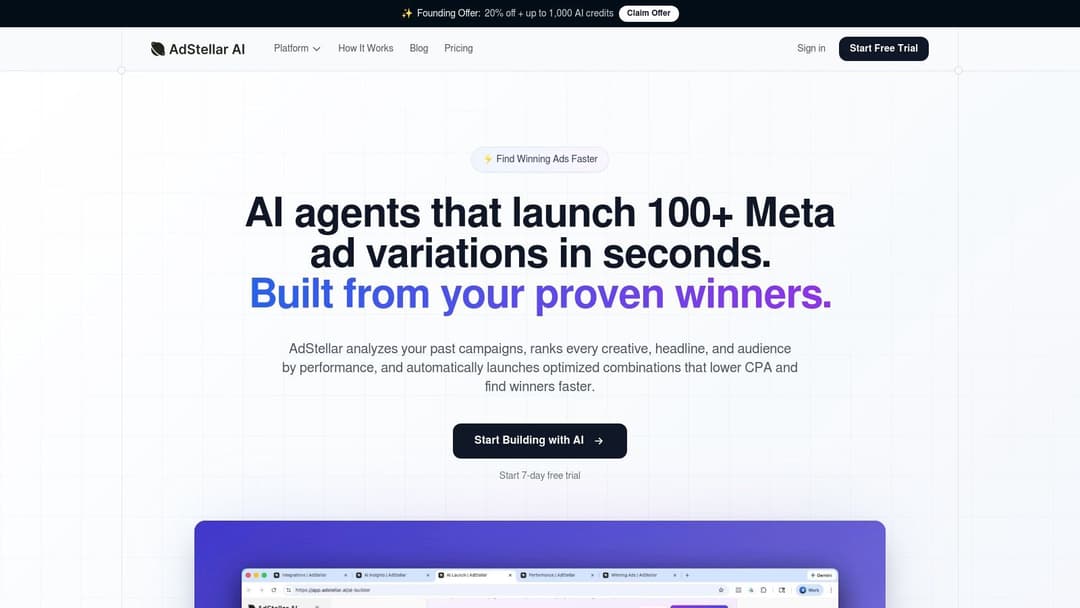
Its core strength lies in translating historical ad performance into actionable intelligence. By connecting securely to your Meta Ads Manager, AdStellar ingests past data and uses auto-learning models to identify what truly works. The AI Insights feature then ranks your best-performing assets against key business goals like ROAS, CPL, or CPA. This data-backed approach fuels its AI Launch feature, which automatically assembles new campaigns from your proven winning components, ensuring every new ad set has the highest probability of success from day one. To learn more about how this technology is changing the game, explore the latest trends in AI marketing automation.
Key Features and Use Cases:
- Massive Speed and Scale: Instead of building ads one by one in Ads Manager, teams can upload creative and copy assets to AdStellar's centralized libraries. The platform then generates every possible combination for rapid, comprehensive testing. This is ideal for agencies managing multiple clients or DTC brands needing to refresh creative constantly.
- Data-Driven Optimization: The AI continuously analyzes performance data to surface clear winners and losers. Marketers can quickly reallocate budgets to top-performing ads and audiences, maximizing efficiency and eliminating wasted spend on underperforming variations.
- Auto-Learning & AI Launch: The platform not only tells you what worked in the past but also uses that knowledge to build future campaigns. This creates a repeatable, data-backed system for scaling what's effective, making it a critical tool for growth-focused teams.
- Centralized Workflow: With dedicated modules for campaigns, creatives, audiences, and performance, it consolidates the entire Meta advertising process. This structured workflow reduces manual errors and improves team collaboration.
Pricing and Access:
AdStellar AI does not list pricing publicly. Access to the platform, including trial details and case studies, requires requesting a demo through their website.
2. HubSpot Marketing Hub (Marketing Automation)
HubSpot Marketing Hub is a comprehensive, all-in-one platform designed to manage the entire marketing funnel. It stands out by natively integrating its powerful automation capabilities directly with its robust CRM, providing a single source of truth for customer data. This tight integration allows SaaS teams to create deeply personalized campaigns based on user behavior, lead scores, and lifecycle stages, making it an excellent choice for businesses prioritizing alignment between marketing and sales.
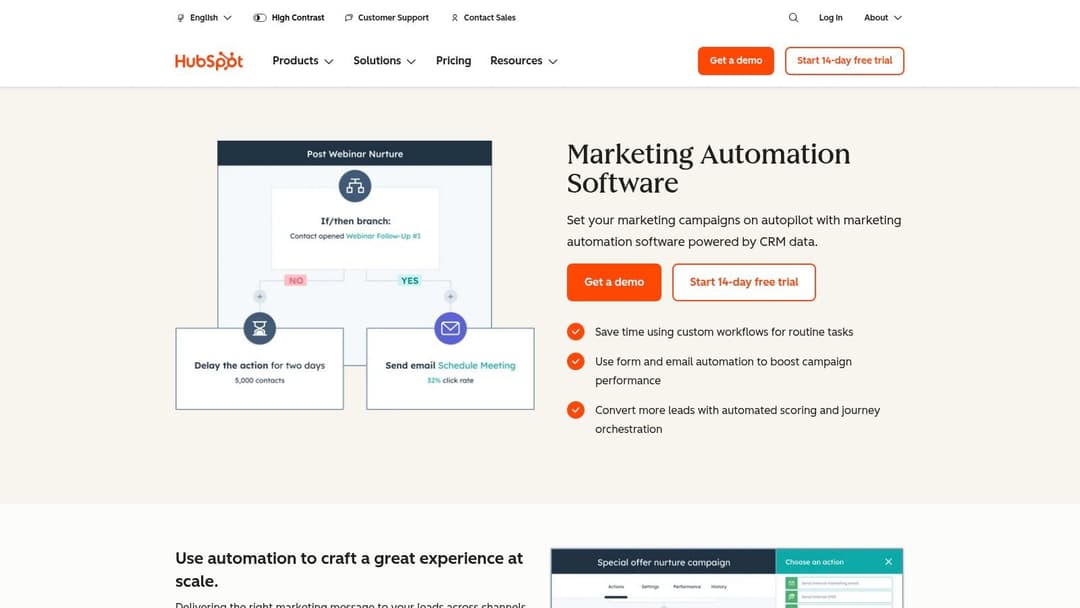
Unlike point solutions, HubSpot combines email marketing, landing pages, social media management, and ad campaign oversight into one unified interface. This reduces tool sprawl and simplifies reporting, offering clear multi-touch revenue attribution to prove marketing ROI. The platform is particularly strong for content-driven SaaS companies looking to nurture leads through complex, non-linear buyer journeys.
Key Features and Use Cases
- Visual Workflow Builder: Create sophisticated automation sequences with branching logic for lead nurturing, internal notifications, and data management.
- Deep CRM Integration: Trigger workflows based on any CRM property, such as deal stage changes or recent support tickets, for hyper-relevant messaging.
- Built-in Analytics: Track campaign performance and customer lifetime value with customizable dashboards and attribution reports.
- Ad Management: Manage and report on Google, Facebook, and LinkedIn ad campaigns directly within HubSpot. To further enhance your paid campaigns, consider pairing it with specialized social media advertising software.
Pricing: Starts with a generous free plan. Paid tiers (Starter, Professional, Enterprise) scale based on marketing contacts and feature access, beginning around $18/month (billed annually). Note that Professional and Enterprise tiers require a one-time mandatory onboarding fee.
Pros:
- All-in-one platform reduces complexity.
- Excellent CRM integration and reporting.
- Extensive educational resources and support.
Cons:
- Can become expensive as your contact list grows.
- Mandatory onboarding fees for higher-tier plans.
Website: https://www.hubspot.com/products/marketing/marketing-automation
3. Adobe Marketo Engage
Adobe Marketo Engage is a powerful, enterprise-grade platform built for complex B2B and B2C marketing automation at scale. It excels in sophisticated lead management, account-based marketing (ABM), and detailed journey analytics. Designed for organizations with mature marketing operations, Marketo offers a highly flexible data model, allowing SaaS teams to manage intricate segmentation and scoring rules to drive revenue and align closely with sales objectives.
Unlike all-in-one solutions that simplify features for ease of use, Marketo provides deep, specialized capabilities. Its native integrations with major CRMs like Salesforce and Microsoft Dynamics are robust, and its high API limits support extensive data throughput for large-scale operations. This makes it one of the top-tier saas marketing automation tools for companies that require granular control over every aspect of their customer lifecycle and revenue attribution.
Key Features and Use Cases
- Advanced Segmentation and Scoring: Create highly specific audience segments and lead scoring models based on demographic, firmographic, and behavioral data.
- Native CRM Integrations: Maintain seamless data synchronization with Salesforce, Microsoft Dynamics, and Veeva for a unified view of the customer.
- Dynamic Content Personalization: Tailor website, email, and landing page content in real-time based on visitor attributes. To take personalization further in paid channels, you can explore the principles behind dynamic creative optimization.
- Account-Based Marketing (ABM): Execute coordinated, multi-channel campaigns targeted at high-value accounts with dedicated ABM features.
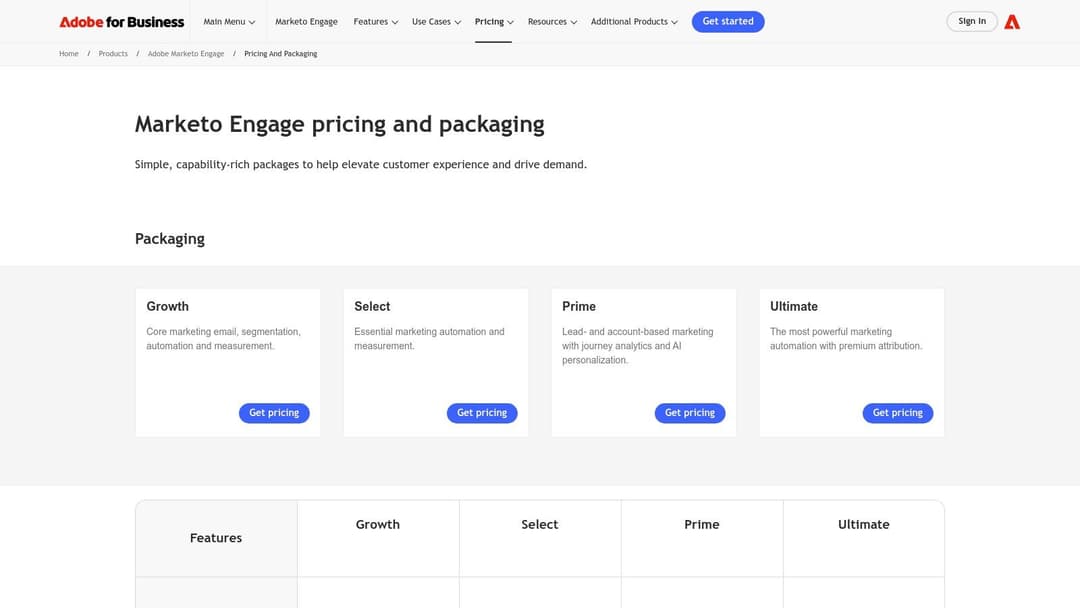
Pricing: Marketo Engage does not have public list pricing. Packages (from Growth to Ultimate editions) are sold through a sales-led process with custom quotes based on database size and feature requirements.
Pros:
- Mature ecosystem for complex, high-scale programs.
- Deep ABM and revenue attribution capabilities.
- Flexible data model and extensive limits at upper tiers.
Cons:
- Sales-led buying process can be slow and lacks transparency.
- Significant implementation and operational overhead required.
Website: https://business.adobe.com/products/marketo/pricing.html
4. ActiveCampaign
ActiveCampaign positions itself as a customer experience automation platform, combining email marketing, marketing automation, and a sales CRM. It excels at delivering powerful, logic-based automation capabilities at a price point that is accessible to small and mid-sized SaaS businesses. The platform is particularly strong for companies that need sophisticated segmentation and triggered messaging based on a wide range of customer behaviors, from email engagement to on-site actions.
Unlike some all-in-one solutions that can feel bloated, ActiveCampaign focuses on a core set of highly effective tools. Its visual workflow builder is both intuitive and robust, allowing marketers to map out complex customer journeys with conditional splits, goals, and various triggers. This makes it a standout choice among SaaS marketing automation tools for businesses that have outgrown simpler email platforms and require more granular control over their lead nurturing and customer communication sequences.
Key Features and Use Cases
- Visual Automation Builder: Design powerful workflows using a drag-and-drop interface with triggers for email, site activity, and e-commerce events.
- Broad E-commerce Integrations: Connect directly with platforms like Shopify, WooCommerce, and BigCommerce to automate abandoned cart reminders and post-purchase follow-ups.
- Predictive Features: Leverage predictive sending and AI-assisted content generation on select plans to optimize campaign performance.
- Built-in Sales CRM: Manage deals, tasks, and contact data within the same system, ensuring alignment between marketing and sales efforts. For companies on a tighter budget, it's a great example of marketing automation software for small business.
Pricing: Plans scale based on contact count and feature tier (Plus, Professional, Enterprise). Pricing starts around $29/month (billed annually), but some advanced plans may require contacting sales for a quote.
Pros:
- Powerful automation capabilities for the price point.
- Strong e-commerce integrations and recipes.
- Mature segmentation and contact management.
Cons:
- Pricing structure can be complex and has changed over time.
- Advanced reporting and features are locked behind higher-tier plans.
Website: https://www.activecampaign.com/
5. Mailchimp (by Intuit)
Mailchimp is a widely recognized platform, primarily known for email marketing, that has evolved into a capable marketing automation tool for small to medium-sized businesses. Its key strength lies in its accessibility and ease of use, making it an ideal starting point for SaaS startups looking to implement their first automated campaigns without a steep learning curve or significant upfront investment. The platform excels at simplifying core marketing tasks like welcome sequences, abandoned cart reminders, and re-engagement campaigns.
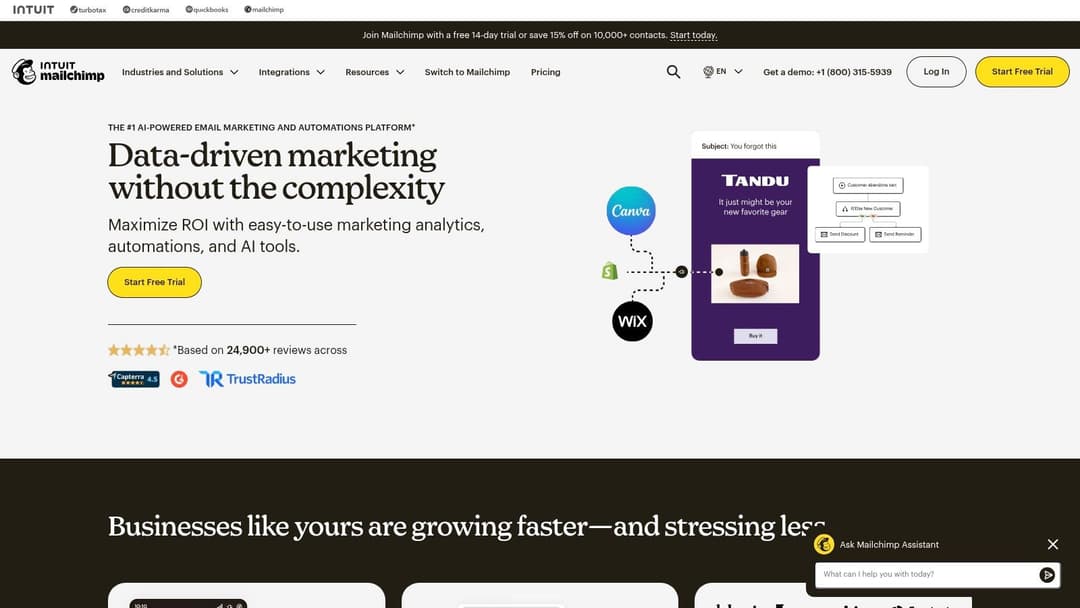
Unlike more complex, enterprise-focused systems, Mailchimp prioritizes a straightforward user experience. This focus allows teams to get up and running quickly, leveraging pre-built journey templates and a visual builder to create effective automations. Its vast library of integrations, especially for ecommerce platforms like Shopify and WooCommerce, makes it a practical choice for SaaS companies with a transactional or product-led growth model.
Key Features and Use Cases
- Customer Journeys and Templates: Build multi-step automated workflows using a visual builder and pre-designed templates for common goals like lead nurturing or onboarding.
- Drag-and-Drop Email Builder: Quickly design professional emails with a user-friendly editor and an AI-powered Creative Assistant to help generate designs.
- 300+ Integrations: Connect with popular SaaS tools and ecommerce platforms to sync data and trigger automations based on user actions in other systems.
- Audience and Campaign Analytics: Track open rates, click-through rates, and audience growth with clear, easy-to-understand reports.
Pricing: Offers a free plan for up to 500 contacts and limited features. Paid plans (Essentials, Standard, Premium) start around $13/month and scale based on contact count and feature access.
Pros:
- Low barrier to entry and very fast to launch.
- Large integration ecosystem and extensive tutorials.
- Free and trial options are available for evaluation.
Cons:
- Automation depth and governance are less advanced than enterprise tools.
- Pricing scales with contacts, and overage fees are possible.
Website: https://mailchimp.com/
6. Klaviyo
Klaviyo is an email and SMS marketing automation platform built specifically for ecommerce and direct-to-consumer (DTC) brands. While many SaaS marketing automation tools are B2B-focused, Klaviyo excels by leveraging deep, real-time data integrations with platforms like Shopify and WooCommerce. This allows for incredibly granular segmentation and personalization based on browsing history, cart contents, and past purchase behavior, making it a powerful tool for SaaS companies with a transactional or product-led growth model.
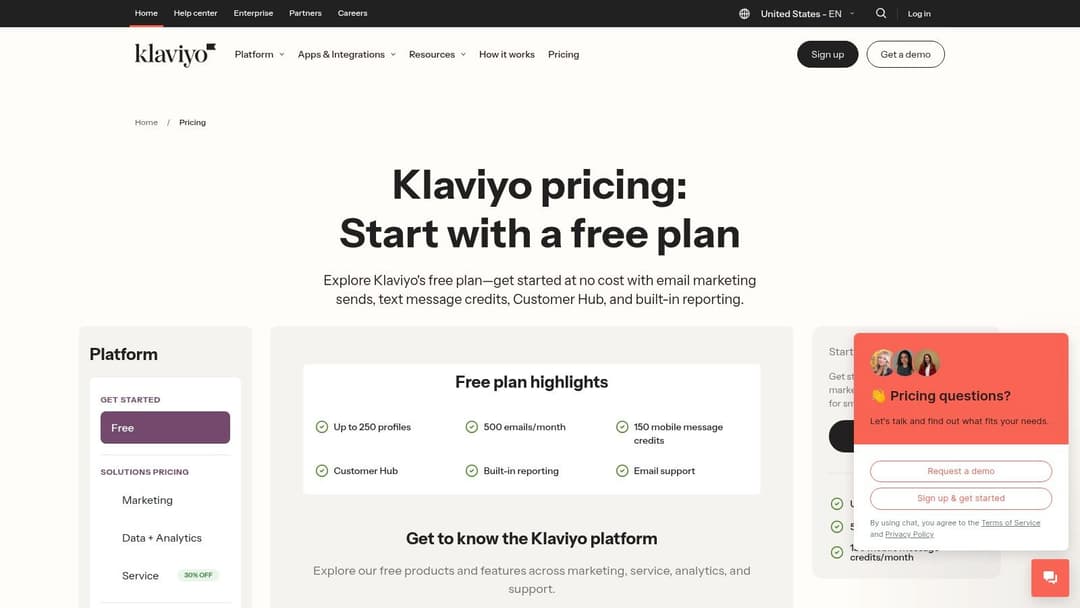
Unlike general-purpose platforms, Klaviyo's entire feature set is optimized for driving sales. Its extensive library of pre-built automation flows for abandoned carts, welcome series, and post-purchase follow-ups enables teams to launch sophisticated campaigns quickly. The platform's ability to combine email, SMS, and push notifications into a single unified customer profile provides a comprehensive view of engagement and drives higher lifetime value.
Key Features and Use Cases
- Pre-built Ecommerce Flows: Quickly deploy proven automation sequences for welcoming new users, recovering abandoned carts, and winning back lapsed customers.
- Robust Segmentation: Create dynamic segments using a combination of event data (e.g., viewed product), profile properties, and predictive analytics (e.g., predicted churn risk).
- Multi-Channel Messaging: Engage users through coordinated email, SMS, and mobile push notification campaigns from a single platform.
- AI-Powered Assistance: Utilize AI tools for generating high-performing subject lines, optimizing send times, and assisting with campaign creation.
Pricing: Offers a free plan for up to 250 contacts. Paid plans scale based on the number of active contacts and SMS/email volume, starting around $20/month for email and $15/month for SMS/MMS.
Pros:
- Best-in-class personalization and segmentation for ecommerce.
- Deep, native integrations with Shopify, WooCommerce, and other platforms.
- Extensive library of proven automation templates and flows.
Cons:
- Pricing can become expensive as your active contact list grows.
- Some advanced features and dedicated support are priced separately.
Website: https://www.klaviyo.com/pricing/
7. Salesforce Marketing Cloud Account Engagement (Pardot)
Salesforce Marketing Cloud Account Engagement, widely known by its former name Pardot, is a B2B marketing automation powerhouse designed for organizations deeply invested in the Salesforce ecosystem. Its core strength lies in its native, bidirectional sync with Salesforce CRM, creating a seamless connection between marketing activities and sales outcomes. This makes it a top choice for SaaS companies that require sophisticated lead management and tight alignment between marketing and sales teams to manage complex, high-value sales cycles.
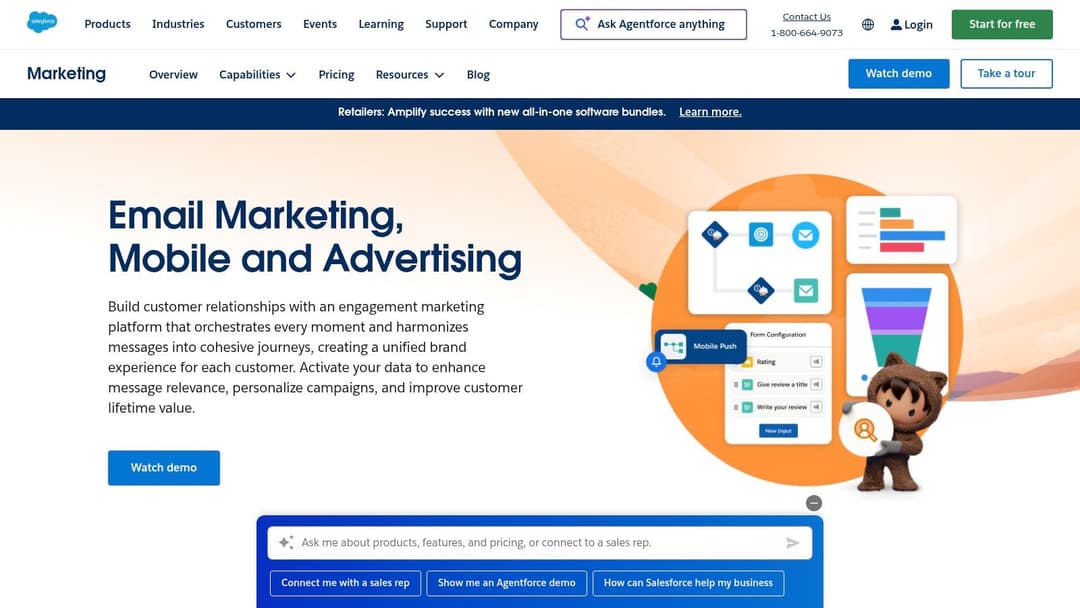
Unlike platforms built for a broader B2C audience, Account Engagement focuses specifically on the needs of B2B marketers. It provides advanced lead scoring and grading models that help qualify leads based on both demographic fit and behavioral engagement. This allows sales teams to prioritize their efforts on the most promising opportunities, armed with a complete history of every marketing touchpoint.
Key Features and Use Cases
- Lead Nurturing and Scoring: Build dynamic engagement journeys and automatically score leads based on activities, sending real-time alerts to sales reps for follow-up.
- Deep Salesforce CRM Sync: Trigger automation based on any standard or custom object in Salesforce, ensuring marketing actions are always in context with the full customer relationship.
- B2B Marketing Analytics: Leverage powerful, Tableau-powered dashboards to track funnel performance, campaign influence, and marketing ROI.
- Enterprise Governance: Higher tiers offer business units and sandboxes, providing the control and separation needed for large, multi-brand organizations.
Pricing: Tiers (Growth, Plus, Advanced, Premium) start at $1,250/month for up to 10,000 contacts, with features and pricing scaling from there. Each tier is clearly defined on their website.
Pros:
- Unrivaled native alignment with Salesforce CRM for B2B funnels.
- Mature governance and multi-business unit features for enterprises.
- Advanced lead scoring and grading capabilities.
Cons:
- Significant investment; the overall cost can be high for the ecosystem.
- The extensive feature set can be complex for small teams to fully utilize.
Website: https://www.salesforce.com/products/marketing-cloud/account-engagement/
8. Customer.io
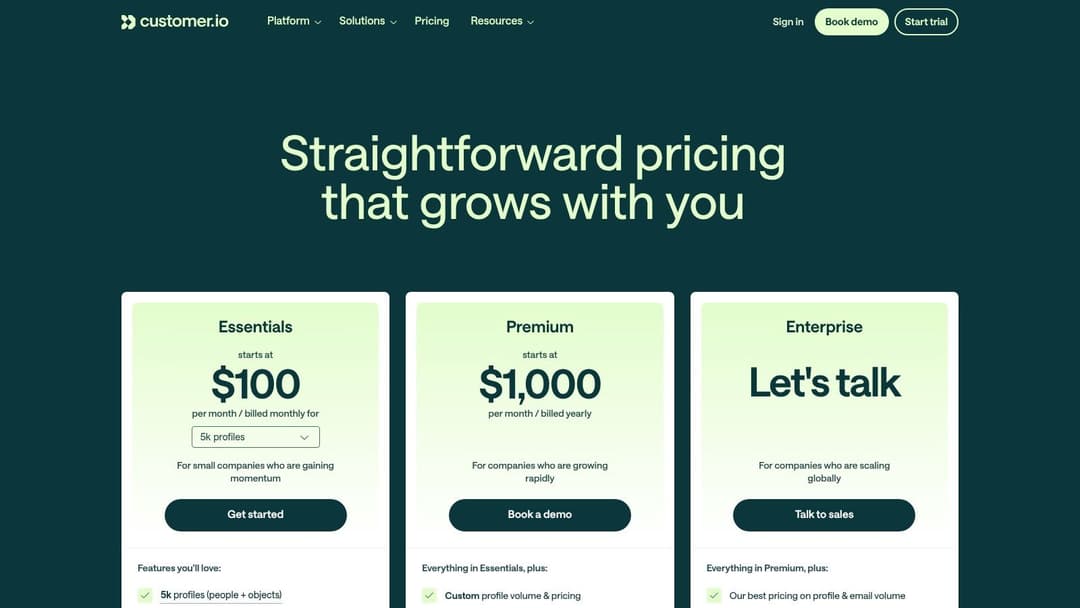
Customer.io is an event-driven messaging platform built for product-led SaaS companies that need to automate communication based on user behavior. It excels at sending hyper-targeted messages across email, SMS, and push notifications triggered by what users do (or don't do) within an application. This makes it a powerful tool for lifecycle marketing, from user onboarding and feature adoption campaigns to churn prevention sequences.
Unlike traditional marketing automation platforms that are often lead-centric, Customer.io is fundamentally user-centric and developer-friendly. Its flexible data model and robust API allow teams to pipe in rich product usage data, enabling complex segmentation and personalization that goes far beyond standard marketing attributes. For SaaS businesses looking to bridge the gap between their product and their marketing messages, Customer.io is a top-tier choice.
Key Features and Use Cases
- Visual Workflow Builder: Design event-triggered campaigns with time delays, A/B tests, and multi-channel messaging paths.
- Ad Audience Sync: Automatically sync dynamic user segments to Google and Facebook Ads to power retargeting and lookalike campaigns.
- Identity Resolution: Consolidate user profiles across anonymous and logged-in states for a unified view of the customer journey.
- HIPAA Support: Available on select enterprise plans, making it a viable option for health-tech SaaS companies that handle protected health information.
Pricing: Offers transparent, usage-based pricing. The Essentials plan starts at $100/month for up to 12,000 profiles. Tiers scale with features and profile/message volume, with a Premium plan available for advanced needs like HIPAA support and dedicated support.
Pros:
- Excellent for product-led and lifecycle automation.
- Clear, scalable pricing based on user profiles.
- Strong documentation and developer-focused features.
Cons:
- Can have a steeper learning curve for non-technical teams.
- Advanced features are gated in higher-tier plans.
Website: https://customer.io/pricing
9. Braze
Braze is an enterprise-grade customer engagement platform built for real-time, cross-channel communication. It excels in environments where speed and scale are critical, particularly for mobile-first consumer applications. The platform processes massive volumes of data to trigger messages across email, SMS, push notifications, and in-app messages, enabling brands to react instantly to user behavior. Its architecture is designed for high-scale B2C SaaS and mobile commerce, where orchestrating a unified user experience across multiple touchpoints is paramount.
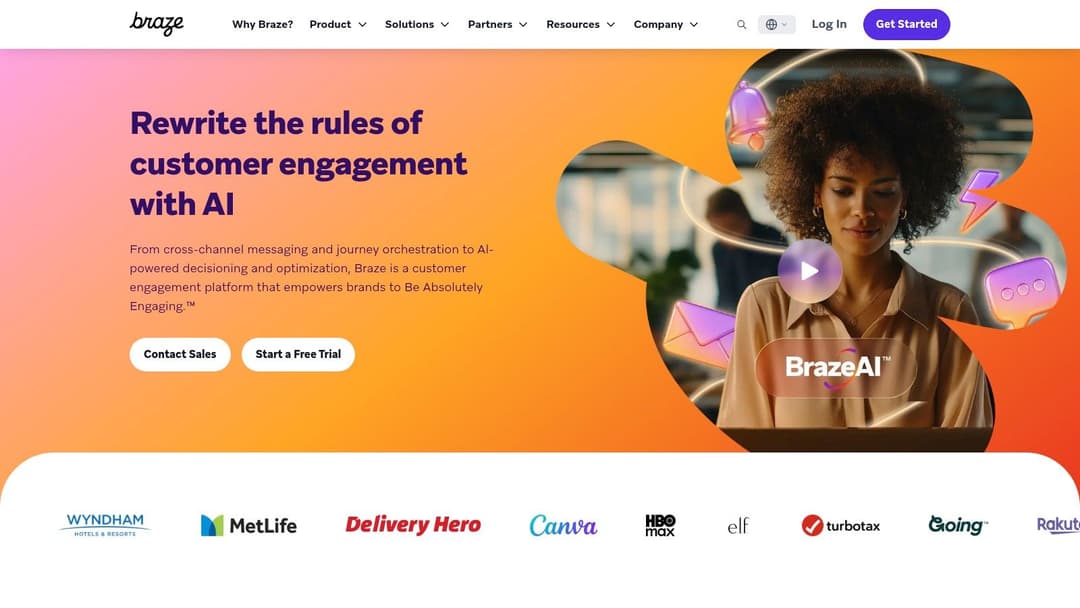
Unlike many SaaS marketing automation tools that are CRM-centric, Braze is data-centric, often connecting with a company's data warehouse or CDP as its primary source of truth. This allows for incredibly granular segmentation and personalization based on complex event streams. Its billing model, based on Monthly Active Users (MAUs) rather than contacts, also reflects its focus on engaging an active user base, making it a powerful choice for high-growth consumer apps.
Key Features and Use Cases
- Cross-Channel Orchestration: Use the Braze Canvas to build sophisticated customer journeys that combine push, in-app, email, and SMS messaging.
- Real-Time Triggers: Act on user behavior the moment it happens, such as sending a promotional offer immediately after a cart is abandoned in a mobile app.
- Comprehensive Analytics: Deeply analyze campaign performance and user behavior with robust, built-in reporting focused on MAUs, events, and conversions.
- Extensive Data Integrations: Connect seamlessly with CDPs like Segment, data warehouses like Snowflake, and analytics tools to create a unified data ecosystem.
Pricing: Braze does not offer public pricing. It is an enterprise-focused solution with custom quotes provided through a sales-led process, typically involving significant annual contracts.
Pros:
- Excellent for mobile-first, high-scale consumer applications.
- Robust multi-channel orchestration and real-time analytics.
- Enterprise-grade administration, permissions, and support options.
Cons:
- High cost and complexity make it unsuitable for smaller teams.
- Longer implementation and time-to-value compared to simpler tools.
Website: https://www.braze.com/
10. Iterable
Iterable is a high-powered, cross-channel growth marketing platform built for enterprise-scale communication. It excels at unifying customer data from various sources to power sophisticated, event-triggered campaigns across email, SMS, push notifications, and in-app messages. Iterable is designed for data-rich SaaS companies that need to orchestrate complex user journeys based on real-time behavioral signals, making it a formidable tool for driving engagement and retention at scale.
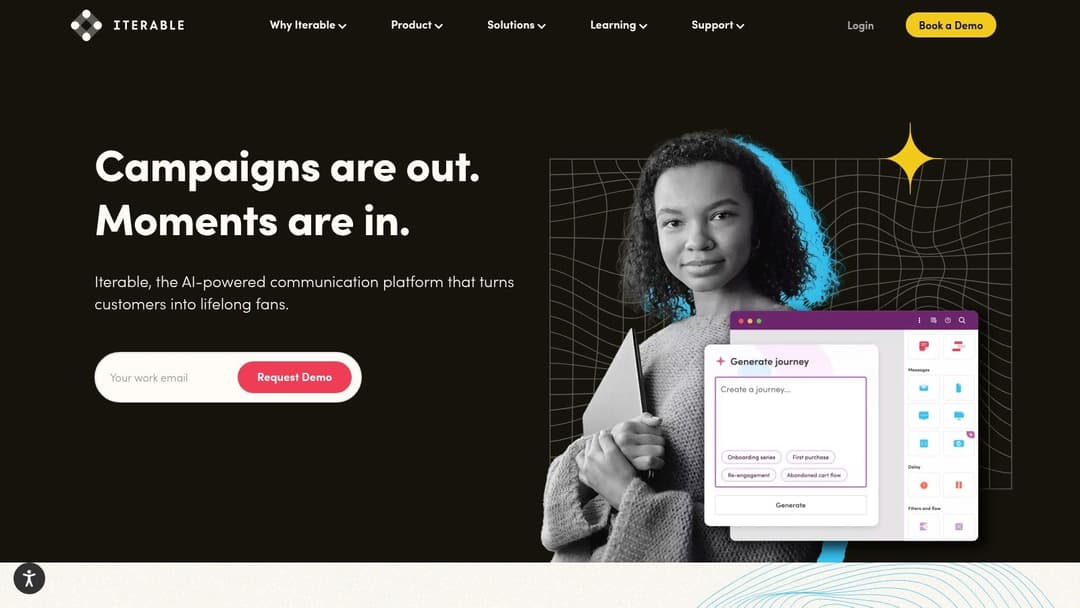
Unlike many all-in-one solutions, Iterable’s core strength is its flexible data model and powerful segmentation engine. This allows marketers to use product catalogs and dynamic data feeds to deliver hyper-personalized content, such as abandoned cart reminders with specific product images or onboarding flows tailored to initial app interactions. This focus on deep data integration makes it one of the more advanced saas marketing automation tools for teams with strong technical resources.
Key Features and Use Cases
- Studio Workflow Builder: Design and execute complex, event-driven journeys with branching logic that responds to user actions across any channel.
- Large-Scale Messaging: Reliably send high volumes of personalized messages using dynamic content from data feeds and catalogs.
- Transparent Usage Dashboards: Provides clear in-product dashboards for monitoring contract usage and potential overages, ensuring billing predictability.
- Marketplace & Packaged Offers: Offers packaged solutions and third-party integrations through its marketplace to streamline implementation.
Pricing: Iterable does not offer standard public pricing. Plans are based on custom quotes tailored to message volume, data complexity, and feature requirements. Packaged offers are available through their marketplace.
Pros:
- Excellent for high-volume, data-intensive use cases.
- Flexible and powerful cross-channel journey orchestration.
- Clear in-product billing and usage metrics for transparency.
Cons:
- Pricing is enterprise-level and requires a custom quote.
- Requires experienced technical teams for effective implementation.
Website: https://www.iterable.com/
11. Ortto (formerly Autopilot)
Ortto strikes a compelling balance between the accessibility of an SMB tool and the power of an enterprise marketing automation platform. It modernizes the user experience by unifying customer data, messaging, and analytics into a single view, positioning itself as a more approachable customer data platform (CDP). This makes it an ideal choice for SaaS businesses that have outgrown simpler email tools but aren't ready for the complexity and cost of a full enterprise suite.
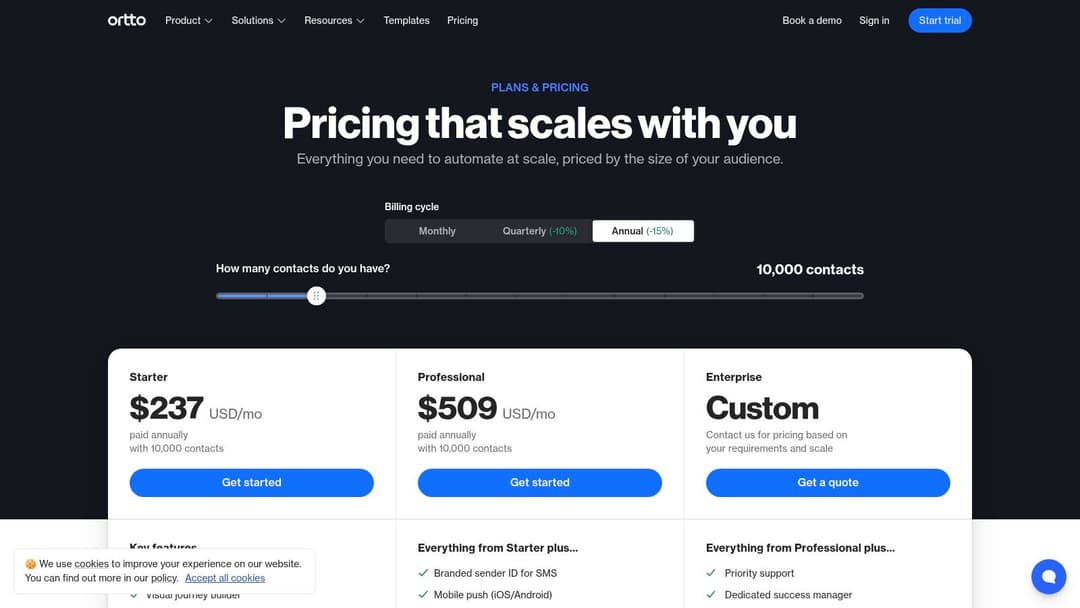
Unlike many competitors with opaque pricing tiers, Ortto’s strength lies in its transparency. Its public pricing calculator allows businesses to see exactly what they will pay based on contact count and desired features. The platform is built around a visual journey builder that supports a wide array of channels, including email, SMS, and push notifications, making it one of the most versatile SaaS marketing automation tools for multi-channel nurturing.
Key Features and Use Cases
- Visual Journey Builder: Design and launch multi-channel campaigns with an intuitive drag-and-drop interface and AI-powered suggestions.
- Multi-Channel Messaging: Engage customers via email, SMS, push notifications, and on-site popups from a single platform.
- Lead Scoring & NPS: Automatically score leads based on behavior and gather customer feedback with built-in Net Promoter Score surveys.
- Transactional Messaging: Trigger and send critical transactional emails and messages via webhooks for seamless user experiences.
Pricing: Features a transparent, calculator-style pricing model. Plans start with a free tier for up to 2,000 contacts. Paid plans (Campaign, Professional, Enterprise) scale based on contact volume and features, starting around $29/month.
Pros:
- Transparent pricing with a contact-based calculator.
- Broad channel coverage without heavy enterprise overhead.
- Not-for-profit discounts are available.
Cons:
- Advanced governance features are reserved for higher-tier plans.
- Fewer third-party integrations than larger enterprise suites.
Website: https://ortto.com/pricing/
12. G2 – Marketing Automation Software Category
G2's Marketing Automation category isn't a single tool but rather a comprehensive marketplace and peer-review platform for researching them. It serves as an essential starting point for SaaS teams looking to compare different saas marketing automation tools based on verified user feedback. The platform aggregates reviews, feature lists, and pricing data, allowing you to filter and shortlist vendors based on your specific business needs, such as company size, user satisfaction, and feature set.
This resource stands out by providing crowdsourced validation, helping you cut through marketing jargon to understand how a tool actually performs in a real-world setting. By leveraging its detailed comparison grids and user-generated pros and cons, teams can make a more informed decision before committing to demos or trials. It’s particularly useful for identifying both market leaders and emerging niche players that might otherwise be overlooked.
Key Features and Use Cases
- Grid Reports and Filters: Visually compare software on the G2 Grid based on user satisfaction and market presence, with filters for features and business size.
- Side-by-Side Comparisons: Select up to four products to compare their features, pricing details, and review scores directly against each other.
- Verified User Reviews: Access hundreds of detailed reviews from real users, providing authentic insights into a platform’s strengths and weaknesses.
- Buyer Intent Data: For vendors, G2 offers data on which companies are researching their category, enabling more targeted outreach.
Pricing: Free to browse, compare, and read reviews. G2 makes money from vendors who pay for premium profiles, buyer intent data, and sponsored placements.
Pros:
- High volume of authentic, verified peer reviews.
- Powerful filtering and comparison workflows.
- Direct links to vendor trials, demos, and websites.
Cons:
- Sponsored placements can influence product visibility on category pages.
- Pricing information is often user-supplied and can be outdated.
Website: https://www.g2.com/categories/marketing-automation
Top 12 SaaS Marketing Automation Tools Comparison
| Product | Core focus | Target audience | Unique selling points | Ease of use & scale | Pricing transparency |
|---|---|---|---|---|---|
| AdStellar AI | Automated Meta ad creation & optimization | Performance marketers, DTC/e‑commerce, agencies | Bulk ad generation, AI Insights, auto‑learning scaling, 1‑click launch | Fast setup for Meta; built for high‑volume variation testing | No public pricing — demo / sales |
| HubSpot Marketing Hub | CRM‑native full‑funnel marketing automation | Growth teams wanting CRM alignment | Visual workflows, multi‑touch attribution, all‑in‑one suite | User‑friendly with strong onboarding; scales but costs rise | Tiered public pricing; costs scale with contacts/seats |
| Adobe Marketo Engage | Enterprise lead management & ABM | Large B2B/B2C enterprises with complex programs | Advanced segmentation, ABM, high API/data throughput | Powerful but implementation‑heavy | Sales‑led; custom pricing (no public list) |
| ActiveCampaign | Email, automations, CRM & ecommerce triggers | SMB → midmarket, ecommerce merchants | Affordable advanced automations, wide ecommerce integrations | Good for SMBs; some advanced features require higher tiers | Contact‑based tiers; some features behind sales |
| Mailchimp (by Intuit) | Email & basic marketing automation | Startups and small businesses | Easy drag‑and‑drop, Creative Assistant, large integrations | Fast to launch; limited enterprise depth | Free tier + paid plans; pricing scales with contacts |
| Klaviyo | Ecommerce‑first email & SMS automation | DTC brands, Shopify/Woo merchants | Deep ecommerce data, prebuilt flows, personalization | Shopify‑native, strong flows; costs grow with profiles | Free tier; paid by active profiles |
| Salesforce Marketing Cloud Account Engagement (Pardot) | B2B marketing automation tightly coupled to Salesforce | B2B orgs requiring deep CRM alignment | Lead scoring/grading, connected sales alerts, analytics | Enterprise governance; can be complex and costly | Published tiers/benchmarks on Salesforce; licensing costs |
| Customer.io | Event‑driven messaging & lifecycle automation | Product teams, developer‑focused marketers | Flexible data model, ad audience sync, detailed logs | Developer‑friendly; steeper learning curve for non‑technical | Transparent plan tiers and volume‑based pricing |
| Braze | Cross‑channel customer engagement for apps | Mobile‑first, high‑scale consumer apps | Real‑time orchestration, MAU analytics, strong personalization | Enterprise complexity; strong for high volume | Sales‑led; MAU‑based billing (no public price card) |
| Iterable | Cross‑channel growth marketing & journey orchestration | Data‑rich, high‑volume marketers | Complex event‑driven journeys, catalog personalization | Powerful but requires experienced teams for setup | Custom quotes; no standard public price |
| Ortto (formerly Autopilot) | Modern, contact‑based marketing automation with CDP features | SMBs → midmarket seeking transparent pricing | Visual journeys, contact‑based billing, broad channels | Accessible UI; advanced governance on Pro/Enterprise | Clear calculator‑style pricing by contacts |
| G2 – Marketing Automation Category | Software marketplace & verified reviews | Buyers researching and shortlisting vendors | Peer reviews, category grids, side‑by‑side comparisons | Easy to research and shortlist tools | Free to use; vendor pricing shown may vary or lag actuals |
Final Thoughts: Automate Smarter, Not Harder
Navigating the expansive landscape of SaaS marketing automation tools can feel overwhelming, but the journey is essential for any modern growth team. We've explored a dozen powerful platforms, from comprehensive enterprise solutions like Marketo and Salesforce to hyper-focused tools like Klaviyo and our featured ad automation specialist, AdStellar AI. The central takeaway is clear: the "best" tool doesn't exist in a vacuum. It is entirely dependent on your unique business context.
Your ideal platform is a direct reflection of your company's stage, budget, technical resources, and primary growth channels. An early-stage B2B startup will have vastly different needs than a global B2C e-commerce giant, and their choice of software should mirror that reality. The key is to move beyond flashy feature lists and focus on the practical application of automation to solve your most pressing marketing challenges.
Key Takeaways and Your Next Steps
As you move forward, keep these core principles at the forefront of your decision-making process. They will serve as your compass in selecting and implementing the right solution.
Audit Before You Buy: Before you even schedule a demo, conduct a thorough audit of your current marketing stack and internal processes. Identify the specific bottlenecks you need to solve. Are you leaking leads between sales and marketing? Is your ad campaign management consuming too many hours? Pinpoint the pain before you shop for the cure.
Scalability is Non-Negotiable: Your chosen tool must grow with you. Consider not just your immediate needs but where your business will be in 18-24 months. A cheap, simple solution today could become an expensive, migration-heavy problem tomorrow. Prioritize platforms that offer tiered plans and a clear upgrade path.
Integration is Everything: A marketing automation tool that doesn't seamlessly connect with your CRM, analytics platform, and ad networks is more of a hindrance than a help. Deeply investigate the native integrations and API capabilities of your top contenders. A truly automated workflow depends on a fully connected ecosystem.
Making the Right Choice for Your Team
To distill this complex decision into a manageable framework, ask your team the following questions:
- Who is the primary user? Will this be managed by a junior marketer, a data scientist, or a seasoned automation specialist? The required user experience and technical complexity will vary dramatically.
- What is our core business model? B2B SaaS companies focused on lead nurturing have different priorities than DTC brands focused on repeat purchase rates and cart abandonment. Align the tool's strengths (e.g., lead scoring vs. e-commerce triggers) with your revenue model.
- How will we measure success? Define your key performance indicators (KPIs) upfront. Are you trying to reduce customer acquisition cost (CAC), improve lead-to-close ratio, or increase customer lifetime value (LTV)? Choose the platform that provides the clearest reporting and analytics for those specific metrics.
The goal of implementing one of these powerful saas marketing automation tools is not simply to do more things, but to achieve better results with greater efficiency. It's about freeing up your talented team from repetitive, manual tasks so they can focus on what truly matters: strategy, creativity, and building genuine customer relationships. Embrace the power of automation not as a replacement for human ingenuity, but as a catalyst for it.
Ready to eliminate the guesswork and manual effort from your Meta advertising? AdStellar AI specializes in automating the campaign creation, management, and optimization process, allowing performance marketers to focus on high-level strategy instead of tedious tasks. See how our AI-powered platform can transform your paid social results by visiting AdStellar AI to learn more.