Most Meta advertisers test creatives by throwing variations at the wall and hoping something sticks. They launch a few different images, wait a couple days, pick the one with the best numbers, and call it optimization. But here's the problem: without a systematic testing framework, you're not really learning anything. You're just gambling with smaller bets.
The difference between advertisers who consistently scale profitable campaigns and those who plateau at modest spend? It's not budget size or access to better designers. It's having methodical creative testing processes that generate reliable insights instead of random wins.
Creative testing isn't just about finding what works today—it's about building a sustainable system for discovering what will work tomorrow, next month, and as your campaigns scale. When you approach creative testing strategically, every dollar spent becomes an investment in knowledge that compounds over time.
The methods below represent proven frameworks that transform creative testing from guesswork into a predictable growth engine. Each approach serves different scenarios, budgets, and objectives, but they all share one thing: they generate clear, actionable insights you can use to scale.
1. Dynamic Creative Testing Framework
The Challenge It Solves
Testing every possible combination of headlines, images, descriptions, and CTAs manually would require dozens of ad variations and massive budgets. You'd need separate campaigns for each combination, making it nearly impossible to identify which specific elements drive performance. Most advertisers end up testing just a handful of complete ads, missing the insights hidden in individual components.
Dynamic Creative Optimization (DCO) solves this by letting Meta's algorithm automatically test combinations of your creative assets and surface the winning elements without requiring you to manually build every variation.
The Strategy Explained
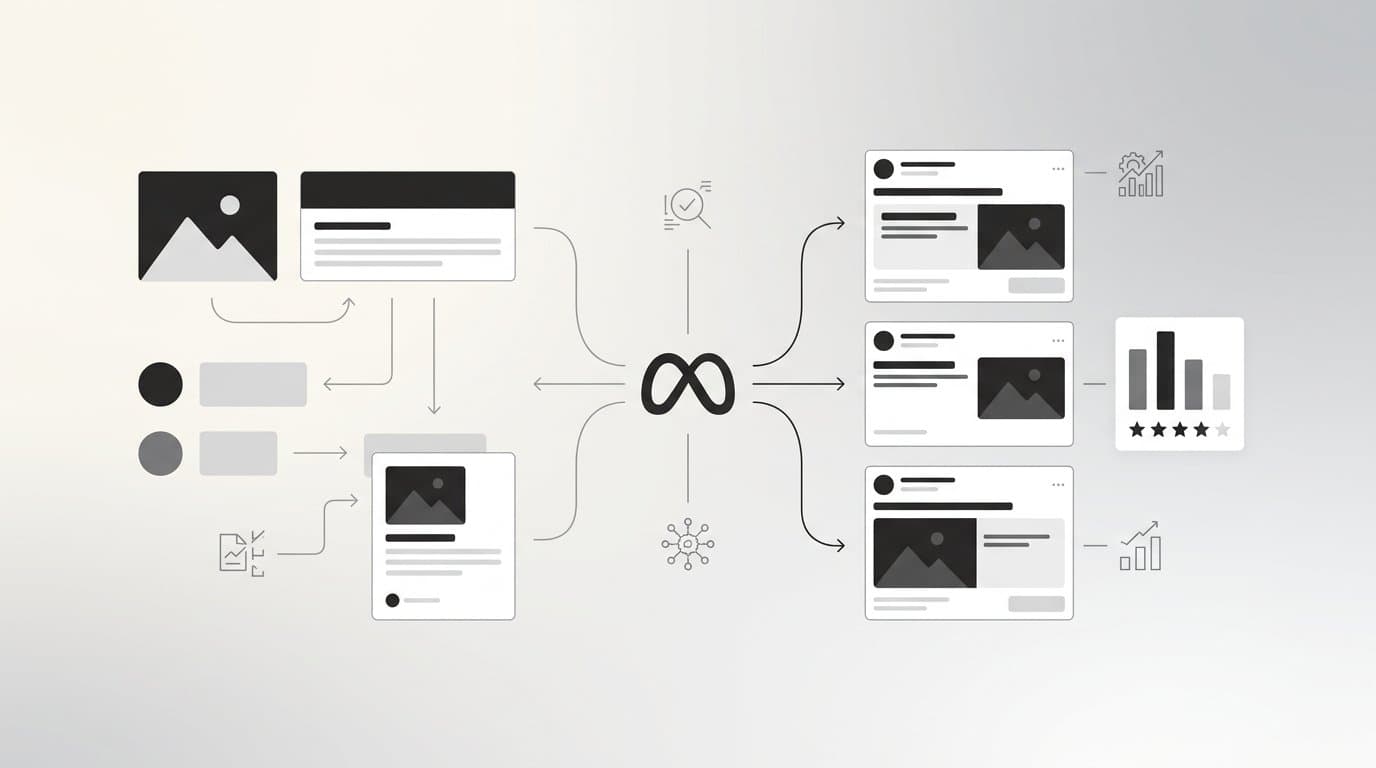
DCO allows you to upload multiple versions of each creative component—up to 10 images or videos, 5 headlines, 5 descriptions, and 5 CTAs. Meta's system then automatically generates and tests different combinations, learning which elements perform best together. The algorithm allocates more budget to winning combinations while continuing to test new pairings.
What makes this powerful is the granularity of insights. Instead of knowing "Ad A beat Ad B," you learn that a specific headline paired with a particular image drives conversions, while that same headline underperforms with other visuals. These component-level insights become building blocks for future campaigns.
The framework works best when you're testing fundamentally different creative approaches rather than minor variations. Think different value propositions, varied visual styles, or contrasting messaging angles. For a deeper dive into automating this process, explore how creative testing automation can accelerate your learning cycles.
Implementation Steps
1. Prepare 3-5 distinct images or videos that represent different creative concepts, not just minor variations of the same idea.
2. Write 3-5 headlines that emphasize different benefits or angles (price, speed, quality, results, ease of use).
3. Create 3-5 primary text variations that match your headline themes and expand on those value propositions.
4. Enable Dynamic Creative in your ad set settings and upload all assets, ensuring each component is meaningfully different from the others.
5. Let the test run until you have at least 50 conversions total before drawing conclusions about individual elements.
6. Review the asset performance breakdown in Ads Manager to identify your top-performing components across each category.
Pro Tips
Don't mix testing objectives—if you're testing messaging angles, keep visual style consistent. If testing visual approaches, keep copy similar. Meta's algorithm learns faster when you give it clear signals. Also, resist the urge to pause underperforming combinations too early. The system needs time to explore the full possibility space before it can reliably optimize.
2. Structured A/B Testing with Isolated Variables
The Challenge It Solves
When you change multiple elements between ad variations, you can't determine which change actually drove the performance difference. Did the new ad win because of the headline, the image, the offer, or some combination? Without isolating variables, you're collecting data points but not building transferable knowledge.
This scientific approach gives you definitive answers about what moves the needle, creating a foundation of proven insights you can apply across campaigns.
The Strategy Explained
Structured A/B testing means changing exactly one variable between your control ad and test variation while keeping everything else identical. You might test two different headlines with the same image, copy, and CTA. Or two different images with identical text elements. Each test answers one specific question.
The power comes from accumulating these single-variable insights over time. After testing headlines, you know which messaging angle resonates. After testing images, you know which visual style converts. After testing CTAs, you know which action prompt works. When you combine all your winning elements, you've engineered a high-performer rather than stumbling onto one.
This method requires patience and discipline, but it builds the most reliable knowledge base for long-term scaling. If you're finding that your creative testing is running slow, structured A/B testing helps you focus resources on the highest-impact variables first.
Implementation Steps
1. Start with your current best-performing ad as the control, or create a baseline ad if starting fresh.
2. Choose one element to test first—headline, primary text, image, video hook, or CTA.
3. Create one or more variations that change ONLY that element, keeping everything else identical.
4. Set up an A/B test in Meta's experiment tool or create duplicate ad sets with identical targeting and budgets.
5. Run the test until you reach statistical significance—Meta generally recommends at least 100 conversions per variation.
6. Document your winner, then move to testing the next variable using your winning ad as the new control.
Pro Tips
Create a testing roadmap before you start so you're not deciding what to test next on the fly. Prioritize testing elements that have the biggest potential impact—usually your core value proposition and primary visual. Keep a spreadsheet of all test results so you can spot patterns across multiple experiments. Sometimes an element that loses one test becomes a winner when paired with different components.
3. The Concept Testing Ladder
The Challenge It Solves
Jumping straight into testing specific creative executions before validating your core messaging often leads to optimizing the wrong thing. You might perfect an ad that promotes the wrong benefit, or polish creative for an audience that doesn't care about your offer. The result is well-tested ads that still don't scale.
The concept testing ladder ensures you validate strategic decisions before investing in tactical refinements.
The Strategy Explained
This progressive testing methodology works from broad to specific across three levels. First, test different value propositions or messaging angles to identify which core benefit resonates most. Second, test creative formats and styles that best communicate your winning concept. Third, test specific executions within your winning format.
Think of it as zooming in progressively. You start by testing whether your audience cares more about saving time, saving money, or achieving better results. Once you know "saving time" wins, you test whether video demonstrations or before/after images better convey that benefit. Finally, you test which specific video script or which exact before/after comparison performs best.
This approach prevents the common mistake of perfectly optimizing a fundamentally flawed concept. Building a comprehensive creative testing strategy ensures each level of testing feeds into the next.
Implementation Steps
1. Identify 3-4 distinct value propositions or messaging angles your product could emphasize (different benefits, different use cases, different outcomes).
2. Create simple test ads for each concept—these don't need to be polished, just clear enough to communicate the core idea.
3. Run these concept tests with modest budgets to identify which strategic direction resonates most with your audience.
4. Once you have a winning concept, test 2-3 different creative formats or styles for presenting that message (video vs. static, testimonial vs. demonstration, etc.).
5. After identifying your winning format, create multiple executions within that format to find the specific creative that maximizes performance.
6. Continue refining at the execution level while periodically re-testing concepts to ensure your core message remains optimal as markets evolve.
Pro Tips
Don't skip the concept level even if you think you know what will work. Markets change, and what resonated six months ago might not be your strongest angle today. Also, budget your testing investment appropriately—spend less on broad concept tests, more on format tests, and most on execution refinement once you've validated the strategic foundation.
4. Audience-Creative Matrix Testing
The Challenge It Solves
Most advertisers test creative in isolation from audience, assuming a winning ad will work across all segments. But different audiences respond to different messaging, visual styles, and value propositions. Your best ad for cold traffic might bomb with retargeting audiences. Your winning creative for one demographic might completely miss with another.
Matrix testing reveals these audience-creative interactions, helping you match the right message to the right people instead of using one-size-fits-all creative.
The Strategy Explained
Audience-creative matrix testing means systematically pairing different creative variations with different audience segments to identify optimal matches. You might test three creative concepts against four audience segments, creating a 3x4 matrix of 12 combinations. The goal is discovering which creative resonates with which audience.
This approach recognizes that creative performance is contextual. An ad emphasizing advanced features might crush it with existing customers but confuse cold prospects. A benefit-focused ad might win with broad audiences but feel elementary to sophisticated buyers. By testing these pairings explicitly, you can customize creative for each audience instead of compromising with generic messaging.
The insights from matrix testing also inform audience strategy—sometimes you discover an audience segment you hadn't prioritized that responds incredibly well to specific creative, opening new scaling opportunities. Leveraging automated Meta ads targeting can help you efficiently test across multiple audience segments simultaneously.
Implementation Steps
1. Define 3-4 distinct audience segments you want to test (cold prospects, website visitors, engaged users, past customers, different demographics, etc.).
2. Create 3-4 creative variations that emphasize different angles, benefits, or approaches.
3. Set up separate ad sets for each audience segment, ensuring identical budgets and settings for fair comparison.
4. Run all creative variations in each ad set simultaneously so every creative gets tested with every audience.
5. Analyze performance by both creative and audience—look for creative that wins across all audiences AND creative that excels with specific segments.
6. Build audience-specific creative strategies based on your findings, using universal winners for broad campaigns and segment-specific winners for targeted efforts.
Pro Tips
Start with your most strategically important audience segments rather than testing every possible micro-audience. The goal is finding meaningful patterns, not exhaustive coverage. Also, look for negative interactions—creative that performs well with most audiences but tanks with one specific segment tells you something important about that audience's preferences or awareness level.
5. Rapid Iteration Testing at Scale
The Challenge It Solves
Traditional testing methodologies require weeks to reach statistical significance, especially with smaller budgets or longer conversion cycles. By the time you identify a winner, market conditions have shifted, creative has fatigued, or competitors have copied your approach. You need insights faster than careful A/B tests can deliver them.
Rapid iteration testing prioritizes learning velocity over statistical perfection, generating directional insights quickly so you can act while opportunities are fresh.
The Strategy Explained
This high-volume approach involves launching many creative variations simultaneously with smaller individual budgets, letting Meta's algorithm quickly identify promising performers, then doubling down on winners while killing losers fast. Instead of testing 2-3 variations carefully, you might test 10-15 variations aggressively.
The strategy accepts that some tests won't reach perfect statistical confidence but compensates through volume and speed. You're looking for clear signals—creative that obviously outperforms or underperforms within days rather than weeks. Marginal differences get ignored; only strong signals trigger action.
This works especially well when you have strong creative production capabilities and can generate variations quickly. The ability to launch multiple Meta ads at once becomes essential for maintaining testing velocity at this scale.
Implementation Steps
1. Develop a production system that can generate 10+ creative variations weekly—this might mean templates, freelancer networks, or AI tools.
2. Launch all new variations simultaneously in a dedicated testing campaign with automated rules for budget allocation.
3. Set aggressive kill criteria—pause any creative that doesn't show promising signals within 48-72 hours or $50-100 spend.
4. Increase budgets on clear winners immediately rather than waiting for perfect statistical confidence.
5. Graduate winning creative from your testing campaign into your main campaigns while continuing to test new variations.
6. Maintain a consistent testing cadence—launch new creative variations on the same schedule every week to build institutional learning velocity.
Pro Tips
This approach requires discipline about killing losers quickly. Many advertisers can't pull the plug on creative that isn't obviously failing, letting mediocre performers drain budget that should go to winners or new tests. Also, track your testing efficiency ratio—what percentage of tests produce scalable winners? If that number drops, you're testing too many similar variations rather than genuinely different concepts.
6. Format-Specific Testing Protocols
The Challenge It Solves
Different ad formats have different performance drivers and require different testing approaches. What matters most in a video ad—the first three seconds, the overall concept, or the final CTA? For carousel ads, is sequence important or do individual cards matter more? Static images depend heavily on immediate visual impact, while videos can build narrative over time.
Generic testing approaches miss these format-specific nuances, leading to suboptimal insights and missed optimization opportunities.
The Strategy Explained
Format-specific protocols mean adapting your testing methodology to match how each ad format actually works. For static images, you might focus on testing visual hierarchy, color schemes, and text overlays since users process these elements instantly. For videos, you'd prioritize testing hooks (the first 3 seconds), story structure, and pacing since engagement unfolds over time. For carousels, you'd test card sequencing, individual card messaging, and whether to use repetition or variety across cards.
Each format also has different engagement patterns that affect how you interpret results. Video metrics include watch time and completion rates alongside standard conversion metrics. Carousel ads show per-card performance data. Static images rely primarily on click-through and conversion rates since there's no time-based engagement.
By tailoring your testing approach to format characteristics, you generate insights that actually help you improve that specific format rather than generic findings that don't transfer. For Instagram-specific considerations, understanding Instagram ad creative testing methods helps you optimize for that platform's unique engagement patterns.
Implementation Steps
1. For static image testing: Create variations that test visual composition, color psychology, text overlay prominence, and product presentation angles while keeping copy constant.
2. For video testing: Focus on hooks first (test 3-5 different opening sequences), then test story structures with your winning hook, finally test different CTAs and closing sequences.
3. For carousel testing: Start by testing card sequencing with the same content, then test individual card creative, finally test the number of cards (3 vs. 5 vs. 7).
4. Analyze format-specific metrics alongside conversion data—thumb-stop rate for images, 3-second and 15-second view rates for videos, card engagement distribution for carousels.
5. Build format-specific creative guidelines based on your findings—what works for static images might not work for video and vice versa.
6. Rotate between formats in your testing calendar so you're continuously improving performance across all creative types rather than optimizing just one.
Pro Tips
Don't assume learnings transfer between formats. A headline that crushes in static image ads might not work as a video hook because the consumption context is different. Also, consider that different formats work better at different funnel stages—videos often excel for cold traffic education, while static images can work well for direct response with warm audiences.
7. Performance Data Analysis and Winner Selection
The Challenge It Solves
Raw performance data doesn't automatically tell you which creative won or what to do next. One ad might have better CTR but worse conversion rates. Another might have higher CPA but better customer LTV. A third might show great early metrics but fail to sustain performance at scale. Without a clear framework for evaluating results, you end up with data paralysis or making decisions based on vanity metrics.
A structured analysis framework transforms test data into actionable decisions and builds a library of proven creative elements you can deploy with confidence.
The Strategy Explained
Effective analysis starts with defining your primary success metric before testing begins—usually cost per conversion, ROAS, or a custom metric that aligns with your business model. This prevents the common mistake of declaring winners based on whichever metric happens to look best. You also need to establish minimum thresholds for statistical confidence and business significance.
Beyond declaring winners, sophisticated analysis looks for patterns across multiple tests. Which creative elements appear consistently in winning ads? What characteristics do losing ads share? Are there interaction effects where certain elements only work when paired together? These meta-insights become your creative playbook.
The final piece is building a winners library—a documented collection of proven creative elements organized by component type, performance level, audience fit, and testing context. Understanding how to build a winning creative library transforms isolated test wins into a scalable asset. This library becomes your scaling foundation, letting you quickly deploy proven creative rather than starting from scratch with each new campaign.
Implementation Steps
1. Define your primary success metric and minimum performance thresholds before launching any test—what result makes a creative worth scaling?
2. Set statistical confidence requirements based on your budget and timeline—Meta generally recommends 100+ conversions per variation for high confidence, but you might accept directional signals with 50+ for faster iteration.
3. Create a standardized analysis template that evaluates every test consistently: primary metric performance, secondary metric performance, statistical confidence level, and qualitative observations.
4. After each test, document not just the winner but the specific elements that contributed to winning performance—was it the headline, the visual, the offer, the audience fit?
5. Build a winners library organized by creative component (winning headlines, winning images, winning hooks, winning CTAs) with performance context for each element.
6. Review your winners library monthly to identify patterns and update your creative brief templates based on accumulated insights.
Pro Tips
Look beyond immediate conversion metrics to understand creative sustainability. Some ads show strong early performance but fatigue quickly. Others start slower but maintain consistent performance at scale. Using a Meta ads dashboard helps you track performance over time to distinguish flash-in-the-pan winners from sustainable creative. Also, don't delete losing ads from your analysis—understanding why creative failed is often more valuable than knowing why it succeeded.
Your Testing Implementation Roadmap
The most effective creative testing strategy isn't choosing one method—it's knowing which approach fits your current situation and building toward more sophisticated testing as you scale.
If you're just starting or have limited budget, begin with structured A/B testing. The isolated variable approach builds reliable knowledge without requiring large budgets or complex setups. Test your headline first, then your primary visual, then your offer. Document everything. These foundational insights will inform every future campaign.
Once you have baseline knowledge and consistent conversion volume, layer in Dynamic Creative testing. DCO accelerates learning by testing combinations automatically, but it works best when you already understand which types of elements perform well. Use your A/B test insights to inform which assets you upload to DCO.
As your budget and creative production capabilities grow, adopt rapid iteration testing. The high-volume approach requires infrastructure—creative production systems, budget to sustain multiple simultaneous tests, and discipline to kill losers quickly. But it creates competitive advantage through learning velocity that careful testing can't match. Implementing campaign automation helps manage this complexity without burning out your team.
Throughout this progression, use the concept testing ladder to ensure you're optimizing the right strategic foundation. Periodically step back from execution-level testing to validate that your core messaging still resonates. Markets evolve, and yesterday's winning concept might not be today's best angle.
The compounding advantage of systematic creative testing becomes obvious over time. Each test generates insights that inform the next test. Your winners library grows. Your creative briefs get sharper. Your production team learns what works. Your hit rate on new creative improves. This accumulated knowledge becomes a moat that competitors can't easily replicate.
The difference between advertisers who scale profitably and those who plateau isn't creative talent—it's having systems that consistently generate, test, and identify winning creative faster than the competition.
Ready to transform your advertising strategy? Start Free Trial With AdStellar AI and be among the first to launch and scale your ad campaigns 10× faster with our intelligent platform that automatically builds and tests winning ads based on real performance data.