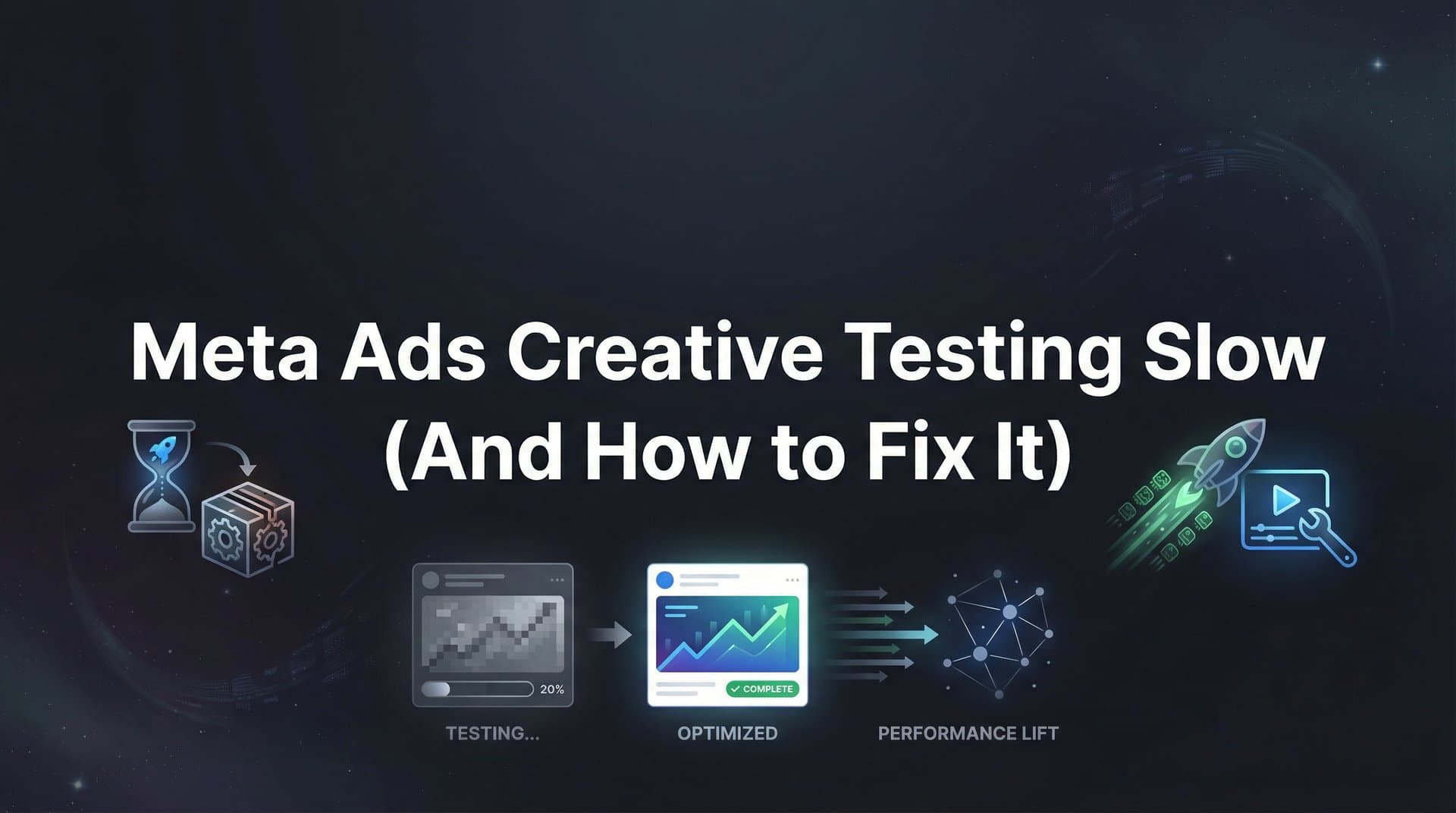
You've got a creative concept that could be a game-changer. Your designer delivered three variations last week. You've set up the campaigns, allocated budget, and now you're waiting. And waiting. And waiting some more.
Two weeks later, you're staring at inconclusive data. One creative has 47 conversions, another has 52, and the third has 41. Are these differences meaningful? Should you wait longer? Meanwhile, your competitor just launched something similar, and that brilliant idea you had doesn't feel quite so fresh anymore.
This is the creative testing paradox: you need statistically significant results to make confident decisions, but by the time you have them, market conditions have shifted, budgets have been spent, and opportunities have passed. The frustration isn't just about slow results—it's about watching your competitive advantage evaporate while you wait for data to accumulate.
Here's the truth: slow creative testing isn't an inevitable reality of Meta advertising. It's a solvable operational challenge with specific causes and practical solutions. This article will help you diagnose exactly why your creative testing drags on for weeks, and show you how to compress those timelines without sacrificing the data quality you need to make confident decisions.
The Anatomy of a Stalled Creative Test
Let's break down what actually happens during a typical creative test, because understanding the timeline reveals where the delays hide.
Day 1-2: Campaign setup. You're building ad sets, uploading creatives, writing copy variations, and configuring targeting parameters. If you're doing this manually, you're probably spending 2-3 hours per campaign variation. Multiply that across multiple creative concepts, and you've already lost a full workday before a single impression is served.
Day 3-9: The learning phase. This is where Meta's algorithm becomes your bottleneck. According to Meta's own documentation, ad sets need approximately 50 conversion events within a 7-day window to exit the learning phase and stabilize performance. During this period, your ads are being shown to different audience segments as the algorithm figures out who responds best. Understanding why the Meta Ads learning phase takes too long is crucial for diagnosing your testing delays.
Here's the mathematical reality: if your conversion rate is 2% and your cost per click is $1, you need 2,500 clicks to generate 50 conversions. At a daily budget of $100, that's 25 days of spending before you have stable performance data. Most marketers dramatically underestimate this timeline.
Day 10-21: Data accumulation. Even after exiting the learning phase, you need enough data to reach statistical significance. Testing two creatives against each other requires each to generate enough conversions that the performance difference isn't just random variation. Depending on your baseline conversion rate and the magnitude of difference you're trying to detect, this can take another 1-2 weeks.
Day 22-28: Analysis paralysis. You've finally got data, but now you're second-guessing yourself. Is a 15% difference in conversion rate meaningful? Should you wait another week to be sure? What if the winning creative just got lucky with audience timing? This decision-making lag can add another week to your testing cycle.
Add it all up, and you're looking at 4-6 weeks from creative concept to confident decision. In fast-moving markets, that's an eternity. Your competitors have launched, iterated, and optimized while you're still validating your first hypothesis.
The hidden time sinks make this worse. Coordinating with design teams adds 3-5 days. Waiting for creative approval from stakeholders adds another 2-3 days. Manual campaign duplication and setup errors that require rebuilding can add a week. These aren't testing delays—they're execution delays that happen before testing even begins.
Budget Constraints That Bottleneck Your Testing Speed
Your budget strategy directly determines how fast you can test. Most marketers get this backwards, and it costs them weeks of time.
Picture this scenario: you have $200 per day to spend on creative testing, and you want to test 10 different creative variations. The instinct is to split that budget evenly—$20 per ad set. It feels fair, comprehensive, and scientific.
But here's the math that kills your timeline: at $20/day with a $2 CPC, you're getting 10 clicks per day per creative. If your conversion rate is 2%, that's 0.2 conversions per day per creative. To reach 50 conversions for learning phase exit, you need 250 days per creative. That's not a typo—250 days.
Now consider the alternative: test 3 creatives at $67/day each. Same total budget, but now each creative gets 33 clicks per day. At a 2% conversion rate, that's 0.66 conversions per day, reaching 50 conversions in 76 days. Still slow, but 3× faster than the spread-thin approach.
The principle is simple: budget concentration beats budget distribution when testing speed matters. Every additional creative you test simultaneously extends your timeline proportionally. The false economy of "testing everything" means you end up with weak signals across many options instead of strong signals on a few strategic choices. Addressing Meta Ads budget allocation issues is often the fastest path to accelerating your testing cycles.
This creates a strategic question: how do you decide which creatives deserve concentrated budget? The answer lies in hypothesis strength. Not all creative ideas are created equal. Some are based on proven patterns from past winners, specific audience insights, or clear competitive advantages. Others are speculative "wouldn't it be cool if..." concepts.
Smart testers prioritize budget toward high-confidence hypotheses. If you have three creatives based on proven patterns and seven based on hunches, allocate 70% of your budget to the proven-pattern group and 30% to the speculative group. This asymmetric allocation lets you validate your strongest ideas quickly while still exploring new territory.
The budget-speed relationship also depends on your conversion event. Testing for purchases requires more budget than testing for add-to-carts because purchase conversion rates are typically 5-10× lower. This is why many experienced advertisers use a two-stage testing approach: broad creative validation at higher-funnel events, then focused scaling tests at purchase events.
Audience Size and Conversion Volume: The Speed Multipliers
Your audience strategy might be your biggest testing bottleneck, and you probably don't realize it.
Narrow audiences feel precise and strategic. "Women aged 25-34 interested in sustainable fashion who have visited my website in the past 30 days" sounds like smart targeting. But when that audience is only 50,000 people and your budget is $100/day, you're creating a mathematical ceiling on testing speed.
Small audiences limit impression volume, which limits click volume, which limits conversion volume. If your narrow audience only allows Meta to serve 5,000 impressions per day, and your CTR is 1%, you're getting 50 clicks. At a 2% conversion rate, that's one conversion per day. You need 50 days to exit the learning phase, and another 30-50 days to reach statistical significance.
Broader audiences solve this problem by removing the impression ceiling. An audience of 5 million people gives Meta room to find the people most likely to convert quickly, accelerating your data accumulation. This doesn't mean abandoning targeting—it means separating testing strategy from scaling strategy.
During testing phases, use broader audiences to accelerate learning. Test your creative concepts against "Women aged 21-45 interested in fashion" instead of your hyper-specific niche. Once you've identified winning creatives, then narrow your targeting for scaling. This two-phase approach can cut testing timelines in half. Implementing automated Meta Ads targeting can help you quickly test across different audience segments without manual setup delays.
The conversion event selection creates a similar speed trade-off. Optimizing for purchases gives you the most accurate performance data—these creatives actually drive revenue. But purchase conversion rates are low, making tests slow. Optimizing for add-to-carts or landing page views generates 5-10× more conversion events, speeding up the learning phase dramatically.
The strategic question becomes: can you trust higher-funnel metrics to predict lower-funnel performance? The answer depends on your funnel efficiency. If your add-to-cart to purchase rate is consistent across different traffic sources and creatives, then add-to-cart is a reliable proxy. If it varies wildly, you need to test at the purchase level despite the slower timeline.
Many advertisers find success with a hybrid approach: use add-to-cart optimization during initial creative testing to quickly eliminate poor performers, then run a focused purchase-optimized test on the top 2-3 winners. This compressed timeline approach gets you to confident decisions faster than testing everything at the purchase level from the start.
Manual Workflows: The Invisible Time Thief
Let's talk about what happens before your test even starts, because this is where days and weeks disappear without anyone noticing.
You've got your creative assets ready. Now you need to build the campaigns. Open Ads Manager, create a new campaign, duplicate your existing structure, upload the new creative, adjust the campaign name, update the ad copy, check the targeting settings, set the budget, review the placement options, and launch. Fifteen minutes later, you've built one ad variation.
Now do that nine more times for your other creative variants. That's 2.5 hours of clicking, typing, and double-checking. And that's assuming you don't make mistakes that require rebuilding campaigns, which happens more often than anyone admits.
This manual execution time isn't just tedious—it's a bottleneck where testing waits on human availability rather than data readiness. Your designer delivered the creatives on Monday morning. You were in meetings until Tuesday afternoon. You built the campaigns Tuesday evening but realized you needed approval from your manager. She reviewed them Thursday morning and requested changes. You implemented the changes Thursday afternoon and launched Friday. Your test started five days after the creatives were ready.
Multiply this across every testing cycle, and you're spending 20-30% of your total testing timeline on manual execution rather than actual testing. The opportunity cost is staggering: while you're building campaigns, your competitors are analyzing results and iterating. Implementing Meta Ads workflow automation can eliminate these execution delays entirely.
The coordination tax makes this worse. Creative testing involves multiple people: strategists who define hypotheses, designers who create assets, copywriters who write variations, and media buyers who build campaigns. Each handoff adds delay. The designer finishes Monday but the copywriter is busy until Wednesday. The copywriter delivers Wednesday but the media buyer is focused on other accounts until Friday.
These aren't individual failures—they're systemic workflow problems. Manual processes create dependencies where testing speed is limited by the slowest person in the chain. When you're testing 10 creative variations per month, that's manageable. When you're trying to test 50 variations per month to stay competitive, manual workflows become impossible.
This is where automation transforms testing speed. Not automation that replaces strategic thinking, but automation that eliminates execution lag. When campaign building takes 30 seconds instead of 15 minutes, when creative variations can be launched in bulk instead of one at a time, when historical performance data automatically informs new tests, the bottleneck shifts from execution back to data accumulation—where it should be. Understanding Meta Ads creative automation is essential for teams looking to break through these operational constraints.
Structuring Tests for Faster, Cleaner Results
How you structure your tests determines both speed and clarity. Most advertisers structure tests in ways that guarantee slow, confusing results.
The fundamental question is: are you testing creative concepts or creative elements? This distinction matters more than most people realize.
Creative concept testing means comparing fundamentally different approaches. One ad showcases your product in use, another focuses on customer testimonials, and a third emphasizes your unique value proposition. These are distinct strategic directions, and testing them gives you clear directional guidance. Concept-level tests often provide actionable insights faster because the differences are large enough to show up in smaller sample sizes.
Creative element testing means comparing variations of the same concept. You're testing different headlines on the same image, or different CTAs on the same video. Element-level tests require larger sample sizes because you're looking for smaller performance differences. They take longer but provide precision once you've identified your winning concept.
The strategic implication: test concepts first, elements second. Start with 3-4 distinct creative concepts at higher budgets to quickly identify which strategic direction works best. Once you have a winning concept, then invest time in element-level optimization. This sequential approach is faster than trying to test concepts and elements simultaneously. A solid Meta Ads creative testing strategy will help you prioritize which tests to run first.
Test isolation determines how cleanly you can interpret results. The gold standard is changing one variable at a time: same audience, same placement, same budget, different creative. This makes attribution clear—if Creative A outperforms Creative B, you know the creative caused the difference.
But single-variable testing is slow when you have multiple hypotheses. Multivariate testing—changing multiple variables simultaneously—can be faster but introduces interpretation challenges. If you test different creatives with different audiences, and one combination wins, you don't know whether the creative or the audience drove the result.
The practical compromise: use controlled multivariate testing where you test multiple variables but in a structured way that preserves interpretability. Test Creative A and B against Audience 1, and also test Creative A and B against Audience 2. Now you can separate creative effects from audience effects even though you're testing both simultaneously.
Determining minimum viable test duration requires math, not guesswork. The formula depends on three inputs: daily budget, conversion rate, and the minimum detectable effect you care about. If you need to detect a 20% improvement in conversion rate and your baseline is 2%, you need roughly 1,500 conversions per variation to reach 95% statistical confidence. At 10 conversions per day, that's 150 days. At 50 conversions per day, that's 30 days.
This math reveals an uncomfortable truth: many tests are underpowered from the start. Advertisers launch tests without calculating whether their budget and timeline can generate enough data to reach significance. Then they make decisions based on noise rather than signal, leading to false conclusions and wasted spend. Following Meta Ads campaign structure best practices ensures your tests are set up for success from day one.
Accelerating Your Testing Cycle Without Sacrificing Quality
Let's get tactical. Here are the specific levers you can pull to compress testing timelines while maintaining data integrity.
First, increase daily budgets during test phases. This sounds obvious but most advertisers resist it because it feels risky. The counterintuitive truth: spending more during testing often reduces total testing costs because you reach conclusions faster. Spending $300/day for 15 days costs the same as spending $150/day for 30 days, but you get results twice as fast.
The key is treating testing budget as a separate allocation from scaling budget. Many advertisers try to test and scale simultaneously with the same budget, which means both happen slowly. Instead, dedicate a fixed testing budget that runs at higher daily spend until you have clear winners, then shift that budget to scaling the winners.
Second, use engagement metrics as early indicators before conversion data matures. Click-through rate, video completion rate, and engagement rate typically stabilize within 2-3 days—much faster than conversion data. While these metrics don't directly predict conversion performance, they can help you eliminate obvious losers early.
If Creative A has a 0.5% CTR and Creative B has a 2.0% CTR after three days, Creative A probably isn't going to win the conversion test either. You can reallocate that budget to stronger performers without waiting for full conversion data. This progressive elimination approach speeds up overall testing by concentrating budget on viable candidates faster.
Third, set clear decision criteria before tests begin. Most testing delays happen during the analysis phase when you're trying to decide whether results are "good enough." Eliminate this paralysis by defining success metrics upfront: "We'll declare a winner when one creative achieves 20% higher ROAS than the others with 90% statistical confidence, or after 21 days, whichever comes first."
This pre-commitment prevents the common trap of extending tests indefinitely because results are "almost conclusive." Sometimes inconclusive results are the result—they tell you the creatives perform similarly, which is valuable information that should trigger a new round of more differentiated testing rather than endless waiting.
Fourth, leverage AI-powered tools that compress execution timelines. Modern platforms can analyze your historical performance data, identify patterns in winning creatives, and automatically generate and launch variations at scale. What used to take 2-3 hours of manual campaign building now happens in under a minute. Exploring AI for Meta Ads campaigns can dramatically reduce the time between creative concept and live test.
This isn't about removing human strategy—it's about removing human bottlenecks. AI handles the repetitive execution: building campaigns, applying proven targeting patterns, and launching variations. You focus on the strategic decisions: which concepts to test, how to interpret results, and what to do with the insights. This division of labor can reduce total testing cycle time by 40-60%.
Fifth, build a winners library so future tests start from proven elements rather than scratch. Every test generates insights about what works—specific headlines, value propositions, visual styles, and audience segments. Documenting these winning elements creates a knowledge base that accelerates future testing. Creating a Meta Ads winning creative library ensures you're building on past successes rather than starting from zero each time.
When you launch your next test, you're not guessing blindly. You're combining proven elements in new ways, which increases your baseline success rate and reduces the number of complete failures you need to test through. Over time, this compounding knowledge advantage dramatically accelerates your testing velocity.
From Testing Bottleneck to Competitive Advantage
Slow creative testing isn't an inevitable reality—it's an operational challenge with specific causes and practical solutions. The timeline compression comes from addressing multiple bottlenecks simultaneously: concentrating budget on fewer, higher-confidence tests; using broader audiences during testing phases; automating manual execution workflows; structuring tests for clear, fast insights; and building systematic knowledge that improves with every cycle.
The advertisers who win in competitive markets aren't necessarily the ones with bigger budgets or better creatives. They're the ones who can iterate faster—testing more hypotheses, learning from results more quickly, and scaling winners before opportunities pass. Learning how to scale Meta Ads efficiently becomes much easier once you've solved your testing speed problem.
Take a hard look at your current testing process. Where are you losing time? Is it budget spread too thin across too many variations? Manual workflows that delay launches by days? Audience constraints that limit data volume? Decision paralysis during analysis? Most advertisers have 2-3 major bottlenecks that, if addressed, could cut testing timelines by 50% or more.
The competitive landscape is shifting toward rapid iteration. AI-powered tools are making fast, data-driven creative testing accessible to teams of all sizes. The question isn't whether to accelerate your testing—it's whether you'll do it before your competitors do.
Ready to transform your advertising strategy? Start Free Trial With AdStellar AI and be among the first to launch and scale your ad campaigns 10× faster with our intelligent platform that automatically builds and tests winning ads based on real performance data.