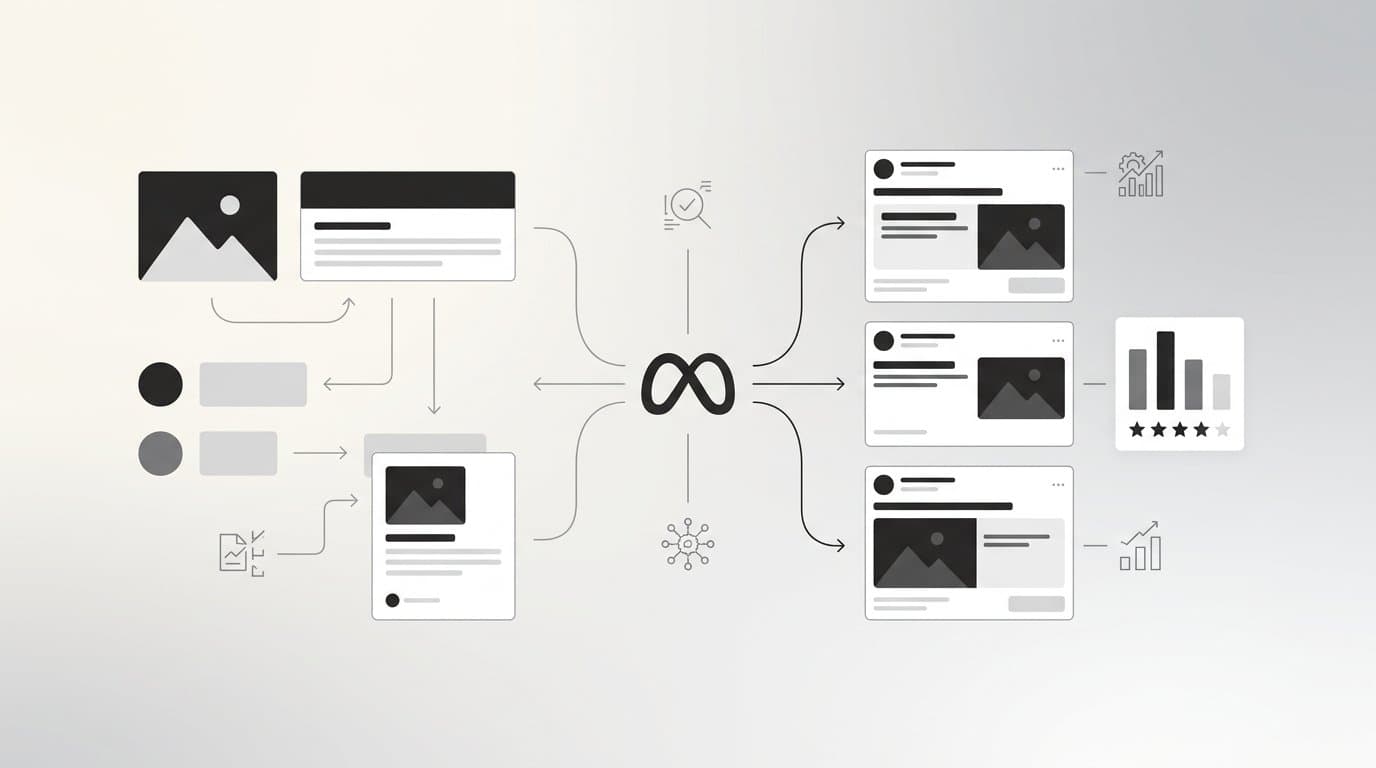
Your Meta ad campaign just crushed it last quarter. 4.2x ROAS. CTR through the roof. That perfect storm of headline, creative, and audience targeting that made your boss actually smile.
Fast forward three months. You need to launch a similar campaign. Where's that winning combination? Buried somewhere in Ads Manager's graveyard of 247 past campaigns. The image file? Maybe in a folder labeled "Q3_Finals_ACTUAL_v7." The audience settings? Good luck.
You end up spending two hours playing detective in your own account, eventually giving up and starting from scratch. Meanwhile, that proven formula that generated real revenue sits forgotten, its institutional knowledge evaporating like morning fog.
This isn't just inefficient—it's leaving money on the table. Every time you rebuild what already worked, you're paying the learning tax twice. Every successful campaign that disappears into the void represents wasted creative investment and lost compounding returns.
The solution isn't complicated: a winning creative library. Think of it as your greatest hits album for Meta ads—a systematic approach to capturing, organizing, and reusing the ad elements that actually drive results. Not every test you've run, not your creative team's favorite concepts, but the stuff that made the cash register ring.
When done right, a winning creative library transforms how you launch campaigns. Instead of starting each one as a blank canvas experiment, you're remixing proven ingredients. Faster launches. More consistent performance. Creative investments that compound rather than expire.
In this guide, you'll learn exactly how to build your own winning creative library—what to include, how to organize it, and most importantly, how to turn it from a static archive into an active campaign launch engine that makes your advertising exponentially more efficient.
The Hidden Cost of Forgetting What Works
Here's what typically happens after a successful Meta ad campaign ends: nothing. The campaign stops running, and all that valuable performance intelligence gets locked away in Meta's interface, accessible only through increasingly tedious navigation as new campaigns pile on top.
That winning combination of headline, creative, and audience targeting? It's technically still there, but practically invisible. Three months later when you want to replicate that success, you're clicking through dozens of old campaigns, trying to remember which one had the magic formula. Was it "Spring_Launch_Final" or "Spring_Launch_ACTUAL_Final_v3"?
This isn't just annoying—it's expensive. The average marketer spends 3-5 hours per week searching for and attempting to recreate elements from past successful campaigns. That's 156-260 hours per year spent on digital archaeology instead of strategy. For a marketing manager earning $75,000 annually, that's roughly $5,600-$9,400 in salary allocated to finding stuff you already created.
But the bigger cost is opportunity loss. When you can't easily access what worked before, you default to starting fresh. And starting fresh means paying the learning tax all over again—that initial period where Meta's algorithm tests your new creative, audiences gradually optimize, and you burn budget figuring out what resonates.
Consider what happens when institutional knowledge walks out the door. Your star media buyer leaves for another company, taking mental notes about which creative angles crushed it with which audiences. The new hire inherits an Ads Manager account with 300 campaigns and zero context about what actually moved the needle. This difficulty replicating winning Facebook ads becomes a recurring drain on resources and performance.
Even worse is the false confidence of "I remember what worked." Memory is notoriously unreliable for specific details. You remember the campaign was successful, but was the winning headline "Transform Your Marketing in 30 Days" or "30-Day Marketing Transformation"? Did that audience include or exclude website visitors? These details matter enormously for performance, but they blur in memory.
The compounding problem is that every successful campaign represents creative investment—designer time, copywriter effort, strategist thinking, and ad budget spent testing. When those investments disappear into the void instead of being systematically captured for reuse, you're essentially throwing away assets that could continue generating returns indefinitely.
What Actually Goes in Your Creative Arsenal
A winning creative library isn't a dumping ground for everything you've ever run. It's a curated collection of elements that have proven themselves through actual performance data. Think quality over quantity—this is your hall of fame, not your storage unit.
The foundation is your visual assets. These are the images, videos, and carousel combinations that generated results. Not the ones your designer loved or the ones that won internal debates, but the ones that made Meta's algorithm happy and your audience click. For each visual asset, you need the actual file plus context: what campaign it ran in, what objective it served, and most importantly, the performance metrics that earned it winner status.
Copy elements form the second pillar. Your library should capture proven headlines, primary text variations, and calls-to-action as discrete, reusable components. The headline that generated a 2.8% CTR deserves to live on beyond its original campaign. Same for that primary text that drove conversion rates 40% above account average. These aren't just words—they're tested messaging that resonates with your specific audience.
Audience definitions are your third critical component. That custom audience combining website visitors from the past 30 days, excluding purchasers, with specific interest overlays? If it performed, capture it completely. The exact parameters, the logic, the size, and the performance benchmarks. Audiences are often the hardest element to recreate from memory because they involve multiple layers of inclusion and exclusion criteria.
Winning combinations matter as much as individual elements. Sometimes magic happens when specific components come together—a particular image paired with a specific headline targeting a defined audience. Your library should capture these proven recipes, not just the ingredients. When you find a combination that consistently delivers 5x ROAS, that's a formula worth preserving intact.
Now, what qualifies as "winning"? This is where you need clear performance thresholds. Generic criteria like "it did okay" won't cut it. Define specific benchmarks that elements must hit to earn library status.
For most Meta advertisers, winning elements typically exceed account averages by meaningful margins. If your average ROAS is 3x, winners might need to hit 4x or higher. If your typical CTR is 1.2%, winners should clear 1.8%. The exact thresholds depend on your business model and objectives, but they should be high enough that your library stays curated, not cluttered.
Consider multiple performance dimensions. An ad creative might have stellar CTR but poor conversion rates—great for awareness, wrong for your library if you're focused on conversions. Conversely, some elements might have modest CTR but exceptional conversion rates and ROAS. Both metrics matter, but weight them according to your actual business goals.
Time-based performance also matters. A creative that crushed it for two weeks then died isn't necessarily library-worthy. Look for sustained performance over meaningful time periods—elements that maintained above-threshold metrics for at least 30 days of active running, or across multiple campaign deployments.
Organization determines whether your library becomes useful or just another place to lose stuff. The best frameworks categorize elements across multiple dimensions for quick retrieval when you need them.
Campaign objective provides your first organizational layer. Awareness-focused creatives that drive reach and brand recall need separation from conversion-focused elements optimized for purchases. The headline that works brilliantly for top-of-funnel engagement might flop in a retargeting campaign.
Funnel stage categorization helps you match elements to campaign intent. Your library should clearly distinguish between cold audience elements (designed for people who've never heard of you), warm audience components (for engaged prospects), and hot audience assets (for ready-to-convert users). These require fundamentally different messaging and creative approaches.
Audience segment tagging adds another crucial dimension. Elements that work for your "high-income professionals" audience might bomb with your "budget-conscious students" segment. Tag each winning element with the audience characteristics it performed best with, so you're not guessing when building new campaigns.
Seasonal and temporal relevance matters more than many marketers realize. That creative that crushed it during Q4 holiday shopping might not translate to summer. Your library should flag time-sensitive elements and evergreen performers differently, preventing you from launching winter-themed creatives in July.
Three Paths to Building Your Library
The spreadsheet approach is where most marketers start. Create a Google Sheet or Excel file with columns for creative assets, copy elements, audience definitions, performance metrics, and campaign context. After each campaign, manually log the winners based on your defined thresholds.
This method works, in the sense that it's better than nothing. You're at least capturing information instead of letting it evaporate. The process forces you to review performance data regularly and make conscious decisions about what deserves preservation.
But manual tracking has serious limitations. First, it's time-intensive. Logging winners after every campaign adds 30-60 minutes of administrative work. Multiply that across dozens of campaigns per year, and you're looking at significant time investment just maintaining the system.
Second, manual systems are prone to gaps. You get busy, skip a few logging sessions, and suddenly your library is incomplete. That winning creative from the campaign you launched during the busy season? Never made it into the spreadsheet because you were slammed. Now it's effectively lost again.
Third, spreadsheets don't scale well with visual assets. You can describe an image or link to a file, but you can't quickly browse and compare visual elements the way you can with actual image libraries. For copy elements, spreadsheets work fine. For visual assets, they're clunky at best.
Meta's native organizational tools offer a middle ground. You can build a basic library system using the platform's built-in features without external tools.
Naming conventions provide your foundation. Develop a systematic approach to naming campaigns, ad sets, and ads that includes performance indicators. Something like "WINNER_Conversion_HighIncome_Q1_2026" immediately signals library-worthy content. When you need to find proven elements later, search becomes much more effective.
Meta's labeling system lets you tag campaigns and ads with custom labels. Create labels like "Library_Winner," "Top_Performer," or "5x_ROAS" and apply them to qualifying campaigns. Later, you can filter your entire account by these labels to surface your greatest hits quickly.
Saved audiences become your reusable audience library. When you find an audience configuration that performs, save it with a descriptive name that includes performance context: "Purchasers_Exclude_30d_4xROAS." This makes that exact audience available for one-click application in future campaigns.
The native approach is free and keeps everything within Meta's ecosystem. You're not maintaining external systems or paying for additional tools. For small-scale advertisers running a handful of campaigns monthly, this might be sufficient.
However, Meta's tools weren't designed specifically for creative library management. You're essentially hacking organizational features to serve a purpose they weren't built for. There's no central dashboard showing all your winners at a glance. No performance-based automatic categorization. No easy way to see which combinations of elements performed best together.
AI-powered library systems represent the third path—and the one that actually scales. These solutions automatically identify winning elements based on your performance thresholds, organize them intelligently, and make them instantly accessible for campaign reuse. This represents the cutting edge of Meta ads creative automation.
The automation eliminates the manual tracking burden entirely. The system continuously monitors your campaigns, flags elements that cross your winning thresholds, and adds them to your library without any manual intervention. You're not spending time on data entry or risking gaps from forgotten logging sessions.
Intelligent organization happens automatically. AI can categorize elements across multiple dimensions simultaneously—objective, audience type, funnel stage, seasonal relevance—without you creating complex tagging systems. The system understands context and relationships between elements, surfacing not just individual winners but winning combinations.
Visual browsing becomes practical. Instead of spreadsheet descriptions or text-based lists, you get actual galleries of your top-performing creatives, organized by whatever dimension matters most for your current campaign planning. Need to see all your winning awareness-stage video creatives for cold audiences? One filter shows them all.
Performance context stays attached. Each library element includes its historical performance data, so you know exactly why it earned winner status. You're not just seeing "this image performed well" but "this image generated 4.7x ROAS with this audience in this campaign objective, maintaining performance over 45 days."
The ROI calculation is straightforward. If manual library maintenance costs you 2 hours per week at a $40/hour opportunity cost, that's $4,160 annually. An AI solution that eliminates that time investment while improving library completeness and usability typically pays for itself within weeks, especially when you factor in the performance gains from actually using your library consistently.
From Archive to Active Campaign Engine
A library that just sits there is a museum. The real value comes when you transform it into an active system that powers rapid campaign deployment and systematic testing.
The remix and test framework turns your library into a creative laboratory. Instead of starting each campaign from scratch, you're combining proven elements in new configurations. Take a winning headline from Campaign A, pair it with a top-performing creative from Campaign B, target it to a successful audience from Campaign C. You're not copying old campaigns—you're creating new ones with built-in performance DNA.
This approach dramatically increases your odds of success. When you combine elements that have each independently proven they resonate with your audience, you're starting from a much higher baseline than untested creative. Yes, the specific combination is new and needs validation, but you're not testing whether the headline works or the image works—you already know they do. You're testing whether they work together, which is a much less risky proposition.
The remix framework also accelerates testing velocity. Traditional creative testing requires developing entirely new concepts, getting them designed, written, and approved. Library remixing lets you generate new test variations in minutes instead of days. Your creative team can focus on developing truly novel concepts for periodic testing rather than churning out variations of proven themes. A solid Meta ads creative testing strategy incorporates both library remixes and fresh creative development.
Scaling winners across audiences becomes systematic rather than ad hoc. You've identified a creative and copy combination that's crushing it with your primary audience. Your library makes it trivial to deploy that exact winning formula to adjacent audience segments for expansion testing.
Let's say your "high-income professionals" audience is saturating. Your library shows you exactly which elements drove that success. Now you can launch the same winning creative and copy to your "mid-level managers" audience, or your "small business owners" segment, testing whether the formula translates. You're scaling proven creative rather than developing new concepts from scratch for each audience expansion.
This approach to scaling maintains creative continuity while expanding reach. Your brand message stays consistent across audiences because you're using the same proven elements. But you're not showing fatigued creative to saturated audiences—you're finding fresh audiences for winning creative. Understanding how to scale Meta ads efficiently means leveraging your library assets strategically.
One-click reuse workflows represent the ultimate efficiency gain. The difference between a passive library and an active engine comes down to friction. If accessing and deploying library elements requires multiple steps, manual file hunting, and complex recreation, you won't use it consistently. If it's genuinely one-click, it becomes your default campaign launch method.
Imagine this workflow: You need to launch a new conversion campaign. You open your library filtered to "conversion objective + proven winners." You see your top-performing combinations ranked by historical ROAS. You select one. Click "Launch Campaign." The system automatically creates a new campaign with that exact creative, copy, and audience configuration, ready for you to set budget and schedule. Total time: 90 seconds.
Compare that to the traditional approach: Open Ads Manager. Create new campaign. Navigate to old campaign to find what worked. Screenshot or note settings. Return to new campaign. Manually recreate audience. Download creative files from wherever they're stored. Upload to new campaign. Copy and paste ad copy. Configure all settings. Total time: 45 minutes, minimum.
The one-click approach isn't just faster—it's more accurate. You're not introducing transcription errors or forgetting subtle settings that mattered for performance. You're deploying the exact configuration that worked, with perfect fidelity.
This level of efficiency transforms campaign economics. If you typically launch 20 campaigns per quarter, and library-powered workflows save you 40 minutes per launch, that's 13+ hours saved quarterly. That's time redirected to strategy, analysis, or testing new concepts—higher-value activities than campaign administration.
The compound effect over time is even more significant. As your library grows with each successful campaign, your ability to launch new campaigns accelerates. Six months in, you might have 50 proven elements in your library. A year in, 100+. Each addition increases the potential combinations and reduces the need for ground-up creative development.
Maintaining a Living Library
Your winning creative library isn't set-it-and-forget-it. Creative fatigue, audience evolution, and platform changes mean elements that worked brilliantly six months ago might underperform today. A living library requires active maintenance.
Creative fatigue signals tell you when winners need retirement or refreshing. The clearest indicator is declining performance from previously successful elements. If a creative that consistently delivered 4x ROAS suddenly drops to 2.5x with the same audience and budget, fatigue is likely culprit. Meta's frequency metrics provide early warning—when frequency climbs above 3-4 for your target audience, performance often degrades as users see the same creative repeatedly.
Click-through rates typically decline first with creative fatigue, often before conversion metrics show impact. If your winning creative's CTR drops 30-40% from its historical average, that's your signal to rotate it out or refresh it. Don't wait for ROAS to crater—proactive rotation prevents performance drops.
Engagement quality also shifts with fatigue. Fresh creative generates genuine engagement—likes, shares, positive comments. Fatigued creative attracts more negative engagement or simply gets ignored. Monitor the sentiment and volume of engagement on your library elements in active campaigns.
The retirement decision doesn't mean deleting elements from your library. Instead, flag them as "needs refresh" or "rotate out." They might perform again after a rest period, or they might inspire new variations. The performance data they generated remains valuable even if the specific execution needs updating.
The continuous learning loop ensures your library improves over time rather than stagnating. Every campaign you run generates new performance data. Some of that data validates existing library elements—confirming they're still winners. Some identifies new winners that should join the library. Some reveals that former winners need retirement.
Build a regular review rhythm. Monthly or quarterly, analyze your recent campaign performance against your library. Which library elements are you deploying most frequently? Are they maintaining their winning performance, or showing decline? This review identifies both rising stars and fading veterans.
New winners should flow into your library automatically based on your performance thresholds. If a creative in your latest campaign exceeds your ROAS threshold and maintains strong performance over 30 days, it earns library status. The key is systematic evaluation—not subjective judgment about what "should" work, but objective data about what does work.
Cross-pollination between campaigns accelerates learning. An element that performed well in one context might excel in another. Your library should make it easy to test winners from conversion campaigns in awareness contexts, or vice versa. Sometimes an element proves versatile across objectives; sometimes it's highly specialized. Both insights are valuable.
Seasonal and trend considerations require proactive management. Consumer preferences shift. Platform best practices evolve. What worked in 2025 might need adaptation for 2026, even if the core concept remains sound.
Seasonal elements need clear flagging in your library. Holiday-specific creative, back-to-school messaging, or summer promotion elements should be tagged with their relevant seasons. This prevents accidentally launching Christmas-themed ads in March while ensuring you remember to deploy them when appropriate.
Trend awareness matters especially for creative formats and styles. Meta regularly introduces new ad formats, placement options, and creative best practices. Your library should evolve to include winners using current formats, not just legacy approaches. When Reels became prominent, winning Reels creative should have joined libraries alongside traditional feed placements.
Platform algorithm changes can affect element performance even when the elements themselves haven't changed. When Meta adjusts its ad delivery system or ranking factors, previously winning combinations might need revalidation. Don't assume library elements will perform identically forever—test them periodically to confirm continued relevance.
The balance is maintaining your proven winners while staying current. Your library should be a mix of evergreen performers that transcend trends and fresh elements that leverage current platform dynamics. Both have value; both deserve space in a well-maintained library.
Putting It All Together
A winning creative library transforms Meta advertising from perpetual reinvention into compounding asset building. Instead of treating each campaign as a standalone project that ends when the budget runs out, you're systematically capturing and leveraging what works, creating a flywheel where each success makes future successes easier.
The implementation path is clearer than most marketers expect. Start by defining what "winning" means for your specific business—the performance thresholds that elements must clear to earn library status. These should be ambitious enough to keep your library curated but achievable enough that you're actually adding winners regularly.
Next, establish your capture system. Whether that's a spreadsheet, Meta's native tools, or an AI-powered solution, commit to one approach and use it consistently. Inconsistent capture is worse than no system because it creates false confidence—you think you're building a library, but it's full of gaps that undermine its usefulness.
Build workflows that turn your library from archive into engine. The test isn't whether you have a library—it's whether you actually use it when launching campaigns. If your default process still starts with "let's brainstorm new creative," your library isn't integrated into operations. Make library-first campaign building your new default.
The efficiency gains compound quickly. Your first month, you might save a few hours. Six months in, as your library grows and workflows solidify, you could be launching campaigns 10x faster than before. A year in, you're operating with institutional knowledge that new competitors can't match—you know what works because you've systematically captured and organized that intelligence.
The performance benefits extend beyond speed. When you're consistently launching campaigns built from proven elements, your average performance rises. Your hit rate improves. Your cost per result decreases. You're not paying the learning tax repeatedly—you're starting each campaign from a higher baseline. This is the foundation of true Meta ads efficiency.
For teams, a winning creative library solves the institutional knowledge problem. When team members change, the library remains. New hires inherit not just an Ads Manager account but curated intelligence about what actually works. Training time decreases because they're learning from documented winners rather than starting from zero. This becomes especially valuable for marketing teams managing Meta ads at scale.
The ultimate vision is a library system that handles identification and organization automatically, letting you focus on strategy rather than administration. When AI continuously monitors your campaigns, flags new winners, organizes them intelligently, and makes them instantly reusable, you're operating at a fundamentally different level of efficiency.
This is exactly what AdStellar AI's Winners Hub was built to deliver. Instead of manually tracking performance and building spreadsheets, the system automatically identifies your top-performing ad elements based on real performance data. Instead of hunting through old campaigns, you get one-click access to proven winners. Instead of slowly rebuilding campaigns, you launch new ones in under 60 seconds using combinations you know work.
The Winners Hub doesn't just store your successful elements—it actively learns from them. The AI analyzes why certain combinations perform, applies those insights to new campaign builds, and continuously refines your library based on evolving performance data. You're not just reusing what worked—you're leveraging AI that understands what made it work.
For marketers tired of reinventing the wheel with every campaign launch, tired of losing track of winning formulas, tired of watching creative investments evaporate instead of compound, a systematic approach to capturing and leveraging proven elements isn't optional—it's the difference between scaling efficiently and staying stuck in constant creation mode.
Your winning creative library is waiting to be built. The question is whether you'll build it manually, piece by piece, or leverage AI to handle the heavy lifting while you focus on the strategy that actually moves your business forward.
Start Free Trial With AdStellar AI and be among the first to launch and scale your ad campaigns 10× faster with our intelligent platform that automatically builds and tests winning ads based on real performance data.