Your budget is getting picked apart in every planning meeting. The CFO wants proof. The founder wants growth. The paid social team wants room to test. Meanwhile, your dashboards tell half the story, your attribution tells a different one, and every platform insists it deserves more spend.
That's the normal operating environment now.
Many organizations already use performance channels. The harder part is knowing how to do performance marketing in a way that compounds instead of turning into a constant cycle of launching ads, chasing short-term wins, and arguing over which numbers count. Good performance marketing isn't a bag of tactics. It's a system. Goals shape measurement. Measurement shapes testing. Testing shapes creative and audience decisions. Optimization feeds the next launch.
Teams that treat those pieces separately stay busy. Teams that connect them build an engine.
Introduction The Performance Marketing Paradox
Performance marketing has become the biggest line item in many marketing budgets, but that hasn't automatically made companies better at it. According to Adobe, performance marketing commands 57% of total marketing spend, yet only 20% of organizations describe themselves as performance-led in Adobe's state of performance marketing findings.
That gap explains why so many paid programs feel messy even when they're funded.
A lot of companies buy performance media as a finance move. They want measurable outcomes, tighter accountability, and faster feedback loops. That part makes sense. The problem starts when performance marketing gets treated as media buying only. Then the team optimizes to the dashboard in front of them instead of the business outcome behind it.
Practical rule: Spending on measurable channels doesn't make you performance-led. Building a system that ties goals, tracking, testing, and budget decisions together does.
If you're still defining success as “better results from Meta” or “more efficient CAC,” you're starting too low in the stack. The fundamental starting point is the business outcome. Do you need more qualified customers, better payback, stronger retention economics, or more efficient new market entry? Until that's clear, every platform metric becomes easy to overvalue.
That's why the cleanest way to understand what performance marketing is in practice is to stop thinking in channels first. Think in systems first. Channels are inputs. Measurement is the control layer. Creative is the variable. Budget is the fuel.
When those parts aren't aligned, performance marketing becomes reactive. Teams pause ads too early, scale too late, and confuse attributed conversions with true business lift. When they are aligned, paid acquisition becomes more predictable. Not perfect, but governable.
Establish Your North Star Goals and KPIs
Most performance problems start before launch. They start when the team agrees on a campaign but not on what winning means.
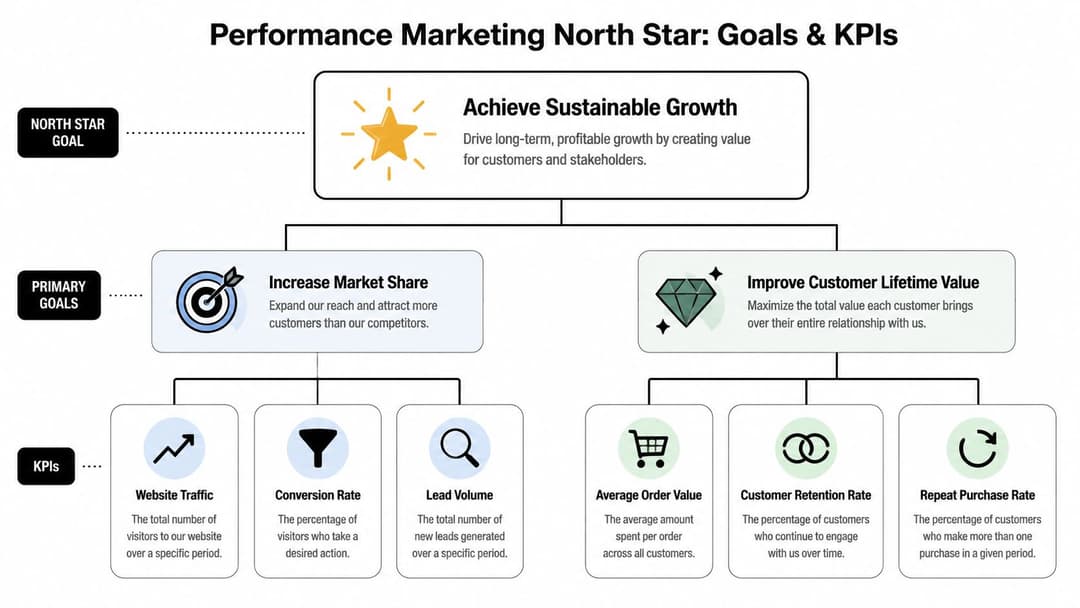
A useful setup has three layers. The first is the business outcome. The second is the marketing objective. The third is the operating KPI that helps you make decisions daily. If you skip that hierarchy, teams obsess over easy metrics and miss the one that matters.
Build a KPI hierarchy that actually guides decisions
At the top sits the North Star. For most growth teams, that's sustainable revenue growth, profitable customer acquisition, or pipeline quality. Under that, place campaign objectives such as new customer acquisition, repeat purchase growth, or qualified lead generation.
Then define the metrics that tell you if you're progressing.
Here's the practical hierarchy:
| Level | What it answers | Example |
|---|---|---|
| Business outcome | Did the company move forward? | Profitable growth |
| Marketing objective | What is marketing responsible for? | Acquire qualified customers |
| Operational KPI | What do we optimize day to day? | ROAS, CPA, conversion rate |
That structure sounds simple, but it changes how teams work. A campaign with strong click volume can still be unhealthy if those clicks don't convert. A campaign with a modest CTR can still deserve more budget if it produces stronger purchase intent and better downstream value.
TVScientific notes that CTR averages around 1.9%, but the more important point is that real performance comes from connecting CTR to conversion rate and ROAS, because ROAS supports real-time budget decisions in this performance metrics breakdown. CTR helps diagnose attention. It doesn't prove commercial value.
Know what each core metric is telling you
Use the formulas, but don't stop at them.
- CTR shows whether the ad earns the click. It's calculated as clicks divided by impressions.
- Conversion rate shows whether the traffic completes the intended action. It's calculated as total conversions divided by total visitors, multiplied by one hundred.
- ROAS shows whether revenue justifies spend. It's calculated as revenue generated divided by advertising cost.
Those metrics should work together, not compete with each other.
A high CTR with weak conversion rate usually points to message mismatch. A strong conversion rate with weak volume usually points to targeting or scale constraints.
For commerce teams, product economics matter beyond the ad account. If your category relies on repurchase, bundling, or retention, your acquisition threshold should reflect customer value over time, not just the first order. That's why teams should anchor paid decisions to customer lifetime value in marketing, especially when deciding how aggressive to be on acquisition.
If you're managing social commerce, it also helps to study platform-specific economics. HiveHQ's guide to maximizing TikTok Shop profit with key metrics is useful because it forces the same discipline. Don't stop at engagement. Tie platform activity back to profit signals.
Don't track vanity metrics as your main scorecard
Vanity metrics still have a role. They can act as diagnostics. They just can't be your scoreboard.
Use this filter before adding any KPI to your reporting deck:
- Can the team take action on it? If not, it's trivia.
- Does it connect to revenue quality? If not, it may distract more than it helps.
- Will it change budget allocation? If not, it belongs lower in the report.
A good KPI stack makes trade-offs visible. That's what you need when spend gets tight.
Build Your Measurement and Attribution Engine
If your tracking is weak, optimization becomes theater. You'll still have dashboards. You just won't have defensible answers.
That's why the measurement layer has to come before aggressive scale. You need a setup that captures user actions cleanly, survives privacy changes, and gives you a way to separate correlation from causation.

Treat pre-launch as a measurement exercise
Before launch, lock four things together: channel choice, budget, audience, and creative.
Why all four? Because attribution is only useful when the initial setup reflects a real hypothesis. If you run broad targeting, mixed messages, unclear offers, and inconsistent landing pages, the result tells you very little. Bad experimental design creates noisy data, and noisy data makes attribution models look smarter than they are.
A clean pre-launch checklist usually includes:
- Platform tracking: Meta Pixel, Google Analytics 4, and any relevant platform event setup.
- Link hygiene: Consistent UTM structures by campaign, ad set, creative, and offer.
- Server-side support: Tools such as a conversion API gateway for server-side tracking become useful, especially when browser-side signals are incomplete.
- Landing page continuity: The ad promise and page promise need to match.
- Event priorities: Decide which conversion events matter before traffic starts.
Stop trusting last-click more than it deserves
Many junior teams assume the ad platform with the cleanest attribution screen is the one creating the most value. That's a common mistake.
Copy.ai's analysis notes that failing to run incrementality tests can overstate impact by 50-70%, and that Marketing Mix Modeling and lift studies can reclaim 20-50% of wasted ad spend by identifying true uplift in this attribution and measurement article. That's the difference between reported performance and caused performance.
Here's the issue in plain language. Some conversions would have happened anyway. Brand demand, direct traffic, email, repeat customers, word of mouth, and price changes all affect outcomes. If you credit the last ad touch with everything, you'll overfund channels that are good at harvesting existing demand.
The question isn't “Which ad got credit?” The question is “Which ad changed behavior?”
A stronger attribution setup usually combines methods:
| Method | Best use | Main limitation |
|---|---|---|
| Platform attribution | Fast optimization inside the ad platform | Can over-credit the platform |
| Multi-touch attribution | Understanding assisted journeys | Depends on data quality |
| Lift testing | Measuring causal impact | Requires clean test design |
| MMM | Budget allocation across channels | Less granular for creative decisions |
Build a habit of testing for lift
Incrementality testing sounds advanced, but the principle is basic. Hold something out. Compare exposed and unexposed groups. Measure what changed because of advertising, not merely what happened after advertising.
That's especially important when campaigns overlap across search, social, email, affiliate, and direct traffic. Without lift testing, teams often scale whatever appears efficient in-platform, even if another channel created most of the demand earlier in the journey.
A quick explainer can help your team align on the concept before implementation:
Measurement discipline feels slow at first. Then it saves you from months of confident mistakes.
Assemble Your Campaign Components
With goals and measurement in place, campaign building becomes much less random. You're no longer asking, “What should we run?” You're asking, “What combination of channel, budget, audience, and message gives us the best first test?”
That shift matters because launch quality is mostly decided before the ads go live.
Choose channels based on buying behavior
Don't pick a platform because it's popular. Pick it because it matches the job.
Search works well when demand already exists and users show intent through queries. Meta is strong when you need audience discovery, creative testing, and faster message iteration. LinkedIn can make sense when deal value is high and targeting matters more than volume. TikTok can be useful when the product needs demonstration and content-native creative.
A practical way to choose is to compare channels against three filters:
- Intent level: Are people already looking for a solution?
- Creative dependency: Does the product need visual persuasion?
- Feedback speed: How quickly can you learn and adjust?
If you sell visually differentiated products, creative volume matters a lot. If you're trying to improve merchandising and paid creative workflows at the same time, this guide on optimizing online sales with AI is useful because it looks at how AI fits into commerce execution, not just reporting.

Build audiences from evidence, not assumptions
Audience setup should start with first-party signals. Existing customer lists, purchase behavior, CRM segments, and on-site activity usually tell you more than generic interest stacks.
Then layer outward:
- First-party audiences for remarketing, suppression, and seed quality
- Lookalikes or modeled expansion audiences when you need scale
- Interest or broad testing when you want discovery and message validation
The mistake I see most often is overengineering audiences while underinvesting in the offer and creative. If your message is weak, narrower targeting only hides the problem for a while.
Create creative as a test matrix
Don't launch one ad with three minor copy edits and call it testing. Build a matrix.
That means varying more than surface-level details. Test distinct hooks, offers, proof types, formats, and emotional angles. Use product-led creative, objection-handling creative, founder-led creative, social proof, comparison framing, and plain direct response copy. If your team needs a refresher on the fundamentals, Facebook ads design principles still matter because good creative structure improves test quality before any algorithm helps you.
Field note: The first launch isn't about finding a winner instantly. It's about giving yourself enough variety to learn why something wins.
A useful pre-flight review asks:
- Does each ad represent a real hypothesis?
- Is the landing page aligned with the hook?
- Can we tell what variable changed if performance moves?
When those answers are clear, your testing has a chance to teach you something.
Execute a Disciplined Launch and Testing Cadence
Most underperforming campaigns don't fail because the first setup was terrible. They fail because nobody ran the launch like a controlled experiment.
The right mindset is simple. You are not launching a finished campaign. You are launching a set of structured tests.
Use a test cadence, not random edits
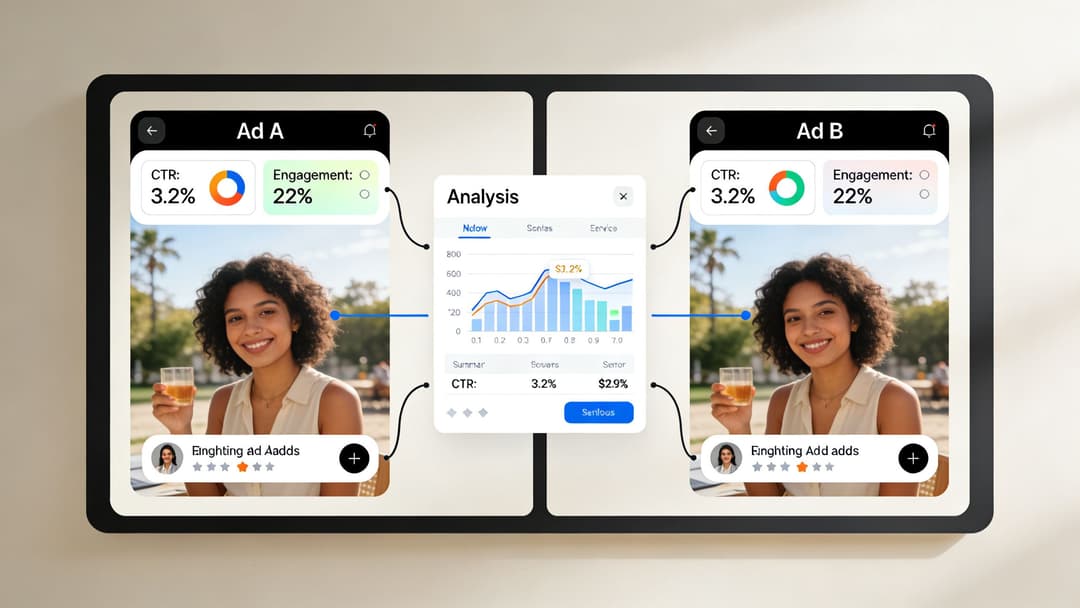
Improvado outlines a rigorous process where A/B tests run for 7-14 days at 95% confidence intervals, and notes that campaigns that neglect continuous testing fail 60% of the time due to a set-and-forget approach, while optimized campaigns can achieve benchmark ROAS of 4:1 to 15:1 in this performance measurement guide.
That gives you a strong operating principle. Leave enough time for a test to mature. Decide the success condition before launch. Don't rewrite the rules midstream because one ad looked exciting on day two.
A disciplined cadence usually looks like this:
- Phase one: Validate message and audience fit
- Phase two: Compare winning hooks against alternative formats
- Phase three: Refine budget allocation and landing page match
Isolate variables or you'll learn nothing
If you change the audience, creative, offer, and landing page at the same time, any result becomes hard to interpret. That's not testing. That's chaos with a spreadsheet.
Use this approach instead:
| Test type | Keep constant | Change |
|---|---|---|
| Creative test | Audience, budget, landing page | Hook, visual, copy |
| Audience test | Creative, offer, page | Segment or expansion strategy |
| Offer test | Audience, creative, page structure | Incentive or framing |
| Landing page test | Ad and audience | Page layout or conversion path |
At this point, junior buyers usually get impatient. They see an early loser and kill it too fast, or see a promising ad and scale it before understanding why it worked. Both are expensive habits.
Set-and-forget breaks at scale
The bigger your testing volume gets, the less realistic manual optimization becomes. Review cycles slow down. Fatigue creeps in. Teams start relying on platform defaults because there are too many combinations to inspect carefully.
That's why launch discipline has to include review discipline. Calendar the check-ins. Define the kill rules. Define the scale rules. Make sure everyone on the team knows which metric is decisive for that test and which ones are just directional.
Manual intuition still matters. But it works best when it's supervising a testing system, not replacing one.
Master Optimization and Scale Strategically
Finding a good ad is not the finish line. It's the start of a different job.
Optimization is where a lot of teams give back the gains they earned in testing. They scale too quickly, keep weak variants alive for too long, or run winning creatives until the audience stops responding. That last issue is one of the biggest reasons paid social performance decays even when the account structure looks fine.
Cut losers early and scale winners carefully
Optimization should answer two questions every review cycle. What should lose budget? What has earned more?
That sounds obvious, but the decision gets muddy when teams grow attached to concepts they expected to work. Keep the review grounded in the evidence from your KPI hierarchy. If an ad gets attention but doesn't produce downstream value, it isn't a winner. If a variant has lower click appeal but stronger purchase efficiency, it deserves a closer look.
A strong optimization rhythm includes:
- Removing weak combinations that burn budget without helping the model learn useful patterns
- Increasing investment in proven combinations without changing too many variables at once
- Refreshing adjacent variants so you extend a winning message before it wears out
- Checking audience quality so scaled volume doesn't subtly degrade conversion economics
Better scaling decisions come from pattern recognition, not attachment to a single ad.
Creative fatigue is an operating problem, not a creative problem
Mountain's analysis points out that rapid, high-volume testing can cause creative fatigue, dropping ROAS by 30-50% within 7-14 days. It also notes that 70% of marketers still rely on static setups, while AI platforms can achieve 15x ROI by auto-learning and rotating creatives in this performance marketing strategy article.
That's the practical reason AI is moving from optional to foundational in paid social. Once you're testing at meaningful volume, fatigue management becomes too fast-moving for manual review alone. Creative decay doesn't wait for your next weekly meeting.
Here's what good teams do differently:
Use AI where speed changes the outcome
AI is most useful when it handles repetitive analysis and high-variation execution.
That includes:
- ranking creative combinations by outcome, not just engagement
- identifying which audiences respond to which message types
- rotating variants before fatigue drags account efficiency down
- using historical results to shape the next launch instead of starting from zero
For Meta-heavy teams, one example is AI for performance marketing workflows, where connected campaign data can inform new launches and help rank creatives, audiences, and messages against goals like ROAS, CPL, or CPA. That kind of tooling isn't magic. It just reduces manual bottlenecks in places where speed matters.
Build a repeatable system, not a heroic process
The teams that keep improving don't rely on one brilliant buyer watching the account all day. They build operating rules.
Those rules define how tests start, how they're judged, when spend moves, when creatives refresh, and how learnings get reused. Over time, that system matters more than any single campaign. It's what lets a team scale without turning every new launch into a reinvention exercise.
If you remember one thing, make it this: performance marketing works best when you stop treating launch, reporting, creative, and optimization as separate jobs. They're parts of the same machine. AI belongs in that machine because modern testing volume, signal loss, and creative turnover demand faster feedback loops than manual workflows can usually support.
The advantage now isn't access to ad platforms. Everyone has that. The advantage is building a system that learns faster than your competitors.
If your team runs Meta campaigns and wants a tighter system for launch, testing, and scale, AdStellar AI is built for that workflow. It connects to Meta through secure OAuth, ingests historical performance data, generates large sets of creative, copy, and audience combinations, and ranks results against goals such as ROAS, CPA, or CPL so teams can move from manual setup to repeatable execution.