You launch a new Meta campaign. The targeting is reasonable, the offer has worked before, and the budget is enough to get signal. Then the ads flop. CTR is weak, CPC drifts up, comments are cold, and the team starts blaming audience quality, landing pages, seasonality, or the algorithm.
Most of the time, the main problem sits in the creative.
That’s why fb ads design matters far more than is often underestimated. Not just making one ad that looks good, but building a repeatable system that can produce, test, and scale a large volume of creatives without turning the marketing team into a content factory running on guesswork. Strong creative gives Meta something to optimize around. Weak creative forces you to buy data at full price.
The teams that keep winning on Facebook rarely rely on one hero ad. They build a process for message selection, visual execution, copy testing, and fast iteration across formats and placements. That process is what separates campaigns that scale from campaigns that burn cash.
Why Your FB Ads Design Is More Critical Than Ever
Creative burnout is common because many organizations still treat ad design like a finishing step. They research, build the campaign, choose audiences, and then ask a designer for “three statics and a video” at the end. That workflow almost guarantees mediocre results.
Meta is too crowded for average creative to survive. In 2025, Meta's global advertising revenue reached over 196 billion U.S. dollars, up 22.1% year over year, which tells you two things at once: advertisers are still spending aggressively, and competition for attention keeps getting tougher, according to Statista's Meta advertising revenue data. In the same verified benchmark set, traffic objective ads averaged a 1.71% CTR, and leads campaigns posted a $1.92 CPC versus Google's $5.26, which is why strong Meta creative still earns a meaningful place in acquisition mixes.
That doesn't mean cheap clicks come from clever targeting hacks. In practice, post-privacy Meta rewards ads that hold attention, communicate value fast, and fit the placement. Creative has become the input that shapes everything after the impression.
Better design changes what Meta can learn
Meta's delivery system can only optimize around the signals your ad creates. If your first frame is weak, your message is buried, or the CTA is unclear, the platform gets low-quality engagement data. You don't just lose a few clicks. You train the system on bad inputs.
A strong design does four jobs quickly:
- Stops the scroll: The ad earns a pause long enough for the user to process the offer.
- Explains the value: The user understands what the product is and why it matters.
- Signals relevance: The creative feels native to the feed, the audience, and the problem being solved.
- Creates a next step: The CTA gives the platform and the user a clear action.
Practical rule: If the ad doesn't make sense with the sound off, on a small screen, in under a couple of seconds, it's probably too slow for Meta.
A lot of media buyers still over-correct by obsessing over audience slices while under-investing in creative systems. That's backwards. Good fb ads design doesn't replace testing, but it gives your tests a real chance to produce signal.
Policy compliance matters too. A surprising amount of “bad performance” is really throttled delivery, rejected assets, or overly risky copy angles. If your team is scaling volume, it's worth tightening your process against the current FB ads policy guide from AdStellar.
Building Your Creative Strategy Foundation
Most failed ads don't fail in Photoshop. They fail in the brief.
If the audience insight is shallow, the visuals get generic. If the message is generic, the copy gets padded with claims nobody feels. If the angle is wrong, even a strong designer can't save the ad.

Start with pains, triggers, and objections
A usable audience profile for paid social isn't a demographic sheet. Age and gender alone won't give you a winning ad. You need to know what pushed the buyer to look, what almost stopped them, and what language they use when they describe the problem.
For practical campaign work, I want answers to questions like these:
- What happened right before they started searching? A missed target, wasted time, high cost, poor outcome, frustration with a current tool.
- What outcome do they want fastest? Save time, reduce risk, look better, feel better, book more calls, get more qualified leads.
- What do they distrust? Complexity, hidden costs, low quality, hype, effort, unclear implementation.
- What proof do they respond to? Demos, testimonials, before-and-after logic, process transparency, expert explanation.
That audience work is what turns a bland product claim into a usable ad angle.
Turn research into angle clusters
Instead of asking for “more creatives,” define a few angle families first. That keeps testing disciplined and gives the design team direction.
A clean angle map usually includes:
- Problem-aware angles: Speak to the pain the buyer already feels.
- Solution-aware angles: Contrast your approach with the alternatives.
- Proof-driven angles: Use testimonials, demos, or outcomes to reduce skepticism.
- Identity angles: Match how the customer sees themselves.
- Objection-handling angles: Answer the reason they haven't bought yet.
Many teams begin to understand why polished brand creative often underperforms. It looks expensive, but it doesn't answer a buying question.
Data from 2025 shows Meta's algorithm shifts favor authentic content. One brand saw meaningful gains after reallocating 70% of its creative budget to testimonials and user-generated demos, and interactive ad formats like polls deliver 2.5x higher engagement than static images, according to WordStream's Facebook Ads benchmarks for 2025. That doesn't mean studio assets are dead. It means authenticity often beats polish when the goal is attention and trust.
The ad that looks most “on brand” is often not the ad that feels most believable in-feed.
Match the angle to funnel temperature
The same product needs different creative depending on how aware the buyer already is.
For cold traffic, the ad should earn attention through relevance. It shouldn't assume too much context. For warm retargeting, the ad can get more specific and deal with hesitation directly. For hot audiences, clarity and urgency matter more than storytelling.
A simple way to think about it:
| Funnel stage | What the ad needs to do | Creative style that usually fits |
|---|---|---|
| Top of funnel | Interrupt and create curiosity | UGC, founder clips, pain-led hooks, demos |
| Middle of funnel | Build trust and explain mechanism | Testimonials, comparison creatives, walkthroughs |
| Bottom of funnel | Remove friction and prompt action | Offer-focused statics, proof snippets, direct CTA ads |
If you're building out a broader paid social system, this is also where channel alignment matters. The same message architecture should travel across placements and campaigns, even when the creative format changes. This is a good discipline to borrow from a wider paid social ad strategy framework.
A useful creative brief should tell the designer and media buyer exactly three things: who this angle is for, what tension it resolves, and what action the ad should create. If the brief can't do that, the ad will probably drift into decoration.
Later in the workflow, video becomes useful for validating which hooks and scenes land in-feed. This breakdown is a helpful reference point before production starts:
Designing Ad Visuals That Stop the Scroll
Design quality on Meta isn't about making ads pretty. It's about making them legible, immediate, and hard to ignore on a phone screen.
A lot of underperforming creative suffers from the same visual mistakes. Tiny text. Weak contrast. No focal point. Too many objects competing for attention. A layout that might work on a desktop mockup but collapses in a feed.
Build the ad around visual hierarchy
When someone sees your ad, they shouldn't have to hunt for the point. The eye should land on one dominant element first, then move naturally to the offer, then to the CTA.
That usually means:
- Lead with one primary focal point. A face, product, transformation, bold claim, or specific object.
- Keep the value proposition high in the frame. Especially for short-form video and mobile placements.
- Use contrast to direct attention. Contrast in color, size, spacing, and motion.
- Reduce decorative clutter. Extra icons, shadows, badges, and patterns often weaken the message.
If the ad needs explanation before it creates interest, it's too slow.
Mobile-first isn't optional
Meta creative should be designed for the screen users primarily access. 79% of users access Facebook via mobile only, according to Taktical's Facebook ad design tips. That single fact should change how you brief every ad.
Desktop-centered design habits still hurt performance. Thin typography, detailed screenshots, dense comparison charts, and horizontal layouts usually lose on mobile. You want assets that remain clear when shrunk, cropped, and viewed in motion.
A few design decisions consistently help:
- Use larger text blocks sparingly: One core message beats five supporting claims.
- Favor tight crops: Product or person should fill the frame with intention.
- Design for sound-off viewing: Captions, overlays, and visual sequencing matter.
- Respect safe zones: Stories and Reels can hide key elements behind UI.
Field note: If a static ad only works when you zoom in, it isn't ready for delivery.
Format choice changes the job of the design
Static images still matter, but they need a stronger first impression. Carousels work when you have a sequence to show, not when you split one weak idea into several cards. Video earns attention faster when the opening frame carries the message immediately.
The same verified Taktical data shows carousel ads achieved a 50% lower cost-per-registration and a 16.74% conversion rate in some campaigns, while a simple colored border can boost CTR by up to 2x in cited testing. Those numbers don't mean every carousel wins. They mean format mechanics matter, and small visual choices can change click behavior.
Here’s a practical way to choose:
- Use static image ads when the offer is simple, visual, and can be understood fast.
- Use carousels when each card advances a story, benefit stack, or product sequence.
- Use short videos when demonstration, pacing, or facial presence adds trust.
- Use Stories and Reels when vertical immersion is part of the attention strategy.
Meta ad placement technical specs
| Placement | Aspect Ratio | Recommended Resolution | Format Notes |
|---|---|---|---|
| Feed single image | 1.91:1 to 4:5 | 1080 x 1080 px | Minimum 476x249 px. Single image works well when the focal point is obvious. |
| Stories video | 9:16 | 720p minimum | Full-screen vertical works best. Keep key text away from interface edges. |
| Reels video | 9:16 | 720p minimum | Vertical video should be built for fast motion and immediate context. |
| Feed video | 9:16 to 16:9 | 720p minimum | .MOV or .MP4 supported, up to 4GB, length from 1 second to 240 minutes. |
| Carousel | 1:1 commonly used | 1080 x 1080 px | Supports up to 10 cards. Best used for stepwise storytelling or multiple offers. |
These specs come from the verified methodology in Taktical's placement and asset guidance, paired with the provided technical constraints for Meta creative.
A practical visual checklist
Before any ad goes live, check five things:
- Message clarity: Can someone identify the offer in a quick glance?
- Thumb-stop strength: Does the first frame or image create interruption?
- Brand restraint: Is the brand visible without overpowering the selling point?
- Placement fit: Does this design still work after feed, story, and reel crop behavior?
- Native feel: Does it belong in the platform, or does it scream “banner ad”?
Most winning fb ads design looks simpler than the team expected. That's not because the designer did less work. It's because the team removed everything that wasn't helping the user make a decision.
Writing Ad Copy That Converts
Visuals earn the pause. Copy earns the click.
A lot of Meta copy fails because it tries to sound polished instead of useful. The user doesn't need a slogan. They need a reason to care and a reason to act.
Write the hook for the scroll, not the boardroom
The first line of primary text has one job. It needs to create enough tension, curiosity, or relevance for the person to keep going.
Three copy approaches work reliably across categories:
- Problem-first: Lead with the pain the buyer already recognizes.
- Outcome-first: Lead with the result they want.
- Contrarian-first: Challenge a bad assumption they already believe.
Weak hook: “Discover the future of modern productivity.”
Stronger hook: “Still chasing leads manually after they’ve gone cold?”
Weak hook: “Premium skincare for every lifestyle.”
Stronger hook: “Your routine isn't failing. Your cleanser may be too harsh.”
Headline and CTA need to finish the argument
The headline should sharpen the promise. The CTA should remove ambiguity.
The biggest mistake I see is writing a strong body line, then wasting the headline on a vague brand phrase. The second biggest mistake is treating CTA choice as a cosmetic setting. It isn't. The CTA tells the user and the platform what kind of action you're trying to create.
A clean structure looks like this:
| Copy element | What it should do | Bad version | Better version |
|---|---|---|---|
| Primary text | Open the loop | “A better way to work” | “Your team doesn't need more leads. It needs fewer bad ones.” |
| Headline | State the promise | “Book a demo” | “See which campaigns are wasting spend” |
| CTA | Make the next step obvious | “Learn More” used by default | Use the CTA that matches the actual intent and landing page |
Simple frameworks still work
You don't need fancy copy systems. You need disciplined ones.
PAS works well for lead gen and problem-aware buyers:
- Problem
- Agitate
- Solution
AIDA works when the offer needs a fuller narrative:
- Attention
- Interest
- Desire
- Action
Use frameworks as drafting tools, not as templates the audience can spot from a mile away.
For B2B, specificity usually beats cleverness. For e-commerce, clarity and visual-copy alignment matter more than long persuasion. For both, the CTA has to match the landing page. If the ad promises a guide, don't send users to a homepage. If it invites a demo, don't make them dig for the form.
If you want a deeper breakdown of hooks, headlines, and CTA structure, this Facebook ad copy guide is a useful operational reference.
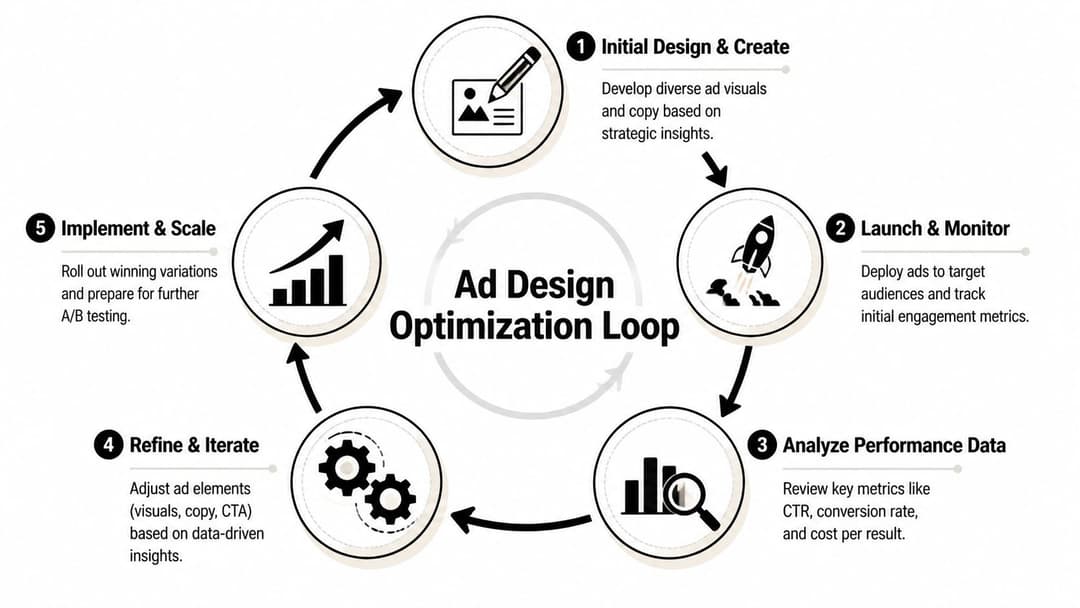
Testing and Optimizing Your Ad Designs
The market doesn't care which version your team liked in review. It cares which version gets attention, converts, and keeps doing it after spend increases.
That’s why creative production without a testing method becomes expensive theater.
Isolate variables or you'll learn nothing
Most ad accounts are full of noisy tests. Teams change the hook, the thumbnail, the CTA, the audience, and the placement at the same time, then pretend the result taught them something. It didn't.
Clean testing means changing one meaningful variable at a time whenever possible. If you're testing visuals, keep the copy stable. If you're testing hooks, keep the core offer and landing page stable. If you're testing format, don't swap the entire angle too.
A disciplined test matrix often includes:
- Hook tests: Same offer, different opening line or first-frame message
- Format tests: Static versus carousel versus short video
- Proof tests: Testimonial versus demo versus founder explanation
- CTA tests: Different user actions tied to the same promise
- Placement-fit tests: Feed-native creative versus vertical-first creative
Watch the metrics that match the objective
Not every good ad has a high CTR, and not every high CTR ad is profitable. Metrics only mean something in context.
For traffic campaigns, CTR and CPC tell you whether the ad can earn low-friction attention. For lead gen, cost per result quality matters more than cheap clicks. For sales, conversion quality and downstream economics beat surface engagement.
The verified guidance from Improvado's Facebook ads guide is useful here. Omitting a clear CTA can increase Cost Per Lead by 2.5x. High ad frequency above 5 can drop engagement by 30 to 50 percent. Faster 6-second videos with an early value proposition achieved 50% lower Cost Per Engagement and 32% higher CTR than longer versions in the cited examples. Those are practical reminders that clarity and pacing affect economics, not just aesthetics.
A simple review rhythm helps:
| What you review | What you're trying to find | What to do next |
|---|---|---|
| CTR by creative | Which ads earn attention | Cut weak hooks and produce more of the top message families |
| CPC by placement | Where clicks get expensive | Adjust placement-specific assets rather than killing the whole angle |
| Conversion rate by ad | Which creatives pre-qualify traffic | Scale ads that attract the right user, not just cheap traffic |
| Frequency and trendline | Whether fatigue is setting in | Refresh the angle, intro, or format before performance degrades further |
Use breakdowns, not averages
Account-level averages hide useful truths. One ad may look average overall but crush on Stories. Another may fail broadly and still work with one age band or one device type.
Look at breakdowns by placement, device, age, gender, region, and time. Then tag what the creative contains. Hook type, creator style, framing, offer style, motion speed, proof type. Native Meta reporting can show outcomes. Your own naming and tagging system explains why those outcomes happened.
The fastest way to waste budget is to kill a good angle because it was packaged badly for one placement.
There’s also a useful lesson from broader user research. The same reason product teams value the benefits of AI testers in market research applies to ad testing. Scale creates pattern recognition that small manual reviews miss. Human judgment still matters, but pattern detection gets stronger when you can process more variations and learn faster from them.
Kill, keep, or scale
Every creative review should end with a decision. Not discussion. Decision.
- Kill it when the hook never earns attention, the message is unclear, or the ad keeps losing after enough delivery.
- Keep testing when the angle shows promise but the packaging is weak.
- Scale it when the ad holds efficiency as spend rises and works across more than one placement or audience context.
Strong optimization isn't glamorous. It's repetitive, structured, and honest about what the data says.
Scaling Creative Production with Automation
Testing a few ads manually is manageable. Very few can manually test creative at the volume required to keep an account fresh across offers, audiences, and placements.
That's where the creative process usually breaks. Not because the team lacks ideas, but because production, naming, launching, and analysis become a mess.
Manual testing hits a ceiling fast
At low spend, a marketer can keep the account moving with spreadsheets, Figma files, and a lot of patience. At higher spend, that system collapses. Creative requests pile up. Version control gets sloppy. Insights stay trapped in someone's notes. Good ideas don't get redeployed quickly enough.
Verified 2025 Meta reporting cited in the provided source states that campaigns with over 50 creative variations saw 27% higher ROAS when AI guided testing and prioritization, while manual creators often stopped after 10 to 15 angles because of time constraints, according to the referenced YouTube source on bulk angle testing. This gap highlights the core problem. Many advertising teams aren't losing because they have no winners. They're losing because they can't generate, launch, and rank enough variations consistently.
Automation should reduce setup work, not strategic thinking
The right automation layer doesn't replace the marketer. It removes repetitive labor.
Useful automation in fb ads design should help with things like:
- Generating controlled variations: Multiple hooks, copy lengths, visual treatments, and placement-ready crops
- Launching in bulk: Pushing many combinations live without rebuilding everything by hand
- Learning from account history: Ranking angles and formats based on actual past performance
- Standardizing feedback loops: Making it easier to see what won and why
This is also where AI-generated copy and scripts need human editing. If your tool produces text that sounds stiff or over-optimized, it will hurt ad performance even if the structure is solid. Teams working with generated drafts sometimes use tools that help humanize chatgpt text before final review, especially when the output needs to sound closer to a real creator or founder voice.
One platform in this category is AdStellar's guide to creative automation tools. It connects to Meta via OAuth, uses historical account data, and supports bulk creation and launch workflows across creative, copy, and audience combinations. That's the practical direction many growth teams need when ad volume outgrows manual execution.

What changes when automation is working
The biggest shift isn't speed alone. It's decision quality.
When production is automated, the team can spend more time on angle quality, offer-market fit, creative review, and landing-page alignment. Instead of debating whether they have time to test another concept, they can ask better questions: Which message family deserves more volume? Which creator style works for warm audiences? Which visual treatment survives spend increases?
That’s the difference between “making ads” and running a creative system.
Your FB Ad Design Questions Answered
How do I know ad fatigue is the problem
Fatigue usually shows up as declining efficiency after an ad has already proven it can work. You often see weaker click quality, rising costs, slower engagement, or conversion softness without any major offer change.
Watch trendlines, not one-day swings. If a previously strong ad starts fading and frequency is climbing, refresh the packaging before replacing the whole angle. New first frames, different creators, tighter edits, or a new headline often buy more life than starting from zero.
Should B2B and B2C fb ads design look different
Yes, but not in the simplistic way people think.
B2B doesn't need to look boring. B2C doesn't need to look chaotic. The bigger difference is buyer motivation. B2B ads usually need more specificity, clearer problem framing, and stronger proof that the solution fits a workflow or business outcome. B2C ads can often move faster on emotion, identity, or immediate product experience.
In both cases, clarity wins. The audience may differ, but the feed behavior is still the same. People scroll fast and judge faster.
How much creative should I test before scaling
Test enough variations to learn something meaningful about the angle, not just the asset.
A practical rule is to test multiple expressions of the same core message before calling the angle a loser. One weak static doesn't invalidate a strong idea. A good angle can fail because the hook is wrong, the visual is too polished, or the placement fit is poor.
Should I use polished brand assets or UGC-style creatives
Use whichever format best earns trust for that offer and audience. In many accounts, UGC-style content wins because it feels more believable and native in-feed. But “UGC-style” doesn't mean low effort. Strong authentic ads still need structure, pacing, and message discipline.
The mistake is forcing every ad into one aesthetic. Some products need demonstration. Some need authority. Some need raw credibility. The format should follow the message.
What's the fastest fix for underperforming ads
Don't rebuild the whole campaign first.
Start with the creative layer closest to the user's first impression. Change the hook, simplify the value prop, tighten the first frame, clarify the CTA, or adapt the asset to the placement. Those changes usually produce signal faster than a full account restructure.
If your team is stuck in the loop of building a few ads, waiting too long, and guessing what to make next, AdStellar AI is built for the part that usually breaks. It helps teams launch, test, and scale Meta campaigns faster by generating bulk creative and copy combinations, pushing them live from one workflow, and learning from historical account performance so you can focus more on strategy and less on repetitive setup.