You’re probably dealing with one of two situations right now.
Either Google Ads has become too important to treat as a side task, or you already hired help and you’re not sure whether they’re driving growth or just producing reports. Both situations are common. Both get expensive fast.
A lot of teams reach this point after the same sequence. Search demand looks strong. Branded traffic is easy enough to manage. Then non-brand campaigns get noisy, lead quality slips, CPCs rise, landing pages need work, and every weekly meeting turns into a debate about attribution instead of a plan to improve performance. That’s usually when the phrase google ads marketing agency starts showing up in internal conversations.
The hard part isn’t finding an agency. The hard part is finding one that has real technical depth, works well with your internal team, and doesn’t treat Google as an isolated channel while your Meta, creative, and CRM data sit somewhere else.
The Google Ads Dilemma Why Expert Help Matters
The pressure around Google Ads is real because the channel is still where a huge amount of paid acquisition happens. Google Ads holds 69.04% of the PPC market share as of 2025, 98% of PPC professionals use it, and 80% to 85% of PPC budgets flow into it, according to Digital Silk’s Google Ads statistics roundup. When one platform absorbs that much budget and attention, mediocre execution stops being a minor issue. It becomes a growth problem.

Most marketing leads don’t struggle because they don’t understand the basics. They struggle because Google Ads now demands specialist judgment in too many places at once. Search terms management, match type strategy, audience layering, creative testing, conversion tracking, offline signal quality, landing page alignment, shopping feed hygiene, Performance Max controls, and reporting discipline all affect outcomes.
That’s why businesses that care about efficient acquisition often stop asking, “Can someone manage this account?” and start asking, “Who can improve this system?”
Why the channel feels harder than it used to
Google Ads isn’t just a keyword platform anymore. It’s part auction engine, part measurement system, part automation layer. If your tracking is weak, Smart Bidding gets worse. If your account structure is messy, search intent gets blurred. If your internal team and agency disagree on what counts as a qualified lead, optimization drifts toward the wrong outcome.
A strong operator understands that Google Ads performance isn’t created inside the Google Ads interface alone. It sits inside the broader discipline of performance marketing, where spend, conversion quality, attribution, and creative all need to work together.
Practical rule: If Google Ads is a core revenue channel for your business, it needs an owner with enough time and depth to question structure, measurement, and offer strategy, not just change bids.
When expert help becomes necessary
You usually need expert help when one or more of these conditions shows up:
- Spend has grown faster than operating discipline. Campaigns expanded, but naming conventions, negatives, and reporting didn’t keep up.
- Lead volume looks fine but sales disagrees. The account may be optimizing for easy form fills instead of revenue-bearing actions.
- Automation is doing too much without supervision. Performance shifts get blamed on “the algorithm” when the underlying issue is poor inputs.
- Internal teams are stretched. No one has enough time to audit search terms, test landing pages, or clean up conversion actions properly.
At that point, hiring a google ads marketing agency isn’t about outsourcing busywork. It’s about bringing in a team that can restore control where complexity has outpaced bandwidth.
What a Google Ads Agency Actually Does
A good agency isn’t a button-pusher. It’s closer to a specialist doctor for your acquisition system. The job starts with diagnosis, moves into treatment, and then shifts into ongoing care.
Bad agencies skip straight to “we’ll launch campaigns fast.” Good ones ask sharper questions first. What counts as a conversion? Which products or services matter most? Are you optimizing for leads, pipeline, purchases, margin, or blended efficiency? Where does tracking break? Which audiences already convert downstream?
Diagnosis before spending more
The first useful deliverable from a serious agency is often an audit, not a launch plan.
That audit should cover account structure, conversion setup, campaign intent, wasted spend patterns, search term quality, landing page fit, and reporting gaps. If an agency can’t explain why performance is weak in operational terms, it probably can’t fix it either.
Typical diagnostic work includes:
- Account audits: Review campaign naming, match types, negatives, asset groups, and conversion actions.
- Tracking validation: Check whether forms, calls, purchases, qualified leads, and imported offline events are recorded correctly.
- Competitive review: Look at offer positioning, ad angle overlap, and visible gaps in search coverage.
- Landing page inspection: Check message match, friction points, mobile experience, and conversion path clarity.
For teams setting up separate Google identities for testing, client access, or admin workflows, operational friction around account setup can slow things down. If that’s part of your process, this guide for bypassing Google phone verification is a practical reference.
Treatment means building for intent, not just traffic
Once the diagnosis is clear, the agency turns strategy into campaigns. Many clients underestimate the work involved here. Campaign building isn’t just choosing keywords and writing three headlines. It’s creating an architecture that lets intent, budget, copy, and measurement line up.
That often includes:
- Campaign planning by intent: Separate prospecting, brand defense, remarketing, competitor terms, and product or service clusters.
- Keyword architecture: Group terms around clear user intent rather than dumping everything into broad categories.
- Ad creation: Write copy that reflects real search intent, not generic brand language from a homepage.
- Landing page guidance: Recommend page changes that improve conversion likelihood, not just click volume.
The role overlaps heavily with what a media buyer actually does. The work is strategic and operational at the same time. Someone has to translate business goals into a spend plan, into campaign structure, into ad messaging, into measurable outcomes.
The agency’s real product isn’t campaign setup. It’s decision quality under pressure.
Ongoing care is where the value compounds
A launch matters. The weekly operating rhythm matters more.
Strong agencies monitor search queries, prune waste, refresh creative, adjust bids, align with sales feedback, and challenge weak landing pages. They don’t hide behind platform automation. They use it where it helps and override it where it drifts.
What that looks like in practice:
- Daily or frequent monitoring for spend pacing, conversion anomalies, and broken tracking.
- Regular search term review to add negatives and protect relevance.
- Testing discipline across ads, offers, landing pages, and audience signals.
- Performance reporting tied to business outcomes, not vanity metrics.
- Cross-team communication with sales, product, and analytics when lead quality or offer fit changes.
If an agency only reports impressions, clicks, and broad trend lines, it’s not managing growth. It’s narrating activity.
Decoding Agency Services and Pricing Models
Agency pricing gets confusing because many firms package the same underlying work in very different ways. One shop calls it “full-funnel search management.” Another calls it “PPC growth ops.” A third gives you a low retainer and then charges separately for landing pages, analytics support, and feed work.
The key is to ignore the label and inspect the operating scope. What are they responsible for every month? What’s excluded? What requires extra fees? Who does the work?
What’s usually included in service packages
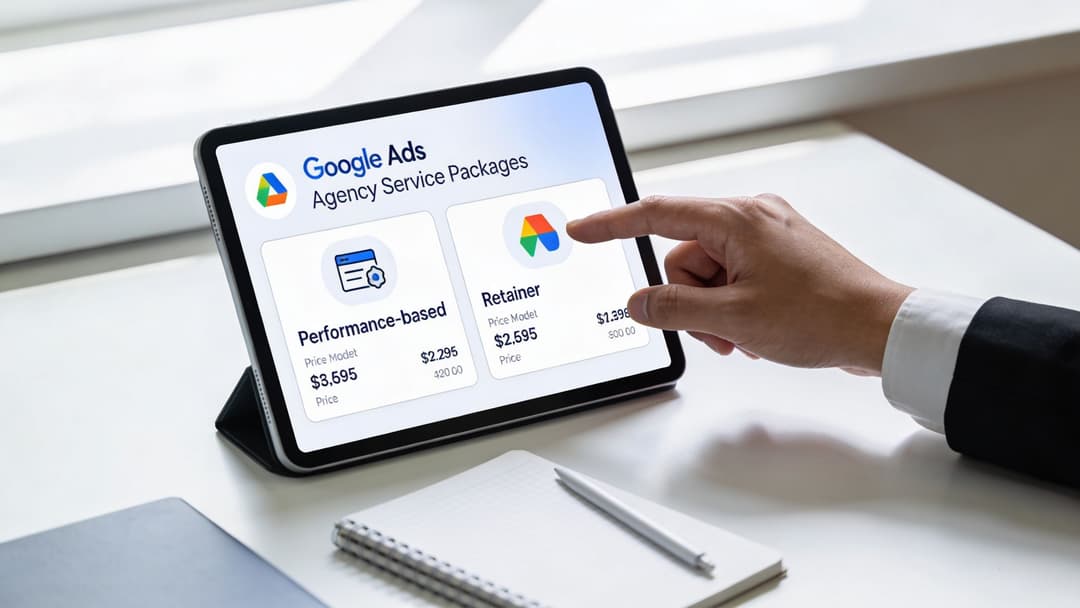
A proper ongoing management package often includes campaign buildout, keyword research, ad copywriting, bid management, negative keyword work, reporting, and some landing page consultation. More technical agencies also handle conversion tracking, audience strategy, feed refinement, and coordination with analytics or CRM teams.
You should ask whether these are included or merely discussed.
A useful way to compare proposals is to separate services into three buckets:
| Service type | What it usually covers | Why it matters |
|---|---|---|
| One-time project work | Audit, rebuild, tracking cleanup, account migration | Useful when the account is broken or ownership has changed |
| Ongoing management | Optimization, reporting, testing, budget pacing, query review | Core monthly operating work |
| Specialist support | Landing page CRO input, feed management, offline conversion imports, analytics alignment | Often where performance gains actually come from |
Some businesses don’t need a large monthly engagement immediately. They need a hard reset. In those cases, a one-time audit or rebuild can be more valuable than a long contract.
For teams comparing execution cost against software options, it also helps to benchmark agency scope against platform pricing transparency such as AdStellar pricing, even if you’re evaluating a different channel alongside Google. It sharpens the question of what you’re paying humans to do versus what software should automate.
Percentage of ad spend
This is still common. The agency charges a percentage of monthly media spend.
It’s simple. It also creates mixed incentives.
The upside is that fees scale naturally as your account grows. That can work for large e-commerce programs or multi-market accounts where campaign complexity rises with spend. The downside is obvious. An agency can make more money when spend increases, even if efficiency doesn’t improve.
This model works best when:
- You already trust the agency’s judgment
- Your budget changes significantly month to month
- The agreement includes clear scope and performance accountability
It works poorly when a business needs cost discipline more than media expansion.
Flat monthly retainer
A flat retainer is easier to budget and often healthier for smaller brands, startups, and lean growth teams. You know the fee. The agency knows the scope. The relationship becomes less about “how much did we spend?” and more about “what work is getting done?”
This model tends to fit businesses that want:
- stable costs
- regular communication
- clear deliverables
- predictable access to senior talent
The catch is scope creep. If the retainer covers “Google Ads management” but your business also expects landing page rewrites, tracking fixes, CRM integration support, and weekly sales feedback loops, the relationship can break down unless those expectations are explicit.
Performance-based pricing
This sounds attractive because it appears aligned. The agency gets rewarded when results improve.
In practice, this model gets messy fast unless attribution is clean and both sides agree on what “performance” means. Is the fee based on qualified leads, revenue, ROAS, pipeline, or some blended target? What happens when the sales team changes qualification criteria or the site launches a new offer mid-quarter?
Useful test: If the compensation formula takes more than a few minutes to explain clearly, there will be friction later.
Performance-based pricing works best when conversion quality is tightly defined and measurement is mature. It’s less suitable when the business has noisy attribution, long sales cycles, or inconsistent downstream data.
Questions that reveal pricing reality
Before signing, ask these directly:
- Who owns strategy versus execution? Some agencies sell senior thinking and delegate daily management to junior staff.
- What happens in month one? You want a concrete plan, not “we’ll optimize as we go.”
- What is not included? This is often the most important pricing question.
- How are landing pages handled? Advice only, wireframes, copy input, or no support at all?
- Do reporting and meetings count toward the retainer? They often do.
A quote isn’t expensive or cheap in isolation. It’s expensive or cheap relative to the depth of thinking, operating cadence, and technical work behind it.
Agency vs In-House vs AI The Right Path for You
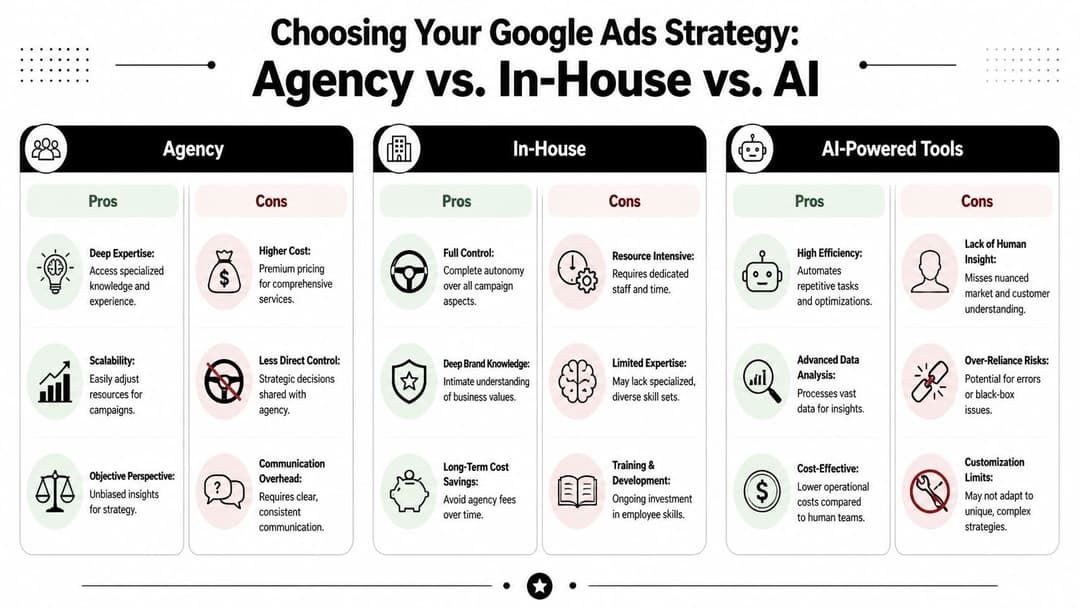
The old question was whether to outsource Google Ads or keep it inside the company. That’s no longer enough. Now there are three real options. You can hire an agency, build in-house capability, or lean hard on AI-powered tools and a lighter human layer.
The right answer depends on stage, speed requirements, management depth, and how much strategic judgment your business already has internally.
Performance expectations also need to be grounded in reality. In 2025, the average Google Ads conversion rate reached 7.52% and the average cost per lead rose to $70.11, according to Spacio Digital’s 2025 Google Ads benchmarks. That combination tells you something important. Costs are climbing, but disciplined optimization still matters because better systems can convert traffic more efficiently.
When an agency is the better choice
Agencies make sense when you need speed, specialist knowledge, and external perspective without hiring a full internal team. They’re often the best fit for brands that have budget but don’t yet have internal PPC leadership.
You’re buying pattern recognition. A seasoned team has seen account sprawl, broken tracking, weak lead quality loops, and automation drift before. That matters when your internal team doesn’t have time to learn through expensive mistakes.
Agency fit is strongest when:
- You need a faster reset than internal hiring allows
- Your current account is underperforming for structural reasons
- You want access to multiple skill sets at once
- You have internal ownership on goals, but not on execution depth
The trade-off is control. You’ll still need an internal owner who can evaluate recommendations, challenge weak reporting, and keep the agency connected to broader business priorities.
When in-house wins
In-house can outperform an agency when the company has enough scale to support dedicated talent and enough operational maturity to feed that team good data.
An internal team usually understands product nuance, sales friction, inventory issues, seasonality, and brand constraints better than any external partner. That advantage grows when paid search needs close coordination with pricing, merchandising, lifecycle, or sales ops.
But in-house isn’t automatically cheaper or better. Hiring well takes time. Training takes time. Retention is its own challenge. One capable individual also won’t replace a full bench of analytics, creative, and technical support.
Where AI tools help, and where they don’t
AI tools are strongest at speed, pattern detection, drafting, workflow compression, and large-scale iteration. They help teams produce variants faster, surface trends earlier, and reduce repetitive setup work.
They do not replace judgment.
That distinction matters most in copy, analysis, and account interpretation. AI can generate ad variations quickly, but those drafts still need a human who understands offer positioning, compliance constraints, and the difference between a high-CTR message and a high-quality lead. If your team uses language models for landing page or ad ideation, tools that humanize ChatGPT text can help clean up robotic phrasing before it goes live.
Here’s the operating reality:
| Model | Best for | Main weakness |
|---|---|---|
| Agency | Speed to expertise, external perspective, multi-skill execution | Less direct control, variable transparency |
| In-house | Deep business context, tight internal alignment | Hiring burden, narrower skill coverage |
| AI tools | Workflow efficiency, rapid testing support, data handling | Weak strategic judgment without strong operators |
A lot of teams land on a hybrid. They keep strategic ownership in-house, use an agency where specialist depth is needed, and layer in AI tools to compress production and analysis time. That tends to work better than treating AI as a replacement for either management discipline or channel expertise.
A broader view on that hybrid model is covered in this piece on the AI ad agency model.
A short walkthrough can help if your leadership team is weighing the trade-offs visually.
The best setup usually isn’t pure agency, pure in-house, or pure automation. It’s clear ownership, strong measurement, and the right amount of specialist help.
Your Vetting Checklist for Choosing the Right Agency
Hiring a google ads marketing agency should feel less like vendor selection and more like due diligence. A polished deck tells you almost nothing. What matters is how they think, how they explain trade-offs, and whether they can go beyond surface-level platform talk.
A lot of bad agencies sound modern because they’ve learned the right buzzwords. They mention AI bidding, first-party data, full funnel strategy, creative testing, and cross-channel synergy. Then you get inside the account and find broad campaign sprawl, weak negatives, duplicated conversion actions, vanity dashboards, and no credible answer for lead quality.
Start with red flags, not credentials
The quickest way to protect yourself is to filter for warning signs early.
One recurring pattern in agency sales is exaggerated certainty. Some firms promise outcomes they can’t control. Others package standard setup work as proprietary intellectual property. Some avoid hard business metrics and keep reports focused on easy wins like clicks and impressions. Commentary around agency deception from Google Ads practitioner Chris Schaeffer’s discussion of common agency lies is useful here, especially the warnings around overpromising and reporting that hides true performance behind vanity indicators.
Watch for these problems:
- Guaranteed outcomes: Nobody can guarantee top ad position, low CPL, or stable performance in an auction they don’t control.
- Mystery-method language: If campaign structure is described like a trade secret, assume the “secret” is basic account work.
- Platform blame as a default answer: AI changes in Google are real, but “the algorithm changed” shouldn’t be the standing explanation for weak execution.
- No access discipline: You should own the account, billing relationship, and historical data.
- Opaque reporting: If they won’t show search term quality, conversion definitions, and business-relevant KPIs, walk away.
If an agency can’t explain bad performance plainly, they’ll probably explain good performance loosely too.
Ask questions that force technical specificity
When questioned on implementation, weak agencies unravel. Don’t ask whether they use best practices. Ask how they implement them.
A strong agency should be able to explain account structure in concrete terms. According to ExterMedia’s agency breakdown, expert agencies use segmented match types to capture 25% to 40% more volume while lowering CPCs by 15% to 20% through relevance-driven Quality Score gains, while poorly structured accounts can waste 30% of spend on overlapping queries. You don’t need them to promise those outcomes for your account. You do need them to understand the underlying mechanics.
Ask questions like these:
- How do you separate broad match prospecting from exact and phrase intent capture?
- How do you prevent overlap between campaigns and ad groups?
- What’s your weekly process for search term reviews and negative keyword additions?
- When do you keep campaigns consolidated, and when do you split them?
- How do you decide whether Performance Max should expand or stay constrained?
Listen for specifics. Thematic ad groups. Match type separation. Shared negatives. Search query mining. Clear reasoning about when structure adds clarity and when it adds clutter.
Vet their measurement depth
Tracking is where a lot of agencies pretend competence. Don’t let them stay abstract.
Ask what they do with enhanced conversions for web. Ask how they handle first-party data matching. Ask whether they validate event quality before switching bidding strategies. Ask how they treat imported offline conversions if your business has a sales cycle beyond the click.
You’re not looking for jargon. You’re looking for operational fluency.
Good answers usually mention prerequisites like proper tagging, reliable conversion sources, and making sure customer data is available at the right point in the funnel. Weak answers usually sound like “yes, we can set that up” with no explanation of dependencies, trade-offs, or QA.
Evaluate how they work with other teams
A paid search agency that can’t collaborate becomes expensive fast. This matters even more if you also run paid social, lifecycle, SEO, or outbound.
Ask who they need in the room each month. Ask how they use feedback from sales. Ask what they do when lead quality drops but volume looks strong. Ask whether landing page recommendations are part of the operating plan or just side comments in reports.
If your growth mix includes other paid channels, it’s also smart to compare the agency’s coordination mindset against what you’d expect from a strong Facebook ads agency. The point isn’t channel loyalty. The point is whether your partners can share signals instead of defending silos.
Use a checklist, not gut feel
Here’s a practical scorecard to use in calls and proposal reviews.
| Category | Question to Ask | What to Look For (Green Flag) | What to Avoid (Red Flag) |
|---|---|---|---|
| Account ownership | Who owns the ad account, billing, and historical data? | You retain full ownership and admin visibility | Agency-controlled accounts with limited access |
| Strategy | How would you structure our account based on our business model? | Clear reasoning tied to intent, funnel stage, and budget control | Generic framework reused for every client |
| Search terms | How often do you review search queries and add negatives? | A recurring review process with examples of decision logic | Vague answers like “we monitor regularly” |
| Measurement | How do you validate conversion quality before optimization? | Discussion of tagging, event QA, and downstream quality | Blind trust in platform-reported conversions |
| Enhanced conversions | What do you need from us to implement enhanced conversions well? | Specific prerequisites and QA steps | “We can enable it later” with no detail |
| Reporting | What will monthly reporting focus on? | Business outcomes, quality signals, and action items | Vanity metrics and screenshots |
| Creative | How do you improve ad copy over time? | Testing tied to search intent and landing page fit | Static ads left running for months |
| Landing pages | What role do you play in page testing or feedback? | Concrete CRO input and prioritization | “That’s outside our scope” with no collaboration path |
| Cross-functional work | How do you use sales or CRM feedback? | Closed-loop process for qualification and optimization | No process beyond platform data |
| Communication | Who is on the account day to day? | Named operators with clear responsibilities | Senior salesperson up front, junior handoff later |
A final screen that saves time
Before you sign, ask the agency to walk through a sample optimization decision.
Not a success story. Not a deck. A decision.
Ask them to explain what they’d do if non-brand CPL rises, branded conversions hold steady, and sales says quality is down. Their answer will tell you more than any credentials page. Strong operators will talk about query quality, offer-message fit, conversion action weighting, sales feedback, landing page friction, and whether the account is optimizing to the wrong proxy. Weak ones will talk about budget, waiting for more data, and “letting the algorithm learn.”
That difference is the whole game.
Integrating Your Agency for Maximum ROI
Many agency relationships underperform for a simple reason. The agency is treated like a channel vendor instead of a working part of the growth system.
Google Ads doesn’t live in a vacuum. Search demand gets shaped by paid social, creative themes, brand awareness, product launches, promotions, pricing, and sales follow-up. If your Google partner never talks to the Meta team, the CRM owner, or the person responsible for landing pages, you’ll feel that disconnect in both efficiency and lead quality.

That silo problem is expensive. According to DentalScapes’ analysis of non-integrated campaign mistakes, non-integrated campaigns can lead to a 25% higher CPA, and teams can miss a 15% to 20% ROAS uplift when Google Ads and Meta data are unified. Whether those exact figures apply to your business or not, the operating lesson is sound. Fragmented teams produce fragmented decisions.
Build one operating system across channels
The fix isn’t more meetings. It’s shared inputs and shared definitions.
Your Google Ads agency should know:
- what counts as a qualified lead or valuable purchase
- which Meta creatives are pulling strong engagement or assisted demand
- what sales is hearing from prospects
- which landing pages are under revision
- how promotions and inventory shifts affect search intent
That doesn’t mean everyone uses the same tactics. Google and Meta work differently. It means both sides optimize against a common commercial picture.
What integration looks like in practice
A workable setup usually has a few essential elements:
- Shared KPI definitions: Don’t let Google optimize for one conversion while Meta optimizes for another unless that split is intentional.
- Unified reporting views: One dashboard or review doc should show channel performance in a way leadership can compare.
- Weekly signal exchange: Search query themes can improve paid social messaging. Paid social hook winners can improve search copy and landing pages.
- CRM feedback loop: Sales-qualified outcomes need to reach both channel owners.
- Landing page ownership: Someone must decide what page changes get tested and when.
The best media teams don’t just share reports. They share learnings fast enough to change what happens next week.
Keep the agency close to internal reality
One mistake I’ve seen repeatedly is giving the agency access to ad accounts but not to the actual business context. Then the team wonders why optimization stays shallow.
Bring the agency into the following conversations:
- Sales quality reviews
- Offer changes and pricing changes
- Product or service launches
- Creative testing summaries from Meta
- Analytics and attribution disputes
When that loop is tight, a search agency can stop acting like a dashboard vendor and start acting like a growth operator.
Don’t confuse coordination with dependence
Integration doesn’t mean your agency should run every part of your acquisition program. It means they should contribute intelligently to a broader system.
Your internal team still needs clear ownership. Someone should decide priorities, approve strategic changes, and make sure Google insights inform Meta and site decisions. Without that owner, agencies drift into isolated channel management because no one is accountable for joining the dots.
A google ads marketing agency creates more value when it’s connected to the rest of your machine. That’s where results stop being channel-deep and start becoming company-wide.
If your team wants that kind of cross-channel operating rhythm, AdStellar AI helps on the Meta side by speeding up campaign launches, organizing creative and audience testing, and turning historical performance into usable insights. That makes it easier to pair a strong Google Ads partner with a faster, more structured paid social workflow instead of managing each channel in isolation.