You launch a Meta campaign, find a pocket of performance, and feel the relief. Cost per lead looks acceptable. The creative is finally clicking. Then you raise budget, duplicate winners, broaden targeting, and the numbers slide the wrong way. Leads get softer. Purchase efficiency drops. Reporting gets messy. Suddenly the question isn't “how do we run Facebook ads?” It’s “who should own this system?”
That’s the moment a lot of teams start shopping for a facebook ads agency.
Some should. Some shouldn’t. And some don’t need a traditional agency at all. They need a narrower specialist, a strong freelancer, or an AI-driven workflow that gives a lean team more output without adding agency overhead. The hard part is that most advice still frames the choice as agency versus in-house, which is too simple for how growth teams operate now.
This guide is built for the practical decision in front of you. If you're spending enough for Meta to matter, but not enough to waste months on the wrong setup, you need a resource model that fits your stage, your team, and your margin targets.
The Real Challenge of Scaling Facebook Ads
A common scaling story looks like this.
A team finds a winning campaign, adds budget, and expects more of the same. Instead, results start to drift. The original audience gets saturated. The ad that looked strong last week loses pull. Reporting gets less clear right when stakes get higher.
Scaling on Meta is hard because the system changes as you push it. At low spend, one strong creative angle and a clean audience pocket can carry performance. At higher spend, weak points get exposed fast. Creative fatigue shows up sooner. Broader targeting brings in colder traffic. Tracking gaps matter more because small measurement errors turn into bigger budget decisions.
That is why growth teams often misread the problem. They assume they have a media-buying issue, when they may have a production issue, a measurement issue, or a resourcing issue. Buying more impressions is easy. Building the operating system behind profitable scale is harder.
A useful comparison is a restaurant on a busy night. Serving 20 tables with a good chef is one challenge. Serving 200 tables requires prep, staffing, timing, quality control, and a way to catch mistakes before customers feel them. Meta accounts work the same way. The bottleneck is rarely one setting inside Ads Manager. It is the coordination between strategy, creative output, testing pace, landing page experience, and feedback loops.
This is also why the decision is no longer just in-house versus agency. Some teams need a full-service facebook ads agency because several parts of the system are underdeveloped at once. Others need a specialized creative partner, a freelance media buyer, or an automation-heavy setup that helps a lean team test faster. If your team is trying to work through the operational friction that appears as budgets rise, this breakdown of why scaling Facebook ads gets difficult is a helpful reference point.
Why spend increases fail so often
A few patterns show up again and again:
- Creative hits a ceiling: An ad can perform well at lower spend and still fail at higher volume because the same message reaches too many similar people too quickly.
- Audience expansion lowers intent: Scaling often means moving beyond the highest-fit users into larger groups that are less ready to buy.
- Measurement gets less trustworthy: Weak tracking makes it harder to tell whether performance changed or whether the signal got noisier.
- Testing capacity falls behind spend: Many internal teams can raise budget faster than they can launch new concepts, which leads to overreliance on yesterday’s winners.
One broken link can slow growth. Several broken links create a pattern many teams recognize. Performance becomes reactive, decisions get slower, and confidence drops.
That pressure is what pushes companies to evaluate new resource models. Sometimes the answer is an agency. Sometimes it is a narrower mix of specialists and software. The smart question is not, “Who can run our ads?” It is, “What capabilities are missing from our current system, and what is the most efficient way to add them?”
What a Facebook Ads Agency Actually Does
A lot of teams start talking to a facebook ads agency when one person on the team is doing too many jobs at once. The paid media manager is building campaigns, the designer is rushing out new ads, the founder wants weekly answers, and nobody is fully confident in the numbers. In that situation, an agency is not just buying media. It is filling capability gaps that sit around the ad account.
That distinction matters.
A strong agency manages a system with several moving parts: research, creative direction, campaign setup, testing discipline, measurement, and communication with the people who own the offer, site, and sales process. Some agencies cover all of that themselves. Others coordinate with your internal team, freelancers, or specialized partners. That is why the better question is not "Will an agency run our Meta ads?" It is "Which pieces of the growth engine should an outside team own, and which should stay close to the business?"

Strategic planning before launch
The first job is defining what the account is trying to learn and what the business is trying to get.
That sounds obvious, but it's typically at this stage that weak engagements usually break down. A B2B company might say it wants leads, when it really wants sales-qualified pipeline. An ecommerce brand might say it wants lower CPA, when the underlying issue is that returning customers are inflating reported performance. A good agency slows that down and sharpens the target before spend increases.
That planning work often includes:
- audience and customer research
- offer positioning
- funnel and landing page review
- conversion tracking checks
- account structure decisions
- test priorities for the first 30 to 60 days
Benchmarks can help with context, but they are not the main job here. The main job is deciding what success should mean for your business, in your sales cycle, with your margins and constraints.
Creative planning and production
Meta rewards teams that can generate fresh ideas, test them quickly, and learn from them without guessing. Agencies that only know how to adjust bids or budgets usually struggle once the account depends on creative volume.
The practical work here includes ad concepts, hooks, copy, visual direction, briefs, feedback loops, and a plan for what to test next. Sometimes the agency makes the assets in-house. Sometimes it works with your designer, a UGC creator network, or freelance editors. Both models can work.
What matters is clarity.
If the agency keeps saying "we need new creative" but cannot explain what kind of message, format, or angle is missing, your team is not getting strategic help. You are getting a request queue. Strong agencies turn performance patterns into specific creative instructions. For example, they can tell you whether to produce more founder-led proof, stronger offer framing, simpler product education, or shorter videos that reach the point faster.
Campaign operations and test management
This is the part clients usually see first because it happens inside Ads Manager. Campaign builds, audience choices, budget shifts, exclusions, naming conventions, and test setup all sit here.
Good campaign management is less about constant activity and more about controlled experimentation. Picture a lab bench. If every variable changes at once, you learn very little from the outcome. The same rule applies to Meta. An agency should know what to isolate, what to hold steady, and when the account has enough signal to make a change.
A disciplined operator is usually answering questions like these:
- What outcome are we optimizing for right now?
- Which variable are we testing?
- How long should this test run before the result is usable?
- What would count as a meaningful win, loss, or inconclusive result?
That is also where specialized support can outperform a full-service agency. Some growth teams keep strategy in-house, hire a freelancer for account builds, and use an AI platform to speed up reporting or creative analysis. Others want one partner responsible for the whole operating rhythm. The right setup depends on what your team already does well and where delays are hurting results.
Measurement, interpretation, and decision support
Reporting should help you make a decision.
A useful agency report explains what changed, what likely caused it, whether lead or purchase quality held up, and what the team plans to test next. It should also connect Meta performance to business outcomes outside the platform whenever possible. For lead generation, that might mean CRM stages or close rates. For ecommerce, it might mean contribution margin, new customer mix, or repeat purchase behavior.
Agencies often differ considerably more than many buyers expect. Some are excellent media buyers but weak analysts. Some are strong on dashboards but weak on interpretation. Some use a tighter operating system that blends human review with software support. If you want to see what that process can look like in practice, this guide to Facebook ad agency workflow optimization gives a useful operating view.
Communication across the whole funnel
Paid social rarely fails because of one toggle in Meta.
It fails because the ad promise, landing page, follow-up process, and sales handling do not match. One of the less visible jobs of a facebook ads agency is pushing insights across those handoffs. That can mean telling your team that ad click-through is strong but the page is losing intent, or that lead volume is up while sales quality is falling, or that one customer segment is responding to a message your homepage barely mentions.
That cross-functional role is easy to miss during a sales call, but it often separates a tactical vendor from a partner that improves performance.
If you are evaluating whether to hire an agency, a specialist freelancer, or add AI tools around your existing team, use this section as a filter. The resource should match the missing function. If your issue is strategic clarity, buy strategy. If your issue is creative throughput, buy creative systems. If your issue is reporting speed, software may solve more than an agency retainer will.
Understanding Agency Pricing Models
A pricing model is a compensation system. It also acts like a set of incentives.
That matters more than many teams expect. Two agencies can promise the same outcome and run the same platform, yet behave very differently because one gets paid for spend growth and the other gets paid for a defined scope. If you miss that point, it becomes hard to tell whether you are buying judgment, labor, output, or risk transfer.
The first filter is simple. Ask what problem the pricing model is designed to solve for your team.
A small brand testing Meta for the first time usually needs clarity and cost control. A mature e-commerce brand may need faster creative iteration, landing page feedback, and budget shifts across campaigns. A B2B team with a long sales cycle may need strategic oversight more than direct response optimization. Agency pricing should reflect that reality. It should not force every company into the same template.
The four common pricing structures
| Model | Typical Structure | Best For | Potential Downside |
|---|---|---|---|
| Percentage of ad spend | Agency fee rises as monthly spend rises | Brands scaling quickly and wanting a simple formula | Can reward spend growth even when efficiency slips |
| Monthly retainer | Fixed fee tied to defined scope | Teams that want predictability | Doesn't automatically align with performance |
| Performance-based | Fee tied to revenue, qualified leads, or another result | Businesses with clean tracking and agreed definitions | Hard to structure when attribution is disputed |
| Hybrid | Retainer plus spend-based or outcome-based component | Brands that want baseline coverage and incentive alignment | More complex contracts and more room for confusion |
Percentage of ad spend
This model works like a property manager charging based on rent collected. As the asset gets larger, the fee rises too. The logic is easy to follow. More spend often means more campaigns, more creative testing, more reporting, and more stakeholder management.
The risk sits in the incentive. If compensation rises with budget, your team needs a clear way to judge whether higher spend is producing stronger business results or just buying more volume at weaker economics.
This model tends to fit teams that already know Meta is a proven channel, have enough budget for active testing, and can review pacing decisions internally. It is a weaker fit for companies still trying to answer a basic question: should we scale this channel at all?
Monthly retainer
A retainer is closer to hiring an outside pod. You pay for access to a defined set of work, whether ad spend goes up, down, or sideways that month.
That can be useful because important agency work does not always map neatly to media budget. Creative briefs, audience research, offer testing, reporting reviews, and conversion path analysis all take time even when spend is flat. For some growth teams, especially those combining an agency with internal operators or freelancers, a retainer gives cleaner planning.
The tradeoff is slack in the system. A vague retainer can hide weak execution because the agency can point to activity instead of results. Scope is the control mechanism.
Ask for specifics:
- How many campaigns, ad sets, and tests are included
- How many creative concepts or iterations are included
- Who is working on the account
- How often strategy changes are proposed
- What triggers a fee increase
Performance-based fees
Performance pricing sounds attractive because it appears to align everyone fast. In practice, it only works when success is measurable in a way both sides trust.
For a direct-to-consumer account with clean purchase tracking, the setup can be straightforward. For lead generation, things get messier. An agency may drive more leads while the sales team closes fewer of them. Or Meta may influence pipeline without getting full credit in the CRM. The argument then shifts from performance to attribution.
A good rule is this. If your finance lead, sales lead, and marketing lead would define a "qualified result" differently, a pure performance contract will create friction.
Hybrid models
Hybrid pricing is often the most practical middle ground. A base fee pays for the standing work. A variable fee adds accountability around growth, efficiency, or another agreed target.
That structure matches how modern teams build resources. One company may use a specialist agency for strategy, freelance designers for creative volume, and internal staff for landing pages and CRM. Another may keep media buying in-house and use software to speed up reporting and testing. In both cases, a hybrid model can separate fixed support from variable upside more cleanly than a one-size-fits-all retainer or spend fee.
If the numbers still feel hard to evaluate, this breakdown of why Facebook ad agency costs feel high gives useful context before you negotiate.
How to choose the model that fits you
Choose based on constraints, not sales pitch polish.
If budget is tight and the channel is still unproven, simpler is usually better. If attribution is messy, avoid deals that depend on perfect measurement. If your team needs strategic input across creative, funnel, and reporting, a retainer or hybrid model may reflect the actual work more accurately than percentage-of-spend alone.
The bigger point is broader than agency selection. You are deciding how to allocate scarce growth resources. Sometimes the right answer is a full agency. Sometimes it is a specialist freelancer plus software. Sometimes it is a small in-house team supported by AI tools and a consultant who checks strategy monthly. Pricing only makes sense once that operating model is clear.
A good fee structure does not guarantee a good partner. It does tell you who carries the risk, who gets rewarded for what, and where misalignment is likely to show up first.
Your Vetting Checklist for Finding the Right Agency
You shortlist three agencies. One has polished slides, one has a founder with strong opinions, and one asks for access to your funnel data before the sales call. The third option often looks less impressive at first. It is usually the one taking the work seriously.
That is the core screening principle. You are not buying a promise to "manage Meta." You are choosing who gets to make repeated judgment calls about budget, creative, measurement, and pace of testing. A good vetting process should tell you how they think, how they work, and where they are likely to fail.
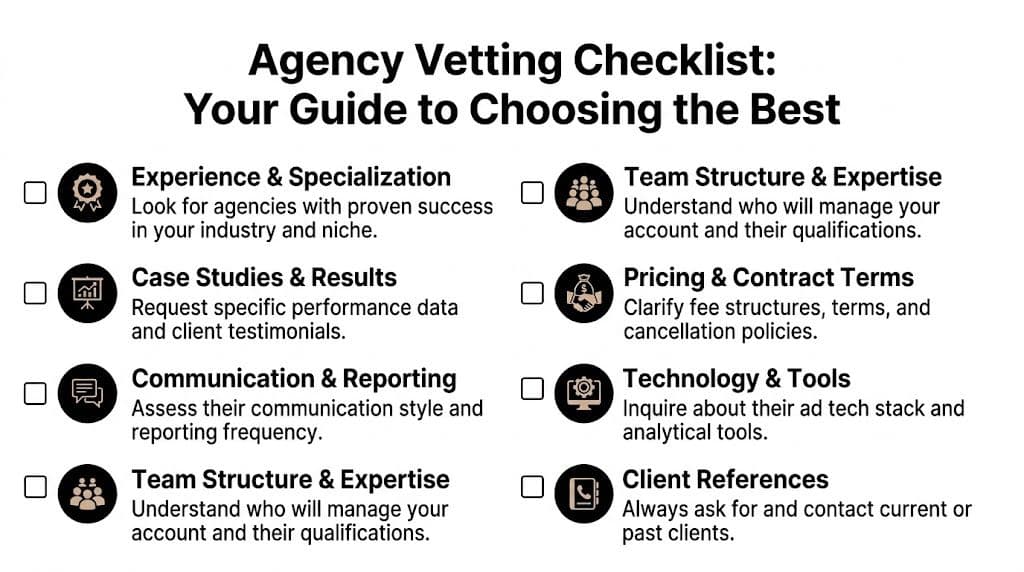
Start with role fit, then specialization
A lot of teams start with the wrong question. They ask, "Which agency is best?" The better question is, "Which parts of our Meta workflow need outside help?"
That shift matters because "agency" is a broad label. One shop may be strong at account strategy and weak at creative production. Another may be excellent at performance design for DTC brands but a poor fit for longer sales cycles. In some cases, the right answer is not a full-service partner at all. It may be a specialist agency for media buying, a freelance creative strategist, and internal ownership of landing pages and CRM.
Once that model is clear, specialization becomes easier to judge. Ask:
- Have you worked with our business model before? DTC, lead gen, SaaS, subscription, multi-location
- Which stage of the funnel do you usually improve? Front-end acquisition, qualification, repeat purchase, pipeline quality
- What creative patterns tend to fail in our category, and why?
AdEspresso recommends testing for category understanding, not just channel familiarity, in its guidance on ad angles and specialization. If an agency cannot explain your category's messaging constraints in plain language, the learning curve will likely be expensive.
Review evidence before the first call
Treat the first review like hiring for a senior role. You would not hire a head of growth based on confidence alone. Agency selection deserves the same standard.
Ask for materials before you book time:
- Case studies with context: What problem were they solving, what did they control, and what stayed outside their control?
- Sample reporting: You want to see how they explain performance, tradeoffs, and next steps
- Team structure: Who handles strategy, trafficking, analysis, and creative feedback?
- Account notes or audit examples: Their thinking process matters more than screenshots of good weeks
This is also where you check whether they speak realistically about performance. Conversion rates and CPAs vary a lot by category, sales cycle, offer type, and traffic quality, as noted earlier in the article. An agency that talks as if every account should scale on the same timetable is selling certainty they do not have.
The useful benchmark is not "good on Meta." It is "plausible for our economics, funnel, and sales process."
If you want a simple reference for the main work areas a partner may cover, this overview of Facebook ad services can help you compare scope across agencies, specialists, and hybrid setups.
Ask questions that expose the operating system
Generic questions get rehearsed answers. Specific questions force the agency to show how it operates.
Use prompts like these:
- What do you audit in the first two weeks? Strong answers usually include tracking quality, offer clarity, creative gaps, conversion friction, and signal quality.
- How do you decide what to test next? Listen for a prioritization method. Good teams rank tests by expected impact, confidence, and effort.
- What happens after a winning ad appears? Scaling depends on concept expansion, not just raising budget.
- How do you separate lead volume from lead quality? This matters for B2B, high-ticket services, and any business with an offline sales step.
- When do you decide not to spend more? Experienced operators know that more spend can magnify weak economics.
A short walkthrough can also help you hear how agencies talk about process in practice:
Check technical depth, but keep the test practical
You do not need every agency to sound like an analytics engineer. You do need clear answers on how they set up and validate measurement.
Ask how they handle tracking after privacy changes
A capable team should be able to explain Conversions API without jargon. The useful test is clarity. Can they explain which events they pass server-side, how they prevent duplicate events, and how they compare platform reporting with your own systems?
The Brand Amp outlines these technical areas in its guidance on evaluating Meta agencies. If the explanation stays vague, that is a risk. Weak measurement changes bidding, reporting, and budget decisions.
Ask:
- Which events do you prioritize server-side?
- How do you deduplicate Pixel and CAPI events?
- How do you validate reported conversions against our CRM, checkout data, or GA4?
If your team still relies on spreadsheets to reconcile channel performance, this guide on how to measure marketing effectiveness using Excel & AI can help you build a better review process before agency reporting muddies the picture.
Ask how they build audiences now
Interest targeting still has a place, but stronger teams usually talk more about customer data, exclusions, value signals, and creative-message fit than about stacking interests. Ryze AI covers that shift in its agency selection guide.
You are testing whether they understand audience strategy as part of a system, not a bag of hacks.
Questions to ask:
- What seed audiences do you prefer, and why?
- How do you use customer value or purchase quality in audience strategy?
- When do you broaden targeting, and when do you tighten exclusions?
Ask how they keep creative from stalling
Many accounts do not break because targeting fails. They stall because the team runs out of fresh messages.
Creative development works like fuel supply. If the agency has no repeatable way to turn customer language into new hooks, concepts, and formats, media buying will slow down no matter how good the account structure looks. Ask where new angles come from. Reviews, sales calls, founder interviews, CRM notes, support tickets, and landing page behavior are all useful sources. "We refresh creatives every two weeks" is not a process. It is a calendar.
Final shortlist criteria
By the end of vetting, you should be able to answer six practical questions:
- Do they understand our business model and funnel?
- Can they explain decisions clearly, without hiding behind dashboards?
- Do they show real measurement discipline?
- Do they have a repeatable creative process?
- Do the commercial terms match the kind of help we need?
- Do we know who will do the work day to day?
A good facebook ads agency should make the operating model clearer. If the sales process makes basic questions harder to answer, keep looking.
Agency vs In-House vs AI A Strategic Comparison
The old debate asks whether you should hire an agency or build in-house. Today, a more useful question arises: where should each part of the Meta workflow live?
That shift matters because Meta work isn't one job. It's a bundle of jobs. Strategy, creative generation, account management, analytics, landing page feedback, and reporting don't always need to sit with the same kind of operator. Once you see that, the decision gets less ideological and more practical.
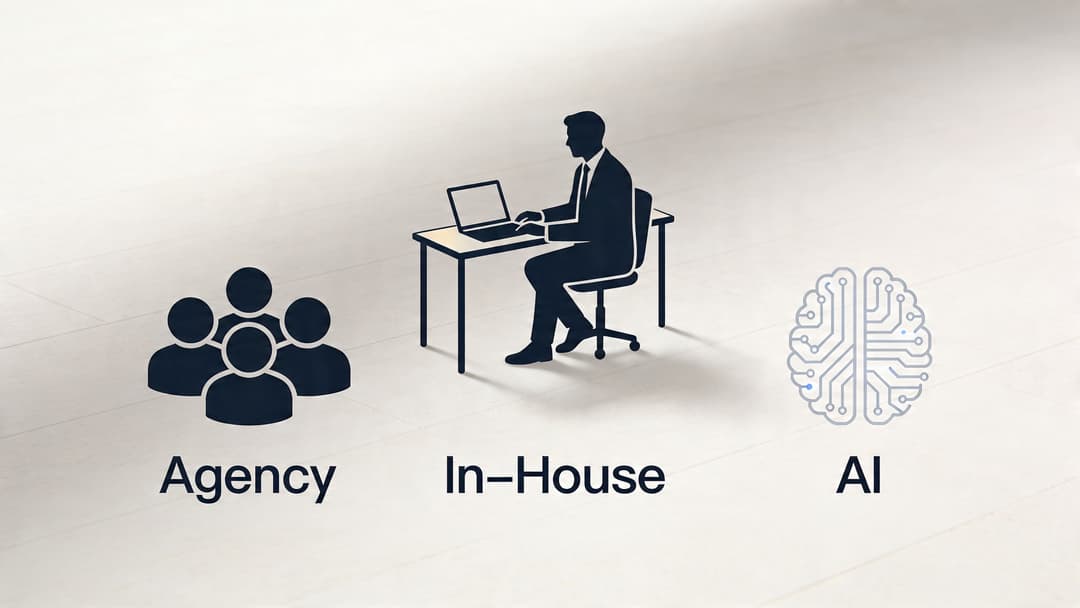
When agencies make the most sense
Agencies are usually strongest when you need a coordinated external team fast. They can bring strategy, media buying, creative direction, and benchmark exposure from multiple accounts. That breadth helps if your internal team is thin or your Meta program is stalled.
They are less attractive when your category requires daily product nuance, very fast internal collaboration, or tight integration with sales and customer success. Agencies can absolutely handle those situations, but friction tends to rise.
Agencies are often a fit when:
- You need specialist capability quickly
- Your internal team lacks senior Meta experience
- You want outside pattern recognition across many accounts
The tradeoff is control. Even good agencies sit one layer away from your business.
When in-house is the smarter choice
In-house teams usually win on context. They know the product, margin constraints, sales objections, and brand voice better than an outside partner. If your company already has strong creative, analytics, and channel leadership, in-house can be more coherent than outsourcing.
The problem is bandwidth. One person can rarely do strategy, creative direction, execution, and measurement at a high level for long. In-house teams also feel the burden of maintaining testing velocity while handling meetings, launches, reporting, and cross-functional requests.
This model tends to work best when:
- Meta is central enough to justify dedicated ownership
- Leadership wants direct control of account decisions
- The company can support creative and analytics around the media buyer
Where AI-driven platforms fit
AI tools change the equation because they don't replace strategic judgment. They compress the heavy production layer around that judgment.
For Meta, that usually means faster ad variation, quicker audience combinations, easier launch workflows, and clearer pattern spotting across creatives or segments. That makes AI especially useful for lean in-house teams, consultants, and agencies that need more output without hiring proportionally more people.
A practical example is AdStellar AI, which is built to launch, test, and scale Meta campaigns faster by generating large sets of creative, copy, and audience combinations, connecting to Meta Ads Manager, and surfacing performance insights across ROAS, CPL, or CPA. That's not a substitute for positioning, offer clarity, or commercial judgment. It is a workflow layer that can reduce manual setup and speed iteration. If you want a closer look at the model, this overview of an AI ad agency approach is helpful.
A side-by-side decision lens
| Option | Best strength | Main limitation | Best fit |
|---|---|---|---|
| Agency | Cross-functional expertise and outside perspective | Less day-to-day business context | Brands needing an external growth partner |
| In-house | Control, context, and close cross-team alignment | Limited bandwidth and specialist depth | Companies with strong internal marketing infrastructure |
| AI platform | Speed, testing scale, and workflow efficiency | Still needs human direction | Lean teams that want to expand output without adding headcount |
The hybrid model is often the real answer
Many of the strongest setups are mixed models.
A company may keep strategy and brand voice in-house, use a freelancer for creative production, rely on a specialist consultant for periodic audits, and use AI to handle bulk variation and launch workflows. Another company may retain an agency for account leadership while internal staff own offers and landing pages.
The right question isn't “which one wins?” It’s “which layer should each resource own?”
If your team can make good strategic decisions but can't execute enough tests, you don't necessarily need a bigger agency. You may need a better production system.
Measurement also affects the choice. If your team is trying to clean up reporting before changing resourcing, it helps to review practical ways to measure marketing effectiveness using Excel & AI. Better measurement often reveals whether your problem is strategy, execution speed, or decision quality.
The modern resource model is modular. That’s good news for growth teams because it means you don't have to buy an all-or-nothing solution.
Navigating Contracts Onboarding and Common Pitfalls
The wrong contract can ruin a decent agency relationship. The wrong onboarding can ruin a good one.
By the time you're reviewing paperwork, most buyers are tired. They’ve sat through demos, checked references, and want to move. That's exactly when they stop asking the questions that matter most.
Contract terms worth slowing down for
First, confirm ownership. Your ad account, Pixel setup, audiences, creative files, and reporting assets should not become hard to access if the relationship ends. If an agency insists on controlling the ad account entirely under its own business manager without a clear ownership path, pause.
Second, define the operating terms in writing:
- Termination rights: How much notice is required, and what happens during handoff
- Reporting cadence: Weekly, biweekly, monthly, and in what format
- Scope boundaries: Creative production, landing page edits, tracking support, meetings
- Approval process: Who approves campaigns, budgets, and creative before launch
If you want a practical legal primer before signing, this guide to mastering the professional service agreement is a useful companion.
What healthy onboarding looks like
Good onboarding feels organized, not theatrical.
The agency should gather business context, offer history, creative assets, account access, tracking details, prior performance, and downstream quality signals. They should also pressure-test goals. If your target metric doesn't match your sales reality, a smart agency will say so early.
A healthy kickoff usually includes:
- Business alignment: Offer, funnel, seasonality, margin, customer profile
- Technical review: Pixel, Conversions API setup, event mapping, CRM handoff
- Creative intake: Existing assets, past winners, customer language, review mining
- Test plan: What gets launched first, what gets held constant, what success means
Subtle red flags buyers miss
Some agency warnings are obvious. Others are easy to overlook because they sound polished in a sales environment.
One common pitfall is hiring a generalist agency for a niche business. As noted earlier, ask agencies to show real vertical specialization because specialists usually bring stronger creative and targeting precision for your market. Another issue is metric framing. If an agency talks mostly about click-through rate, reach, or cheap traffic without connecting those to lead quality or revenue, your goals may already be misaligned.
Watch for patterns like these:
- They avoid plain answers: Technical language replaces clear explanations
- They push budget increases too early: Spend growth is presented as strategy
- They hide the operators: You meet salespeople, not the team doing the work
- They over-index on vanity metrics: Cheap clicks become the success story
- They lack onboarding discipline: Access requests, tracking checks, and launch logic feel improvised
A bad agency relationship rarely fails in one dramatic moment. It usually slips through a series of small ambiguities nobody fixed early.
If the onboarding process feels vague, the ongoing management usually will too.
Making the Right Choice for Your Growth
The best facebook ads agency isn't the one with the loudest case studies. It's the one that matches your stage, your constraints, and the parts of the system your team needs help with.
If you're early and cash-conscious, a full agency may be too much structure for the amount of spend you can support. A strong freelancer, a consultant, or an AI-supported in-house setup can be more sensible. If you're a scale-up with a real budget, multiple offers, and a need for faster testing, a specialized agency can make sense, especially when internal bandwidth is already stretched. If you're larger and Meta is a major acquisition channel, in-house ownership often becomes more attractive because context and coordination matter so much.
The cleanest decision framework is simple:
- Choose an agency when you need outside expertise and coordinated execution.
- Choose in-house when control and business context matter most.
- Choose AI-supported workflows when your strategy is decent but your production speed is weak.
- Choose a hybrid when different parts of the workflow need different owners.
Teams often don't fail because they picked the wrong philosophy. They fail because they assigned the wrong resource to the wrong bottleneck.
Make the decision based on bottlenecks, not labels.
If your team already knows how to make strategic decisions on Meta but needs a faster way to produce, launch, and learn from more creative and audience combinations, AdStellar AI is one option to evaluate. It’s built to help marketers and agencies create campaigns at scale, connect performance data back to Meta Ads Manager, and reduce the manual work that often slows testing.