Picking the right partner for your Facebook ads is one of those make-or-break decisions. The Meta ad ecosystem is incredibly powerful, but it’s also a tangled mess of complexity. The right choice for you depends entirely on your company's budget, internal resources, and growth goals.
Navigating the Modern Facebook Ad Services Landscape
Running Meta ads in 2026 isn’t just about boosting a few posts and hoping for the best. It’s a specialized field that demands a sharp strategy, relentless creative testing, and a deep understanding of data. The "best" way to manage your campaigns has split into several distinct models, and each comes with its own set of rules.
The real challenge for performance marketers is figuring out which service model truly fits their immediate needs.
Choosing wrong can burn through your ad spend, stall your growth, and leave you watching competitors fly by. A fast-moving startup, for instance, could get bogged down by a traditional agency’s pace. On the other hand, a large enterprise might find a freelancer just doesn't have the strategic firepower they require. This guide will help you frame the decision by breaking down the core options available today.
Your Primary Options for Ad Management
Every business aiming to scale on Meta eventually has to go down one of four main paths. These aren't just different vendors; they're fundamentally different ways of working. Each is built for a specific stage of business growth and a different level of internal skill.
Your options boil down to:
- Full-Service Agencies: All-in-one partners that handle strategy, creative, and campaign management.
- Specialized Freelancers: Individual experts you hire for specific tasks or projects.
- Dedicated In-House Teams: Building your own internal department of ad specialists.
- AI Advertising Platforms: Software that automates campaign creation, testing, and optimization.
The question isn't "Which service is best?" It's, "Which service gives us the right mix of speed, control, cost, and strategic support right now?" Your answer will dictate how effectively you can actually scale.
To make a smart call, you have to know how each of these models really works. If you want to get granular on the specific software out there, you might find our guide reviewing various Meta advertising platforms helpful. For now, let's set the stage for a detailed comparison.
The table below gives you a quick, high-level look at where each model fits.
| Service Model | Ideal For | Key Characteristic |
|---|---|---|
| Agency | Established brands needing comprehensive strategy and brand oversight. | High-touch, strategic partnership. |
| Freelancer | Businesses needing flexible, project-based support or specialized skills. | Agility and focused expertise. |
| In-House Team | Large companies with the resources to build a dedicated marketing arm. | Maximum control and brand alignment. |
| AI Platform | Growth-focused teams prioritizing speed, data-driven scale, and efficiency. | Automation and rapid iteration. |
Picking the right way to manage your Facebook ads isn't just a small detail—it's a major decision that shapes your budget, your speed, and your entire strategy. There are a few different facebook ad services models out there, and figuring out how they differ is the only way to make a smart choice for your business.
Whether you go with a full-service agency or an automated AI platform, each path comes with its own set of benefits and compromises. We're going to break down each model based on what really matters: how much it costs, the strategic brainpower you get, how fast you can move, and how much control you keep.
Cost Structures And Pricing Models
How you pay for facebook ad services says a lot about the kind of partnership you're getting into. The price tag isn't just a number; it tells you what the service is really about, whether it's hands-on strategy, flexible help, or pure automated power.
- Agencies almost always work on a monthly retainer plus a percentage of your ad spend, usually 10-20%. This gets you a dedicated team looking after your account's long-term success, but it usually demands a pretty high minimum monthly spend to make sense.
- Freelancers are far more flexible. You'll find them charging by the hour ($50 to $250+), per project, or on smaller monthly retainers. This works great for one-off tasks like setting up a campaign, but it can get pricey if you need someone managing everything full-time.
- In-House Teams are a fixed cost—salaries, benefits, and ongoing training. You get total control, but building out a proper team with a media buyer, copywriter, and designer can easily run you over $200,000+ a year. It's a huge investment.
- AI Platforms like AdStellar typically use a SaaS subscription model. The pricing is tiered based on your ad spend or feature access, which makes your costs predictable and easy to scale. It’s built for teams who want to run things themselves without the massive overhead of hiring.
Strategic Depth Versus Execution Speed
Here’s a classic trade-off: do you need deep strategic thinking or lightning-fast execution? Some businesses need a partner to help them figure out their place in the market. Others just need to get ads live and start collecting data, fast. Knowing which camp you're in will make this decision much easier.
Agencies are the masters of deep strategy. They bring experience from dozens of other industries to the table, helping with everything from brand positioning to complex, multi-channel campaigns. The downside? This detailed, layered approach can be slow. It might take weeks to get a new campaign off the ground.
On the flip side, freelancers and AI platforms are all about speed. A good freelancer can take a clear brief and have ads running in a few days. AI platforms push this even further, letting one person create, launch, and test hundreds of ad variations in minutes. The performance data starts rolling in almost immediately. You can dig deeper into this by exploring the differences between automated vs traditional ad management.
The core trade-off is clear: Agencies offer strategic oversight at the cost of speed, while freelancers and AI platforms deliver rapid execution, placing more of the strategic burden on your internal team.
This infographic lays out the core traits of each of these facebook ad services options.
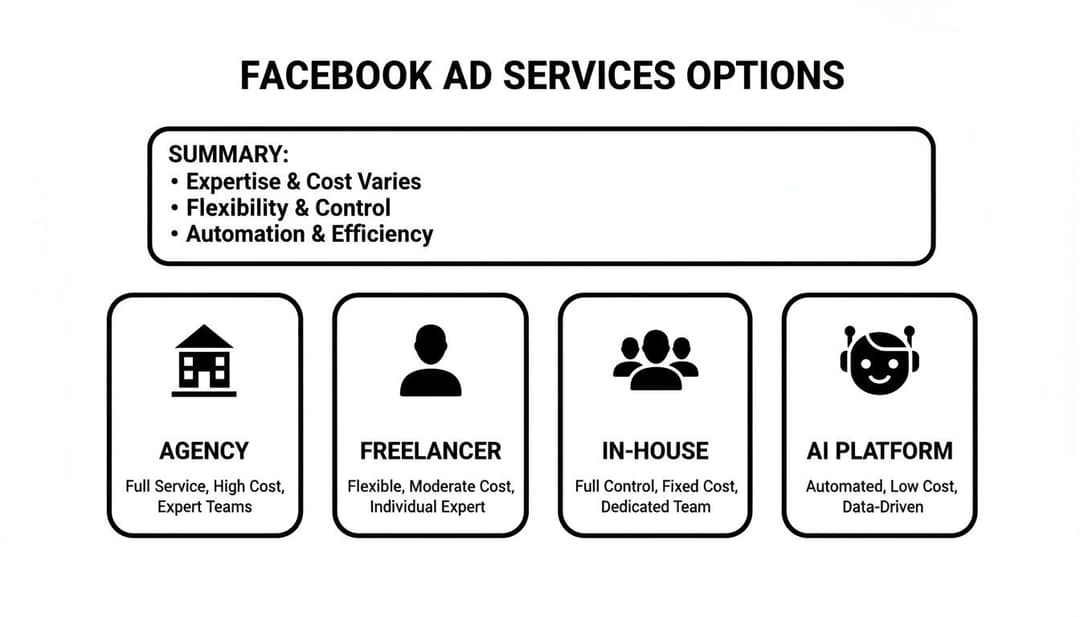
As you can see, moving from an agency to an AI platform means shifting from an external strategic partner to empowering your own team with powerful technology.
Control And Scalability
How much control do you really want over your ad account? And how fast do you need to scale up? Your answer points directly to one of these service models.
An in-house team gives you the ultimate level of control. Every single decision, from the creative to the budget, happens under your roof. The problem is that your ability to scale is tied directly to your headcount. To run more tests or launch in new markets, you have to hire more people, which is slow and expensive.
Agencies are the middle ground. You hand over the day-to-day management but keep strategic oversight. They can usually scale faster than an in-house team because they can pull people from their larger talent pool to work on your account.
Freelancers give you control over specific tasks but can quickly become a bottleneck. When you're relying on just one person, it's tough to dramatically ramp up your ad spend or testing. This is exactly where AI platforms shine. They're built for massive scalability, letting your team expand campaigns without needing to hire more people or blow up your costs. When looking at different ad strategies, it's helpful to see how platforms compare, like in this detailed breakdown of Facebook Ads vs Google Ads.
The power of advertising on Facebook is undeniable. More than 90% of marketers globally use Facebook ads for growth, and the platform reaches almost 60% of all internet users. For many, this has translated into incredible results, with advertisers reporting an average ROI of 4x ad spend and 70% seeing positive returns within just three months.
Facebook Ad Service Models At a Glance
To make things even clearer, let's put these options side-by-side. This table breaks down how each model stacks up across the most important factors.
| Service Model | Typical Pricing | Level of Control | Speed to Launch | Best For |
|---|---|---|---|---|
| Agency | High retainer + % of spend | Low (Strategic Oversight) | Slow | Established brands needing a full strategic partnership. |
| Freelancer | Hourly or project-based | Medium (Task-Level) | Moderate | Businesses needing flexible, specialized help on specific projects. |
| In-House Team | High (Salaries & Overhead) | High (Total Control) | Moderate | Large companies with the budget to build a dedicated department. |
| AI Platform | Tiered SaaS subscription | High (Execution Control) | Fast | Growth-focused teams who prioritize speed, data, and efficiency. |
In the end, choosing the right service model isn’t about finding the one "best" option for everyone. It's about finding the perfect match between a service's strengths and your company's specific needs, budget, and ambitions for growth.
When to Choose Each Service Model
Picking the right partner for your Facebook ad services isn't a one-size-fits-all decision. It’s about finding a perfect match for your company's current stage, immediate goals, and the resources you already have in-house. What works wonders for a scrappy startup could easily hold back a large corporation, and the other way around.
The trick is to stop thinking in general terms and start looking at practical situations. Let's walk through a few real-world business scenarios to see which approach truly makes the most sense.
Scenario 1: An Ecommerce Brand Scaling Top Products
Imagine a direct-to-consumer (DTC) brand that has already found its winning products. Sales are steady, and they know their customer inside and out. The main goal now is simple: scale ad spend aggressively without letting their Return on Ad Spend (ROAS) tank.
For this brand, speed is everything. They need to cycle through hundreds of creative and audience combinations to discover new pockets of growth and keep their ads from going stale.
This is a perfect job for an AI advertising platform. An agency might move too slowly, with feedback loops and strategy meetings gumming up the works. An in-house team could try, but they'd have a hard time matching the sheer volume and speed of an AI-powered system without hiring a small army.
Key Differentiator: When the top priority is rapid, high-volume creative testing and budget optimization, AI is the clear winner. If you're looking to pour fuel on a fire that's already burning, automation gives you a level of scale that human-led services just can't keep up with.
An AI platform like AdStellar lets a lean team launch hundreds of ad variations at once. It automatically spots the top performers based on real-time ROAS and shifts the budget to the winners. This allows the brand to scale what works without the high overhead of an agency or the crushing manual workload of a big in-house team.
Scenario 2: A B2B SaaS Company Focused on Lead Quality
Now, let's switch gears to a B2B SaaS company. Their goal isn't just getting a ton of leads; it's about attracting highly qualified prospects who match a very specific ideal customer profile (ICP). The sales cycle is long, and a bad lead is a huge waste of the sales team's time and energy.
This company's advertising needs a more strategic, nuanced touch. They need someone with deep expertise in writing compelling messages for a sophisticated audience and who understands the long, winding B2B customer journey.
A specialized B2B freelancer or a boutique agency is often the best fit here. These partners bring a focused expertise that a generalist agency just can't offer. They know the difference between a Marketing Qualified Lead (MQL) and a Sales Qualified Lead (SQL) and can build campaigns that actually get in front of decision-makers. With the average CPA for B2B advertisers on Facebook hovering around $23.77, optimizing for quality isn't just a nice-to-have—it's essential for profitability.
A good freelancer can feel like an extension of your marketing team, offering dedicated support on everything from strategy to execution. It's a great balance of expert guidance without the hefty price tag and long onboarding process of a full-service agency.
Scenario 3: A Global Enterprise with Complex Brand Needs
Think about a massive, multinational corporation. They have rigid brand guidelines, dozens of product lines, and complex legal hoops to jump through. Their ads need to be perfectly in sync with massive campaigns running across every channel, from TV spots to print magazines.
For an organization like this, control, brand safety, and seamless integration are absolute must-haves. It's not just about performance; it's about flawless execution that protects their hard-earned brand reputation.
This is where a full-service agency or a well-oiled in-house department becomes non-negotiable.
Full-Service Agency: An agency brings a whole team to the table—strategists, copywriters, media buyers, and account managers—who can wrangle all that complexity. They have proven processes for managing huge budgets, ensuring brand compliance, and reporting up the chain to multiple stakeholders.
In-House Team: Building an in-house team gives the enterprise the ultimate level of control. This model guarantees that everyone touching the ads has a deep, intuitive understanding of the company's brand, culture, and long-term vision.
An AI platform or a freelancer just can't cut it here. They don't have the comprehensive strategic oversight or the sheer manpower required to handle the intricate needs of a global brand. The choice between an agency and an in-house team usually boils down to a simple question: do you want to build that expertise internally or rent it? To dig deeper into this, you can explore the pros and cons of Facebook campaign automation versus hiring.
Scenario 4: A Venture-Backed Startup Needing Rapid Market Testing
Finally, picture a venture-backed startup with a brand-new product. They've got seed money in the bank but a very short runway to find product-market fit and prove they have traction for the next round of investors. Their most precious resource isn't money; it's time.
They can't afford to get bogged down in months of strategic planning. They need to get into the market, get data, and iterate—fast.
This situation is tailor-made for an AI advertising platform. The ability to rapidly launch and test dozens of value propositions, creatives, and audience theories is exactly what a startup needs to learn and pivot on a dime. The platform automates the grunt work of campaign setup, freeing up the small team to focus on what really matters: analyzing results and sharpening their strategy. The predictable cost of a subscription model also fits perfectly with a startup's need to keep a close eye on their burn rate.
Understanding the Rise of AI Advertising Platforms
 Beyond the world of agencies and freelancers, a new category of Facebook ad services has emerged: AI-powered advertising platforms. These aren't just another tool or vendor. They represent a complete overhaul of how campaigns are managed, moving away from slow, manual work toward intelligent, automated execution.
Think of it this way: an AI platform connects directly to your ad account and instantly starts learning from your historical performance data. It's built for performance marketers and growth teams who need to move fast and make decisions backed by data, not just intuition.
This data-first approach fundamentally changes how you advertise.
From Manual Work to Intelligent Automation
Anyone who has managed Facebook campaigns knows the drill. Launching a proper testing campaign is a tedious, click-heavy grind. A media buyer can easily spend hours setting up just a few ad variations, manually duplicating ad sets to test audiences, and then watching performance like a hawk to shift budgets.
This old way of working is not only slow, but it also puts a hard limit on how many ideas you can actually test.
AI platforms blow this bottleneck wide open. They use automation to generate hundreds—or even thousands—of ad variations in minutes. By mixing and matching your headlines, images, copy, and audiences, the system builds a massive testing matrix that would take a human team weeks to assemble.
This unlocks a few critical advantages:
- Massive Creative Testing: You can test every value prop, creative angle, and audience segment at the same time to quickly find out what works.
- Data-Driven Budget Allocation: The platform's algorithms constantly analyze results against your goals (like ROAS or CPA) and automatically move spend to the ads delivering the best returns.
- Reduced Guesswork: Your decisions are based on what the performance data clearly says is working, not just what you think will work.
When you're looking at new tech, it's worth seeing how different AI tools for marketing teams are shaking up campaign management, as this is at the heart of their impact.
Empowering Human Strategists, Not Replacing Them
There's a common fear that AI platforms will make marketers obsolete. The reality is just the opposite. They free up strategists from the mind-numbing, repetitive tasks that eat up their day.
Instead of getting lost in the weeds of campaign setup, marketers can finally focus on what really matters: high-level strategy, creative direction, and digging into the insights the AI uncovers.
The real power of AI in advertising is that it handles the execution so humans can focus on the strategy. It turns a single media buyer into a high-output growth engine.
This shift is more important than ever. Meta's advertising revenue, for example, soared to over $196 billion worldwide in 2025, a 22.1% annual jump, underscoring the platform's incredible scale. With average ROIs hitting 4x ad spend and 70% of advertisers seeing positive returns quickly, the opportunity is huge, but so is the competition. You can explore more research on this topic in Meta's advertising revenue trends.
Platforms like AdStellar are built to give teams the edge they need in this crowded space. By automating bulk ad creation and using AI to find and scale winning ads, they bring clarity and repeatable success to your campaigns. For a deeper dive, check out our guide on how to leverage AI for Facebook Ads. The whole point is to unlock more revenue with less time and less wasted spend.
A Framework for Making Your Decision
Alright, we’ve laid out the different models for managing your Facebook ad services. Now it’s time to bring it all home and figure out which one actually fits your business. This isn’t just a tactical choice—it's a major strategic decision that will shape your growth.
The right answer depends entirely on an honest look at your goals, budget, and team. Get your key people in a room and start hashing out the answers to these critical questions. Once you’re clear on these, the path forward becomes much easier to see.
Key Questions to Guide Your Choice
Before you even think about picking a partner, you need to get your own house in order. Getting aligned internally on these points is the only way to avoid choosing a service model that’s completely wrong for how you operate.
- What’s our real monthly ad spend? Be brutally honest. Is it under $5,000, over $50,000, or somewhere in between? Your budget is the fastest way to narrow down your options.
- What expertise do we already have? Do you have a marketing manager who can steer the ship but doesn't have the time for day-to-day execution? Or are you truly starting from square one?
- Is our main goal rapid growth or steady brand building? Startups often need to move fast and gather data, while established companies might be more focused on brand consistency and long-term strategy.
- How much control do we really need? Are you okay with handing over the keys, or does your team need to keep daily execution in-house to stay agile and maintain direct oversight?
Working through these questions is your first, most important step. If you want to dig deeper into this process, check out our guide on how to select the right ad platform for more tips.
For teams that need to move fast, make data-backed decisions, and scale massively, an AI platform is the modern answer. On the other hand, for businesses that need deep, hands-on brand strategy and complex integrations, a full-service agency is still a powerhouse.
A Simple Decision Path
Once you have your answers, a recommendation usually starts to jump out. Think of this as a quick decision tree to point you toward the best-fit solution.
If your main priority is…
Speed, Scale, and Efficiency: You need to test hundreds of ad variations in a flash and optimize your budget with real-time performance data. Your team is smart but lean.
- Your Best Bet: An AI Advertising Platform like AdStellar.
Strategic Oversight and Brand Integrity: You have a serious budget, complex brand rules, and need a partner to manage campaigns across multiple channels.
- Your Best Bet: A Full-Service Agency.
Flexibility and Specialized Support: You need an extra set of hands for a specific project, like a campaign launch or creative production, and want to add to your team without a long-term commitment.
- Your Best Bet: A Specialized Freelancer.
Making the right call here is more critical than ever. The competition on Meta’s platform is white-hot—Facebook ad services pulled in a staggering $58.1 billion in Q4 2025 advertising revenue, a 24% YoY jump. In such a crowded space, tools like AdStellar, which use AI to find and scale your winning ads, are what give you an edge and maximize your ROAS. You can read more about Meta's record-breaking performance on Marketing Dive.
Answering Your Top Questions About Facebook Ad Services
When you start digging into different Facebook ad services, the same questions pop up time and time again. Getting straight answers is the only way to make a decision you feel good about—one that actually fits your budget, team, and goals.
We’ve pulled together the most common questions marketers have when they're at this crossroads. Think of it as a quick guide to cut through the noise.
How Much Should I Budget for Facebook Ad Services?
Budgeting for Facebook ads isn't just about what you spend on the ads themselves. You also have to factor in the cost of someone managing them. These management costs swing wildly from one service model to another, and each is built for a different kind of business.
Here’s a rough breakdown of what to expect for management fees:
- Freelancers: You're typically looking at $50 to $250+ per hour, though some prefer a fixed project fee. Monthly retainers are also common, usually starting between $500 and $2,000 for basic campaign oversight.
- Agencies: Most agencies start with a monthly retainer, often $3,000-$5,000+, and add a percentage of your ad spend on top of that—usually 10-20%.
- AI Platforms: These are almost always a SaaS subscription. The price is often tiered based on your monthly ad spend, which makes your costs predictable and lets them grow alongside your campaigns.
Your total cost is always your media spend plus the management fee. For example, if an agency requires a $10,000 minimum monthly ad spend and charges a 20% fee, your actual monthly bill will be $12,000 or more.
How Difficult Is It to Switch From an Agency to an AI Platform?
Moving from a traditional agency to an AI-driven platform like AdStellar is much simpler than most people think. The whole migration is designed to be a clean handoff, causing as little disruption as possible.
It really comes down to a few key steps:
- Granting Access: You’ll connect the AI platform to your Meta Ads Manager through a standard, secure process. This gives the software read-only access to analyze your historical data without messing with any live campaigns.
- Asset Transfer: Your agency will hand over all your creative assets—every image, video, and piece of copy—along with your audience lists. You just upload them into the AI platform's libraries.
- Strategy Handoff: The strategic plan your agency built becomes your playbook. Your team takes that foundation and uses the AI platform to execute and test those strategies on a much bigger, faster scale.
The biggest hurdle is really just a change in mindset. Instead of an external team doing the work, your own team is now in the driver's seat, using AI to automate the repetitive tasks and find what works.
What Metrics Truly Matter for Measuring Success?
Vanity metrics like likes and shares are nice, but they don't pay the bills. The KPIs that actually matter will always tie back to your core business goals, but there are a few that are non-negotiable for measuring the success of any Facebook ad service.
Here’s what you should be obsessed with:
- Return on Ad Spend (ROAS): This is the ultimate bottom line. It tells you exactly how much revenue you’re making for every single dollar you spend on ads.
- Cost Per Acquisition (CPA): This is how much it costs you to get one new customer. Your target will depend on your industry—the average CPA for B2B is around $23.77, but it can jump to $55.21 for tech companies.
- Customer Lifetime Value (LTV): This metric gives you the long-term perspective. A high LTV means you can afford a higher CPA upfront because you know that customer will bring in more revenue over time.
If you aren't tracking these, you're flying blind. It's the only way to know if your ad spend is actually growing your business.
Ready to take control of your Meta advertising and scale faster? AdStellar AI is the platform that lets your team launch, test, and scale campaigns 10x faster. Discover how AdStellar can unlock more revenue with less wasted spend.