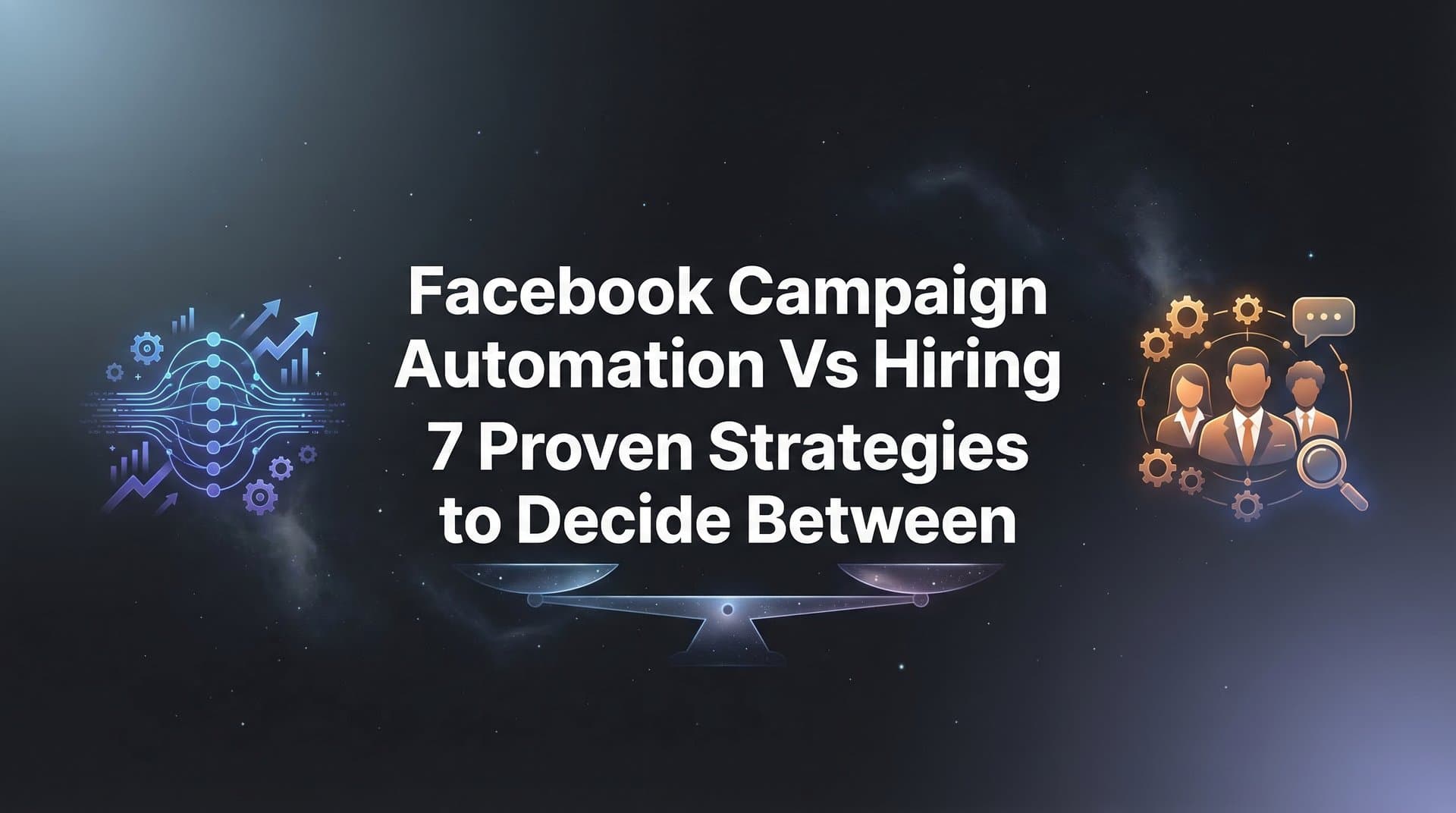
The Meta advertising landscape has reached a complexity tipping point. Campaign structures now require managing dozens of ad sets, hundreds of creative variations, and constant optimization cycles that never sleep. Meanwhile, the war for marketing talent has driven salaries skyward, with experienced Meta advertisers commanding six-figure packages plus benefits.
You're facing a fundamental strategic question: Should you invest in Facebook campaign automation tools that promise AI-powered efficiency, or build a human team with the creativity and judgment that machines can't replicate?
The answer isn't binary. This decision shapes not just your advertising operations, but your entire growth trajectory, cash flow management, and competitive positioning. Make the wrong choice, and you'll either burn budget on underutilized tools or drown in payroll costs that don't scale with results.
The following strategies provide a systematic framework for evaluating both paths. You'll learn how to calculate true costs beyond sticker prices, map your operational needs to the right solution, and design a hybrid approach that captures the best of both worlds.
1. Calculate Your True Total Cost of Ownership
The Challenge It Solves
Most businesses make this decision by comparing monthly software costs against annual salaries—a comparison that misses 60% of the actual expenses. The real financial picture includes hidden costs that emerge months after your initial investment, turning what seemed like a clear choice into a budget nightmare.
Hiring costs extend far beyond base salary. Recruitment fees, benefits packages, equipment, software licenses, training time, and management overhead add substantial expenses that many businesses discover too late. Similarly, automation tools carry hidden costs in implementation time, learning curves, and integration requirements.
The Strategy Explained
Build a comprehensive Total Cost of Ownership analysis that captures every expense over a 12-month period. For hiring, include recruitment costs (typically 15-25% of annual salary), benefits (add 25-40% to base salary), equipment and software, training time, and the management hours required to oversee the hire.
For automation, calculate not just subscription fees but implementation time (valued at your internal hourly rate), training requirements, any necessary integrations, and the opportunity cost of learning curve periods when campaigns may underperform. Factor in whether you'll need any human oversight or strategic input alongside the automation. Understanding Facebook campaign automation pricing structures helps you build more accurate projections.
Create a spreadsheet with monthly breakdowns. Many businesses discover that a $50,000 salary actually costs $75,000-$85,000 when fully loaded. Meanwhile, a $500/month automation tool might require $5,000 in setup time and $2,000 monthly in oversight hours—still significantly less expensive, but not the simple comparison the sticker prices suggest.
Implementation Steps
1. List every hiring cost: base salary, payroll taxes, health insurance, retirement contributions, equipment, software licenses, recruitment fees, training time (valued at your rate), and estimated management hours per week.
2. Calculate automation costs: subscription fees, implementation time (hours × your internal rate), training requirements, integration costs, and ongoing oversight needs (hours per week × rate).
3. Project both scenarios across 12 months, then calculate cost per campaign launched and cost per dollar of ad spend managed to determine efficiency metrics.
Pro Tips
Don't forget to factor in replacement costs—the average marketing hire stays 2-3 years, meaning you'll face recruitment costs again. Automation tools typically lock in pricing for longer periods. Also consider the cash flow timing: hiring requires immediate full salary payments, while automation costs scale more gradually with usage.
2. Audit Your Campaign Volume and Complexity Requirements
The Challenge It Solves
Your campaign workload determines which approach can actually handle the job. A single human can effectively manage perhaps 10-15 active campaigns with multiple ad sets each, but beyond that threshold, quality deteriorates rapidly. Conversely, automation tools excel at volume but may struggle with highly nuanced campaigns requiring contextual judgment.
Many businesses choose based on current needs, then find themselves constrained six months later when growth demands more capacity than their chosen solution can provide. This mismatch forces expensive pivots or operational bottlenecks that slow growth precisely when momentum matters most.
The Strategy Explained
Map your current campaign architecture: How many active campaigns do you run simultaneously? How many ad sets per campaign? How many creative variations are you testing? How frequently do you launch new campaigns or refresh existing ones? Document the typical complexity—are these straightforward conversion campaigns, or do they involve complex funnel sequences with multiple touchpoints? A solid grasp of Facebook ads campaign hierarchy helps you assess complexity accurately.
Now project forward 12 months. If your business grows 50%, how will your campaign needs scale? Will you need more campaigns, or more complexity within existing campaigns? Will you expand to new products, audiences, or markets that require specialized expertise?
Compare these requirements against realistic capacity estimates. A skilled marketer can typically handle 10-15 campaigns with daily optimization. Automation platforms can manage hundreds of campaigns simultaneously, but may require human input for strategic decisions, creative direction, and audience insights.
Implementation Steps
1. Document your current state: count active campaigns, ad sets per campaign, creative variations being tested, and launch frequency over the past 90 days.
2. Calculate growth projections: multiply current volume by your expected growth rate, then add any new initiatives (product launches, market expansion, seasonal campaigns) planned for the next year.
3. Assess complexity factors: rate each campaign type on strategic complexity (1-10 scale) and identify which elements require human judgment versus execution speed.
Pro Tips
Consider your testing velocity requirements. If you need to launch 50 ad variations weekly to find winners, automation handles this far better than humans. But if you're running highly targeted campaigns to niche B2B audiences requiring contextual messaging, human expertise becomes more valuable. Volume favors automation; nuance favors humans.
3. Assess Your Speed-to-Market Priorities
The Challenge It Solves
Competitive advantage in digital advertising often comes down to who can test, learn, and scale fastest. If your competitors launch new campaigns in hours while you take days, they'll capture market opportunities before you even enter the race. Conversely, rushing to market with poorly conceived campaigns wastes budget faster than moving slowly with strategic precision.
The speed equation involves more than just launch velocity. It includes how quickly you can respond to performance data, adapt to market changes, capitalize on trending topics, and scale winning campaigns before saturation sets in. Different approaches deliver speed at different stages of the campaign lifecycle.
The Strategy Explained
Evaluate where speed creates the most value in your business model. E-commerce brands often benefit from rapid testing of dozens of creative variations to identify winners quickly. B2B companies might prioritize thoughtful audience targeting and messaging precision over sheer launch velocity. Seasonal businesses need the ability to scale proven campaigns instantly when demand spikes.
Automation tools excel at execution speed—building and launching campaigns in minutes rather than hours. Platforms with AI for Facebook advertising campaigns can analyze performance data and create new variations faster than any human team. However, strategic pivots, messaging repositioning, and creative conceptualization still benefit from human thinking time.
Human teams provide speed in strategic adaptation and contextual decision-making. An experienced marketer can recognize subtle market shifts, competitive moves, or audience sentiment changes that require campaign adjustments. They can make judgment calls about when to pause, pivot, or double down based on factors that algorithms might miss.
Implementation Steps
1. Map your current campaign lifecycle: measure average time from concept to launch, time to first optimization decision, and time to scale winning campaigns to maximum budget.
2. Identify your speed bottlenecks: where do campaigns stall? Is it in creative production, campaign building, audience research, or decision-making about what to test next?
3. Calculate your speed-to-value metric: how quickly do you need to go from idea to measurable results? Days, hours, or minutes? This determines whether execution speed or strategic speed matters more.
Pro Tips
Think about your competitive landscape. If you're in a fast-moving consumer market where trends shift weekly, execution speed through automation becomes critical. If you're in a relationship-driven B2B space where campaigns run for months, strategic speed and adaptability matter more. Match your speed priorities to your market dynamics, not industry hype.
4. Evaluate Your Data Utilization Maturity
The Challenge It Solves
Your advertising performance data contains patterns that predict future success—but only if you can extract and act on those insights systematically. Many businesses sit on goldmines of historical campaign data while making optimization decisions based on intuition or surface-level metrics. The gap between data you have and insights you use determines whether automation or human expertise delivers more value.
Automation tools thrive on data volume and pattern recognition. They can analyze thousands of data points across campaigns to identify which creative elements, audience segments, and messaging approaches drive results. But they require clean data infrastructure and clear performance metrics to optimize against. Human marketers excel at interpreting ambiguous signals and making decisions when data is incomplete or contradictory.
The Strategy Explained
Assess your current data infrastructure and analytical capabilities. Do you have historical campaign performance data organized in a way that reveals patterns? Can you identify which creative elements, headlines, audience segments, and campaign structures have historically driven your best results? Or are you starting fresh with each new campaign, unable to leverage past learnings systematically?
Automation platforms deliver maximum value when they can analyze your performance history to inform new campaigns. AI-powered tools can identify that certain headline patterns, visual styles, or audience combinations consistently outperform others—then automatically build new campaigns using those winning elements. This data-driven approach compounds over time as the system learns from each campaign. Understanding campaign learning in Facebook ads automation helps you leverage this compounding effect.
Human marketers add value when data is ambiguous, incomplete, or requires contextual interpretation. They can recognize that a campaign "failed" due to external factors (competitor launch, news event, seasonal timing) rather than creative quality. They can spot emerging trends in early-stage data that algorithms might dismiss as noise.
Implementation Steps
1. Audit your data readiness: inventory what performance data you have, how it's organized, and whether you can easily identify patterns across campaigns (winning creative elements, audience segments, messaging themes).
2. Define your key performance indicators: establish clear metrics that define campaign success for your business—not just clicks and impressions, but conversion rates, customer acquisition costs, and lifetime value where possible.
3. Assess your analytical capacity: can your current team extract actionable insights from campaign data, or do optimization decisions rely primarily on intuition and best practices?
Pro Tips
If you're starting with limited historical data or unclear success metrics, human expertise helps establish the foundation before automation can optimize effectively. Once you've run enough campaigns to identify clear patterns, automation can scale those insights far beyond human capacity. The maturity of your data determines the sequence, not the ultimate destination.
5. Map Your Strategic vs Tactical Needs
The Challenge It Solves
Not all advertising tasks create equal value. Strategic decisions—which markets to enter, what positioning to take, how to structure your funnel—require human judgment, market understanding, and creative thinking. Tactical execution—building campaigns, launching ad variations, adjusting bids—benefits from speed and consistency that automation provides. Misaligning tasks with capabilities wastes your most expensive resource: human creativity on repetitive work, or automation on decisions requiring contextual judgment.
Many businesses struggle to distinguish between strategic and tactical work, treating all advertising activities as equally important. This leads to skilled marketers spending 70% of their time on campaign setup and monitoring—tasks that automation handles better—while strategic opportunities go unexplored.
The Strategy Explained
Create a comprehensive task inventory of everything involved in running your Facebook advertising operations. Include strategic activities like audience research, competitive analysis, messaging development, funnel design, and creative concepting. Then list tactical execution tasks: campaign building, ad set creation, budget allocation, bid adjustments, performance monitoring, and reporting.
Evaluate each task on two dimensions: Does it require human judgment and creativity, or is it rule-based and repeatable? Does it create strategic value, or is it necessary execution? This creates a matrix that reveals which tasks suit automation (repeatable execution), which require human expertise (strategic judgment), and which might benefit from hybrid approaches. Exploring Facebook advertising workflow automation reveals how to systematically categorize these tasks.
Automation excels at repeatable, rule-based tasks that benefit from speed and consistency: building campaign structures, testing variations at scale, monitoring performance against thresholds, adjusting budgets based on performance rules, and generating reports. Human expertise shines in ambiguous situations requiring judgment: interpreting market shifts, developing positioning strategies, creating original messaging concepts, and making decisions when data conflicts or context matters.
Implementation Steps
1. List every task in your advertising workflow: from initial strategy development through campaign launch, optimization, and performance analysis—capture everything currently happening.
2. Categorize each task: mark whether it's strategic (requires judgment) or tactical (follows rules), and whether it's high-value (directly impacts results) or necessary overhead (must be done but doesn't differentiate).
3. Identify automation candidates: tasks that are tactical, repeatable, time-consuming, and don't require contextual judgment are prime candidates for automation—even if humans currently handle them well.
Pro Tips
The highest-value use case combines automation for tactical execution with human oversight for strategic direction. Let automation handle building 50 ad variations based on proven templates, while humans focus on developing the positioning strategy, creative concepts, and messaging themes that the automation executes. This hybrid approach multiplies human creativity rather than replacing it.
6. Consider Your Growth Trajectory and Scalability
The Challenge It Solves
Today's perfect solution becomes tomorrow's constraint if it can't scale with your growth. Hiring one marketer works brilliantly until you need three, then face months of recruitment, onboarding, and integration challenges. Automation scales instantly—but only if your campaigns, creative supply, and strategic direction can keep pace with the execution capacity you've unlocked.
Growth creates different bottlenecks at different stages. Early-stage businesses often lack the campaign volume to justify automation costs. Mid-stage companies hit the human capacity ceiling where one person can't manage the workload but hiring feels premature. Late-stage businesses face coordination challenges as teams grow and automation becomes essential for consistency.
The Strategy Explained
Project your business trajectory over the next 12-24 months. How will your advertising needs evolve as you grow? Consider campaign volume (more campaigns running simultaneously), market expansion (new geographies or audience segments), product launches (additional offers requiring dedicated campaigns), and testing velocity (more variations to identify winners faster).
Evaluate how each approach scales with these growth dimensions. Human teams scale linearly—double your workload, double your team. This provides flexibility but creates ongoing recruitment and management overhead. Automation scales exponentially—the same tool that manages 10 campaigns can handle 100 with minimal additional cost, though you may need human input for strategy and creative production. Learning how to scale Facebook advertising campaigns effectively requires understanding these dynamics.
Consider your organizational capacity to support each scaling path. Can you recruit, onboard, and manage a growing marketing team effectively? Do you have the systems and processes to maintain quality as headcount increases? Or would you benefit from keeping teams lean while scaling execution through automation?
Implementation Steps
1. Map your growth scenario: project your business metrics (revenue, customer acquisition targets, market expansion plans) 12 and 24 months forward, then translate those into advertising requirements.
2. Calculate scaling costs for each approach: model what hiring looks like at 2×, 3×, and 5× your current advertising workload versus automation costs at those same volumes.
3. Identify scaling bottlenecks: where will each approach hit capacity constraints? For hiring, it's recruitment and management. For automation, it's typically creative supply and strategic direction.
Pro Tips
Think about your scaling timeline. If you need to double advertising output in 90 days, automation delivers that capacity instantly while hiring takes months. But if you're planning steady growth over years, building a strong human team creates organizational knowledge and capability that compounds over time. Match your scaling approach to your growth velocity and timeline.
7. Design a Hybrid Implementation Roadmap
The Challenge It Solves
The automation-versus-hiring question presents a false dichotomy. The most effective advertising operations combine both approaches strategically: automation for execution speed and scale, human expertise for strategy and creativity. But implementing a hybrid model without a clear roadmap leads to confusion about roles, duplicated efforts, and tools that don't integrate with team workflows.
Many businesses attempt hybrid approaches by adding automation to existing human workflows or hiring people to "manage" automation tools. Both create inefficiency. The goal is designing complementary roles where each approach handles what it does best, creating a system that outperforms either approach alone.
The Strategy Explained
Start by defining clear swim lanes: which tasks belong to automation, which require human expertise, and where they intersect. A well-designed hybrid model typically assigns tactical execution to automation—building campaigns, launching variations, monitoring performance against rules, adjusting budgets based on thresholds. Human expertise focuses on strategic direction, creative concepting, audience insights, and judgment calls that require contextual understanding. Reviewing a comprehensive Facebook campaign automation guide helps establish these boundaries.
Design the integration points where automation and human expertise connect. Humans set strategy and provide creative assets; automation executes at scale and surfaces performance insights; humans interpret those insights and adjust strategy. This creates a learning loop where each component enhances the other rather than competing for the same tasks.
Plan your implementation in phases rather than attempting everything simultaneously. Phase 1 might involve implementing automation for your highest-volume, most repetitive tasks while maintaining human oversight. Phase 2 expands automation to additional workflows as you validate effectiveness. Phase 3 optimizes the division of labor based on actual performance data rather than assumptions. You can get started with Facebook ads automation through a structured pilot program.
Implementation Steps
1. Define your target state: describe what your ideal hybrid operation looks like in 6-12 months—which tasks are automated, what humans focus on, and how they work together.
2. Identify your Phase 1 pilot: select one high-volume workflow to automate first (typically campaign building and launching), maintain human oversight for strategy and creative, and measure results rigorously.
3. Create decision rules for the handoff points: establish clear criteria for when automation handles tasks independently versus when it escalates to human judgment—this prevents confusion and ensures quality.
Pro Tips
Start with automation for execution speed while keeping strategic control human. As you build confidence in the automation's performance, gradually expand its scope. The goal isn't eliminating human involvement—it's multiplying human impact by removing repetitive tasks that don't require judgment. Track how much time automation saves, then reinvest those hours into higher-value strategic work that compounds your competitive advantage.
Putting It All Together
The choice between Facebook campaign automation and hiring isn't about picking a winner—it's about understanding where each approach creates maximum value for your specific situation. Start with the financial reality: calculate your true total cost of ownership for both paths, including all the hidden expenses that emerge over time. Then map your operational needs: assess your campaign volume, complexity requirements, and speed-to-market priorities.
Your data maturity determines which approach delivers better optimization. If you have rich historical performance data, automation can extract patterns and scale winning approaches faster than any human team. If you're building from scratch or operating in ambiguous markets, human expertise helps establish the foundation before automation can optimize effectively.
The strategic versus tactical framework reveals the highest-value path forward. Automation excels at repeatable execution tasks that benefit from speed and consistency. Human expertise shines in judgment calls, creative concepting, and strategic decisions that require contextual understanding. The most effective operations combine both: automation multiplies human creativity rather than replacing it.
Think beyond today's needs to your growth trajectory. Will your advertising requirements double in six months or scale gradually over years? Automation provides instant capacity for rapid scaling, while human teams build organizational knowledge that compounds over time. Match your approach to your growth velocity and timeline.
For most growing businesses, a hybrid implementation delivers optimal results. Begin with a pilot program that automates your highest-volume tactical tasks while maintaining human oversight for strategy and creative direction. Measure rigorously, iterate based on real performance data, and gradually expand automation's scope as you validate effectiveness.
The businesses that win in Meta advertising don't just choose between automation and hiring—they design systems where each approach handles what it does best, creating competitive advantages that neither could achieve alone.
Ready to transform your advertising strategy? Start Free Trial With AdStellar AI and be among the first to launch and scale your ad campaigns 10× faster with our intelligent platform that automatically builds and tests winning ads based on real performance data.