Most marketers dive into Facebook Ads Manager and start clicking buttons. They pick an objective that sounds right, choose some targeting options, upload a few images, and hit publish. Three weeks later, they're staring at a dashboard that looks like a digital crime scene—overlapping audiences, conflicting objectives, and budget spread so thin across random ad sets that nothing has enough data to optimize.
The problem isn't their strategy or their creative. It's that they never understood the architecture.
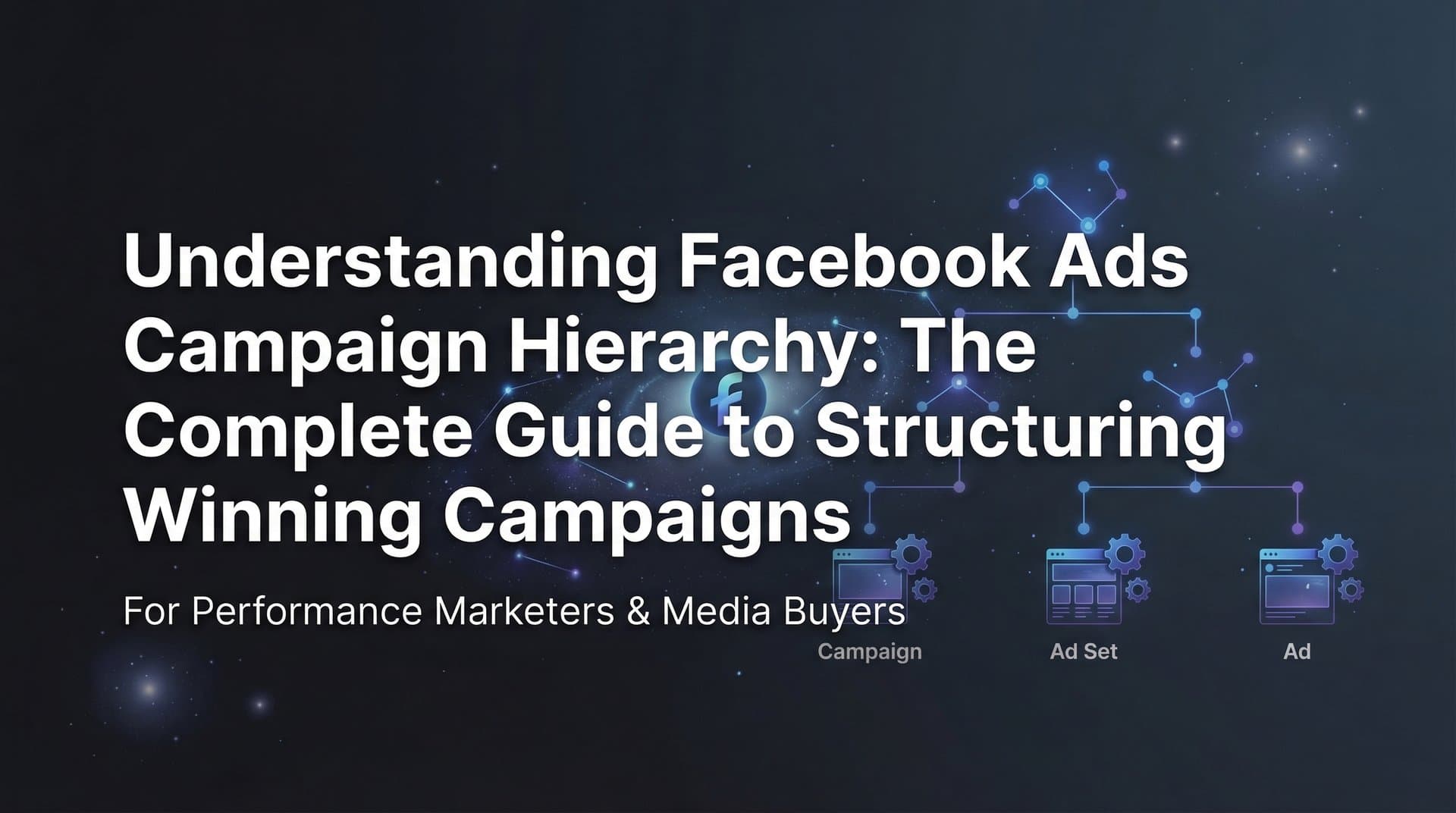
Facebook's advertising platform operates on a precise three-tier hierarchy: Campaign, Ad Set, and Ad. This isn't just organizational bureaucracy—it's the structural foundation that determines how Meta's algorithm learns, how your budget flows, and whether your campaigns can scale or collapse under their own weight. Understanding this hierarchy transforms you from someone who "runs ads" into someone who engineers systematic growth.
The Three-Tier Architecture: How Meta Organizes Your Advertising
Think of Meta's advertising structure like a building. The campaign is the foundation that determines what type of structure you're building. The ad sets are the individual floors, each with its own purpose and inhabitants. The ads are the rooms where people actually experience what you've created.
At the Campaign level, you make one critical decision: your marketing objective. This isn't a suggestion—it's a binding contract with Meta's algorithm. Choose "Sales" and the algorithm optimizes for purchases. Choose "Traffic" and it optimizes for clicks. Choose "Awareness" and it optimizes for impressions. You cannot mix objectives within a single campaign, and this choice cascades down to every optimization decision Meta makes on your behalf.
The campaign level also houses your budget strategy. You can enable Campaign Budget Optimization (CBO), which lets Meta's algorithm distribute your total budget across ad sets based on performance, or you can maintain manual control by setting individual ad set budgets. This decision fundamentally changes how your money flows through the structure.
The Ad Set level is where you define WHO sees your ads, WHEN they see them, and HOW MUCH you're willing to spend to reach them. Each ad set contains specific targeting parameters—whether you're reaching a custom audience of past website visitors, a lookalike audience modeled on your best customers, or cold traffic based on interests and demographics.
Ad sets also control placements (Facebook Feed, Instagram Stories, Messenger, Audience Network), scheduling (run continuously or on specific dates), and optimization events (what action you want people to take). If you're running manual ad set budgets, this is where you allocate spend. Multiple ad sets within a campaign let you test different audiences or strategies against the same objective.
At the Ad level, you finally get to the creative work—the actual images, videos, headlines, body copy, and calls-to-action that your audience experiences. Each ad set can contain multiple ads, and Meta will automatically test them to find which combinations perform best for your chosen objective.
Here's what most people miss: the hierarchy isn't just organizational. It's functional. Data flows upward—ad performance informs ad set optimization, which informs campaign-level learning. Decisions flow downward—your campaign objective constrains which ad set options are available, which constrains which ad formats make sense. Break this structure, and you break the machine learning loop that makes Facebook advertising work.
Campaign Level Decisions That Shape Everything Downstream
Your campaign objective isn't a preference—it's the instruction set for Meta's entire optimization algorithm. When you select "Sales," you're telling the system to find people likely to complete purchases. When you select "Leads," you're optimizing for form submissions. The algorithm uses completely different signals and bidding strategies for each.
Meta currently offers six core objectives under the Outcome-Driven Ad Experiences framework: Awareness (reach people), Traffic (send people to destinations), Engagement (get people to interact), Leads (collect contact information), App Promotion (drive app installs or actions), and Sales (drive purchases). Each objective unlocks specific optimization events and bidding options at the ad set level.
The classic mistake? Trying to accomplish multiple goals in one campaign. You cannot optimize for both awareness and conversions simultaneously. You cannot ask Meta to maximize reach while also prioritizing purchase intent. Pick one objective per campaign, or you'll confuse the algorithm and get mediocre results across all goals.
Campaign Budget Optimization represents a fundamental choice about control versus automation. With CBO enabled, you set one total budget and Meta distributes it across your ad sets based on real-time performance. The algorithm shifts money toward winning ad sets and away from underperformers automatically. For a deeper dive into when automation makes sense, explore our comparison of Facebook ads automation versus manual management.
Without CBO, you manually allocate budgets to each ad set. This gives you precise control but requires constant monitoring and adjustment. Many advertisers use CBO for broad testing phases, then switch to manual ad set budgets once they've identified winning audiences and want to control spend distribution precisely.
The campaign level also determines whether you're subject to special ad category restrictions. If you're advertising housing, employment, credit, or social issues, Meta limits your targeting options and requires additional documentation. These restrictions apply to every ad set and ad within the campaign—you cannot mix special category ads with standard ads in one campaign.
Finally, campaign naming conventions matter more than you think. A well-named campaign tells you instantly what it's testing, which objective it uses, and when it launched. Something like "2026-03-Sales-RetargetPurchasers-TestCreativeV2" is infinitely more useful than "Campaign 47" when you're analyzing performance across dozens of campaigns.
Ad Set Strategy: The Control Center for Targeting and Delivery
If campaigns define your objective, ad sets define your audience strategy. This is where you decide who sees your ads, where they see them, and how aggressively Meta pursues them.
Audience segmentation happens entirely at the ad set level. You can create ad sets targeting custom audiences (people who've visited your website, engaged with your content, or exist in your customer database), lookalike audiences (people who resemble your best customers), or cold audiences built from interests, behaviors, and demographics.
The critical insight: each ad set should represent a distinct audience hypothesis. One ad set might target past purchasers with a retention offer. Another might target a lookalike of your email list. A third might target broad interest-based targeting to find new cold traffic. Separate ad sets let you compare performance across audience types and allocate budget accordingly.
Many advertisers over-segment their ad sets, creating tiny audience slices that never generate enough conversion volume for Meta's algorithm to learn effectively. Industry practitioners often recommend keeping conversion campaign audiences above 1-2 million people. Smaller audiences can work for engagement or awareness objectives, but conversion optimization needs volume. Understanding proper Facebook campaign structure automation can help you avoid these common segmentation mistakes.
Placement strategy determines where your ads appear across Meta's family of apps and partner sites. Automatic placements let Meta show your ads wherever they're likely to perform best—Facebook Feed, Instagram Feed, Instagram Stories, Facebook Marketplace, Messenger, and Audience Network.
Manual placements give you control but require more management. You might exclude Audience Network if you want to stay within Meta's owned properties. You might focus exclusively on Instagram Stories if your creative is optimized for that vertical format. You might exclude Messenger if your customer service team can't handle the message volume.
Here's the trade-off: automatic placements give Meta more inventory to optimize across, which often lowers your cost per result. Manual placements give you control over brand experience and message context. Test both approaches with identical audiences to see which delivers better performance for your specific business.
Budget and scheduling options at the ad set level control how fast Meta spends your money. Daily budgets spread spend evenly across each day. Lifetime budgets let Meta pace spending across your entire campaign duration, often front-loading spend to gather learning data quickly.
Ad scheduling lets you run ads only during specific hours or days—useful if you're advertising a business with limited operating hours or if your data shows certain times convert better. Start and end dates define your campaign window, though many successful campaigns run continuously and adjust based on performance rather than arbitrary time limits.
Bid strategy options—Lowest Cost, Cost Cap, or Bid Cap—determine how aggressively Meta pursues your optimization event. Lowest Cost (the default) seeks the maximum results for your budget. Cost Cap sets a target cost per result. Bid Cap sets a maximum bid per auction. Most advertisers start with Lowest Cost and only move to bid controls once they have solid performance data.
Ad Level Execution: Where Creative Meets Structure
After all the strategic decisions at campaign and ad set levels, you finally arrive at the creative work. The ad level is where your audience actually experiences your message—but even here, structure matters.
Meta supports multiple ad formats, each suited to different objectives and placements. Single image ads work across all placements and load quickly. Video ads capture attention and can demonstrate products in action. Carousel ads let you showcase multiple products or tell a sequential story across up to 10 cards. Collection ads combine video with a product catalog for mobile shopping experiences.
Your campaign objective constrains which formats make sense. Sales campaigns benefit from carousel ads that showcase product variety or dynamic ads that automatically show relevant products from your catalog. Lead generation campaigns often use single image or video ads with a clear form CTA. Awareness campaigns might use video ads optimized for views rather than clicks.
Within each ad, you control the creative elements: primary text (the copy above the image), headline (bold text on the image), description (additional text below the headline), media (image or video), and call-to-action button. Meta's algorithm tests different combinations of these elements when you use Dynamic Creative, automatically finding which combinations resonate with different audience segments.
Ad-level performance data is what actually trains Meta's algorithm. When someone sees your ad and takes your desired action, that signal flows up through the structure. The ad learns which creative elements work. The ad set learns which audience segments respond. The campaign learns how to optimize toward your objective.
This is why running multiple ads within each ad set is so powerful. You're not just testing creative—you're giving Meta's machine learning more data points to optimize from. Three to five ads per ad set is often the sweet spot. Fewer than that and you're not testing enough. More than that and you might dilute your budget before any single ad exits the learning phase.
The learning phase deserves special attention. Meta needs approximately 50 conversion events per ad set per week to optimize effectively. During this learning phase, performance is volatile and costs are typically higher. Make significant changes to your ad, ad set, or campaign, and you reset the learning phase. Our guide on campaign learning Facebook ads automation explains how to navigate this critical optimization period. This is why structural stability matters—constant changes prevent the algorithm from ever learning what works.
Common Hierarchy Mistakes That Drain Your Budget
Mixing objectives within a campaign is the cardinal sin of Facebook advertising structure. You cannot tell Meta to optimize for both awareness and conversions. You cannot ask for maximum reach while also prioritizing high-intent audiences. Yet advertisers do this constantly by creating ad sets with conflicting goals within one campaign.
The result? Meta's algorithm receives contradictory signals and delivers mediocre performance across all goals. Your awareness ad sets compete with your conversion ad sets for budget. Your reporting becomes meaningless because you're averaging together metrics from fundamentally different objectives. Always create separate campaigns for separate objectives.
Over-segmentation kills campaign performance more often than bad creative. Advertisers create 15 ad sets targeting tiny audience slices—"women 25-34 interested in yoga and vegetarian cooking in Los Angeles" versus "women 25-34 interested in yoga and vegan cooking in Los Angeles." Each ad set gets a $10 daily budget and generates two conversions per week.
Meta's algorithm never exits the learning phase. You never gather enough data to know which audiences actually work. You're essentially running 15 separate experiments with sample sizes too small to produce reliable conclusions. Better approach: start with broader audiences and let Meta's algorithm find the high-intent users within them. You can always narrow targeting once you have performance data.
Neglecting naming conventions seems minor until you're managing 50 campaigns across multiple clients or product lines. When every campaign is named "New Campaign" or "Test 3," your reporting becomes archaeological work. You can't quickly identify which campaigns are testing what, which makes optimization decisions slower and more error-prone. If you're handling multiple accounts, our resource on how to manage Facebook ads for clients covers organizational best practices.
Implement a consistent naming structure that includes date, objective, audience type, and creative concept. Something like "2026-03-11_Sales_LAL-Purchasers_SpringSale" tells you everything you need to know at a glance. Your future self will thank you when you're analyzing performance across quarters.
Ignoring the learning phase by making constant changes is another budget killer. You launch a campaign, check it after 24 hours, see high costs, and immediately change the targeting or creative. Meta resets the learning phase. You check again in 24 hours, see different but still imperfect results, and change something else. You're stuck in a loop of perpetual learning without ever gathering enough data to optimize.
Give campaigns at least 3-5 days and 50+ conversion events before making significant changes. Yes, this requires patience. Yes, you might spend more initially. But it's the only way to gather reliable data and let Meta's algorithm actually work.
Building a Scalable Campaign Structure That Grows With You
A well-architected Facebook advertising account isn't just organized—it's designed for growth. The structure you build today should accommodate 10× the spend without becoming unmanageable.
Start by organizing campaigns around funnel stages. Create separate campaigns for cold traffic acquisition, retargeting engaged audiences, and converting warm leads. This structure maps to your customer journey and makes it obvious where to allocate budget based on business priorities. When you need to scale, you increase budget to the appropriate funnel stage rather than spreading money randomly across campaigns. For a comprehensive approach, check out our Facebook campaign automation guide.
Alternatively, organize campaigns by product line or service category. If you sell both physical products and digital courses, separate campaigns let you optimize each business line independently. You can test different creative approaches, measure ROI separately, and scale winners without the complexity of mixed objectives.
Within each campaign, structure ad sets by audience type rather than demographic details. Instead of creating separate ad sets for "men 25-34" and "women 25-34," create ad sets for "custom audience - purchasers," "lookalike - email list," and "cold - interest targeting." This approach scales better because you're testing strategic audience differences rather than arbitrary demographic splits.
Proper hierarchy enables faster testing and clearer insights. When you want to test a new creative concept, you add ads to existing ad sets rather than rebuilding entire campaigns. When you want to test a new audience, you add an ad set to an existing campaign rather than creating redundant structure. Your testing velocity increases while your account stays organized.
The structure also makes scaling decisions obvious. When an ad set consistently delivers your target cost per acquisition, you increase its budget. When an entire campaign proves profitable, you duplicate it with variations. When creative performance declines, you know exactly which ads to refresh without disrupting winning ad sets. Learn more about how to scale Facebook advertising campaigns once you've established this foundation.
Modern AI marketing tools for Facebook campaigns can help maintain structural integrity while dramatically accelerating campaign creation. Instead of manually building each campaign, ad set, and ad combination, AI can analyze your historical performance data, identify winning patterns, and generate properly structured campaigns at scale—all while maintaining the clean hierarchy that makes optimization possible.
Your Blueprint for Advertising Success
Understanding Facebook's campaign hierarchy isn't optional knowledge for serious advertisers—it's the foundation that determines whether your campaigns can scale profitably or collapse under their own complexity. The three-tier structure of Campaign, Ad Set, and Ad isn't bureaucratic overhead. It's the architecture that enables Meta's machine learning to work, your budget to flow efficiently, and your insights to compound over time.
Every optimization decision you make, every budget allocation, every scaling move depends on respecting this structure. Choose the right objective at the campaign level. Define clear audience strategies at the ad set level. Test creative variations at the ad level. Maintain naming conventions that make your account navigable. Give the algorithm time to learn before making changes.
Take an hour this week to audit your existing account structure against these principles. Are your campaigns mixing objectives? Are your ad sets over-segmented with audiences too small to optimize? Is your naming convention helping or hindering your decision-making? Fix structural issues before spending another dollar on creative or targeting experiments.
The difference between advertisers who scale profitably and those who burn budget isn't usually creative genius or targeting secrets—it's systematic thinking about structure. Build your campaigns like an architect, not a gambler, and you'll create a foundation that supports growth for years to come.
Ready to transform your advertising strategy? Start Free Trial With AdStellar AI and be among the first to launch and scale your ad campaigns 10× faster with our intelligent platform that automatically builds and tests winning ads based on real performance data. Our specialized AI agents understand Meta's hierarchy intimately, ensuring every campaign maintains proper structure while dramatically accelerating your testing velocity and optimization speed.