Managing Facebook ad campaigns feels like juggling flaming torches while riding a unicycle. You're constantly adjusting bids, monitoring audience fatigue, testing new creatives, and trying to catch performance dips before they torch your budget. Meanwhile, automation tools promise to handle all of this for you—but can you really trust an algorithm with your advertising dollars?
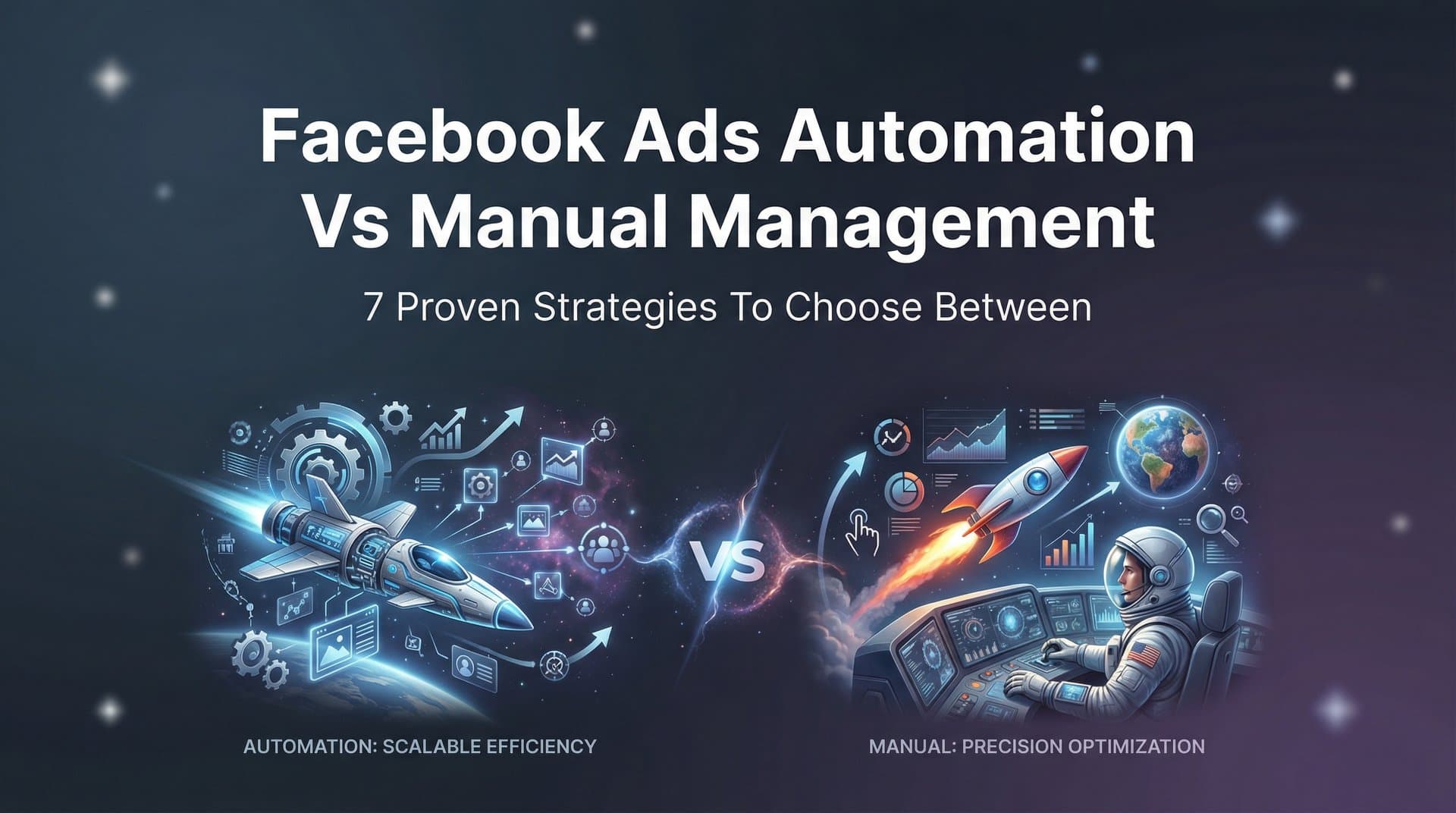
The truth is, this isn't a binary choice. The most successful Meta advertisers don't pick a side—they build systems that leverage both automation's speed and human judgment's nuance. The key is knowing which approach delivers better results for each specific situation you face.
Your campaign goals, budget scale, team capacity, and performance targets all influence whether automation or manual management makes sense. A solo marketer running three campaigns has completely different needs than an agency managing 50 client accounts. A brand awareness push requires different controls than a direct response campaign with tight ROAS targets.
These seven strategic frameworks will help you determine the right balance for your specific situation. You'll learn when to trust automation, when to maintain manual control, and how to build hybrid systems that combine the best of both approaches. The goal isn't working harder—it's working smarter while maximizing your return on ad spend.
1. Audit Your Campaign Complexity to Determine Automation Readiness
The Challenge It Solves
Many marketers struggle with the question of when automation becomes necessary rather than optional. Running too many variables manually creates bottlenecks and missed optimization opportunities. But automating too early—before you have sufficient data or proven campaign structures—can waste budget on unvalidated approaches. You need an objective framework to assess whether your campaign complexity has reached the automation threshold.
The Strategy Explained
Start by mapping all the variables you're actively managing across your campaigns: ad sets, audiences, creative variations, placement combinations, and bidding strategies. Calculate how many individual decisions you're making each week—adjusting bids, pausing underperformers, reallocating budgets, and launching new tests.
When you're managing fewer than 10 ad sets with limited audience variations, manual management remains practical. You can monitor performance daily, make strategic adjustments based on qualitative insights, and maintain tight control over messaging and brand positioning.
Once you cross 20+ ad sets with multiple creative variations and audience segments, the decision volume becomes overwhelming. You're spending more time on tactical adjustments than strategic planning. This is your signal that selective automation would free up capacity for higher-value work.
Implementation Steps
1. Create a spreadsheet listing every campaign, ad set, and active creative variation you're currently managing, then count the total number of optimization decisions you make weekly across bid adjustments, budget reallocations, and performance-based pauses.
2. Calculate your time investment per campaign element by tracking how many hours you spend on routine optimization tasks versus strategic work like creative development, audience research, and performance analysis.
3. Identify your complexity threshold by determining which campaign elements consume the most time for the least strategic value—these become your first automation candidates, while high-impact strategic decisions remain under manual control.
Pro Tips
Document your current manual processes before automating them. This baseline helps you measure whether automation actually improves performance or just shifts where problems occur. Start your audit during a typical campaign period, not during unusual spikes or seasonal lulls, to get an accurate picture of your ongoing complexity.
2. Match Your Management Approach to Campaign Lifecycle Stage
The Challenge It Solves
Different campaign phases require different levels of control and intervention. Applying the same management approach throughout a campaign's lifecycle leads to either wasted manual effort during stable periods or insufficient oversight during critical testing phases. The mismatch between management style and campaign maturity creates either inefficiency or missed opportunities.
The Strategy Explained
Campaign lifecycle stages demand distinct management approaches. During the launch phase, manual management gives you the control needed to validate assumptions, catch setup errors, and gather initial performance signals. You're testing hypotheses about audience fit, creative resonance, and offer positioning—areas where human judgment outperforms algorithms working with limited data.
Once you've identified winning combinations and accumulated sufficient conversion data, automation excels at scaling what's working. Automated bid strategies can react faster to auction dynamics than manual adjustments. Campaign Budget Optimization distributes spend more efficiently across proven ad sets than most manual allocation strategies.
The optimization phase benefits from a hybrid approach. Use automation for routine bid management and budget distribution while maintaining manual control over creative refresh cycles, audience expansion tests, and strategic pivots based on competitive or market changes.
Implementation Steps
1. Define clear stage transitions for your campaigns by establishing data thresholds—for example, 50 conversions marks the shift from launch to scaling phase, while 30 days of stable performance triggers the optimization phase.
2. Create stage-specific management protocols that specify which elements remain manual and which shift to automation at each transition point, documenting the rationale for each decision to build institutional knowledge.
3. Set calendar reminders to review lifecycle stage assignments monthly, ensuring campaigns don't remain stuck in manual management mode after they've matured past the testing phase.
Pro Tips
Build in overlap periods when transitioning between stages. Run automation alongside manual management for one week to compare results before fully committing to the new approach. This validation step catches situations where your campaign's specific characteristics don't fit standard lifecycle patterns.
3. Evaluate Time-to-Value Against Team Bandwidth
The Challenge It Solves
The hidden cost of manual management isn't just the hours spent adjusting campaigns—it's the strategic opportunities you miss while buried in tactical work. When you're constantly firefighting performance issues and making routine optimizations, you lack bandwidth for the creative testing, audience research, and strategic planning that drive breakthrough results. Understanding the true cost of your current approach helps you make data-driven automation decisions.
The Strategy Explained
Calculate your effective hourly rate by dividing your salary (or billing rate for agencies) by working hours, then multiply by the time spent on routine campaign management tasks. Compare this against the cost of automation tools. If you're spending 15 hours weekly on tasks that automation could handle for a fraction of your hourly cost, the math becomes clear.
Beyond direct costs, consider opportunity costs. Those 15 hours could be spent developing new creative concepts, researching emerging audience segments, or analyzing customer feedback to refine messaging. The value of these strategic activities often exceeds the efficiency gains from manual optimization.
However, automation isn't free. Factor in learning curves, integration time, and the ongoing need to monitor automated systems. Some tasks that seem automatable still require human oversight to prevent brand safety issues or catch algorithm drift.
Implementation Steps
1. Track your actual time investment for two weeks using a time-tracking tool, categorizing activities into tactical optimization (bid adjustments, budget moves, pausing underperformers) versus strategic work (creative development, audience research, performance analysis).
2. Calculate the financial cost of your current manual approach by multiplying tactical hours by your effective hourly rate, then compare against the subscription cost of relevant automation tools plus estimated setup time.
3. Identify your highest-value activities by listing strategic tasks you're not doing because tactical work consumes your bandwidth, then estimate the potential revenue impact if you had time to focus on these initiatives.
Pro Tips
Don't just calculate direct time savings. Consider the cognitive load reduction from not having to context-switch between strategic thinking and tactical adjustments throughout the day. Many marketers find that automation's biggest benefit is sustained focus on high-impact work, not just reclaimed hours.
4. Implement Hybrid Control Systems for Critical Metrics
The Challenge It Solves
Full automation can feel like surrendering control over outcomes that directly impact your business results. But pure manual management doesn't scale and leaves money on the table through delayed optimizations. The tension between control and efficiency creates decision paralysis—you know you need automation's speed but can't risk algorithmic decisions that contradict brand guidelines or miss important context.
The Strategy Explained
Hybrid control systems let you set automation guardrails while maintaining manual override capability for critical decisions. Think of it as defining the playing field where automation operates freely, with clear boundaries that trigger human review.
For budget management, you might automate daily bid adjustments within a defined range while requiring manual approval for any budget increases above 20%. For audience targeting, automation can optimize within your approved audience segments while flagging any expansion recommendations for human review before implementation.
This approach works particularly well for brand safety concerns. Automated placement optimization can run freely across approved placements, but any expansion into new placement types triggers a manual review. Similarly, automated creative testing can rotate approved assets, but new creative concepts require human approval before entering the rotation.
Implementation Steps
1. List your non-negotiable brand standards and business rules that must never be violated regardless of performance data, such as prohibited placements, restricted audience combinations, or messaging guidelines that protect brand positioning.
2. Configure automation boundaries by setting up automated rules with specific parameters—for example, "optimize bids between $5-$15 but alert me if the algorithm recommends going above $15" or "rotate these five approved creatives but don't add new variations without approval."
3. Establish alert thresholds that trigger manual review when automated systems approach your defined boundaries, ensuring you maintain oversight without constant monitoring of routine optimizations.
Pro Tips
Start with tighter boundaries than you think necessary, then gradually expand the automation's operating range as you build confidence in its decision-making. This progressive approach lets you validate that the algorithm understands your business context before giving it more autonomy. Review your boundary settings quarterly to ensure they still align with current business priorities.
5. Use Data Volume as Your Automation Trigger
The Challenge It Solves
Automated optimization requires sufficient data to identify meaningful patterns and make reliable decisions. Turning on automation too early—before you've accumulated enough conversions—leads to erratic performance as the algorithm chases statistical noise rather than genuine signals. Understanding minimum data thresholds prevents premature automation that wastes budget on unvalidated optimizations.
The Strategy Explained
Meta's automated bidding strategies work best when they have substantial conversion data to analyze. Industry consensus suggests waiting until you've accumulated at least 50 conversions per week at the campaign level before trusting automated bid strategies. Below this threshold, the algorithm lacks sufficient signal to distinguish between random variance and meaningful performance patterns.
For Advantage+ campaigns and other advanced automation features, even higher data volumes improve results. These systems analyze patterns across creative elements, audience characteristics, and contextual factors—analysis that requires hundreds of data points to produce reliable insights.
If your campaigns don't generate sufficient conversion volume, consider optimizing for higher-funnel events initially. Build your data foundation with link clicks or landing page views, then transition to conversion optimization once you've accumulated enough downstream data. This staged approach lets you leverage automation earlier while working toward your ultimate conversion goals.
Implementation Steps
1. Calculate your weekly conversion volume by reviewing the past four weeks of campaign performance, identifying which campaigns consistently generate 50+ conversions weekly and which fall below this threshold.
2. Segment campaigns into automation-ready and data-building groups, keeping low-volume campaigns under manual management while enabling automated bidding for campaigns that meet minimum data thresholds.
3. Create a graduation plan for low-volume campaigns by identifying higher-funnel optimization events you can use to build data volume, then set calendar reminders to reassess automation readiness as conversion volume grows.
Pro Tips
Don't average conversion volume across good and bad weeks. Automation needs consistent data flow, so base your assessment on typical weeks rather than occasional spikes. If your conversion volume fluctuates significantly week-to-week, that volatility itself suggests manual management may serve you better until you stabilize performance.
6. Build Automation Layers Based on Risk Tolerance
The Challenge It Solves
Jumping straight into full campaign automation feels risky because you're trusting algorithms with decisions that directly impact revenue. This all-or-nothing thinking prevents many marketers from capturing automation's benefits. The solution is progressive automation—starting with low-risk tasks and expanding to higher-stakes decisions as you build confidence in the system's judgment.
The Strategy Explained
Layer your automation implementation based on risk levels. Start with zero-risk automation like reporting and performance monitoring. Automated dashboards and alert systems can't hurt performance—they just make information more accessible and timely.
Next, automate low-risk optimizations like pausing ads that hit frequency caps or reallocating small budget amounts between similar-performing ad sets. These decisions have limited downside even if the automation makes suboptimal choices.
Medium-risk automation includes bid management within defined ranges and budget optimization across proven ad sets. These decisions meaningfully impact performance but operate within guardrails you've established.
High-risk automation—like creative selection, audience expansion, and strategic budget allocation—should come last, after you've validated the system's decision-making through lower-risk implementations. Many sophisticated advertisers keep these high-impact areas under manual control indefinitely, using automation as a recommendation engine rather than an autonomous decision-maker.
Implementation Steps
1. Map your current manual tasks onto a risk matrix by listing every optimization activity you perform and rating each on potential budget impact and brand safety risk, creating four quadrants from low-risk/low-impact to high-risk/high-impact.
2. Implement automation in phases starting with your low-risk quadrant, running each phase for at least two weeks while monitoring results before advancing to the next risk level.
3. Document lessons learned at each phase by recording what worked well, what required adjustment, and what signals indicated readiness to advance to higher-risk automation.
Pro Tips
Don't feel pressure to reach full automation. Many successful advertisers permanently keep certain high-stakes decisions under manual control. The goal is finding your optimal automation level—the point where you've captured efficiency gains without sacrificing the strategic control that drives your competitive advantage.
7. Create Feedback Loops Between Automated and Manual Insights
The Challenge It Solves
Treating automation and manual management as separate systems means you miss valuable insights from each approach. Automated systems identify patterns in data that humans might overlook, while human analysis provides context and market understanding that algorithms can't access. Without feedback loops connecting these perspectives, you're operating with incomplete information regardless of which approach you choose.
The Strategy Explained
Build systems that capture insights from both automated and manual analysis. When your automated bidding system identifies winning audience segments, manually investigate why those segments perform well. The algorithm might discover that 25-34 year olds in coastal cities convert best, but human analysis reveals they're responding to specific messaging about urban lifestyle benefits—insight you can apply to creative development.
Conversely, when manual analysis identifies emerging trends or competitive shifts, feed that context back into your automation parameters. If you notice competitors launching aggressive promotions in specific regions, manually adjust your automation boundaries to increase bids in those markets rather than waiting for the algorithm to detect the pattern through performance degradation.
This bidirectional feedback creates a learning system where automation handles execution speed while human intelligence provides strategic direction. The combination outperforms either approach in isolation.
Implementation Steps
1. Schedule weekly automation review sessions where you examine which audiences, placements, and creative elements your automated systems are favoring, then manually investigate the underlying reasons for these performance patterns.
2. Create a shared insight repository documenting discoveries from both automated pattern detection and manual strategic analysis, making these insights accessible to inform future campaign planning regardless of management approach.
3. Establish protocols for feeding manual insights back into automation by defining how competitive intelligence, seasonal trends, and market shifts should trigger adjustments to your automation parameters and boundaries.
Pro Tips
Pay special attention to cases where automated and manual analysis disagree. These conflicts often reveal important nuances—perhaps the algorithm is optimizing for immediate conversions while missing long-term customer value signals that human analysis captures. Investigating these discrepancies typically yields the most valuable strategic insights.
Putting It All Together
The automation versus manual management debate misses the point entirely. The question isn't which approach is better—it's how to build the right system for your specific needs, campaign maturity, and team capacity.
Start by auditing your campaign complexity and data volume. These objective metrics tell you whether you've reached the point where automation becomes necessary rather than optional. A solo marketer running five campaigns has completely different needs than an agency managing 50 client accounts.
Match your management approach to each campaign's lifecycle stage. Manual control during testing phases lets you validate assumptions and gather initial signals. Automation during scaling phases captures efficiency gains once you've identified winning formulas. Hybrid approaches during optimization phases combine automation's speed with human judgment on strategic decisions.
Build your automation layers progressively based on risk tolerance. Start with low-stakes tasks like reporting and performance monitoring, then expand to higher-risk areas like budget allocation as you build confidence in the system's decision-making. Many successful advertisers permanently keep certain high-impact decisions under manual control—and that's perfectly fine.
The most sophisticated approach treats automation as a force multiplier for your expertise, not a replacement for strategic thinking. Create feedback loops that capture algorithmic insights while applying human context that machines can't access. Let automation handle execution speed while you focus on the creative and strategic work that drives breakthrough results.
Your goal isn't maximum automation—it's optimal automation. Find the balance point where you've reclaimed time for high-value strategic work without surrendering control over decisions that define your competitive advantage.
Ready to transform your advertising strategy? Start Free Trial With AdStellar AI and be among the first to launch and scale your ad campaigns 10× faster with our intelligent platform that automatically builds and tests winning ads based on real performance data. Our specialized AI agents handle campaign structure, targeting strategy, and creative optimization while you maintain strategic control over brand positioning and business objectives.