The question isn't whether automation will replace traditional ad management. The real question is: which parts of your workflow should you automate right now, and which require your strategic oversight?
Digital marketers face mounting pressure to do more with less. Campaign volume increases while budgets stay flat. Creative demands multiply across platforms. Testing requirements expand exponentially. The old approach of manually building every campaign, writing every headline, and analyzing spreadsheets until midnight simply doesn't scale.
But automation isn't a magic solution that removes all decision-making. The marketers seeing the best results aren't choosing between automated and traditional approaches. They're strategically combining both, letting AI handle repetitive tasks while focusing their expertise on strategy, brand positioning, and high-level optimization.
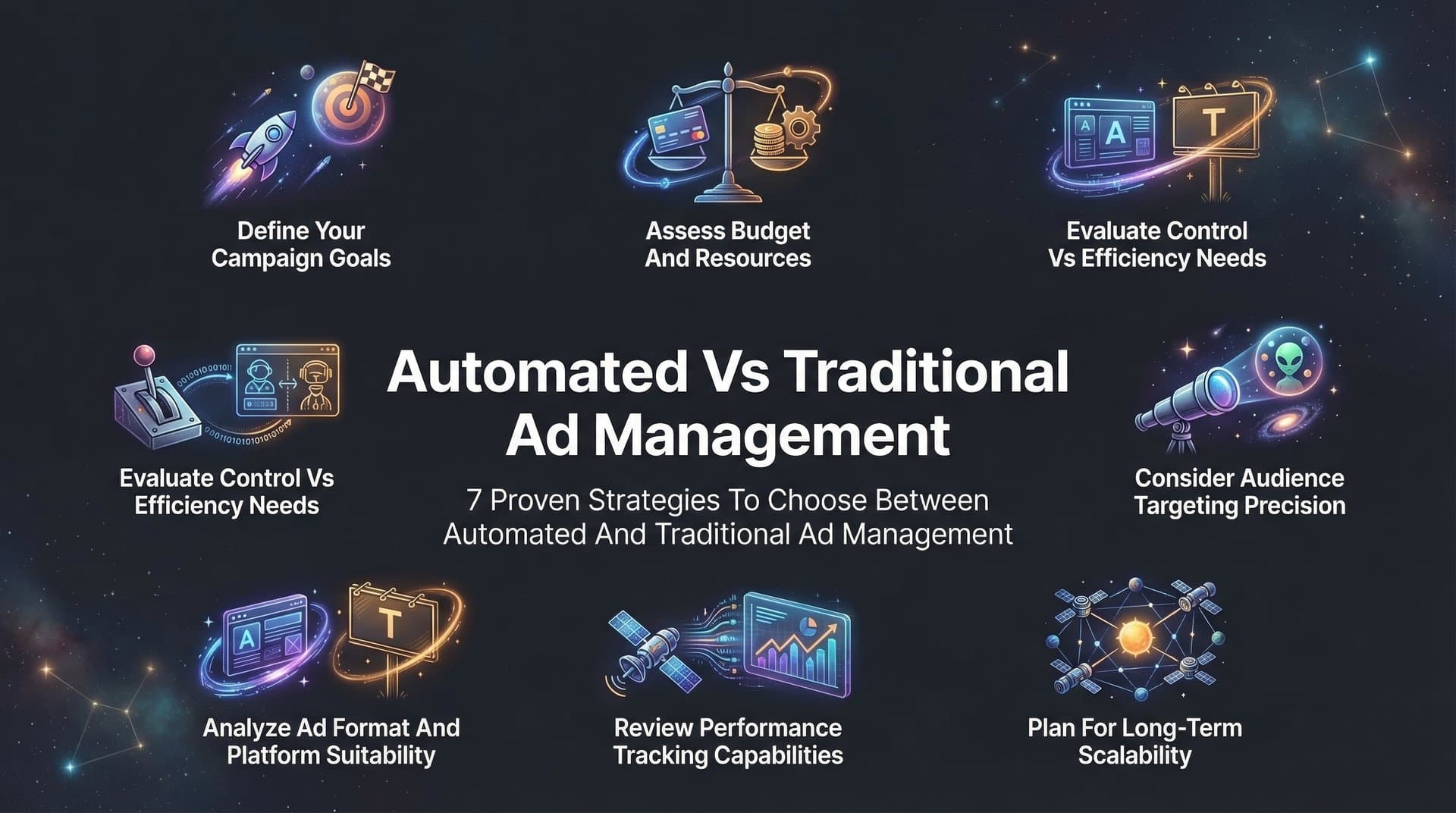
This guide walks through seven practical strategies to help you evaluate where automation delivers the most value and where manual control remains essential. You'll learn how to audit your current processes, match management styles to campaign complexity, and build a hybrid framework that evolves with your needs.
Whether you're managing campaigns for a single brand or juggling dozens of clients, these strategies will help you make smarter decisions about when to automate and when to take the reins yourself.
1. Audit Your Current Workflow to Identify Automation Opportunities
The Challenge It Solves
Most marketers spend hours each week on repetitive tasks that add minimal strategic value. You're manually resizing creatives for different placements, copying audiences between campaigns, writing variations of the same headline, and building ad sets one by one. These tasks consume time that could be spent on strategy, analysis, or client communication.
The problem is that you can't optimize what you don't measure. Without a clear picture of where your time actually goes, you'll continue investing hours in low-value activities while missing opportunities for meaningful automation.
The Strategy Explained
Start by tracking how you spend your time across a typical week of campaign management. Break down your activities into categories: creative production, campaign setup, audience configuration, ad copywriting, performance analysis, and optimization decisions. Be honest about which tasks require strategic thinking and which are purely mechanical.
Look for patterns in your workflow. Are you recreating similar campaigns for different products? Manually testing the same audience segments across multiple campaigns? Spending hours in design tools producing creative variations? These repetitive patterns represent your highest-value automation opportunities.
The goal isn't to automate everything. It's to free up your time for the work that genuinely requires human judgment: understanding customer psychology, developing positioning strategies, interpreting complex performance patterns, and making budget allocation decisions. Understanding why use automated ad platforms can help you identify which workflows benefit most from AI assistance.
Implementation Steps
1. Log your activities for one full week, noting time spent on each task category and whether it required strategic thinking or was purely mechanical execution.
2. Calculate the total hours spent on repetitive tasks like creative resizing, audience duplication, ad set creation, and headline variations.
3. Rank these tasks by time investment and automation potential, prioritizing high-time, low-strategy activities for your first automation experiments.
4. Identify one workflow bottleneck that causes the most frustration or delays, whether it's creative production, campaign setup, or performance reporting.
Pro Tips
Don't try to automate everything at once. Start with the single most time-consuming repetitive task and measure the impact. Many marketers find that automating creative generation alone saves 10-15 hours per week. Once you've proven the value with one workflow, expand to other areas systematically.
2. Match Management Style to Campaign Complexity
The Challenge It Solves
Not all campaigns require the same level of hands-on management. A straightforward product launch with a single audience and clear messaging doesn't need the same oversight as a complex multi-audience campaign with seasonal messaging variations and regional targeting nuances. Yet many marketers apply the same manual approach to every campaign, wasting time on simple initiatives while struggling to give complex campaigns the attention they deserve.
This one-size-fits-all approach creates inefficiency at both ends. Simple campaigns consume unnecessary time, while complex strategies don't get the strategic depth they need.
The Strategy Explained
Think of your campaigns on a complexity spectrum. At one end, you have straightforward initiatives: single product promotions, retargeting campaigns with proven creatives, or seasonal sales with established messaging. These campaigns benefit from full automation because the strategic decisions are already clear.
At the other end, you have complex campaigns requiring nuanced judgment: brand repositioning efforts, new market expansion, multi-product bundles with interdependent messaging, or campaigns testing fundamentally new value propositions. These need a hybrid approach where automation handles execution while you maintain strategic control.
The key is matching your management intensity to campaign requirements. Simple campaigns can run on autopilot with periodic check-ins. Complex campaigns need your strategic input upfront, then automation to execute and test your hypotheses at scale. Exploring automated Meta advertising can help you understand which campaign types benefit most from AI-driven execution.
Implementation Steps
1. Categorize your current campaigns into three tiers: simple (single product, proven messaging), moderate (multiple audiences, seasonal variations), and complex (new markets, brand positioning, multi-product strategies).
2. For simple campaigns, test full automation from creative generation through launch, limiting your involvement to initial goal-setting and weekly performance reviews.
3. For moderate campaigns, use automation for creative variations and bulk testing while maintaining manual control over audience strategy and budget allocation.
4. For complex campaigns, leverage automation to execute your strategy at scale, using AI to generate creative variations of your core concepts and test them across audience segments.
Pro Tips
Campaign complexity often decreases over time. A complex launch campaign becomes a simple retargeting campaign once you've identified winning elements. Adjust your management approach as campaigns mature, moving proven performers toward greater automation while you focus on new strategic initiatives.
3. Leverage AI for Creative Generation While Maintaining Brand Control
The Challenge It Solves
Creative production is often the biggest bottleneck in scaling ad campaigns. You need dozens of variations to test different angles, formats, and messaging approaches. Traditional methods require designers, video editors, actors for UGC content, and multiple rounds of revisions. This process takes weeks and costs thousands, limiting how many creative concepts you can test.
The result is that most marketers test far fewer creative variations than they should. You might launch campaigns with three or four ad variations when you really need thirty or forty to find the winners. This limited testing means you're likely missing your best-performing creatives entirely.
The Strategy Explained
AI creative generation solves the production bottleneck by creating image ads, video ads, and UGC-style content at scale. Instead of waiting weeks for a designer, you can generate dozens of variations in minutes. The key is establishing clear brand guidelines upfront so AI-generated creatives maintain consistency with your brand identity.
Think of AI as your creative production team, not your creative director. You still make the strategic decisions about messaging angles, value propositions, and brand positioning. AI handles the execution, producing variations based on your direction and allowing you to refine outputs through conversational editing. A robust Facebook ad creative management system can streamline this entire process.
This approach lets you test creative concepts that would be too expensive or time-consuming with traditional production methods. Want to see if lifestyle imagery outperforms product shots? Generate both approaches instantly. Curious whether video ads beat static images? Test them simultaneously without hiring a video production team.
Implementation Steps
1. Document your brand guidelines including color palettes, typography preferences, tone of voice, and visual style standards that all creatives must follow.
2. Start with a single product or campaign, using AI to generate multiple creative variations exploring different angles: benefit-focused, feature-focused, social proof, problem-solution, and lifestyle contexts.
3. Review AI-generated options and refine them through chat-based editing, adjusting elements that don't perfectly match your brand or messaging strategy.
4. Launch the refined variations simultaneously to identify which creative approaches resonate most with your audience, then use those insights to guide future creative direction.
Pro Tips
The Meta Ad Library is a goldmine for creative inspiration. Platforms like AdStellar let you clone competitor ads directly, then modify them to fit your brand and product. This gives you proven creative concepts as starting points rather than building from scratch.
4. Implement Data-Driven Decision Making with AI Insights
The Challenge It Solves
Traditional ad management relies heavily on gut feel and limited data analysis. You look at campaign-level metrics, make educated guesses about what's working, and manually adjust based on incomplete information. This approach works at small scale but breaks down when you're managing dozens of campaigns with hundreds of ad variations.
The real winners and losers often hide in the noise. That headline you think is underperforming might actually be your top converter when paired with specific audiences. The creative you're about to kill might be your best performer on mobile placements. Without granular, objective analysis across every element, you're making decisions based on partial data.
The Strategy Explained
AI-powered insights analyze performance at a level of granularity that's impossible manually. Instead of looking at campaign-level averages, you see exactly how each creative, headline, audience, and landing page performs against your specific goals. Every element gets ranked by the metrics that matter to your business, whether that's ROAS, CPA, CTR, or conversion rate.
This objective ranking removes guesswork from optimization decisions. You don't need to interpret spreadsheets or build complex pivot tables. AI surfaces your winners and losers automatically, showing you exactly which elements to scale and which to eliminate. Understanding the differences between AI vs traditional advertising methods helps you appreciate why data-driven approaches consistently outperform manual analysis.
The key is setting clear performance benchmarks upfront. Define your target ROAS, acceptable CPA, or minimum conversion rate, then let AI score everything against these goals. This creates a consistent framework for decision-making that improves over time as you gather more performance data.
Implementation Steps
1. Define your primary performance goals and acceptable thresholds for each campaign type, whether that's a minimum ROAS of 3x, maximum CPA of $25, or target conversion rate above 2%.
2. Set up tracking to capture performance data at the element level, not just campaign level, so you can see how individual creatives, headlines, and audiences perform independently.
3. Review AI-generated leaderboards weekly to identify top performers across all elements, looking for patterns in what makes creatives, headlines, or audiences successful.
4. Document winning elements in a centralized location with their performance metrics, creating a library of proven assets you can reuse and combine in future campaigns.
Pro Tips
Performance context matters. A creative that wins for cold traffic might underperform for retargeting. An audience that converts well for one product might not work for another. Always analyze performance within the specific campaign context rather than assuming universal winners.
5. Scale Testing Through Bulk Launch Capabilities
The Challenge It Solves
Traditional campaign setup is painfully slow. You build one ad set, configure targeting, upload creatives, write copy, and repeat the process for every variation you want to test. Testing five audiences with three creatives each means manually creating fifteen ad sets. Want to test different headlines too? Now you're looking at hours of repetitive configuration work.
This manual process severely limits your testing scope. Most marketers test far fewer variations than they should simply because the setup time isn't worth the potential insights. You end up making assumptions about what will work rather than actually testing your hypotheses.
The Strategy Explained
Bulk launching transforms testing from a manual bottleneck into a strategic advantage. Instead of building campaigns one ad set at a time, you define the elements you want to test, then generate every combination automatically. Mix multiple creatives, headlines, audiences, and copy variations at both the ad set and ad level, creating hundreds of test combinations in minutes.
This approach lets you test comprehensively rather than selectively. Want to see how five different value propositions perform across seven audience segments with four creative approaches? That's 140 combinations. Building them manually would take days. Bulk launching creates all variations instantly, letting you surface winners through actual data rather than educated guesses.
The power isn't just in speed. It's in the ability to test hypotheses you couldn't afford to test manually. You can explore creative and audience combinations that might seem unlikely but could reveal unexpected winners. Dedicated Facebook ads campaign management software makes this bulk testing approach practical for teams of any size.
Implementation Steps
1. Identify the variables you want to test in your next campaign: creatives, headlines, audiences, ad copy, and landing pages that represent different strategic approaches.
2. Create variations for each element, generating multiple options that explore different angles rather than minor tweaks of the same concept.
3. Use bulk launch capabilities to generate every combination of these elements, creating comprehensive test matrices that would be impractical to build manually.
4. Set consistent budgets and durations across all variations to ensure fair testing, then let the combinations run long enough to gather statistically meaningful performance data.
Pro Tips
More variations don't always mean better results. Focus on testing meaningfully different approaches rather than minor tweaks. Test bold creative differences, distinct audience segments, and fundamentally different value propositions. The goal is to find breakthrough winners, not optimize marginal improvements.
6. Build a Continuous Learning Loop for Ongoing Optimization
The Challenge It Solves
Traditional ad management treats each campaign as a standalone project. You build campaigns from scratch, test elements, analyze results, then start over with the next campaign. This approach wastes valuable learning because insights from previous campaigns don't systematically inform future builds.
You might remember that a particular headline style worked well last quarter, but you don't have a systematic way to apply that learning. Winning creatives get buried in old campaigns. Successful audience combinations get forgotten. Each new campaign requires the same trial and error process you've already completed multiple times.
The Strategy Explained
A continuous learning loop captures insights from every campaign and applies them to future builds. Instead of starting from zero, each new campaign benefits from accumulated knowledge about what works for your brand, products, and audiences. Winning elements get stored, tagged with performance data, and become available for reuse in new contexts.
This approach transforms advertising from repeated experimentation into progressive improvement. Your campaigns get smarter over time because they're built on proven foundations rather than fresh guesses. AI analyzes historical performance data, identifies patterns in what makes creatives, headlines, and audiences successful, then applies those patterns to new campaigns. Implementing automated ad account management software ensures these learnings are captured and applied consistently across all your accounts.
The learning compounds. Each campaign adds more data about what works. The system gets better at predicting which combinations will succeed. Your hit rate improves because you're building on validated insights rather than starting from scratch.
Implementation Steps
1. Create a centralized repository for winning elements, organizing top-performing creatives, headlines, audiences, and copy by product category, campaign goal, and performance metrics.
2. Tag each winning element with context: what product it promoted, which audience it targeted, what campaign objective it served, and what performance metrics it achieved.
3. Before building new campaigns, review your winners library to identify proven elements that could apply to the new initiative, starting with validated approaches rather than untested concepts.
4. After each campaign, conduct a structured review to identify new winners worth adding to your library, looking for elements that exceeded your performance benchmarks.
Pro Tips
Platforms like AdStellar automate this learning loop through their Winners Hub, which organizes your best-performing elements with real performance data. You can select any winner and instantly add it to your next campaign, ensuring that proven elements get reused rather than forgotten.
7. Create a Hybrid Framework That Evolves With Your Needs
The Challenge It Solves
The automated versus traditional debate assumes you must choose one approach and stick with it. This binary thinking creates unnecessary limitations. Full automation might miss strategic nuances that require human judgment. Full manual management can't scale to meet growing campaign demands. Neither extreme serves your actual needs.
Your requirements also change over time. A new product launch needs different management than an established retargeting campaign. Seasonal campaigns have different demands than evergreen initiatives. A rigid approach can't adapt to these shifting needs.
The Strategy Explained
A hybrid framework combines the best of both approaches, using automation where it adds value and maintaining manual control where strategic judgment matters. The specific balance shifts based on campaign type, business goals, team capacity, and performance results.
Start with automation for creative generation and testing. Let AI produce variations, launch combinations, and surface performance data. This frees your time for strategic decisions: budget allocation across campaigns, audience strategy development, messaging positioning, and high-level optimization. Agencies managing multiple brands find that campaign management for multiple clients becomes significantly more scalable with this hybrid approach.
The framework evolves based on quarterly reviews. Analyze which automated elements delivered results and which needed more oversight. Adjust the balance, expanding automation in areas where it proved valuable and maintaining manual control where human judgment made a difference.
Implementation Steps
1. Define your initial automation boundaries, deciding which tasks to automate immediately (creative generation, bulk testing, performance reporting) and which to keep manual (budget strategy, brand positioning, messaging development).
2. Implement automation in phases, starting with one workflow area and measuring results before expanding to others, ensuring each automation addition proves its value.
3. Establish review cadences to evaluate automation performance, conducting weekly tactical reviews of campaign metrics and quarterly strategic reviews of your overall approach.
4. Adjust your framework based on results, expanding automation where it saves time without sacrificing performance and adding manual oversight where strategic decisions require deeper judgment.
Pro Tips
The goal isn't maximum automation. It's optimal automation for your specific situation. Some marketers find that 80% automation with 20% strategic oversight delivers the best results. Others need a 60/40 split. Let performance data guide your balance rather than aiming for a predetermined ratio.
Putting It All Together
The choice between automated and traditional ad management isn't a one-time decision. It's an ongoing process of evaluation and adjustment based on your campaign goals, team capacity, and performance data.
Start by auditing your current workflow to identify where automation can save the most time. Look for repetitive tasks that consume hours without requiring strategic thinking. These represent your highest-value automation opportunities.
Match your management style to campaign complexity. Simple campaigns with proven messaging can run on full automation. Complex initiatives need a hybrid approach where automation handles execution while you maintain strategic control.
Leverage AI for creative generation while maintaining brand control through clear guidelines and refinement processes. This lets you test dozens of variations that would be impossible to produce manually, surfacing winning concepts you might never have discovered.
Use data-driven insights to guide your decisions. Set clear performance benchmarks and let AI rank every element objectively. This removes guesswork from optimization and ensures you're scaling what actually works.
Scale your testing through bulk launch capabilities. Move beyond limited manual testing to explore comprehensive combinations of creatives, audiences, and messaging. The winners you find will more than justify the expanded testing scope.
Build a continuous learning loop that captures insights from every campaign. Store winning elements, tag them with performance data, and systematically apply proven approaches to new initiatives. Your campaigns get smarter over time instead of starting from scratch.
Create a hybrid framework that evolves with your needs. Combine automation for creative and testing with manual oversight for budget and strategy. Review results quarterly and adjust the balance based on what's actually working.
The most effective approach combines the efficiency of automation with strategic human oversight. Platforms like AdStellar enable this hybrid model by handling creative generation, campaign building, and performance analysis while giving you full transparency into every AI decision. The AI Creative Hub generates and clones ads. The AI Campaign Builder analyzes historical data and builds complete campaigns with specialized agents. Bulk launching creates hundreds of variations in minutes. AI Insights provide leaderboard rankings across every element. The Winners Hub organizes proven elements with real performance data.
Begin with one strategy from this list, measure the results, and expand from there. Track time saved, performance improvements, and testing scope expansion. Let the data guide your next steps. Start Free Trial With AdStellar and be among the first to launch and scale your ad campaigns 10× faster with our intelligent platform that automatically builds and tests winning ads based on real performance data.