You launch a Meta campaign on Monday with a clear offer, a clean landing page, and targeting that looks right on paper. By Thursday, CPA is climbing, ROAS is flat, and the account has spent enough to hurt without generating enough signal to make the next decision obvious.
That pattern usually comes from weak testing operations, not one bad ad. Many in-house teams and agencies still treat Facebook ads like a string of isolated guesses. They publish a handful of variations, wait too long, then start changing audiences, copy, and budgets at the same time. That makes it hard to know what caused the result.
Growth hacking facebook ads works best as a repeatable experiment system. Set one variable to test. Define the success metric before launch. Push enough variation to reach a usable read. Cut spend from clear losers early, move winners into the next round, and document what carried over. Over time, the account improves because the process improves.
That approach matters because Meta is now a high-speed auction shaped by automation, creative turnover, signal quality, and fast feedback loops. Meta reports that ad revenue from its Family of Apps reached $160.6 billion in 2024 in its annual report. Bigger ad markets attract more competition, and more competition punishes slow testing discipline.
The practical shift is simple. Stop asking which ad might work. Start asking which experiment should run next, what success looks like, and how the learning will feed the next campaign build. That is the difference between sporadic wins and a system that can scale.
That system also needs workflow support. Teams that use a structured iterative design process for ad experimentation can move from idea to launch faster, with cleaner naming, fewer duplicated tests, and clearer post-test analysis. If you are tracking competitors before a launch, a basic layer of digital marketing competitive analysis helps identify offer patterns, creative angles, and saturation risk before spend goes live. Tools like AdStellar AI fit here as an execution layer. They help automate variation planning, test organization, and performance ranking so the experimentation cadence does not break when volume increases.
If you want a quick reset on the broader model behind this approach, this overview of understanding growth hacking is a useful primer.
Here’s the playbook I’d use in 2026.
1. Creative Testing and Iteration at Scale
A campaign launches on Monday with four new ads. By Wednesday, one has a cheap click, another has a few conversions, and the team starts editing budgets, swapping copy, and turning things off before the system has produced a clean read. That cycle creates activity, not learning.
Creative testing at scale fixes that by turning every batch into a repeatable experiment. The goal is not to find one winning ad. The goal is to build a testing engine that can answer a specific question, record the result, and feed the next round. On Meta, creative still shifts performance faster than most account changes, so this is usually the first place to tighten process.

The right unit of work is a creative hypothesis. For a DTC skincare brand, that might be, "customer proof beats founder explanation for cold traffic." For a SaaS brand, it could be, "pain-led hooks get more qualified demo starts than efficiency-led hooks." That framing matters because it forces clear variable control. If the hook, format, audience, and offer all change at once, the result is noise.
What to test
Start with one dominant variable per batch. In most accounts, that is the hook, then the format, then the proof style.
- Hook families: pain-led, outcome-led, objection-led, identity-led
- Formats: static, carousel, short-form video, talking-head UGC
- Proof styles: customer testimonial, product demo, founder explanation, feature-first
- CTA framing: buy now, shop now, learn more, see how it works
User-generated creative usually earns its place in that matrix because it often blends into the feed better than polished brand work. Polished assets still matter, especially for premium offers or retargeting, but they should compete in the same test structure instead of getting a free pass.
A useful rule is simple. Test message before design polish. If the angle is weak, better editing rarely saves it.
Why this works
Scaled testing gives you pattern recognition, not isolated wins. After enough batches, you can answer questions like which hook family travels across products, which proof style holds CPA longer before fatigue, and which format performs well only in prospecting versus retargeting. That is where growth hacking facebook ads becomes an operating system instead of a collection of one-off tricks.
It also makes automation possible. A structured iterative design process for ad experimentation keeps naming, approvals, and post-test reviews consistent. A stronger framework for audience segmentation strategies also improves creative readouts because the team can see which angles travel across audience classes and which ones collapse outside a narrow pocket. If you source new angles through competitor review, a disciplined digital marketing competitive analysis process helps you collect themes, offers, and visual patterns without copying weak surface details. Tools like AdStellar AI are useful here for variation planning, test logging, and ranking creative by the metric that matters.
How to run the experiment
Use a what, why, how-to structure for each test.
What: Define the variable. Example: compare pain-led versus outcome-led hooks in short-form video.
Why: State the business reason. Example: the account has strong click-through rate but weak conversion rate, so the team suspects the current angle attracts curiosity instead of buyers.
How-to: Launch enough variants to give each angle a fair read, keep the audience and offer stable, and set a decision window before spend goes live. Judge the batch on the KPI tied to the campaign objective, not on whichever number looks best in the first day.
A practical naming taxonomy saves hours later. Include hook, format, proof type, offer, audience, and CTA in every ad name. That lets you review results across weeks instead of scrolling through vague labels like "UGC final v3."
Success metrics and failure patterns
Success depends on the stage of the funnel. For prospecting, early indicators might be thumb-stop rate, click-through rate, landing page view rate, or cost per qualified visitor. For conversion campaigns, the core question is whether the creative can hold efficient CPA after the first burst of novelty.
Watch for common failure patterns:
- Too few variants to reveal a pattern
- Multiple variables changed in the same test
- Winners chosen from tiny spend
- One ad left running until fatigue drags down the whole ad set
- No record of why a variant won
The trade-off is speed versus clarity. More variations increase learning, but only if the account can spend enough to separate signal from randomness. Smaller budgets should run fewer, cleaner experiments. Larger budgets can support broader matrices and faster refresh cycles.
That discipline is what makes creative iteration scale. Each round should leave the account with a stronger angle library, cleaner assumptions, and a shorter path from idea to launch.
2. Audience Segmentation and Lookalike Expansion
A campaign launches with strong creative, clean tracking, and a reasonable CPA target. Three days later, spend is stuck. The problem often sits in audience design, not in the ad.
Audience segmentation works best as a repeatable experiment, not a one-time setup choice. Broad targeting, lookalikes, and interest-based audiences each solve a different problem. Broad gives Meta room to find pockets of demand. Lookalikes transfer signal from known converters. Interest stacks help when seed quality is weak or the buying pattern is too niche for broad to stabilize early.
The mistake is treating one of those options as the default winner. A better approach is to test audience classes against the same offer and the same creative angle, then review them on downstream efficiency and scaling behavior.
For B2C, a simple three-lane structure usually gives enough contrast:
- Broad audience: Pair with specific creative that filters out weak-fit users.
- Lookalike audience: Build from purchasers, high-LTV customers, or other real converter groups.
- Interest audience: Group interests by buying motive, not by loose category similarity.
For B2B, the setup needs more care. Facebook’s professional targeting is limited, and low-volume job title segments often fail before the algorithm gets enough conversion signal. In practice, better tests come from customer-list seeds, lead quality exclusions, industry proxy interests, and longer evaluation windows. The Scribd guide on growth hacking gaps in B2B targeting highlights that same constraint.
What to test, why it matters, and how to run it
Use one offer, one conversion goal, and one creative family across audience classes. That isolates the audience variable.
A practical B2B SaaS test grid might look like this:
Broad prospecting
- What: Open targeting with age, geo, and basic exclusions only
- Why: Finds intent pockets you would not identify manually
- How: Use proof-led ads, exclude customers and recent leads, and give it enough budget to exit the learning phase
Qualified-seed lookalike
- What: Lookalike built from demos, activated trials, SQLs, or closed-won accounts
- Why: Better seed quality usually beats larger but noisier source lists
- How: Start with the tightest qualified seed available, then test expansion tiers only after the base audience is stable
Hybrid audience
- What: Narrow interest or behavior layers combined with a small high-intent seed
- Why: Helps when broad is too expensive early and job title targeting is too thin
- How: Keep the logic simple. Two to four strong audience signals are enough
Warm-assisted prospecting
- What: Prospecting campaigns with exclusions based on recent visitors, engagers, or low-quality lead segments
- Why: Cleans overlap and protects budget from recycling weak traffic
- How: Refresh exclusions weekly and check overlap before increasing spend
That structure gets stronger when naming, exclusions, seed sources, and decision rules are documented. This guide to audience segmentation strategies for paid social is a useful model for keeping those tests organized. If the account also struggles with event quality, fix that before drawing hard conclusions from audience results. A cleaner signal path through a Conversion API gateway for Meta event quality often changes which audience appears to win.
Broad can scale well, but only when the ad does the filtering. Specific creative makes broad targeting useful. Generic creative makes it expensive.
Success metrics and failure patterns
CTR is a weak judge here. Audience tests should be scored on metrics that reflect business value.
For e-commerce, compare purchase rate, CPA stability, MER or blended efficiency, and how far each audience can scale before performance breaks. For SaaS and lead gen, track qualified lead rate, sales acceptance, opportunity creation, and eventual pipeline contribution. An audience that starts slightly more expensive and keeps lead quality intact is often the better scaling choice.
Watch for these patterns:
What works:
- Testing audience classes against the same creative and offer
- Building seeds from real converters instead of all leads
- Pairing broad audiences with highly specific ads
- Reviewing scale tolerance, not just first-week CPA
- Using tools like AdStellar AI to standardize naming, log outcomes, and automate the experiment workflow across launches
What fails:
- Letting all audience types compete inside one pooled budget before a winner is clear
- Judging audiences on click metrics alone
- Using low-intent lead lists to build lookalikes
- Porting DTC targeting logic directly into B2B without checking lead quality
- Expanding lookalikes before the source audience is clean
The trade-off is reach versus control. Narrow audiences can produce cleaner early data, but they cap out fast and fatigue sooner. Broad audiences give Meta more room, but they only work when the conversion signal and the message are precise. The point of segmentation is not to find the single best audience forever. It is to build a testing system that shows which audience class works for this offer, with this creative, at this stage of account maturity.
3. Conversion API Implementation and First-Party Data Leverage
A common failure pattern looks like this. CPA starts rising, reported conversions stop lining up with CRM revenue, and the team starts swapping creatives every few days. The underlying issue is often weaker event quality, not ad fatigue.
Conversion API fixes part of that signal loss by sending events from your server, CRM, or ecommerce backend directly to Meta. That gives the platform more consistent conversion inputs than browser tracking alone. For growth teams, the experiment is straightforward: improve signal quality, then measure whether optimization gets closer to real business outcomes.
A SaaS account might send trial signup, booked demo, sales-qualified lead, and closed-won events. An ecommerce brand might send purchase, refund, subscription renewal, and high-LTV customer events. The rule is simple. If an event helps distinguish valuable customers from cheap conversions, send it.
For a practical implementation reference, use this guide to a Conversion API gateway for Meta event quality.
What to test, why it works, and how to set it up
Treat CAPI as a repeatable experiment, not a one-time technical task.
What to test: browser-only tracking versus browser plus server events.
Why it works: Meta can optimize more reliably when event coverage is less dependent on cookies and browser conditions.
How to do it: run a clean event audit, confirm deduplication, and pass downstream events that reflect real value.
A strong setup usually includes:
- Deduplicated events: If the pixel and server both send a purchase or lead event, match them correctly so reporting stays clean.
- Business-value event mapping: Send the events that matter to revenue, not just top-funnel actions.
- Enhanced matching: Hashed email and phone inputs can improve match quality when privacy handling is set correctly.
- Naming discipline: Standardized event names make reporting, QA, and automation much easier.
This explainer helps visualize the mechanics before rollout:
Where teams get this wrong
Privacy changes made browser-only tracking less reliable. The better response was better data plumbing, cleaner event hierarchy, and tighter feedback loops between ad platform data and source-of-truth systems.
The biggest mistake is sending shallow events. Lead gen teams often pass "lead" and stop there, even when they know which leads were qualified, accepted by sales, or closed. Ecommerce teams often pass purchase but ignore refunds, cancellations, or repeat orders. Meta will optimize toward whatever signal you provide. If the signal is incomplete, the output usually is too.
Success metrics should reflect that reality. Track event match quality, deduplication rate, CRM-to-Meta event consistency, qualified pipeline volume, and revenue efficiency after implementation. CPA may not drop right away. What should improve first is signal accuracy and the platform’s ability to favor higher-value users over lower-quality converters.
Better event quality does not guarantee cheaper conversions. It gives Meta a better chance to optimize toward the conversions that actually matter.
What works:
- Server-side event passing tied to CRM or backend systems
- Mapping events to funnel stages and revenue quality
- Sending qualified lead or closed-sale signals for lead gen
- Ongoing event validation and QA after every site or form change
- Using tools like AdStellar AI to standardize event naming, log implementation tests, and automate the experiment workflow across launches
What fails:
- Relying on pixel-only tracking for optimization
- Treating every lead or purchase as equal
- Ignoring deduplication between browser and server events
- Letting engineering ship tracking changes without marketing QA
- Judging the setup on platform-reported conversions alone instead of CRM outcomes
The trade-off is speed versus precision. A basic CAPI setup can go live quickly, but a fuller event model takes more coordination across marketing, engineering, and ops. The extra work usually pays off when spend grows, because cleaner first-party data gives Meta a much better optimization target than clicks, form fills, or browser events on their own.
4. Funnel Optimization and Stage-Specific Messaging
A cold prospect sees a hard-close demo ad on Monday, ignores it, then gets the same angle again on Wednesday and Friday. Spend goes out. Conversion rate stays flat. The problem usually is not reach or bidding. It is message-stage mismatch.
Funnel optimization on Meta works best as a repeatable experiment, not a one-time audience split. The job is simple. Define what each stage needs to believe, match that belief gap to a format, then measure whether users move to the next stage at an acceptable cost. Teams that do this well stop asking one campaign to create demand, handle objections, and close the sale all at once.
Build the funnel by objection, not by campaign name
Awareness, consideration, and decision are useful labels, but objections are more useful operating inputs.
At the top of funnel, the user often needs problem recognition. Mid-funnel, they need differentiation and proof that your approach fits their situation. Bottom-funnel, they need risk reduction, implementation clarity, pricing context, or a direct answer to a blocker.
For a B2B SaaS account, a practical test plan looks like this:
- Top of funnel: Short video or Reels focused on the costly manual process or missed revenue tied to the problem
- Mid-funnel: Carousel or short explainer that shows the workflow, feature logic, and why your approach is different
- Bottom-funnel: Case-study creative, objection-handling copy, demo offer, or click-to-message for sales-assisted conversion
That structure matters because each stage has a different success metric. Top of funnel should earn attention and qualified engagement. Mid-funnel should drive deeper site visits, pricing-page sessions, or high-intent video completion. Bottom-funnel should produce qualified leads, purchases, booked demos, or sales conversations.
What to test
Treat each stage as its own experiment.
Test one objection cluster at a time. For example, compare "too expensive" versus "too hard to implement" in bottom-funnel creative. In mid-funnel, test product proof against process proof. In top-of-funnel, test problem agitation against opportunity framing.
The goal is not more ads. The goal is cleaner learning.
A useful experiment framework is:
- What: Stage-specific message matched to a defined objection
- Why: Different intent levels respond to different proof and different asks
- How-to: Build separate ad sets or campaigns by audience temperature, cap each test to one core variable, and route users to the next logical step instead of pushing every click to the same conversion page
- Success metric: Cost per engaged user, cost per qualified visit, demo-book rate, purchase rate, or assisted conversion rate by stage
Match format to buying intent
Format choice changes what kind of response you get.
Short-form video is usually better for generating attention and framing the problem. Carousel is stronger when the buyer needs multiple proof points in sequence. Lead forms reduce friction, but they can lower lead quality if the offer is weak. Click-to-message works well when buyers have specific pre-purchase questions and the sales team can respond fast.
For e-commerce, stage-specific messaging should also line up with the post-click experience. If you are testing lower-funnel offers on Shopify, checkout friction can erase gains from better ads. This guide to modifying Shopify checkout is a useful reference when the ad angle is strong but completion rate drops after the click.
How to operationalize it
Keep the structure simple enough to maintain.
Use engagement depth, site behavior, or CRM stage to define progression rules. Someone who watched a high percentage of a video can move into a proof-focused retargeting pool. Someone who viewed pricing or started checkout can receive risk-reversal or urgency messaging. Someone who already converted should exit and move into upsell, retention, or exclusion logic.
I usually separate budgets for cold, warm, and hot traffic because blended setups hide where the funnel is breaking. The trade-off is slower account simplicity versus better diagnosis. Separate stage budgets create more work, but they make it much easier to see whether the issue is weak top-of-funnel education, weak mid-funnel proof, or a bottom-funnel conversion problem.
What works:
- Clear stage definitions tied to objections and next-step actions
- Different creative and landing experiences for cold, warm, and hot traffic
- Retargeting windows based on engagement depth, not just site visits
- Stage-level KPIs instead of judging every campaign on last-click conversions
- Using tools such as AdStellar AI to log hypotheses, standardize naming, and automate the testing workflow across stages
- Connecting message sequencing with downstream catalog and commerce infrastructure, especially if your team also uses the Meta product advertising API workflow
What fails:
- Sending every audience to the same sales message
- Treating awareness traffic as worthless because it does not convert immediately
- Measuring top-of-funnel ads only on direct CPA
- Letting retargeting repeat the same value proposition instead of answering the next objection
- Optimizing creative without checking whether the landing page or checkout flow supports the promise in the ad
5. Dynamic Product Ads and Catalog-Driven Campaigns
A prospect views three products, leaves, then sees the wrong item in a retargeting ad. That campaign does not have an audience problem. It has a catalog problem.
Dynamic Product Ads work when the feed is clean, product sets reflect buying intent, and recommendation rules match the job of the campaign. Meta can assemble the ad automatically, but it cannot fix bad titles, stale inventory, weak images, or sloppy category logic. Product infrastructure drives performance here.

The practical upside is scale without building a new ad for every SKU. The trade-off is control. Manual ads let you shape every detail, but they break once the catalog gets large or inventory changes fast. Catalog-driven campaigns give back efficiency and relevance if the underlying feed is accurate.
Where DPA works best
Retargeting usually delivers the fastest win. A user viewed a product, added to cart, or browsed a category, and the ad reflects that action with the exact item, a close substitute, or a complementary product.
Prospecting can work too, but only when product grouping is deliberate. A home goods brand can organize sets by room type. A supplement brand can group by outcome such as sleep, energy, or recovery. A fashion brand can split bestsellers, new arrivals, and bundles. Those groupings are not admin work. They are test variables.
If you manage a Shopify store, checkout changes can raise or suppress the return from catalog traffic. This guide to modifying Shopify checkout is relevant because high-intent retargeting traffic falls apart fast when the handoff from product page to checkout is weak.
The repeatable experiment
Treat DPA setup as a recommendation test with clear success metrics.
What to test
- Viewed products
- Added-to-cart products
- Related products
- Bundles or complementary items
Why it matters
- Exact-item recapture usually wins on conversion rate
- Related-product logic helps when viewed items go out of stock or have low margin
- Bundles can raise AOV even if click-through rate is lower
- Cart-based logic often needs stronger exclusions to avoid wasting spend on recent buyers
How to run it
- Build separate product sets for each recommendation rule.
- Keep creative shells consistent so the recommendation logic is the main variable.
- Exclude recent purchasers and suppress out-of-stock items.
- Judge results on purchase rate, AOV, and revenue per impression, not CTR alone.
- Log the setup, naming, and success criteria before launch.
For teams running a high SKU count, a structured product advertising API workflow helps standardize product-set creation, audience mapping, and experiment launches. AdStellar AI is useful here as an operations layer for hypothesis tracking, naming conventions, and automated test handoffs across catalog campaigns.
Feed hygiene is campaign strategy. If price, availability, image quality, or variant mapping is wrong, delivery quality drops and retargeting relevance drops with it.
What works:
- Product sets built around buying intent, margin, or inventory behavior
- Exact-item retargeting for recent product viewers
- Complement and bundle tests when AOV matters
- Feed rules that catch out-of-stock items, broken images, and bad titles before launch
- Success metrics tied to revenue quality, not just cheap clicks
What doesn’t:
- Putting the full catalog into one ad set and calling it personalization
- Letting low-quality thumbnails or inconsistent titles stay live
- Running the same recommendation logic across prospecting and retargeting
- Ignoring post-click friction on product pages or checkout
- Treating DPA as a set-and-forget channel instead of an ongoing experiment system
6. Retargeting and Sequential Messaging Funnels
Retargeting fails when it repeats the same ad to every non-buyer until frequency turns irritation into brand damage. Sequential messaging fixes that. It changes the message based on what the user already did and what they likely need next.
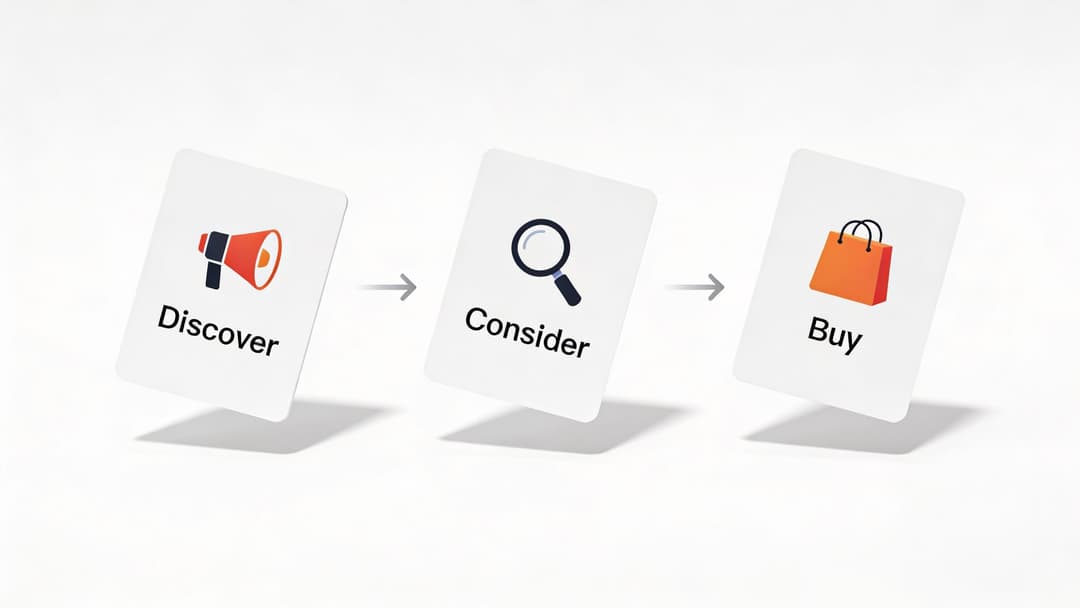
This is one of the most reliable growth hacking facebook ads tactics because it respects buyer psychology. A site visitor who bounced after one page doesn’t need urgency first. A cart abandoner doesn’t need a broad brand story. Sequence lets you match pressure to intent.
The timing problem matters because ad decay is real. The undercovered gap in most 2025 content is what happens after launch, once early winners start tiring out. The YouTube discussion on ad angle research and scaling gaps points toward the operational issue: marketers spend energy finding angles, then underinvest in automated refresh and winner reassembly after launch.
A sequence that fits real behavior
For e-commerce, a simple version works well:
- Product viewer sees benefit reminder or social proof
- Cart abandoner sees exact-item reminder
- Checkout starter sees reassurance around shipping, returns, or trust
- Non-converter after multiple touches sees an alternate angle or a softer offer
For SaaS:
- Pricing page visitor gets implementation clarity
- Webinar attendee gets proof and objection handling
- Demo no-show gets a lower-friction CTA such as a guide or message-based follow-up
The message should evolve. Education first, proof second, urgency last. If you reverse that order, a lot of warm traffic won’t convert because you skipped the objection they were stuck on.
Don’t overbuild it
A common mistake is creating so many windows and exclusions that delivery gets too thin to matter. Keep the sequence simple enough that each audience has meaningful volume and a distinct message.
I also like to pair sequence testing with creative rotation. The same message can stay alive longer if the format changes from video to carousel to static proof.
Retargeting should answer the buyer’s next question, not repeat your first pitch.
What works:
- Message progression by behavior
- Excluding recent converters
- Different creative formats across the sequence
- Simpler audience windows with clear intent
What doesn’t:
- Same ad for every warm segment
- Constant discounting as the only close tactic
- Overcomplicated exclusions
- Ignoring fatigue in small remarketing pools
7. Cohort Analysis and Cohort-Based Campaign Optimization
A campaign can look efficient in Ads Manager on Friday and still be the reason revenue quality slips next month.
That gap is where cohort analysis earns its keep. Instead of judging traffic on the first conversion, group customers by when and how they were acquired, then measure what happens after the click. Revenue retention, refund rate, lead qualification, repeat purchase rate, sales acceptance, and payback period usually tell a different story than CTR or front-end CPA.
Treat this as a repeatable experiment, not a one-off report.
What to test: cohorts grouped by acquisition date, campaign objective, audience type, creative angle, and landing path.
Why it matters: the cheapest lead source often produces the weakest pipeline or lowest customer value.
How to run it: set naming rules and UTMs at launch, push cohort labels into your CRM or warehouse, and review quality on a fixed lag such as 7, 14, or 30 days based on your sales cycle.
Lead gen accounts show this clearly. Lead Ads often produce lower CPL than higher-intent flows, but lower friction can also reduce intent. The useful comparison is not cost per lead by itself. It is cost per qualified lead, cost per opportunity, and revenue per cohort after enough time has passed for the sales process to do its job.
For e-commerce, the pattern is different but the method holds. One creative angle might drive more first purchases, while another brings in customers who reorder faster and return less. For SaaS, a broad audience may look less efficient on day three and still win on pipeline contribution because the message screened out weak-fit users.
What a useful cohort setup looks like
Keep the structure tight enough to use every week.
Track each lead or customer by:
- acquisition week or month
- campaign objective
- audience class
- creative angle
- landing page, form path, or offer type
Then map each cohort to the metric that reflects actual business value. For e-commerce, that usually means repeat rate, average order value over time, refund rate, and contribution margin. For SaaS, use MQL to SQL rate, pipeline creation, win rate, and early retention.
A simple example. A subscription brand may find that UGC prospecting drives more purchases in-platform, while founder-led education brings in fewer buyers who stick longer and discount less. If the second cohort supports stronger margin over 60 days, that ad set deserves more budget even with a higher day-one CPA.
How to turn findings into campaign changes
Use cohort results to set bid tolerance and budget rules.
If one audience consistently produces higher-value customers, let it carry a higher front-end CPA cap. If one creative angle produces cheap conversions but poor retention, cut spend faster even if the platform still reports acceptable ROAS. Cohort analysis helps protect unit economics during scale because it filters out volume that looks good only in the first reporting window.
This process gets easier when reporting is automated. A performance marketing AI workflow for Meta campaign analysis can group results by angle, audience, and source so the team spends less time exporting CSVs and more time making budget decisions. The win is not automation for its own sake. The win is reviewing cohorts often enough to act before bad traffic stacks up.
Success metrics for this experiment:
- qualified lead rate by cohort
- revenue or margin per acquired customer
- payback period
- repeat purchase or retention rate
- refund or churn rate
What works:
- tagging cohorts before launch
- reviewing lagging quality metrics on a set schedule
- allowing higher CPA for stronger downstream value
- comparing creative themes and acquisition paths side by side
What fails:
- optimizing only to platform-reported ROAS
- mixing lead types or offer types in the same cohort bucket
- building cohort tracking months after spend has started
- keeping cheap, low-quality volume because CPL looks efficient
8. AI-Driven Audience Intelligence and Predictive Scaling
A common scaling failure looks like this. The account has enough winning ingredients to grow, but the team cannot spot the right combinations fast enough. Spend rises, performance drifts, and budget keeps flowing into ad set and creative pairings that should have been cut two days earlier.
AI helps by shortening the time between signal detection and budget action. In practice, that means using models to score creative and audience combinations, flag early performance shifts, and suggest where incremental budget is most likely to hold efficiency. Meta is pushing advertisers toward more automated buying and optimization, so faster analysis is becoming part of the job, not a nice extra.
The repeatable experiment here is straightforward.
What to test: AI-assisted ranking for audience, creative, and message combinations before and after launch.
Why it matters: Manual reviews miss small but profitable patterns, especially in larger accounts with many active tests.
How to run it: Start with a clean naming system and consistent event tracking. Feed historical performance data into your workflow, then compare AI-ranked combinations against the combinations your team would have scaled manually. Review the output at a fixed cadence, usually daily for active scaling campaigns and weekly for broader account pattern reviews.
I use AI most in three specific jobs:
- ranking creatives by likely scale potential, not just early CTR or CPC
- matching message angles to audience segments based on conversion quality
- rebuilding new ad sets from winning parts after launch
That last point matters more than it gets credit for. Strong performance rarely comes from one perfect ad. It usually comes from a repeatable pattern across hook, offer framing, audience type, and placement mix. AI is useful because it can surface that pattern faster than a buyer working through reports by hand.
A performance marketing AI workflow for Meta campaign optimization helps operationalize this by turning campaign data into ranked testing inputs instead of static reports. The practical value is speed. Teams spend less time exporting data and more time deciding which experiments deserve more budget.
Keep the machine focused on pattern recognition and repetitive execution. Keep people responsible for offer strategy, margin thresholds, brand risk, seasonality, and any call that needs business context.
That division of labor protects against a common mistake. Accounts get into trouble when automation starts scaling combinations that look cheap in-platform but bring in poor customers, weak lead quality, or unstable conversion rates. AI can recommend the next budget move. It cannot decide whether that move makes sense for the business.
Success metrics for this experiment:
- time from performance change to budget action
- CPA, CPL, or ROAS by AI-ranked vs manually selected combinations
- conversion quality after scale
- percentage of spend shifted to top-quartile combinations
- volume maintained at target efficiency
What works:
- using clean historical data and consistent campaign naming
- scoring combinations on business metrics, not just click metrics
- setting budget and CPA guardrails before automation runs
- reviewing AI recommendations on a fixed schedule
What fails:
- feeding the system noisy data from messy account structures
- letting automation scale before quality checks are in place
- judging winners too early on weak signal volume
- ignoring margin, retention, or sales-team feedback when approving scale
Facebook Ads Growth Hacking: 8-Point Comparison
Use this table to decide which experiment to run next, based on your team’s constraints, data quality, and speed to impact. The point is not to chase all eight tactics at once. It is to choose the highest-upside test your account can support, define the win condition early, and build a repeatable process around it.
| Item | Implementation complexity | Resource requirements | Expected outcomes | Ideal use cases | Key advantages |
|---|---|---|---|---|---|
| Creative Testing & Iteration at Scale | Medium to high. Requires naming discipline, automation rules, and structured test design | High creative output, dedicated test budget, design tools or AI support | Faster identification of winning angles, stronger ROAS, and a reusable creative library | E-commerce, DTC brands, in-house growth teams, agencies | Faster learning cycles, clearer creative decision-making, lower waste on weak ads |
| Audience Segmentation & Lookalike Expansion | Medium. Requires pixel and CRM setup plus audience logic | Clean first-party data, pixel health, test budget | Lower CAC, tighter targeting, broader reach from proven customer inputs | SaaS, e-commerce, performance teams with usable customer data | Finds higher-intent segments, expands beyond saturated audiences, improves targeting efficiency |
| Conversion API Implementation & First-Party Data Use | High. Requires server-side setup, deduplication, and event validation | Engineering support, secure data systems, privacy review | Better attribution, stronger optimization signals, improved event match quality, offline event visibility | SaaS with longer funnels, omnichannel retail, subscription brands | More reliable tracking, less dependency on browser-side data, better signal quality for optimization |
| Funnel Optimization & Stage-Specific Messaging | Medium. Requires separate campaign logic by funnel stage and clean tracking | Multiple creative variants, audience definitions, conversion tracking | Higher conversion rates and better spend efficiency by matching message to buyer intent | B2B SaaS, high-consideration offers, subscription services | Better message fit, clearer drop-off diagnosis, stronger budget allocation by stage |
| Dynamic Product Ads & Catalog-Driven Campaigns | Medium to high. Requires clean feed structure and stable catalog sync | Catalog management, accurate product data, pixel setup | More conversions through product-level personalization and easier scale across large inventories | E-commerce, retailers, marketplaces | Personalized product delivery, live inventory alignment, efficient scale across many SKUs |
| Retargeting & Sequential Messaging Funnels | Medium to high. Requires timing rules, audience windows, and sequence planning | Strong pixel setup, multiple creative steps, automation support | Higher conversion rates from warm traffic, better ROAS, stronger message progression | E-commerce, SaaS, considered purchases | Better conversion from known visitors, lower CAC, tighter control over frequency and message order |
| Cohort Analysis & Cohort-Based Campaign Optimization | High. Requires cross-system reporting and enough time for cohorts to mature | CRM and finance inputs, analytics support, longer measurement windows | Better budget allocation by LTV, clearer identification of profitable customer groups | Subscription businesses, repeat-purchase brands, SaaS | Connects spend to downstream value, improves long-range budgeting, surfaces stronger customer segments |
| AI-Driven Audience Intelligence & Predictive Scaling | High. Requires model training, validation, and process oversight | Historical data, data engineering support, ongoing monitoring | Faster identification of scalable combinations, earlier budget shifts, more efficient scaling decisions | Analytically advanced teams, agencies, performance-focused organizations | Speeds up pattern detection, reduces manual bias, helps teams act faster on emerging winners |
A useful way to read this comparison is through trade-offs. Creative testing usually gives the fastest feedback loop, but it burns time and budget if the team cannot produce enough variation. Conversion API work takes longer to set up, but it improves signal quality across the whole account. Cohort analysis often produces the best budgeting decisions, though it is slower and depends on clean post-purchase data.
That is why strong teams treat each row as an experiment design, not a channel tactic. Define what you are testing, why it should improve performance, how long it needs to run, and which metric decides whether it earns more spend. If you are automating that workflow with a tool like AdStellar AI, the goal stays the same. Standardize the inputs, score results against business outcomes, and speed up the path from test result to budget action.
From Hacking to System Scaling Your Ad Experiments
The biggest shift in strong Meta accounts isn’t usually one breakthrough ad. It’s the moment the team stops treating performance as a series of isolated campaigns and starts treating it as a testing system. That’s the center of growth hacking facebook ads. You’re not trying to be clever once. You’re trying to build a machine that keeps producing useful learning, then turns that learning into scale.
Each tactic here works best when you treat it like a repeatable experiment. Creative testing gives you message signal. Audience segmentation tells you where that message travels best. Conversion API improves the quality of the signals Meta uses to optimize. Funnel messaging helps you stop asking cold traffic to convert like warm traffic. Catalog ads, retargeting sequences, and cohort analysis tighten the link between acquisition activity and actual business outcomes. AI then shortens the distance between raw data and action.
That system mindset also forces better discipline. You start naming variables clearly. You stop changing three things at once. You track post-click quality instead of worshipping CTR. You spend less time arguing over opinions and more time reviewing evidence. That alone can change how a paid social team operates.
There are trade-offs, and they’re worth saying out loud. More experimentation creates more operational complexity. More creative variation demands better asset management. Broader targeting can scale, but only if the ad itself is sharp enough to qualify the right user. Automation saves time, but weak inputs still produce weak outcomes. None of this removes the need for judgment. It just gives judgment a better operating environment.
If I were resetting an account today, I wouldn’t try to implement all eight tactics at once. I’d pick the one creating the biggest bottleneck.
If creative fatigue is constant, start with structured creative testing.
If reporting feels unreliable, fix event tracking and first-party data flow.
If scaling stalls after early wins, build retargeting sequences and cohort reviews.
If the team is drowning in manual setup, focus on automation and AI-assisted ranking.
The useful question isn’t “Which tactic is best?” It’s “Which experiment will produce the clearest next learning for this account?” That framing keeps your roadmap practical. It also keeps you from copying tactics that work in someone else’s business but don’t fit your sales cycle, offer, or margin structure.
This is also why automation is moving from helpful to necessary. As Meta inventory expands and creative volume expectations rise, teams that launch and analyze faster get more chances to find winners before the market catches up. AdStellar AI is one option that fits that workflow. Based on the product details provided, it connects to Meta via OAuth, ingests historical performance data, helps launch large batches of creative, copy, and audience combinations, and ranks results against goals like ROAS, CPL, or CPA. For teams trying to reduce manual campaign setup and turn testing into a repeatable operating system, that kind of workflow support is directly relevant.
Start smaller than your ambition, but more systematically than you have before. Choose one tactic. Define the variable. Decide what success looks like before launch. Then run the test cleanly enough that the result teaches you something.
That’s how Facebook ads stop being guesswork and start becoming a growth engine.
If you want a faster way to launch, test, and scale Meta experiments, AdStellar AI is built for that workflow. It helps teams generate large batches of creative, copy, and audience combinations, push them live, ingest historical account data through secure OAuth, and rank performance against the KPIs that matter most.