
Think of a product advertising API as the ultimate universal translator for your e-commerce business. It's the critical connection that lets your product catalog, inventory system, and ad platforms like Meta or Amazon all speak the same language, fluently and instantly. This link automates the entire campaign creation process by sending product details, prices, and images directly to advertising networks without you lifting a finger.
What Exactly Is a Product Advertising API?

At its core, a product advertising API (Application Programming Interface) is a secure and automated communication line. Instead of wrestling with manual uploads or building ads one by one, the API acts as a go-between. It allows all your different software systems to talk, share data, and trigger actions based on rules you set.
Imagine you're running a global shipping network where every port speaks a different language. You’d need a dedicated translator at each stop, creating a recipe for delays, mistakes, and chaos. An API is that universal translator, making sure every system understands the others perfectly and in real time.
How It Works in Practice
Let's get practical. Say you have 500 products in your online store. The thought of manually creating an ad for each one on Facebook is enough to make any marketer's head spin. With an API, that nightmare becomes a dream.
- Your e-commerce platform sends product data—like the name, price, stock level, and image URL—to your ad management tool through the API.
- The ad tool grabs this data and uses it to automatically generate ad creatives, copy, and targeting rules based on your templates.
- The tool then uses the ad platform's own API (like the Meta Marketing API) to create and launch the campaigns directly.
This whole process just happens. When a price changes or a product sells out, the API sends that update, and your ads are automatically paused or adjusted. No manual check-ins needed. This is the bedrock of modern ad automation, enabling brands to scale their marketing without bloating their payroll. To see how this applies to a specific channel, our detailed guide on Meta Ads API integration breaks it down even further.
An API isn't just a techy tool for developers; it's a strategic weapon for marketers. It swaps repetitive manual work for automated, data-driven workflows, freeing your team to focus on strategy and creativity instead of mind-numbing execution.
The Core Benefits of API-Driven Ads
The biggest win here is scalability. You can manage campaigns for thousands of products just as easily as you can for ten. This fundamental shift from manual clicking to automated systems is what helps businesses truly compete and grow.
Other key benefits are just as compelling:
- Real-Time Accuracy: Your ads will always show the latest product information, like current pricing and stock levels. This builds trust, improves the customer experience, and boosts conversions.
- Efficiency and Speed: Launching complex campaigns with hundreds of variations can take minutes, not days. This gives you a massive speed-to-market advantage over competitors.
- Reduced Human Error: Automation gets rid of the typos, incorrect prices, and other simple mistakes that can cost you money and hurt your brand's reputation.
Ultimately, a product advertising API is the technical backbone that makes dynamic, large-scale advertising possible. It sets the stage for more advanced strategies, better performance, and a much saner marketing team.
How APIs Fuel Modern Ad Automation
If a product advertising API is the universal translator between your product catalog and an ad platform, how does that conversation actually work? This is where the mechanics of automation come alive, turning a simple product spreadsheet into hundreds of live, targeted ads with almost unbelievable speed.
The whole process runs on a few key components working in perfect harmony. Think of it like a highly secure, automated delivery service between your business and a platform like Meta or Amazon.
It all starts with authentication, which acts as your digital key. An application like AdStellar uses a secure token to prove its identity to the ad platform’s API. This isn't like sharing your password; it's a specific key that grants limited, revocable access, so your ad account always stays protected.
Once that secure handshake is complete, the conversation begins using a shared language laid out in data schemas. These schemas are basically blueprints, telling the API exactly how your product info—price, name, image URL—needs to be structured so the ad platform can read it correctly.
From a Spreadsheet to Live Campaigns
Let's say you're an e-commerce brand launching a new line of sneakers. Manually creating ads for every single size, color, and design variation would be a soul-crushing, multi-day task. This is exactly where the magic of a product advertising API shines.
- Data Ingestion: First, your product data—maybe from a simple spreadsheet or straight from your Shopify store—is pulled into an automation tool.
- Ad Generation: The tool then uses this data to automatically build out hundreds of ad variations. It can mix and match headlines, pull in different sneaker images from various angles, and write unique copy for each audience you’re targeting.
- API Execution: Finally, the tool sends all these instructions to the ad platform's API using specific endpoints. An endpoint is like a dedicated phone number for a specific job—one for creating a campaign, another for updating a budget, and a different one for pulling performance reports.
This is the actual documentation for Meta's Marketing API. It shows the different endpoints that developers and tools like AdStellar use to build, manage, and analyze campaigns programmatically.
These endpoints are the action-oriented commands that give an application total control over an advertising account, from creating audiences to uploading creatives.
The True Value of Automation
The most obvious win here is saving a massive amount of time. If you want to see just how quickly that time adds up, check out the real cost of manually posting cars on Facebook Marketplace. The inefficiency is staggering.
But the value of a product advertising API goes way beyond just saving hours. It eliminates the risk of human error—no more typos in your pricing or, worse, running ads for items that are already out of stock.
This level of automation opens the door to strategies that are flat-out impossible to pull off by hand. You can see how we put this into practice in our guide to Meta advertising API integration.
An API turns your ad strategy into a set of repeatable, scalable instructions. You define the 'what' (the creative, the audience, the budget), and the API handles the 'how' (the creation, the updates, the reporting) at a scale and speed no human team can match.
However, all this power comes with some ground rules. Ad platforms carefully manage API usage to keep their systems stable. For example, when you start with the Amazon Product Advertising API, you have to navigate its strict usage limits. New developers get 1 transaction per second (TPS) with a daily cap of 8,640 requests.
After 30 days, these limits change based on the revenue your API activity is generating. In short, the more effective your ads are, the more access you're granted. It's a system designed to reward performance with greater scale.
Comparing Major Advertising API Platforms
Once you start exploring the world of product advertising APIs, you’ll quickly realize it’s not a one-size-fits-all situation. The major players—Amazon, Meta, and Google—each built their APIs with a completely different mindset. Picking the right one isn't about which is technically "better," but which one aligns with what you're trying to achieve.
Think of Amazon's API as the ultimate in-store associate, laser-focused on one thing: closing the sale. Its entire universe is built around your product catalog and driving purchases directly on its marketplace. Every single function, from bidding on keywords to pulling reports, is designed to answer the question, "Did this ad make someone buy something?"
Meta's Marketing API, on the other hand, is more like a brand evangelist. While it can absolutely drive sales, its real magic lies in building audiences from scratch, creating demand for products people didn't know they needed, and telling your brand’s story. It's less about the immediate transaction and more about nurturing a customer from first glance to final purchase.
H3: Core Philosophies Amazon vs. Meta
The difference in their core approach is night and day. Amazon is a high-intent environment. People go there specifically to search for products and buy them. The API is a direct reflection of this, focusing on putting your products right in front of shoppers who are ready to pull out their wallets. It’s all about bottom-of-funnel conversion, connecting your ads directly to SKUs and sales data within the Amazon ecosystem.
Meta, meanwhile, operates on a discovery model. Users are scrolling through their feeds to connect with friends and see interesting content, not necessarily to shop. The API is engineered to interrupt that flow in a compelling way. It excels at introducing new products, building massive lookalike audiences from your best customers, and supporting the entire marketing funnel, from brand awareness videos to dynamic product ads that bring back cart abandoners.
This is how a product advertising API acts as the bridge, connecting your store's live data directly to the ad platform to automate the entire workflow.
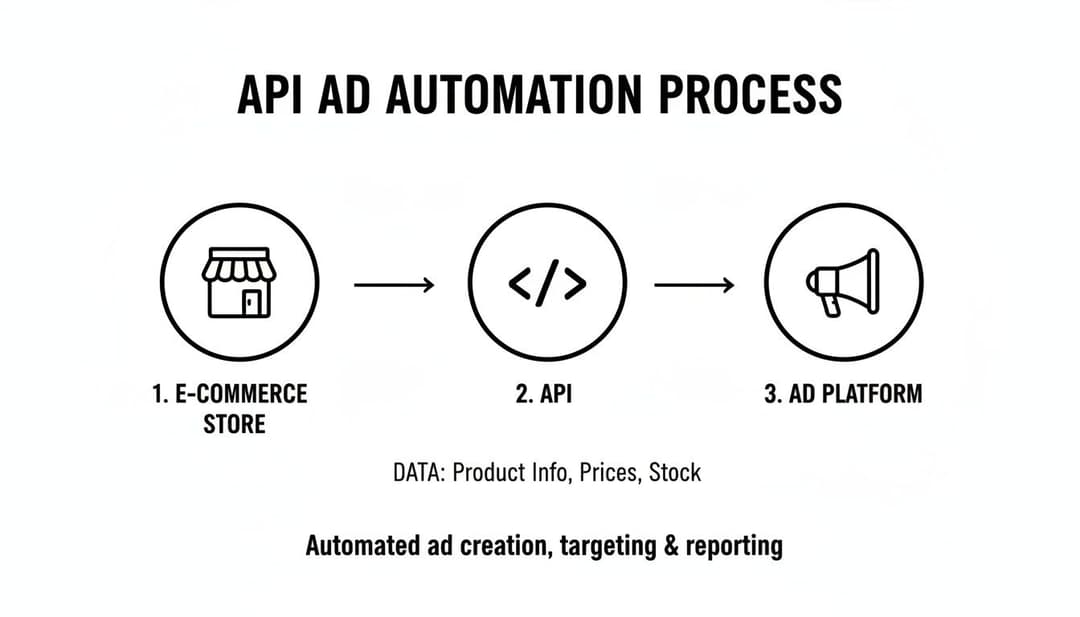
This flow shows just how central the API is to modern ad automation, turning your product catalog into a powerful campaign engine.
H3: Breaking Down The Technical Differences
Beyond the big-picture philosophy, the technical nuts and bolts of each API are also worlds apart. Google, for example, offers an incredibly powerful and complex API that mirrors the sheer scale of its advertising network—spanning Search, Shopping, YouTube, and Display. It offers granular control over almost everything but comes with a much steeper learning curve.
To make the choice clearer, let’s put the key technical differences side-by-side.
Comparison of Major Product Advertising APIs
This table breaks down the key differences between the advertising APIs from Amazon, Meta, and Google, helping you see which platform is the best match for your specific goals.
| Feature | Amazon Advertising API | Meta Marketing API | Google Ads API |
|---|---|---|---|
| Primary Goal | Drive on-platform sales | Build audiences and drive demand | Capture intent across a vast network |
| Data Focus | Product-centric (ASINs, sales) | User-centric (interests, behaviors) | Keyword and query-centric |
| Best Use Case | Brands selling directly on Amazon | D2C brands and visual storytelling | Businesses with strong search intent |
| Complexity | Moderate | Moderate to High | High |
| Creative Control | Limited to predefined formats (Sponsored Products, etc.) | Extensive (Carousel, Video, Stories) | High, but varies by ad format (Search, Display, Video) |
This comparison should help clarify which platform is the right starting point for your brand. If you want to go even deeper on channel-specific strategies, our guide on choosing the right PPC advertising platforms is a great next step.
Interestingly, the Amazon Product Advertising API (once known as the Associates Web Service) has found a home with marketers of all sizes. Data shows that 56% of its users are small businesses with revenues under $50M, while 14% are large enterprises earning over $1 billion. This wide adoption, with 46% of users based in the United States, proves its versatility, even with a modest 0.1% market share in the overall advertising tools category.
The Takeaway: Your choice of API isn't about which one is "best," but which one best aligns with your marketing funnel. For direct conversions on a retail platform, Amazon is king. For building a brand and creating demand on social media, Meta leads the way. For capturing high-intent users across the web, Google’s API offers unparalleled reach.
Unlocking Growth with API-Driven Use Cases
Understanding the theory behind a product advertising API is one thing. Seeing how it actually makes money is another entirely. So, let's move past the technical jargon and look at how smart brands and agencies are using these connections to fuel serious growth.
These aren't just minor efficiency gains. We're talking about fundamental shifts in how advertising gets managed, scaled, and optimized.
Take a direct-to-consumer fashion brand that was constantly playing catch-up with seasonal trends. Their marketing team was sinking dozens of hours each week just manually building ads for new arrivals. By plugging into a product advertising API, they completely overhauled their workflow.
The new system automatically pulled product data from their store, generated over 1,000 ad variations by mixing and matching images and headlines, and launched them all in a massive A/B test. The result? They found their winning creatives in days, not months, which led to a 40% drop in their cost-per-acquisition. The team was finally free to think about big-picture strategy instead of just building ads.
Automating Campaign Management at Scale
The real power of a product advertising API isn't just in the initial setup; it's a total game-changer for ongoing management, especially for agencies juggling tons of clients.
Imagine an agency handling paid social for 50 different e-commerce stores. The weekly reporting process alone was a nightmare, eating up over 20 hours of tedious work just pulling data and building spreadsheets.
By building a solution with the API, they created a central dashboard that pulled in performance metrics from every single client account in real time.
- Centralized Reporting: The dashboard automatically grabbed key metrics like ROAS, CPA, and spend, making manual data entry a thing of the past.
- Proactive Alerts: They set up custom rules to flag any campaign or ad that suddenly started underperforming, letting them jump on problems instantly.
- Streamlined Client Updates: Instead of building reports from scratch, they gave clients a live, tailored view of their own results, which boosted transparency and saved everyone time.
That one integration saved the agency 20 hours every week on reporting alone. They could finally put that time back into strategic planning and creative work for their clients, transforming their role from data-pullers to true strategic partners.
The core benefit of a product advertising API is not just doing things faster, but doing things that were previously impossible. It enables a level of scale, testing, and real-time optimization that manual workflows simply cannot match.
Real-Time Bid and Budget Optimization
Another huge advantage is real-time optimization, which is absolutely critical in competitive spaces. The Amazon Advertising API ecosystem is a perfect example of this in action. It gives advertisers direct access to metrics like impressions, clicks, and Return on Ad Spend (ROAS) across its various ad types.
For instance, brands can automate bid adjustments for their best-performing keywords while simultaneously pulling back spend from the losers. This all happens by pulling live data and reacting in minutes, not days. When you pair this with the right analytics tools, you can slash manual work by up to 80% for certain tasks. You can explore how businesses are using this to their advantage and discover more insights about the Amazon Advertising API.
This immediate feedback loop between performance data and campaign controls is what separates winning advertisers from the rest. The API acts as a tireless analyst, constantly monitoring results and making adjustments based on the rules you define. This is also where a deeper understanding of how data is tracked becomes vital. If you're running campaigns on Meta, for example, it's crucial to also have a solid grasp of how the Meta Conversions API can improve your measurement and feed the platform better data for optimization.
These examples all point to the same conclusion. Whether you’re a DTC brand, a large agency, or a marketplace seller, a product advertising API provides the backbone for smarter, faster, and more profitable advertising. Tools like AdStellar are built specifically to solve these exact challenges, providing an intuitive interface that harnesses the full power of the Meta API for advertisers who want results without the complexity.
API Integration Best Practices
So you’ve successfully connected to a product advertising API. That's a great first step, but it’s just the starting line. The real magic—and what separates the pros from the rookies—is building an integration that’s robust, efficient, and built to last.
Get it wrong, and you’re stuck with a system that’s slow, buggy, and constantly on the fritz. But get it right from day one, and you’ll have an ad automation powerhouse that can scale with your business.
First things first: you have to play by the rules. Every API has its limits, and pushing them is a quick way to get put in a time-out. These rate limits aren't there to annoy you; they keep the platform stable for everyone. If you constantly bombard the API with requests, your access can be throttled or even suspended, bringing your entire ad operation to a screeching halt.
This is where batching comes in. Instead of making thousands of separate calls to update each product one by one, a smart integration groups them together. Need to change the price on 100 products? That’s one API call, not a hundred. This simple trick dramatically cuts down your request volume, keeps you safely under the rate limits, and makes the whole system run smoother.
Build a Resilient System
Let's be honest: no API is perfect. Servers go down, requests get mangled, and authentication tokens expire. It’s not a matter of if things will go wrong, but when. A fragile system will fall apart at the first sign of trouble, but a resilient one is built to handle the bumps in the road.
This is why robust error logging and handling is non-negotiable. Your system shouldn't just crash when a request fails; it needs to log the error with enough detail to figure out what happened. Was it a mistake on your end or a temporary hiccup on the server's side? Good logs are the breadcrumbs that lead you to a fix.
And when an error does happen, don't just keep hammering the API. That’s where an exponential backoff strategy comes in. If a request fails, wait a second before trying again. If it fails again, wait two seconds, then four, and so on. This gives the server time to recover and prevents you from making a bad situation worse.
Work Smarter, Not Harder
Are you constantly asking the API, "Anything new? How about now? Anything yet?" This method, called polling, is the digital equivalent of a kid in the backseat on a road trip. It's inefficient and annoying. There's a much better way: webhooks.
Think of it like this:
- Polling: Calling a restaurant every five minutes to ask if your table is ready.
- Webhooks: Giving the host your number so they can text you the moment your table is free.
Webhooks flip the script. Instead of your app constantly pulling data, the API pushes real-time updates to you as they happen. A product just went out of stock? A webhook can trigger an action to instantly pause its ads, saving you money and preventing customer frustration.
Secure and efficient data handling is the foundation of any successful API integration. Your goal should be to create a system that is not only powerful but also respectful of the platform's resources and resilient in the face of temporary issues.
Finally, let’s talk security. Your API keys and access tokens are the keys to your advertising kingdom—treat them that way. Always use secure authentication protocols like OAuth 2.0, which lets you grant specific permissions without ever sharing your master password.
And whatever you do, never hardcode credentials directly into your application's source code. Store them securely, rotate them regularly, and protect them at all costs. In the world of ad automation, a single leaked key can be disastrous.
How AdStellar Turns the Meta API Into a Growth Engine

The Meta Marketing API is incredibly powerful, but raw power alone doesn’t drive results. Think of it like getting the keys to a Formula 1 race car—you have the engine, but you still need a skilled driver, a race strategy, and a pit crew to win. That’s exactly where AdStellar steps in, acting as the intelligent control system that turns raw API potential into a simple, revenue-driving machine.
Our platform plugs securely into your Meta Ads account through the API, giving us read-only access to your historical performance data. This becomes the fuel for our AI. It digs through every campaign you've ever run to pinpoint your unique winning patterns—which creatives clicked with which audiences, what copy actually drove conversions, and where your best ROAS has consistently come from.
Instead of just giving you more tools, AdStellar delivers the answers you've been looking for, backed by your own data.
From Raw Code to Real Strategy
Let's be honest, interacting directly with any advertising API can be a headache. It's often complex, time-consuming, and built for developers, not marketers. AdStellar strips away all that complexity, giving you an intuitive interface designed for one purpose: launching winning campaigns, faster.
- Massive Ad Variation, Minimal Effort: Our platform uses the API to spin a few of your inputs into hundreds of unique ad variations. You can generate a full spectrum of creative and audience combinations in minutes, a task that would otherwise take your team days. See how our approach to streamlining ad launches with bulk creation saves countless hours.
- AI-Guided Campaign Blueprints: AdStellar doesn’t just help you build more ads; it helps you build the right ads from the start. Our AI recommends campaign structures based on your proven top performers, so every new launch begins with a data-backed advantage.
- Automated, Crystal-Clear Reporting: We constantly pull performance data through the API, but we don't just dump it on you. We translate those raw numbers into clear, actionable insights, so you can see precisely which ads are working and why, without ever getting lost in a spreadsheet again.
AdStellar transforms the Meta product advertising API from a developer's toolkit into a marketer's strategic weapon. We handle all the technical heavy lifting so you can focus on what you do best—growing the business.
Launch Smarter, Scale Faster
The goal is simple: launch more effective campaigns with less friction. By marrying deep historical data analysis with rapid-fire campaign generation, AdStellar gives you the power to test more ideas, find your winners faster, and scale your budget with genuine confidence.
You no longer have to guess which creative will hit the mark or which audience is the right one to target. Our platform uses the API to run those experiments at a scale that's physically impossible to manage by hand. This means you can drive more revenue from your ad spend while saving 10x the time on campaign setup and management.
Frequently Asked Questions
As you start exploring the world of API-driven advertising, a few practical questions almost always come up. Let's tackle some of the most common ones to clear up any confusion and highlight what really matters.
Product Feeds Versus APIs
One of the biggest points of confusion is the difference between a product feed and a product advertising API. They might seem similar, but they operate in completely different ways.
Think of a product feed as a static file, like a spreadsheet of your inventory. You create it, upload it to an ad platform like Meta or Google, and it just sits there until you manually upload a new version. It's a one-way data dump.
A product advertising API, on the other hand, is a live, two-way conversation. It’s a direct connection between your e-commerce platform and the ad channel, allowing for instant updates. If an item goes out of stock, the API can pause the ad automatically. It’s dynamic, responsive, and works in real time.
Do I Need to Be a Developer to Use an API?
Not anymore. While building a custom, direct-to-the-metal API integration from scratch does require coding skills, that’s no longer the only way.
Modern platforms now act as a user-friendly layer on top of the complex API code. This gives you all the automation power without ever needing to write a single line yourself.
Platforms like AdStellar are built specifically to bridge this exact gap. We provide an intuitive interface that unlocks the full power of a product advertising API, making advanced campaign automation accessible to marketers, not just developers.
How Do These APIs Keep My Data Secure?
Security is a fundamental part of API design, not an afterthought. These connections use robust protocols like OAuth 2.0 to keep your accounts completely safe.
It works by granting an application specific, revocable permissions instead of you handing over your username and password. Think of it like giving a valet a key that only starts the car and opens the door—it won’t open the glove box or the trunk. You keep the master key and can revoke the valet’s access anytime.
Can an API Help Me Test Ad Creatives?
Absolutely. In fact, this is one of an API's superpowers. It's the perfect tool for running creative tests at a scale that would be impossible to manage by hand.
An API can programmatically generate and launch hundreds of ad variations by mixing and matching different images, headlines, and calls-to-action. This lets you gather performance data incredibly fast, showing you which combinations actually drive results. You can test more ideas in an afternoon than a whole team could test in a month, leading to faster optimizations and a much better return on your ad spend.
Ready to transform your Meta advertising with the power of an API, but without the technical headaches? AdStellar AI provides the intelligent layer you need to launch, test, and scale campaigns 10x faster. Discover how AdStellar can help you drive more revenue today.