Most paid social teams still launch creative like they are shipping a final product. The brief gets approved. The assets get polished. Budget goes live. Then everyone stares at Ads Manager and hopes the market agrees.
That approach breaks fast. Audiences fatigue. Messages that looked strong in review fall flat in-feed. The offer is right, but the hook is wrong. Or the hook works, but only for one audience pocket. By the time the team realizes what happened, too much spend has already gone into a weak first draft.
That is why iterative design processes matter in advertising. Not as a design-theory concept, but as an operating system for creative testing, decision-making, and budget allocation. In paid social and display, iteration turns creative from a one-time deliverable into a compounding learning loop. The output is not just better ads. It is a faster path to stable performance.
Moving Beyond 'Set and Forget' Advertising
A big campaign launch feels productive because it creates the illusion of control. Everything is approved. Naming conventions are clean. The media plan is signed off. But the market does not reward polish on its own. It rewards relevance.
That is the flaw in set-and-forget advertising. It treats launch as the finish line. In practice, launch is just the first data collection point.

Why the old launch model underperforms
The non-iterative model assumes your team can predict the best headline, visual, CTA, format, and audience fit before real users respond. Sometimes that works. Usually it produces a decent control, not a durable winner.
Creative performance changes quickly because buyers react to context. A direct-response video that worked for cold traffic can stall on warmer retargeting pools. A studio product image can lose to a rough customer-style shot. Long copy can beat short copy for one offer and fail for another.
When teams accept the first version as final, they lock in those assumptions.
Iteration compounds learning
The better model is simple. Launch a structured first version, watch how people respond, identify the strongest signals, then rebuild around those signals. That is iterative design applied to ad creative.
The value is not abstract. Empirical data from Nielsen Norman Group shows that iterative design processes deliver an average usability gain of 38% per iteration, and in one web case study a key performance indicator increased by 233% over six iterations (NNG on parallel and iterative design). The direct lesson for marketers is not that ads and websites are identical. It is that small, disciplined refinements can stack into outsized performance change.
Practical takeaway: A weak first draft is not a failure. It is only expensive if you keep funding it without learning from it.
In paid media, that learning loop is what separates account activity from account improvement. A testing system that can generate, launch, compare, and revise faster will usually outperform a team that waits for perfect creative before going live.
If you already run high-volume Meta campaigns, this matters even more. Bulk production and fast deployment tools have changed what “iteration” looks like in execution. Teams no longer need to rebuild every variation by hand. They can automate production, tighten feedback loops, and keep moving. A useful example is this guide on automating Facebook ad workflows, which shows how modern teams reduce manual setup so they can focus on testing decisions instead of repetitive build work.
Laying the Foundation with Strong Hypotheses and Metrics
Most creative testing fails before the ads go live. The problem is not the image or the copy. The problem is the team never defined what it was trying to prove.
A real test starts with a hypothesis, not a vague idea like “let’s try more UGC” or “let’s make this feel punchier.” Those are creative directions. They are not decision frameworks.
Build a hypothesis that can survive contact with data
A usable hypothesis ties one creative choice to one business outcome for one audience.
A strong template looks like this:
- Audience: Who should this resonate with?
- Variable: What exactly are you changing?
- Expected effect: What response do you expect?
- Business metric: How will success be judged?
Here is the kind of thinking that works in practice:
- Weak hypothesis: UGC should perform better.
- Strong hypothesis: Customer-style testimonial videos will resonate better with first-time visitors than polished studio edits because they reduce skepticism. Success will be judged on our primary acquisition metric.
That structure forces discipline. It also protects the team from post-launch storytelling. Without a hypothesis, marketers often reverse-engineer meaning from mixed results.
Pick one North Star metric
If your team celebrates CTR, comments, thumb stop rate, conversion rate, and CPA all at once, someone can always claim the test “worked.” That is how bad decisions survive.
Pick one primary KPI before launch. For most paid social teams, that is usually:
| Goal type | Best primary metric |
|---|---|
| Revenue efficiency | ROAS |
| Lead generation | CPL |
| Purchase acquisition | CPA |
| Pipeline quality | Qualified conversion metric tied to sales handoff |
Use secondary metrics only for diagnosis. Do not use them to overrule the primary KPI.
A creative can attract cheap clicks and still be a bad ad. Another can have a lower click rate but drive stronger buyers. If the business goal is efficient acquisition, the primary metric decides.
For teams tightening their measurement model, this walkthrough on how to measure advertising effectiveness is a useful reference because it keeps the focus on business outcomes rather than vanity metrics.
Define success and failure before spend starts
Good testing systems remove ambiguity early. Before launch, write down:
- The hypothesis
- The primary KPI
- What result invalidates the idea
- What result earns another iteration
- What result justifies scale
Creative teams are naturally attached to new concepts. Buyers are naturally tempted to keep “promising” ads alive. Predefined thresholds reduce that bias.
Tip: If the team cannot explain why a variable should affect the KPI, it is not ready to test. It is only ready to brainstorm.
Keep the test narrow enough to learn
One of the easiest ways to corrupt a creative test is to change too many things at once. If you swap the visual, hook, CTA, audience, and offer framing together, the result may improve, but you will not know why.
That makes the next iteration weaker, not stronger.
A cleaner approach is to decide what layer you are testing:
Message test
Hold the visual style relatively steady. Change the hook, promise, objection handling, or CTA language.
Format test
Keep the core message stable. Compare static, short-form video, carousel, or creator-style edit.
Visual treatment test
Hold the message stable. Change color treatment, product framing, on-screen text, or motion style.
Audience resonance test
Keep the ad concept similar. Test whether one segment responds more strongly than another.
Senior marketers usually outperform junior teams here. They know every test should produce a reusable insight, not just a temporary winner.
Write the brief like an experiment, not a request
A strong testing brief is short and precise. It should answer:
- What belief are we testing?
- What single variable matters most?
- Which KPI decides the outcome?
- What must stay constant for a fair read?
- What will we do if the result is mixed?
When those answers are missing, production becomes noise. Designers make assets they think look good. Copywriters write lines they think sound strong. Media buyers launch combinations that are hard to interpret later.
Iterative design processes work because they force clarity before motion. In paid acquisition, that clarity is where profit starts.
Running the Rapid Iteration Engine for Creatives
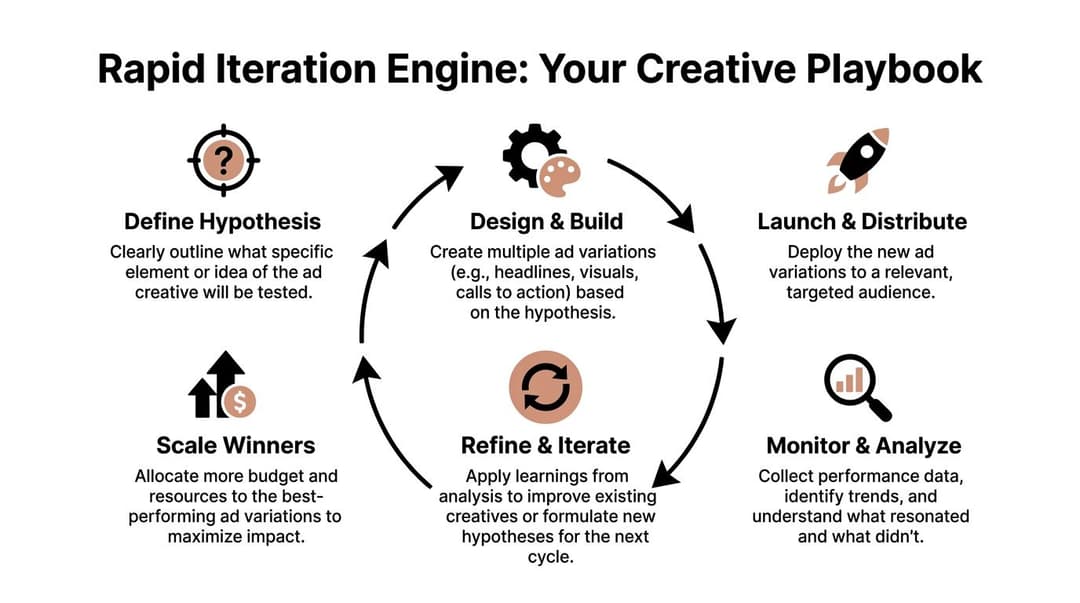
The fastest teams do not build ads one at a time. They build systems for variation.
That changes everything. Instead of debating whether one headline is better than another in Slack, the team creates structured variants, launches them into the market, then lets performance data settle the argument.
Start with the five-part operating loop
The most practical version of iterative design for ad creatives follows the familiar cycle of Plan, Design, Implement, Test, Evaluate. According to Webflow’s summary of the iterative process, a first-pass design may succeed only around 50% of the time, and each additional iteration raises the odds by catching issues earlier and refining the work (Webflow on the iterative process).
For performance marketers, that translates cleanly into campaign execution.
Plan the test before opening Ads Manager
Planning is where most wasted spend can still be prevented.
Decide:
- The hypothesis
- The primary KPI
- The audience slice
- The budget allocation logic
- The variable being tested
- What stays fixed
This is also where you define the shape of the test matrix. If you are testing hooks, for example, you may keep the same offer, same landing page, and same audience pool while rotating different openings.
For teams that want a more campaign-centric breakdown of this discipline, Skup’s complete Facebook Ads testing system is a useful companion read because it shows how structured testing decisions affect downstream scaling.
Design variations as modules
Strong creative iteration comes from modular thinking.
Do not treat an ad as one inseparable artifact. Break it into parts:
| Creative layer | Examples of variables |
|---|---|
| Hook | Problem-led, benefit-led, curiosity-led |
| Visual | Product demo, testimonial, founder clip, lifestyle image |
| Copy body | Short direct copy, objection-led copy, story-based copy |
| CTA | Shop now, learn more, start trial, claim offer |
| Audience angle | New customer, lapsed buyer, category aware, competitor aware |
This lets the team create families of ads instead of isolated one-offs.
Modern tools are useful here because production volume matters. A system like AdStellar AI can generate large sets of creative, copy, and audience combinations from a defined testing brief, then push those variants live through a connected Meta workflow. That changes the bottleneck. The limiting factor becomes decision quality, not manual ad assembly.
If you want a deeper look at how test design works inside campaign execution, this guide on how to test ads systematically is worth reviewing.
Implement quickly, but not sloppily
Speed helps only when the structure is sound. Rapid iteration is not the same as random launch velocity.
A clean implementation checklist looks like this:
- Name every variant clearly so results are readable later.
- Group tests logically by hypothesis or audience.
- Keep budgets comparable enough to read outcomes fairly.
- Use consistent destination paths unless landing page variation is part of the test.
- Record the reason each variant exists so the learning survives after the campaign ends.
This documentation piece gets ignored a lot. Then two weeks later, nobody remembers whether “V3 final alt new” was testing a hook, a CTA, or a different visual crop.
Test for signal, not entertainment
The market will often surprise you. That is good. But surprise alone is not insight.
When you monitor a live test, ask narrower questions:
- Did one message consistently attract stronger conversion quality?
- Did one visual treatment get attention but not action?
- Did one audience respond well to proof-based copy and reject aspirational copy?
- Did a concept fail everywhere, or only in one segment?
That is the difference between reading data and reacting to a dashboard.
Key rule: If a result does not change your next creative decision, you have not learned enough yet.
Evaluate with a decision tree
Every test should end in one of four actions.
Kill it
The concept did not support the KPI. Do not rescue it with stories.
Refine it
The idea showed some traction, but one component likely held it back. Keep the core belief. Replace the weak layer.
Isolate it
The result is promising but ambiguous because multiple variables changed. Rebuild a cleaner version of the test.
Scale it
The ad is not just interesting. It is doing the job the account needs.
Teams that iterate well are ruthless here. They do not keep underperforming creatives alive because production time was expensive. They let weak work go and redirect effort toward sharper hypotheses.
What this looks like in practice
A simple example:
You launch three versions of the same offer.
- Version A leads with a discount.
- Version B leads with customer proof.
- Version C leads with a product demo.
Customer proof wins. The next cycle should not restart from zero. It should go deeper into that winning lane. Test new testimonial formats. Test different speakers. Test different objection-handling lines within the same trust-heavy angle.
That is the rapid iteration engine. Each round narrows uncertainty. Each winning signal gets pushed forward into the next creative generation.
From Data to Decisions to Dollars
Testing only creates value when the team acts on what it learns. Plenty of accounts look “busy” because they contain lots of experiments, but the budget still sits on average creative and muddy insights.
Good iteration closes the gap between observation and action.

Read outcomes at the component level
The most useful post-test question is not “Which ad won?” It is “What inside the ad won?”
That shift matters because ad-level winners can be temporary. Components are reusable.
If several winning creatives share the same opening claim, that claim deserves another round. If losing ads all rely on a polished product render while stronger ads use rougher lifestyle context, the visual treatment is now part of your playbook. If a format drives attention but not conversion, you may keep the attention structure and replace the promise.
At this stage, marketers benefit from a discipline similar to sales-side win-loss analysis. The point is not just to label a winner or loser. It is to understand the reason, then operationalize it.
Make kill or scale decisions fast
A mature team does not leave borderline creative running indefinitely. It decides.
Use this simple frame:
| Outcome | What it means | Next move |
|---|---|---|
| Clear loser | The concept failed against the primary KPI | Pause and document why |
| Mixed result | Some elements worked, but the test is not clean enough | Rebuild a narrower test |
| Clear winner | The concept supports the KPI and fits the account goal | Increase budget and expand carefully |
| Segment-specific winner | It works only for a certain audience or stage | Keep it specialized, do not generalize too early |
The mistake here is usually emotional, not technical. Teams hesitate to cut ads they worked hard on. Or they over-scale a creative before understanding whether the win came from the message, audience context, or novelty.
Tip: Scale the principle before you scale the exact asset. If “customer proof beats product demo” is the lesson, create more proof-led variations before treating one asset as the permanent answer.
Close the loop into the next hypothesis
The next test should come from the last one.
If proof-led ads outperform feature-led ads, ask a more specific question in the next cycle. Is the proof stronger when it is written on screen, spoken by a customer, or shown as a review screenshot? If testimonials work, does founder authority work too, or does the audience need peer validation?
That is how iterative design processes become a profit system. Learning changes production. Production creates cleaner data. Cleaner data sharpens the next hypothesis.
Teams that skip this step waste the biggest asset they have, which is historical evidence from their own market.
Use automation to shorten the lag
The handoff between insight and relaunch is where many teams lose momentum. Analysts identify a pattern. Creatives wait for a new brief. Buyers rebuild variants manually. By the time the next round is live, the account has stalled.
Automation shortens that lag.
A workflow built around AI-driven marketing insights can help teams rank which creative elements, audience signals, and messages are contributing most to the KPI they care about. The value is not that software “replaces” judgment. It is that it reduces the time between seeing a pattern and acting on it.
A practical workflow looks like this:
- Review the last batch of tests.
- Tag repeatable winning components.
- Build new variants around those components.
- Relaunch quickly.
- Watch whether the principle still holds under new conditions.
Later in the cycle, it helps to watch this process in action:
The point is simple. Data is only useful when it changes budget direction. In paid social, dollars follow decisions. Iteration gives those decisions a structure.
Assembling Your Iterative Design Squad
Iterative design processes do not require a huge team. They do require clear ownership.
Even in a lean growth setup, the work still breaks into three functions. Someone defines the bet. Someone produces the assets. Someone interprets the result. One person can hold more than one role, but the responsibilities should stay distinct.
The three roles that keep the system moving
The Strategist owns the hypothesis, the KPI, and the testing logic. This person decides what the team is trying to learn and prevents random creative activity from masquerading as experimentation.
The Creative turns hypotheses into ads people will notice. That includes concept development, visual execution, copy variants, and version control across iterations.
The Analyst reads the performance through the lens of the original test design. This person separates signal from noise, identifies reusable patterns, and recommends whether to kill, refine, isolate, or scale.
If these responsibilities blur too much, the system slows down. Creatives start picking winners based on taste. Analysts report numbers without context. Strategists chase ideas that cannot be executed cleanly.
Roles and Responsibilities in the Iterative Design Process
| Role | Core Responsibilities | Primary Tools |
|---|---|---|
| Strategist | Define hypotheses, set primary KPI, choose test structure, decide what stays constant, approve scale decisions | Ads Manager, planning docs, dashboards, experiment briefs |
| Creative | Build asset variations, adapt hooks into formats, maintain naming consistency, translate feedback into new concepts | Design tools, video editors, copy docs, creative libraries |
| Analyst | Review results against KPI, diagnose component-level patterns, document learnings, recommend next iteration | Reporting dashboards, spreadsheets, analytics tools |
| Operator or Media Buyer | Launch campaigns, manage setup, monitor delivery issues, maintain clean campaign structure | Ads Manager, bulk upload tools, QA checklists |
Match handoffs to the cycle
A simple handoff rhythm works well:
- Before launch: Strategist briefs. Creative builds. Operator checks setup.
- During test: Analyst monitors, operator manages delivery, strategist watches for validity issues.
- After test: Analyst summarizes, strategist decides next move, creative rebuilds around the insight.
This sounds basic, but it prevents the most common operational mess, which is everyone “kind of” owning everything.
Practical rule: If a test ends and nobody is clearly responsible for converting the result into the next brief, the iteration loop is broken.
Solo marketers still need the same structure
A team of one still benefits from role separation. The trick is to time-block by function.
One block for strategy. One for production. One for analysis.
That mental split reduces a common failure mode where the marketer builds ads while half-thinking about metrics and half-rewriting the hypothesis at the same time. Structured roles create cleaner work, even when one person fills every seat.
For teams trying to increase output without turning production into chaos, tools that help generate ad creatives automatically can support the creative role, but the strategic and analytical roles still need human judgment.
Avoiding Common Pitfalls in Iterative Ad Design
Failure in iterative ad design often results not from a flawed model, but from teams using the language of iteration while keeping the habits of guesswork.
The process looks active. New ads launch every week. Reports get shared. Variants pile up. But the account is not learning cleanly.
The mistakes that corrupt the signal
The first problem is testing too many variables at once. If every new ad changes the hook, visual, audience, and offer framing, you may find a winner, but you will not know what caused the win.
The second problem is calling the result too early. Early movement can be noise. A creative can look promising for the wrong reason, especially when delivery is still unstable across the test set.
The third problem is switching KPIs midstream. Teams often do this when the original metric looks bad. Suddenly an acquisition test becomes a CTR discussion. That is not iteration. That is evasion.
Rushing the loop creates low-quality iterations
Fast cycles help only when the team has enough time to observe, diagnose, and document. When teams rush, they produce shallow revisions.
Common signs include:
- Repeated ideas in new packaging
- No clear record of what changed
- Creative feedback based on opinion, not response
- Winners scaled before the reason for the win is understood
That usually leads to more activity and less progress.
Key warning: If every iteration feels urgent but none of them create a stronger testing brief, your team is moving fast in circles.
Non-linear workflow is normal. Chaos is not.
Real iterative design processes are rarely neat. Teams jump backward. A test can send you from evaluation back to ideation. A delivery issue can force changes during implementation. Audience feedback can reopen the original assumption.
That is normal.
What hurts teams is unmanaged loop-backs. The PLOS discussion around iterative and human-centered workflows notes an often ignored challenge: managing non-linear cycles and iteration debt, the time lost when teams keep revisiting prior phases without a clear structure. It also notes 30% workflow chaos in multi-client setups as a real issue in these environments (PLOS One article on iterative workflow challenges).
For agencies and in-house teams running multiple accounts, that is familiar. One client needs fresh hooks. Another needs audience resets. A third wants offer testing before the previous creative loop is finished. Without a system, every account starts borrowing attention from every other account.
How to keep iteration debt under control
Use a few hard rules:
- Write a reason for every loop-back. “Needs more work” is not a reason.
- Limit open test threads. Too many parallel hypotheses make the account unreadable.
- Archive learnings aggressively. If insight is not documented, the team will pay to relearn it.
- Separate exploratory rounds from optimization rounds. One is broad. The other is narrow.
- Stop polishing failed concepts. Some ideas need to die.
A lot of marketers assume more iterations automatically mean better outcomes. That is only true when each round has a sharper question than the last. Without that discipline, iteration becomes churn.
Frequently Asked Questions about Iterative Design for Ads
How many ad variations should I launch in one test?
Launch enough to compare a real hypothesis, but not so many that you cannot interpret the result. Start with a focused set built around one variable. If you cannot explain what each variation is meant to teach you, the batch is too broad.
Should I test one variable at a time only?
For clean learning, yes, most of the time. Isolating one variable makes results easier to interpret. The exception is when you are in an exploratory round and intentionally testing different creative territories to find a new direction. Even then, label those tests clearly so you do not confuse exploration with optimization.
What is the best primary KPI for creative testing?
Use the metric closest to the business outcome you are buying for. If the campaign exists to drive purchases efficiently, use a purchase-efficiency metric. If it exists to drive qualified leads, use a lead-efficiency metric. Secondary engagement metrics can help diagnose behavior, but they should not overrule the primary goal.
When should I kill a creative?
Kill it when it is not supporting the primary KPI and you do not have a clear reason to believe one small change will fix it. Do not keep funding ads because the concept looked strong in review or because the team spent time making them.
When should I iterate instead of replacing the concept?
Iterate when the ad shows a valid signal but one layer appears weak. For example, the message may be resonating while the visual treatment is dragging it down. Keep the working principle. Replace the weak component.
How do I know what to scale?
Scale the ads that support the KPI and show a repeatable pattern you can reproduce in new variants. The safest winners are not just good individual assets. They reveal a principle that can survive another round of testing.
Can iterative design processes work for small teams?
Yes. Small teams often benefit the most because iteration prevents long production cycles around assumptions. A solo buyer or lean growth team can still run the same loop by separating time for strategy, asset creation, launch, and analysis.
What is the biggest sign my testing system is broken?
You are producing lots of variants, but each new round feels disconnected from the last one. That usually means the team is launching activity, not compounding insight.
If you want a faster way to turn creative testing into a repeatable operating system, AdStellar AI helps teams generate large sets of ad variations, launch them into Meta quickly, and organize performance feedback into the next iteration cycle. It fits best when you already know that winning paid social comes from structured testing, not one perfect first draft.