Auto Facebook ads are campaigns that use Meta's artificial intelligence to automate the heavy lifting—things like budget allocation, audience targeting, and creative testing. Instead of you making constant manual adjustments, you set the goals and provide the creative assets. The AI then handles the complex optimization work, finding the most efficient path to get you conversions.
What Are Auto Facebook Ads
Imagine your ad campaigns have a smart pilot, not just a driver who needs constant direction. That’s the core idea behind auto Facebook ads. This approach shifts advertising management away from endless manual tweaking and toward intelligent, data-driven automation powered by AI and machine learning.
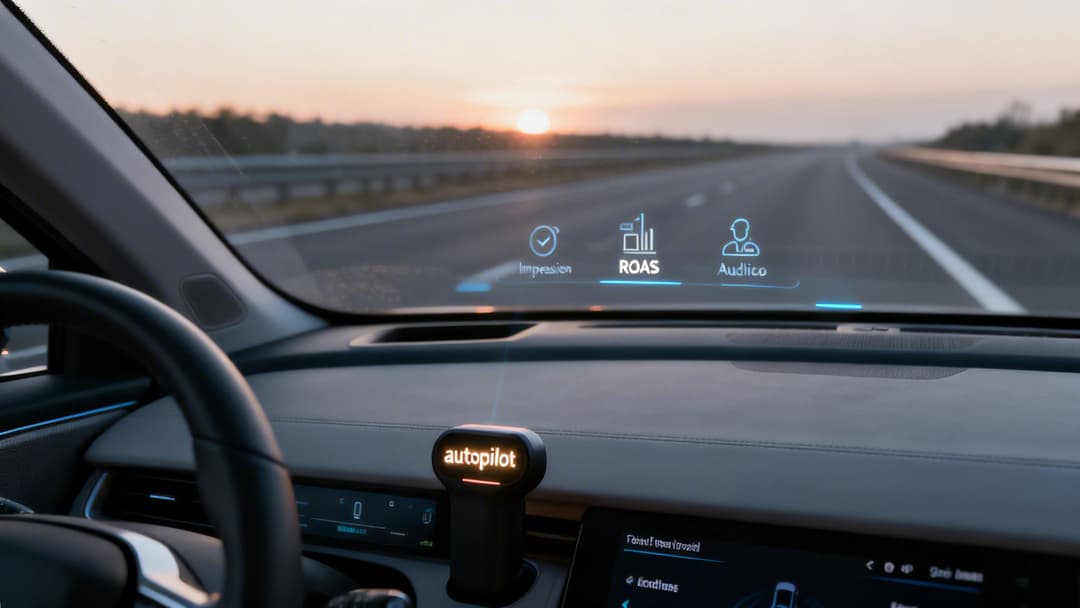
It’s a lot like handing the keys to a self-driving car. You tell it the destination (your campaign goal, like driving more sales) and provide the fuel (your ad budget and creative). The AI takes the wheel, navigating the incredibly complex ad ecosystem to get you there as efficiently as possible. It makes thousands of micro-decisions every second—a feat no human marketer could ever hope to match.
The Shift From Manual Control to Smart Guidance
In the not-so-distant past, running campaigns meant you were responsible for every single detail. You had to guess which audiences would perform best, manually shift budgets between ad sets, and painstakingly build A/B tests to figure out which image or headline was the winner. The process was a huge time-sink and was always limited by what one person could realistically manage.
Auto Facebook ads completely flip this model on its head. Now, your job is to be the strategist, not the button-pusher. The system handles the granular, tedious tasks, freeing you up to focus on what really moves the needle: developing compelling creative and analyzing high-level performance trends.
This is a crucial distinction: 'auto' means smarter effort, not 'no effort.' The AI is a powerful partner, but it relies on your strategic direction and high-quality inputs to deliver exceptional results.
To make this clearer, let's compare the two approaches side-by-side.
Manual vs Automated Facebook Ad Management
| Aspect | Manual Management | Automated Management (Auto Facebook Ads) |
|---|---|---|
| Budgeting | Manually set and adjust budgets for each ad set. | AI automatically allocates budget to top-performing ads and audiences. |
| Targeting | You define and test specific audience segments. | AI discovers new, high-intent audiences based on real-time data. |
| Creative | Manually create and test different ad variations (A/B testing). | System automatically mixes and matches creative elements to find winning combinations. |
| Pace | Slow and reactive. Changes are made based on past performance. | Fast and predictive. AI makes thousands of micro-adjustments in real-time. |
| Your Role | Technician. Focused on implementation and constant adjustments. | Strategist. Focused on goals, creative direction, and performance analysis. |
| Scalability | Limited by your time and capacity to manage complexity. | Highly scalable, as the AI can manage countless variables simultaneously. |
This table shows a fundamental change in how we approach ad management, moving from a hands-on-everything model to a strategic oversight role.
Key Automated Functions You’ll Use
Some of the most impactful automated features include:
- Intelligent Budget Allocation: Tools like Advantage+ Campaign Budget are a game-changer. They automatically shift your spending toward the ad sets and creatives that are delivering the best results, maximizing your return on ad spend (ROAS) without you having to lift a finger.
- Audience Discovery: The AI is brilliant at finding new customer segments you might have overlooked. It analyzes massive datasets to expand beyond your initial targeting and uncover high-intent users who are ready to convert.
- Relentless Creative Testing: The system can automatically mix and match your headlines, images, and call-to-action buttons. It then finds the winning combination for different audience segments, optimizing for peak performance around the clock.
This automated approach allows businesses to make data-driven decisions at a scale that was previously impossible. The AI uses the vast ocean of information within the Meta ecosystem to predict user behavior and serve the most relevant ad at the perfect moment.
If you're looking to dive deeper into the core concepts, our complete guide on what Facebook ad automation is is a great next step. By embracing this technology, you're not just saving time; you're building a more resilient, efficient, and scalable advertising engine that gets smarter every day.
The AI Engine Driving Your Ad Automation
If automated Facebook ads are the smart pilot flying your campaigns, then artificial intelligence is the sophisticated engine powering the entire operation. This isn't some far-off concept from a sci-fi movie; it's a practical, data-driven system working right now inside the Meta Ads ecosystem.
Let's pop the hood and see how this technology actually turns your creative assets into real-world conversions.
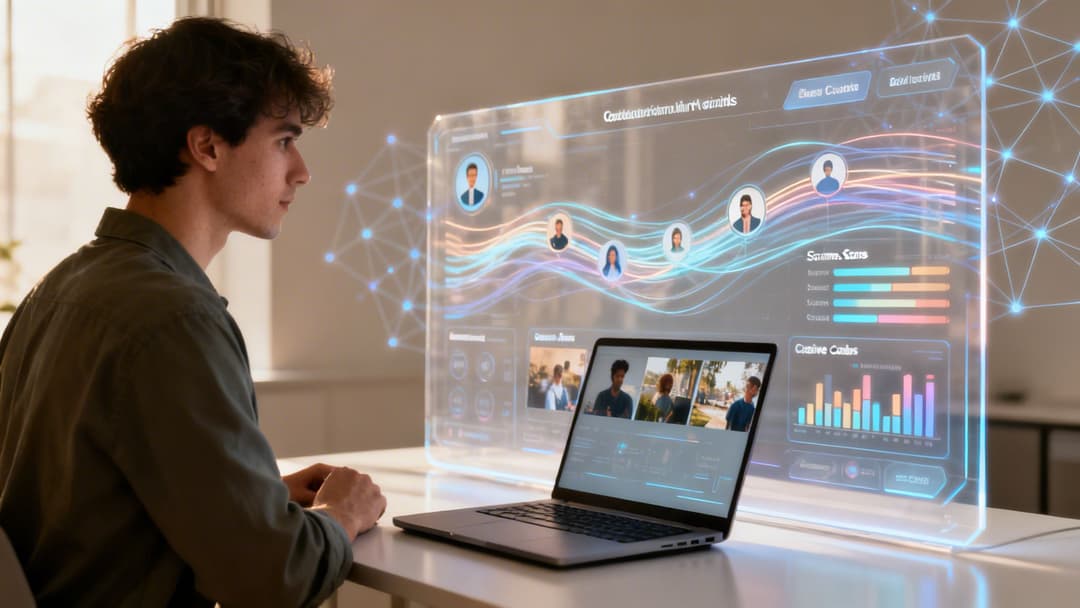
Think of the AI as a team of millions of tiny, hyper-efficient analysts. Each one is assigned a specific task, and they all work together in perfect sync. They don’t get tired, they don’t take breaks, and their one and only focus is finding the most efficient path to your campaign goal.
Predictive Analytics: The Core of Ad Delivery
At the heart of auto Facebook ads is a powerful prediction machine. The AI is constantly sifting through trillions of data points across Meta's platforms—demographics, interests, past purchases, on-site actions your Meta Pixel has tracked, and engagement history. It uses all this information to build machine learning models that predict what a user will do next with incredible accuracy.
These models answer critical questions in real-time, in the split second it takes to load a feed:
- Which user is most likely to click an ad for running shoes right now?
- What’s the maximum we should bid to show an ad to someone who looks like they’re about to make a high-value purchase?
- Is this person more likely to watch a video or click a link to a landing page?
Based on those predictions, the system serves the perfect ad to the right person at the exact moment they’re most open to it. This isn't random guesswork. It's a calculated process designed to maximize your return on every single dollar spent.
Dynamic Creative Optimization: How AI Finds the Perfect Ad
One of the most powerful ways this AI works for you is through Dynamic Creative Optimization (DCO). Manually testing every possible combination of your ad components—images, headlines, descriptions, and calls-to-action (CTAs)—is simply impossible. With DCO, you just provide the building blocks, and the AI steps in as your tireless creative director.
Imagine you upload:
- 5 different product images
- 3 distinct headlines
- 2 unique ad descriptions
- 2 different CTAs (like "Shop Now" and "Learn More")
The AI will automatically mix and match these elements, creating a staggering 60 unique ad variations (5 x 3 x 2 x 2). It then tests these combinations with different audience segments, learns which ones perform best, and starts showing the winning formula more and more. It’s a continuous cycle that ensures your ads are always getting better.
The real power here is personalization at scale. The AI might discover that one headline works best with younger audiences on Instagram Reels, while a totally different image and copy combo resonates with older users on the Facebook feed.
This process has a real, measurable impact on campaign efficiency. Facebook's algorithm has long favored this kind of automation, with traffic campaigns recently posting a stellar 1.71% average CTR—and the average cost-per-click dropping to just $0.70. For e-commerce brands and agencies in competitive markets, that kind of efficiency is gold. You can find more stats in these Facebook advertising benchmarks.
The Continuous Learning Loop
The AI driving your auto Facebook ads isn't a static program. It’s a living system that gets smarter with every single impression, click, and conversion. It learns from your campaign's past performance, analyzes real-time results, and constantly refines its strategy.
This creates a powerful feedback loop. The more high-quality data and creative assets you provide, the faster the AI learns and the better your results become. For performance marketers, understanding this relationship is the key to unlocking scalable growth. Your job is no longer to manually pull dozens of levers, but to strategically feed the engine with the fuel it needs to win. To learn more about this partnership, check out our post on using AI for Facebook ads.
Here’s the rewritten section, crafted to sound human-written and match the expert, conversational style of the provided examples.
What’s In It For Your Business? The Real-World Benefits
It’s one thing to talk about the AI engine powering Meta’s ad platform, but what does that actually mean for your bottom line? Let’s skip the buzzwords and get straight to the tangible results—the key performance indicators (KPIs) that growth teams and e-commerce brands obsess over.
The advantages of automation really boil down to three core pillars: speed, intelligence, and scale. Think of each one as a direct solution to a major headache in traditional ad management, unlocking new levels of efficiency and profit for your campaigns.
The First Pillar: Speed
In a market that moves at lightning speed, being fast is a massive competitive advantage. Anyone who’s built a campaign manually knows the grind. Crafting dozens of ad variations, each with unique creative and audience pairings, can chew up hours, if not entire days, for a skilled media buyer. This "time to launch" is a hidden cost that holds you back from testing new ideas or jumping on trends.
Automated Facebook ads completely shatter this bottleneck. Instead of painstakingly building ads one by one, you can generate hundreds of unique variations in just a few minutes.
For an e-commerce brand, this means you can test 50 different product shots against 10 different audiences all at once to pinpoint the most profitable combinations. Trying to set that up manually would be a logistical nightmare.
This isn’t just about saving a few hours on the clock; it’s about dramatically speeding up your learning curve. Faster launches lead to faster data collection. Faster data collection means quicker insights and more rapid optimization. You can run through more campaign ideas in a single week than a manual approach could ever manage in a month, letting you find the winning ads before your competition even gets started.
The Second Pillar: Intelligence
The second major win is the sheer intelligence of the system. Let's be honest—human marketers, no matter how experienced, are still human. We have our biases and can only process so much data at once. We naturally lean toward what’s worked before, which means we might be missing out on untapped goldmines of high-intent customers.
The AI, on the other hand, operates on pure, cold logic. It sifts through performance data without any preconceived notions, uncovering winning ad creative and audiences that a manual analysis would almost certainly overlook. The result is a direct, measurable lift in your Return on Ad Spend (ROAS).
This data-driven intelligence works its magic in two key ways:
- Creative Ranking: The system automatically figures out which images, videos, and headlines are actually driving conversions. This allows you to instantly double down on what’s working and cut the creative that’s burning cash.
- Audience Discovery: It goes way beyond your predefined audiences to find new customer segments that act just like your best converters, expanding your reach to people you never knew were looking for you.
This automated brainpower ensures your budget is always flowing to the most profitable mix of creative and audience, pushing your ROAS higher without you having to constantly babysit the account.
The Third Pillar: Scale
Finally, automated ads are the key to sustainable growth. As your ad spend climbs, the complexity of managing everything explodes. Manually taking a campaign from $1,000 a day to $10,000 a day often means you need to hire more media buyers just to keep up with the workload.
Automation completely breaks this link. It empowers you to manage much larger budgets and more intricate campaign structures without needing to expand your team. The AI takes care of all the tiny, moment-to-moment adjustments, freeing up your team to focus on what humans do best: big-picture strategy, creative direction, and analyzing overall performance.
This operational efficiency is a game-changer for any brand serious about growth. It stops your overhead costs from spiraling out of control and turns your ad account from a list of manual chores into a self-optimizing engine for growth.
How to Implement And Scale Auto Facebook Ads
Getting started with automated campaigns isn't about being a tech wizard. It’s about having a clear strategy. This is your high-level game plan for getting your first auto Facebook ads off the ground and scaling them into a non-stop optimization machine.
The first move is simple: give an AI platform secure, read-only access to your ad account. This is usually done through a standard process like OAuth. It allows the system to analyze your historical performance—what’s worked and what hasn’t—without ever getting its hands on your sensitive account details.
Setting the Foundation For Success
Once you’re connected, the next step is the most critical one. You have to define your objective. This is your campaign's North Star, telling the AI precisely what "success" means to you.
Don't skip this. The AI will make every single decision based on the target you set here.
Common goals usually boil down to one of these KPIs:
- Return on Ad Spend (ROAS): Perfect for e-commerce brands that live and die by direct profitability.
- Cost Per Lead (CPL): The go-to metric if you’re a B2B or service business focused on gathering customer info.
- Cost Per Acquisition (CPA): A more general metric focused on the cost to get one new customer, regardless of their initial purchase value.
With a clear goal locked in, the system has the direction it needs to start working for you.
Bulk Ad Creation And The Launch Phase
Now for the fun part. Instead of building ads one by one, you just feed the AI your raw creative assets—all the images, videos, headlines, and ad copy you have. The platform then takes these ingredients and automatically whips up hundreds of unique ad combinations.
This turns what used to be hours of mind-numbing work into a single click. These ad variations are pushed live, kicking off what we call the "launch and learn" phase. Here, the AI uses a small slice of your budget to test everything, quickly gathering data to spot the early winners.
Scaling Winners and The Continuous Optimization Loop
This is where the real magic happens. As performance data starts pouring in, the AI models get to work and begin scaling your ads. This isn't a one-and-done task; it's a continuous cycle of improvement that never stops.
The optimization loop typically looks like this:
- Budget Reallocation: The AI automatically pulls budget from the ads that are bombing and funnels it directly to the variations that are crushing it—the ones with the best ROAS or lowest CPA.
- Insight Generation: The system digs into the top performers to figure out why they're winning. It pinpoints the exact creative elements, copy angles, and audience segments that are driving your results.
- Automated Campaign Building: Armed with these data-backed insights, an advanced AI platform like AdStellar can build entirely new campaigns from your proven assets. This creates a powerful feedback loop that fuels sustained growth.
This flow is all about turning speed into intelligence, and intelligence into scale.
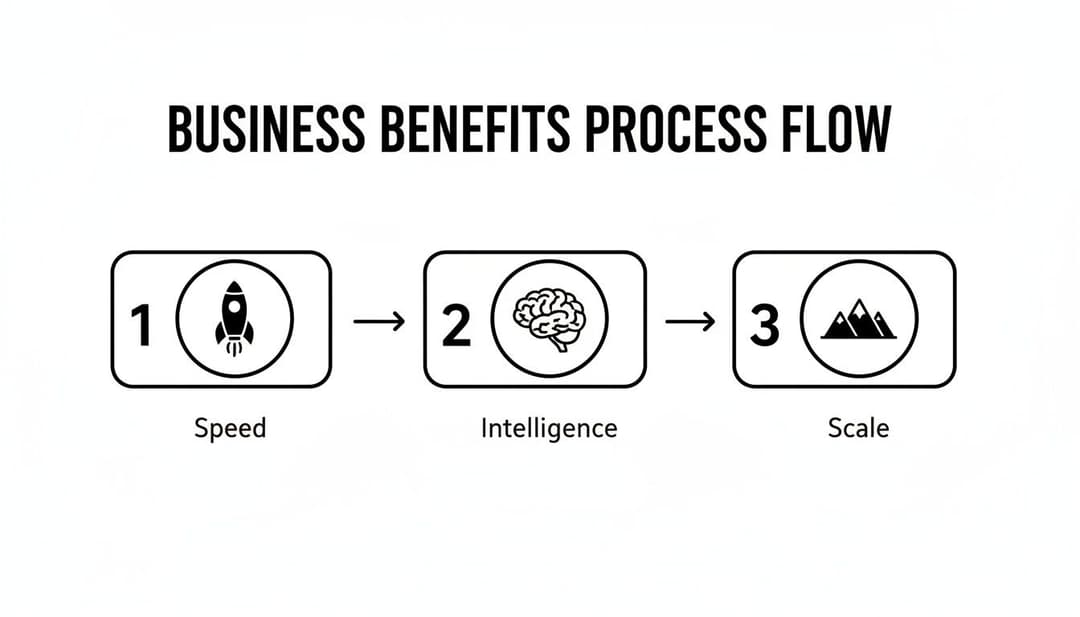
The entire framework makes your campaign management smarter and more efficient. For a deeper look, our guide on how to automate Facebook campaigns breaks it down even further.
Think about launching Meta campaigns 10x faster—that’s what AI automation makes possible. While recent benchmarks show a median ROAS of 2.06x, campaigns powered by AI are seeing that number jump to $4.52 earned for every dollar spent. For growth-focused marketers, this is why manual management is quickly becoming a thing of the past.
Best Practices for Maximum Automated Campaign ROI
While automated Facebook ads are incredibly powerful, they aren’t a magic “set it and forget it” button. Think of Meta’s AI as a brilliant engine—its performance depends entirely on the quality of the fuel you put in. It’s like hiring a world-class chef; they can cook a masterpiece, but only if you provide them with high-quality, fresh ingredients.
Your role shifts from being a hands-on task manager to a high-level strategist. You're no longer pulling dozens of tiny levers. Instead, you're designing the blueprint the AI will execute, focusing on clear goals and a rich library of creative assets.
Feed the Algorithm High-Quality Inputs
The single most important practice is to give the automation system options. If you only provide one image and one headline, you’re tying the AI’s hands behind its back. The entire point is to let the system test countless combinations to discover what truly resonates with your audience.
A strong creative library should always include:
- A Mix of Visuals: Don’t rely on just one type of asset. Combine polished, professional product shots with authentic-looking user-generated content (UGC). Mix static images with short, punchy videos designed for vertical formats like Reels and Stories.
- Diverse Copy Angles: Write several distinct headlines and primary text options. You might focus one on a key benefit, another on a customer pain point, and a third that uses social proof from a compelling testimonial.
- Clear Audience Hypotheses: Instead of creating dozens of tiny, fragmented ad sets, give the AI broader audiences to work with. A great starting point is a custom audience of your past purchasers, letting Meta’s lookalike expansion find new customers for you.
By providing this variety, you’re giving the AI the raw materials it needs to run thousands of micro-experiments, uncovering winning formulas you’d likely never find on your own.
Set Realistic KPIs and Trust the Learning Phase
You have to define what success actually looks like by setting a clear Key Performance Indicator (KPI). Whether your main goal is Return on Ad Spend (ROAS) or Cost Per Acquisition (CPA), this north star directs every decision the AI makes. Automated campaigns are built to optimize your spend, and applying these best practices can help you significantly reduce your Customer Acquisition Cost.
One of the biggest mistakes advertisers make is panicking and tweaking campaigns too soon. Every new campaign goes through a "learning phase" where performance can be volatile. Resist the urge to jump in and make changes after one bad day.
Constant adjustments just reset the learning process, preventing the algorithm from gathering enough data to truly optimize. You need to trust the system, be patient, and analyze performance trends over a full week, not just a few hours.
A Practical Checklist for Managing Automated Campaigns
Here’s a simple Do's and Don'ts list to keep your automated strategy on the right track.
| Do | Don't |
|---|---|
| Do provide a diverse mix of creative assets. | Don't use only one image and one headline. |
| Do set a clear, measurable KPI like ROAS or CPA. | Don't leave your campaign goal vague or undefined. |
| Do trust the learning phase and analyze weekly trends. | Don't overreact to daily performance fluctuations. |
| Do consolidate audiences into broader groups. | Don't hyper-segment ad sets, which dilutes data. |
| Do refresh winning creatives to avoid ad fatigue. | Don't let top-performing ads run unchanged for months. |
This kind of strategic oversight is where your expertise truly shines. For more advanced tips, our guide on the best practices for Meta ad automation offers deeper insights.
Remember, the platform is a cash cow for those who use it wisely. Back in 2024, Facebook's ad revenue in the US alone rocketed to $32.55 billion. Data consistently shows that campaigns optimized for conversions can deliver 2-3x higher ROI, and systematic A/B testing can boost performance by 30-50%. By feeding the AI the right inputs, you allow it to rank your best creative and messages, ensuring you double down on what truly converts. Discover more stats about Facebook ads to guide your strategy.
Measuring Success For Long-Term Growth
Getting your auto Facebook ads live is a great first step, but it’s not the finish line. Honestly, that’s where the real work begins. The next, and most important, part of the job is turning all that performance data into a repeatable engine for long-term growth. To get there, you've got to look past surface-level numbers like clicks and impressions and focus on the metrics that actually drive your business forward.
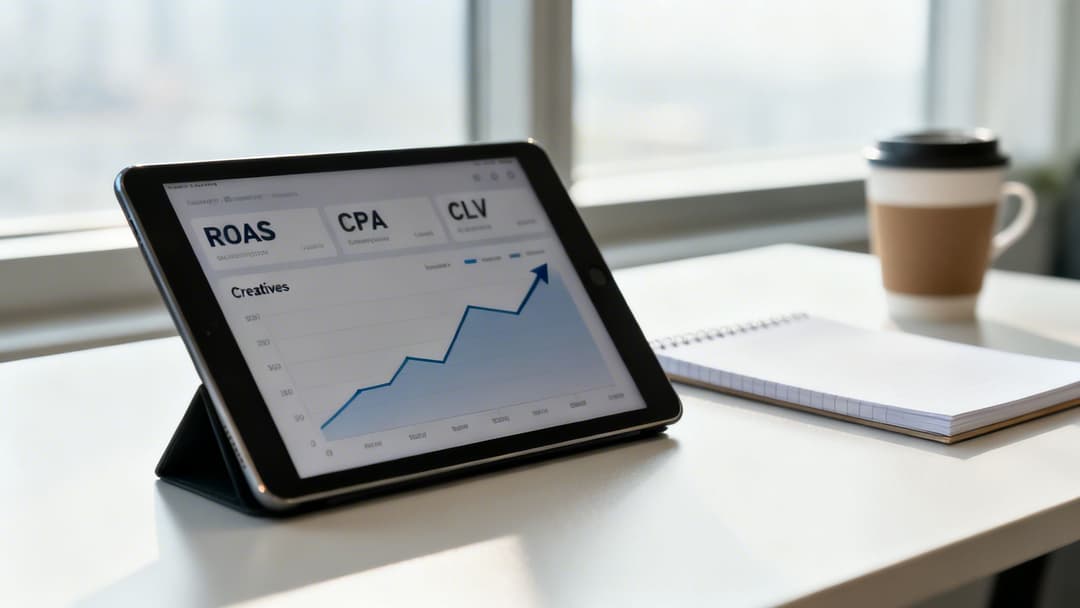
Think of it this way: the AI optimizes based on the goals you set, but you’re still the one steering the ship. It’s your job to read the map—the data—and guide the overall strategy toward the right destination. That means zeroing in on the KPIs that directly impact your bottom line.
Key Metrics That Actually Matter
When you're looking at your automated campaigns, it's easy to get lost in the noise. You need to train your eyes to find the signal. Your dashboard should be built to track these core metrics above all else:
- Return on Ad Spend (ROAS): This is the ultimate test of profitability. For every dollar you put into your ads, how much revenue are you getting back? A healthy ROAS is the clearest sign of a sustainable campaign.
- Cost Per Acquisition (CPA): This number tells you exactly what it costs to land a new customer. A falling CPA means your campaigns are getting more efficient, bringing in new business for less money.
- Customer Lifetime Value (CLV): This one is a little trickier to track directly in Ads Manager, but it provides crucial context. A campaign might have a higher upfront CPA but attract customers who stick around and make repeat purchases, leading to a much higher return over the long run.
These are the KPIs that cut through the vanity metrics and give you a clear, honest picture of how well your ads are performing. For an even deeper dive, check out our complete guide on how to measure advertising effectiveness for your business.
Turning Insights Into Action
This is where a good AI platform really shines. A tool like AdStellar pulls all this performance data together into a single, actionable dashboard. It doesn't just throw numbers at you; it actually ranks your creatives, audiences, and ad copy against your specific goals. You can see at a glance which image is driving the most sales or which headline is generating the cheapest leads.
This clarity is where your role as a strategist comes alive. The AI provides the "what"—the data-backed evidence of what’s working. Your job is to analyze the "why" and use it to inform your next move.
For example, if your dashboard shows that raw, user-generated videos are consistently beating your polished studio ads, that’s a goldmine of an insight. You can then immediately pivot your creative strategy to produce more of that authentic, UGC-style content for future campaigns.
Creating a Continuous Growth Loop
This process creates a powerful feedback loop that fuels sustainable, long-term growth. You're no longer just guessing what might work; you're making smart, data-driven decisions that build on proven success.
The cycle is simple but incredibly effective:
- Launch: You deploy campaigns with a diverse mix of creative and audience ideas you want to test.
- Measure: The AI gets to work, testing everything and feeding back clear performance data on what’s winning based on your core KPIs.
- Learn: You analyze the winning elements to understand the patterns and pull out actionable insights.
- Optimize: You use those insights to create better ads, refine your audience strategy, and launch even smarter campaigns.
This loop transforms your advertising from a series of one-off projects into a system that gets smarter over time. Each campaign becomes more intelligent and efficient than the last, ensuring your auto Facebook ads don't just deliver short-term wins but become a predictable engine for scalable growth.
Frequently Asked Questions
Even with a clear strategy, a few practical questions always pop up when you're getting started with auto Facebook ads. Let's tackle the big ones so you can move forward with confidence.
How Much Do Automated Ads Cost?
This is one of the most common questions, and the answer is simple: there’s no fixed price. You are always in the driver's seat when it comes to your ad spend.
The system is built to work with whatever budget you have, whether it’s $10 a day or $1,000. Think of the AI as your team's most efficient budget manager. Its whole job is to take the budget you set and make every single dollar work as hard as possible, automatically shifting funds to the ads and audiences that are actually delivering results. It does all this without ever spending a penny more than you've allocated.
Can I Still Choose My Target Audience?
Yes, absolutely. But your role shifts from being a micromanager to a strategist. Instead of getting lost in the weeds creating dozens of tiny, restrictive audiences, you give the AI smart, high-level direction.
You still set the most important guardrails. For instance, you can define:
- Key Demographics like specific age ranges or genders.
- Geographic Locations, whether it’s entire countries, specific cities, or even postal codes.
- Custom Audiences built from your own data, like lists of past buyers or recent website visitors.
The AI takes these instructions as its starting point. From there, it intelligently explores beyond your initial inputs, discovering new pockets of users who act just like your best customers—often uncovering high-intent audiences you would have never found on your own.
Key Takeaway: You provide the "who" to get things started, and the AI’s job is to find more people just like them. Your role evolves from building lists to providing smart direction.
Are Automated Ads Really Better Than Manual Campaigns?
For the vast majority of advertisers who want to scale their growth, the answer is a resounding "yes." While manual campaigns give you a feeling of granular control, auto Facebook ads are engineered to deliver better results with a fraction of the time investment.
No human marketer, no matter how skilled, can compete with a system that analyzes billions of data signals in real time. It constantly fine-tunes your budget, creative, and placements with a speed and accuracy that leads to incredible efficiency and performance.
This frees you and your team to focus on what really matters: big-picture strategy and developing knockout creative. Those are the areas where human insight makes all the difference.
Ready to stop guessing and start scaling? With AdStellar AI, you can launch, test, and optimize hundreds of ad variations in minutes, not days. Let our AI uncover your winning creatives and audiences so you can double down on what works and unlock more revenue from Meta. Learn more and get started at https://www.adstellar.ai.