At its core, Facebook AI ads are simply campaigns where Meta's artificial intelligence does the heavy lifting. It handles the targeting, mashes up your creative assets, and decides where to spend your budget. This is a huge pivot from the old days of manual control, moving us into an AI-driven world where algorithms hunt for the best results with less minute-to-minute meddling from us marketers.
What Are Facebook AI Ads and How Do They Work?

It helps to stop thinking of Facebook's ad platform as a dashboard of manual levers and start seeing it as a master strategist running your campaigns. This strategist sifts through billions of data points in real time, making moves faster and more accurately than any human ever could. That’s the big idea behind Facebook AI ads.
Our role has shifted. We're no longer the pilots manually flying the plane; we're the air traffic controllers. We set the destination (the campaign objective) and provide the right "fuel" (the creative assets and budget) for the journey.
To really get your head around this, it's worth understanding the mechanics behind Facebook Automated Ads, which are built on these exact principles. The system doesn't need you to painstakingly carve out niche audiences or guess which ad will land. You just need to give the AI the building blocks, and it takes the reins from there.
The Three Pillars of Meta's AI Advertising
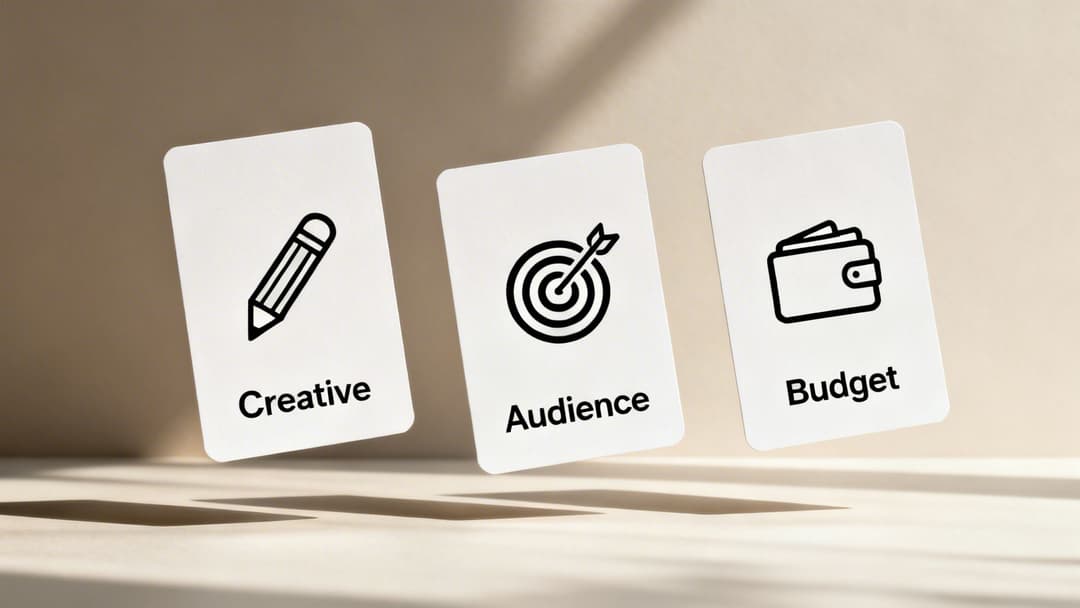
The real power of Facebook's AI ads comes from three core pillars that work together to drive performance. Each one represents a major departure from how we used to manage campaigns.
Audience Optimization: Forget about targeting tiny, hyper-specific interest groups. The new best practice is to go broad. Meta’s AI has gotten so good at spotting user intent that it can find your perfect customers in a massive audience, often blowing narrowly defined Lookalike or interest audiences out of the water.
Creative Optimization: The AI acts like a tireless creative director, dynamically building ads by mixing and matching the assets you provide—your images, videos, headlines, and descriptions. It then relentlessly tests these combinations across different placements and audiences to find the winning formula. You'll see this in action with features like Dynamic Creative or Advantage+ Creative.
Budget Automation: Tools like Advantage+ Campaign Budget (what we used to call CBO) automatically shift your budget to the best-performing ad sets or ads in real time. This is a game-changer, stopping you from wasting money on duds and making sure every dollar flows toward what’s actually working.
Key Takeaway: The modern marketer's number one job is to "feed the algorithm." Your mission is to supply a steady stream of quality creative variations, clear conversion signals, and a solid strategic goal. The AI handles the rest.
This is exactly where third-party platforms can give you a massive edge. A tool like AdStellar AI, for example, puts this whole process on steroids by helping you generate hundreds of creative variations in a flash.
When you feed Meta's algorithm a diverse and constant flow of top-notch creative, you empower it to test, learn, and scale your campaigns at a speed and efficiency that was impossible just a few years ago. To see how this powerful partnership works, check out our guide on how AI can build and optimize your Facebook campaigns.
A Look At Meta’s Key AI Advertising Features
Alright, let's move from the what to the how. To really understand Facebook AI ads, we need to get familiar with the engine driving them: the Advantage+ suite. You can think of Advantage+ as Meta's official AI toolkit, built to take over the most tedious and complex parts of running a campaign.
The big idea here is a shift in your role. Instead of tweaking every little detail, your job is to give the AI a clear goal and high-quality inputs (like good creative). The system then figures out the most efficient way to hit that goal. It’s a departure from the old days of manually adjusting every knob and dial.
Key Advantage+ Features You Need To Know
Meta’s AI toolbox is pretty deep, but a handful of features are the true workhorses for most automated campaigns. Getting a handle on what each one does will help you structure your efforts much more effectively.
Advantage+ Shopping Campaigns: This is the go-to for any e-commerce or DTC brand. It's an end-to-end solution that automates almost everything—audience targeting, ad placements, and creative delivery—all wrapped up in a single campaign laser-focused on driving sales.
Advantage+ Creative: Think of this as your automated design assistant. You feed it your images, videos, and headlines, and it gets to work. It might brighten an image, crop a video to fit Stories perfectly, or mix and match your text to find the combination that gets the most clicks.
Advantage+ Audience: This feature completely changes the game for targeting. Instead of building restrictive interest or Lookalike audiences, you give the AI a few pointers and let it run. It will search for customers well beyond your initial suggestions, uncovering pockets of buyers you would have never found on your own.
Meta is all-in on this direction. They’ve stated that by 2026, they expect advertisers to have access to full AI generation for ads—images, videos, copy, and targeting—across their entire family of apps, complete with automated budget advice.
We’re already seeing hints of this future. A new tool can take up to 20 product photos and spin them into a polished, multi-scene video. This dramatically cuts down on production time and lets you test hundreds of video variations with almost no effort.
Manual Campaign Setup vs Advantage+ AI Workflow
The difference between the old way and the new AI-powered workflow is night and day. Tasks that used to eat up hours of your week are now handled automatically, freeing you up to think about big-picture strategy and creative quality.
Here’s a simple breakdown of how Advantage+ transforms the campaign setup process:
| Campaign Task | Manual Approach (The Old Way) | Advantage+ AI Approach (The New Way) |
|---|---|---|
| Audience Targeting | Manually creating multiple ad sets for different interests, demographics, and Lookalike audiences. | Setting broad targeting or providing audience "suggestions" and letting the AI find the best pockets of users. |
| Creative Testing | Building separate ads for each image, headline, and copy combination, then manually analyzing results. | Uploading multiple creative assets and letting the AI dynamically test and serve the winning combinations. |
| Budget Allocation | Setting individual budgets for each ad set and manually shifting funds based on performance reports. | Using Advantage+ Campaign Budget to automatically allocate the total budget to the top-performing ads and audiences. |
By offloading these tactical decisions, you’re not just saving time; you’re tapping into a level of optimization that’s simply not possible for a human to achieve.
The system can make thousands of micro-adjustments every single minute, reacting to performance data in a way no marketing team could ever replicate manually.
If you want to see these AI-driven ads in the wild, the official Meta Ads Library is a great resource to spy on what competitors and other brands are running.
This all ties into the concept of "explainable AI," where the platform gives you insights into why it's making certain decisions. It's a topic worth exploring, and you can learn more about Meta's approach to explainable AI in our dedicated article. Platforms like AdStellar AI are built on this very foundation, helping teams generate the high volume of creative assets needed to truly feed Meta's powerful algorithms and get the best results.
All this talk about AI can feel a bit up in the clouds, but when it comes to Meta's platform, the results are anything but. The move toward automation isn't just about changing how we work—it's directly boosting ad performance in ways you can see and measure.
We’re talking about real, tangible improvements to the numbers that matter: conversion rates, click-through rates (CTR), and your all-important Return on Ad Spend (ROAS). The data is clear: letting the algorithm take the wheel often gets you further down the road than trying to micromanage every single turn.
The Model Behind the Momentum
A perfect example of this in action is Meta's Generative Ads Recommendation Model, or GEM. Think of it as the central brain processing incredible amounts of data to make your ads more relevant and effective across the entire platform.
Meta supercharged this model by doubling its GPU capacity and implementing a new sequence-learning architecture. This allows it to process longer, more complex user behavior sequences, even pulling in organic data from Instagram. The payoff was huge: a 3.5% lift in ad clicks on Facebook and over a 1% gain in conversions on Instagram during Q4 2025. You can dig into the specifics in their full announcement.
The connection here is undeniable. More investment in the AI engine directly leads to better results for advertisers.
What This Means for Your Campaigns
So, what’s the takeaway for your own campaigns? When you launch an Advantage+ campaign and see your conversion rates climb or your cost-per-acquisition drop, it isn't just a stroke of luck. It's the direct result of powerful models like GEM working tirelessly behind the scenes.
This is where your strategy becomes absolutely critical. The AI is a powerful engine, but it needs high-quality fuel to run. By feeding it a diverse and compelling mix of ad creatives, you’re giving it the raw material it needs to find and convert your ideal customers at scale.
This is exactly the reality that platforms like AdStellar are built for. They’re designed to help you generate the volume of creative variations needed to really unlock the AI’s full potential. These days, maximizing your returns is all about learning to work with the algorithm, not against it. To get a better handle on which numbers to watch, take a look at our complete guide on the Meta ads performance metrics you should be tracking.
Best Practices For Winning With Facebook AI Ads
To get the most out of Facebook's AI, you have to throw out the old playbook. The days of obsessive, granular control and constant manual tweaking are over. In fact, that old approach actually holds the algorithm back. You need to stop thinking like a campaign micromanager and start acting like a strategic director.
Your most important job now is feeding the machine a steady diet of high-quality, diverse creative. Think of the AI as an expert chef. Give it bland, cheap ingredients, and you’ll get a forgettable meal. But give it a pantry stocked with a wide variety of excellent ingredients—striking images, engaging videos, and different copy angles—and it can cook up a masterpiece.
Simplify Your Account Structure
Remember creating dozens of ad sets for every tiny audience niche? That's a habit you need to break, fast. Slicing your campaigns so thinly just splinters your data, starving the AI of the information it needs to learn and optimize effectively.
Instead, it's time to consolidate. By grouping your ads into fewer, broader campaigns and ad sets, you create a much larger data pool for the algorithm to work with. This is what allows it to spot performance trends and shift your budget with a speed and precision you could never match manually.
A lean, mean, simplified structure might look something like this:
- One primary Advantage+ Shopping Campaign dedicated to all your e-commerce sales goals.
- One prospecting campaign using a broad audience to drive top-of-funnel awareness.
- One retargeting campaign to bring back people who have already interacted with your brand.
This kind of consolidation is exactly what makes AI-powered tools like AdStellar so powerful. It gives the platform a focused, data-rich environment to rapidly test hundreds of creative combinations and find the winners.
Trust Broad Audiences and Clean Data
Letting go of precise targeting can feel wrong, but it’s absolutely essential for unlocking the full potential of Facebook's AI. The system is now smart enough to find your ideal customer inside a massive audience, often outperforming the narrow interest or Lookalike audiences we used to rely on. Just start broad and trust the machine to find your buyers.
Your job isn’t to find the audience; your job is to create ads so compelling that the AI can easily identify who the audience is based on who responds.
Of course, this only works if the AI is getting clean, accurate signals from your website. This is why properly implementing the Meta Pixel and Conversions API (CAPI) is completely non-negotiable. These tools are what feed the algorithm the high-fidelity data it needs to understand what a "conversion" actually means to you and find more people who will take that exact action.
And the data shows this works. On average, Facebook AI ads are hitting some strong benchmarks, with click-through rates for lead campaigns reaching 2.59% and conversion rates averaging a solid 7.72% across different industries. To see how your results stack up, check out the latest Facebook ads statistics and see what top performers are doing to get there.
A Step-By-Step Workflow for Launching AI-Powered Campaigns
Alright, enough with the theory. Let's get practical. Real results come from having a solid process you can run time and time again. So, let’s walk through a repeatable workflow for launching AI-powered campaigns that actually work.
This is a step-by-step guide for modern performance marketers, showing how you can pair a platform like AdStellar with Meta's own AI to build a seriously powerful advertising engine.
Phase 1: Define Your Strategy and Gather Your Assets
Before you even think about building an ad, you need to know where you're going. What’s the one goal that matters most? Are you trying to maximize your Return on Ad Spend (ROAS)? Or maybe you need to slash your Cost Per Lead (CPL) or just drive as many purchases as possible.
This single objective is your North Star. It’s what will guide every single decision the AI makes on your behalf, so get crystal clear on it.
With your goal locked in, it’s time to gather your raw materials. This means collecting:
- Visuals: Pull together a wide variety of images and videos. Don't just use one style. Think different angles, backgrounds, people, and product shots. The more variety, the better.
- Copy: Write a bunch of different headlines and primary text options. Try out different hooks—hit on pain points, showcase benefits, flash some social proof, or lead with a strong offer.
- Audiences: While broad targeting is often the best approach with Meta's AI, you can still give it a nudge in the right direction. Prepare some "seed" audiences, like a list of your past purchasers or high-value customer segments.
The whole point here is to build a big library of creative components. You're feeding the machine everything it needs to mix and match its way to hundreds of unique ad combinations.
Phase 2: Generate and Launch Variations at Scale
This is where the old, manual way of doing things completely falls apart. Instead of painstakingly building ads one-by-one inside Ads Manager, you can use an AI-powered tool like AdStellar to generate hundreds of variations in just a few minutes.
You just upload your assets—all those images, videos, and copy variations—and the platform automatically creates every possible combination for you.
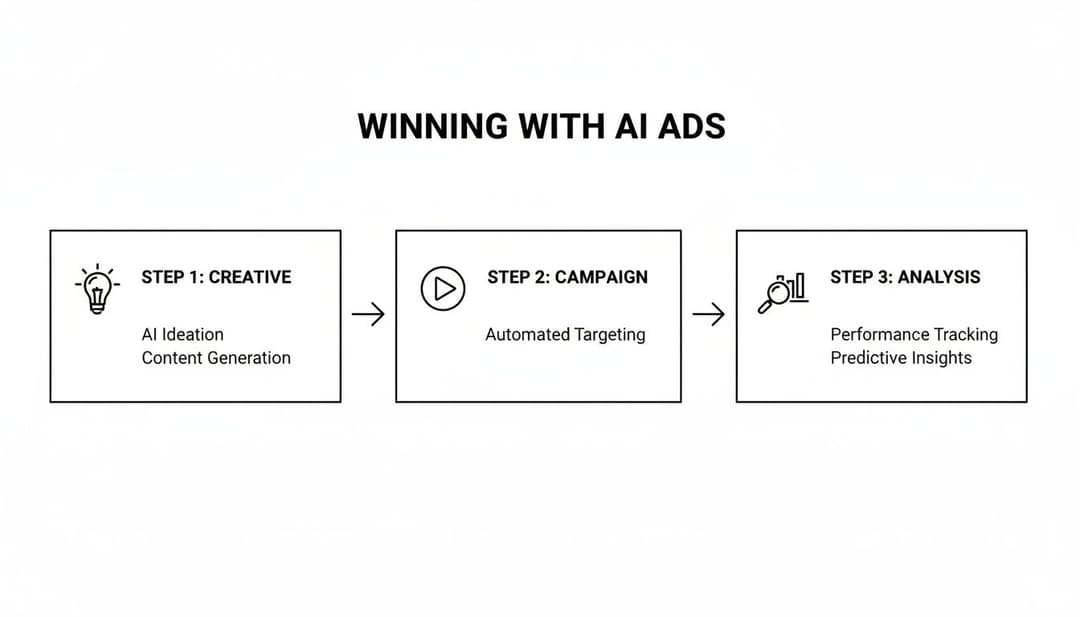
The image above gives you an idea of how an AI platform can organize and prep a huge volume of creative variations for launch. This kind of structured approach is exactly what you need to give Meta's algorithms the creative diversity they crave.
Once your variations are ready, you launch them into a simplified Advantage+ campaign. This lets the two AIs work together: AdStellar's AI handles the creative generation, and Meta's delivery AI takes over to find the perfect person for each one of those ads.
Phase 3: Analyze and Iterate with AI Insights
The campaign is live and data is pouring in. Now the real magic begins: analysis and iteration. But instead of getting lost in a sea of spreadsheets, your AI platform can do the heavy lifting, analyzing performance and ranking every single creative element against the goal you set in Phase 1.
The crucial thing to understand is that this isn't a straight line. It’s a continuous cycle of testing, learning, and improving fueled by real-time data.
You'll start to see exactly which headlines, images, or creative angles are driving the best ROAS or the lowest CPL. This is how you move from guesswork to making decisions backed by cold, hard data.
Key Takeaway: The workflow is a closed loop. The insights from one campaign directly feed the creative strategy for the next. You find your winning creative components and use them as the foundation for your next batch of ads, getting smarter and more efficient with every single launch.
This automated system lets you create new campaigns built entirely from proven winners. By following a structured process, you’re not just launching ads; you’re building a scalable engine for growth.
For a more detailed pre-flight rundown, check out our guide to a successful Facebook campaign launch. It's the perfect companion to this workflow.
If you take one thing away from all this, it should be that the future of advertising on Meta is automated. Your role as a marketer is shifting away from being a manual tweaker of knobs and dials and toward becoming a high-level strategic thinker.
Success with Facebook AI ads isn't about granular control over every last campaign setting anymore. It just isn't.
Instead, your primary job is to give the algorithm what it needs to win. This means pouring your energy into big-picture creative strategy, sharp data analysis, and feeding the system a steady diet of high-quality assets. The machine handles the thousands of micro-decisions; you guide the overall mission.
This shift puts a massive premium on creative excellence and strategic oversight. The marketers who will come out on top are the ones who can produce the absolute best inputs for the AI to work with.
This new reality makes platforms like AdStellar an essential part of the toolkit for any serious performance marketer or growth team. They perfectly bridge the gap between your human strategy and the machine’s execution, helping you generate the sheer volume of creative you need to thrive.
For a deeper look at how agencies are adapting, you can see the evolution of the automated marketing agency and its new operating models. The challenge—and the opportunity—is to lean into this change, test the AI features relentlessly, and unlock some serious growth.
Of course. Here is the rewritten section, crafted to sound completely human-written, following the specified style and tone.
Your Top Questions About Facebook AI Ads, Answered
As more marketers lean into Meta's AI tools, a lot of the same questions keep popping up. It's a big shift from the old way of doing things, so a little uncertainty is normal. Let's clear the air and tackle some of the most common concerns head-on.
Do I Lose All Control With Facebook AI Ads?
Not at all—but your role definitely changes. Think of yourself less as a hands-on operator and more as a high-level strategist. You’re still in the driver's seat for the things that matter most.
You still provide all the critical inputs: your creative assets (the images, videos, and copy), the overall campaign budget, and the core objective, whether that's driving conversions or generating leads. The AI simply takes your direction and handles the thousands of micro-decisions needed to get there, like who sees which ad variation and where.
Are Detailed Targeting And Lookalike Audiences Dead?
They’re not dead, but they are becoming far less critical to success. While you absolutely can still use them, we're seeing Meta's AI deliver better, more consistent results with broader audiences.
The system is now smart enough to find your ideal customer without you needing to fence it in with restrictive targeting layers. The new best practice is to start broad, feed the algorithm great creative, and let it learn. You should only start layering on constraints if performance really starts to lag.
The new mindset is this: Your job isn’t to find the audience; your job is to create ads so compelling that the AI can easily identify who the audience is based on who responds.
This approach works because of the sheer scale of the platform. A staggering 74.3% of Facebook's monthly active users see ads. When you pair that reach with formats like Reels, which often have 10–30% cheaper CPMs than the Feed, the AI has a massive, cost-effective playground to find your customers. You can dig deeper into Meta's evolving AI advertising plans on Adtaxi.com.
How Many Creatives Should I Test In An AI Campaign?
As a rule of thumb, more is almost always better, provided you don’t sacrifice quality. The AI engine thrives on data and options, so giving it a diverse menu of creative concepts is the fastest way to find a winner.
A solid starting point is to launch with at least 4-6 distinct ad concepts. Make sure each of those concepts also has multiple headline and primary text variations for the system to mix and match.
Ready to stop guessing and start scaling? AdStellar AI helps you generate hundreds of ad variations in minutes, analyze performance with AI-driven insights, and launch winning campaigns faster. Discover how our platform turns creative testing into a repeatable, revenue-driving system at https://www.adstellar.ai.