You're staring at Meta Ads Manager again, and the same problem keeps showing up. The budget is there, the campaigns are live, but the account won't give you enough clean signal to know what to kill, what to keep, or what to scale. That's the core facebook ad budgets problem for many teams, not “how much should I spend,” but how do I stop wasting limited spend on too many variables at once.
The wrong move is to treat budget like a simple daily cap and hope the algorithm figures it out. The right move is to treat budget as a scarcity allocation problem, where every dollar has to buy learning, not just impressions. That means choosing the single highest-impact test first, then protecting that test until the account can produce reliable feedback.
A useful mental reset is this. Small budget advice is really about reducing variables, not spending as little as possible. Once you accept that, the whole channel gets easier to manage. If you want a broader paid media framework that sits above the channel level, this paid media strategy guide is a useful companion.
The Budget Problem Mid-Market DTC Teams Are Solving
The person in pain usually looks the same. They've got a fixed monthly number, a list of audiences they want to test, three creative concepts that all feel promising, and a Meta account that keeps slipping back into learning because nothing gets enough volume to stabilize. They are not short on ideas, they are short on signal.
That is why Facebook ad budgets feel more stressful than many other paid channels. Search can often harvest existing intent. Meta asks you to create demand, persuade fast, and feed the machine enough conversion data to make the auction useful. If spend is too thin, the platform cannot optimize cleanly, and every decision starts to feel like a guess.
Practical rule: when the account cannot learn, your job is not to add more experiments. It is to cut the number of experiments until one of them can collect signal.
The market data makes that pressure obvious. Analysts at Meta's Ads Library report show 18,194,152 ads in the library with a reported total amount spent of $5,426,917,530 Meta Ads Library report. The benchmark spend distribution is also heavily skewed, with a median Facebook ad spend of $1,065 per month and an average of $7,713 per month in the same benchmark. That gap tells you what most operators already feel, a small number of large buyers distort the mean and dominate the auction.
The only sane response is to stop asking “what's a normal budget?” and start asking “what test can this budget support without going incoherent?” If you are at startup scale, in DTC, or managing multiple clients, that question matters more than the size of the number itself.
A useful way to frame the problem is to treat budget as a triage decision, not a media-buying preference. If you cannot fund enough conversion signal for creative, audience, and offer all at once, pick the highest-impact test and starve the rest until the account can read the result. That is also where paid media strategy guidance earns its keep, because the channel decision has to sit inside a broader allocation plan, not float on gut feel.
For teams that need hands-on execution help, the right partner should be able to pressure-test that decision fast. The Next Point Digital Facebook services team can help if you need a second set of eyes on what to keep live and what to cut.
How Facebook Ad Budgets Work Under the Hood
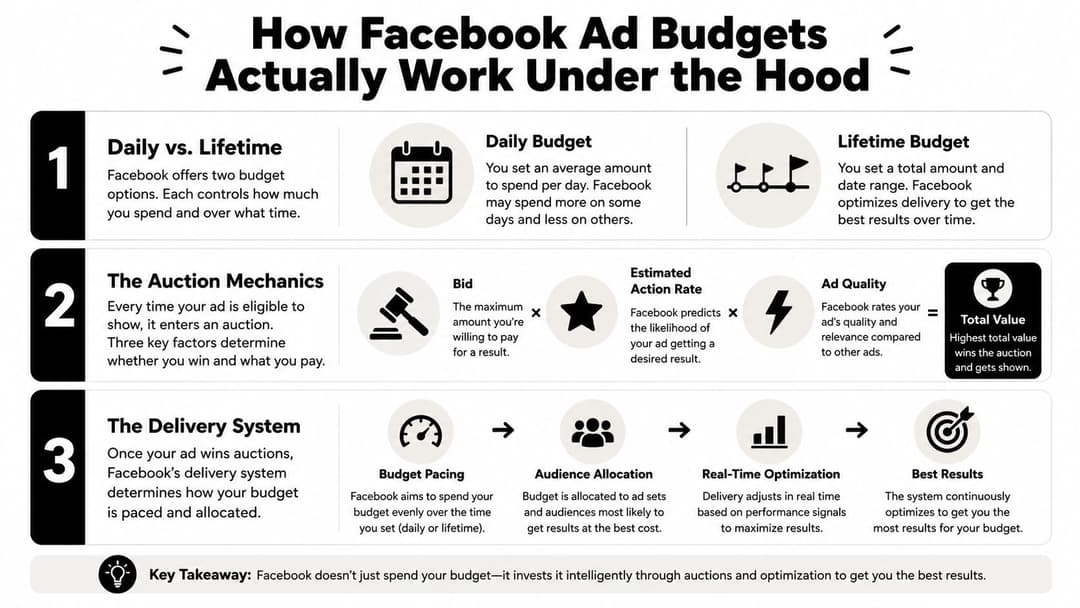
A Meta budget setting is a delivery instruction. A daily budget tells Meta the approximate amount to pace each day. A lifetime budget gives the system room to spend more on some days and less on others across the campaign window, which makes it behave more like a festival pass than a fixed dinner tab.
The auction decides cost, not your intent
Meta charges through an auction, so your spend competes against other advertisers in real time. Cost is shaped by bid pressure, estimated action rates, and ad quality, your intent doesn't enter the auction. A high budget with weak creative still loses to better ads, because budget buys more chances, not better persuasion.
Delivery tuning matters. The internal ad delivery optimization guide is worth reading if you want the mechanics without the fluff. It sits in the same reality as the auction, and the system rewards ads it expects people to engage with.
CBO and ABO send different signals
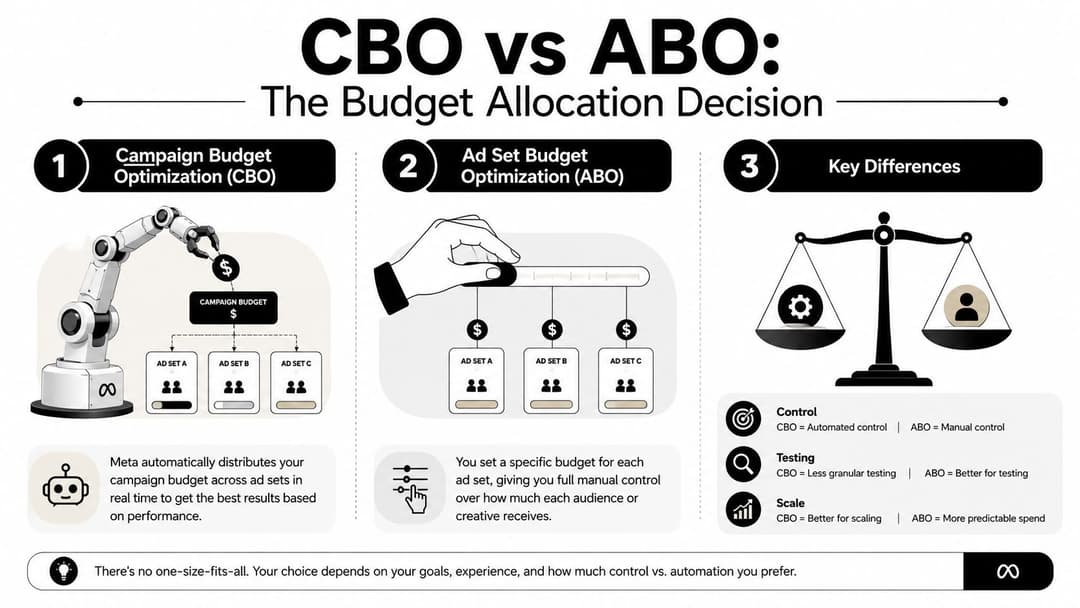
CBO, or campaign budget optimization, lets Meta move spend across ad sets based on expected performance. ABO, or ad set budget optimization, locks each ad set to a specific cap. If you want Meta to find the cheapest conversion path, CBO gives it more freedom. If you need strict test control, ABO keeps the boundaries tight.
That's the trade. More automation usually means faster allocation, but less manual certainty. More control usually means cleaner readouts, but slower discovery. A good Facebook advertising agency should be able to explain exactly where your account sits on that spectrum before it tells you to scale.
Meta's learning phase makes the stakes higher. If you change budgets too aggressively, the system often needs to relearn what it thinks it knows. That is why incremental changes matter so much. The platform is built to respond to signals, not to tolerate chaos.
CBO vs ABO and the Budget Allocation Decision
This is the decision often overcomplicated. If you want Meta to hunt for the best conversion path across a few decent options, use CBO. If you need to isolate one variable and keep the test clean, use ABO. That's the core choice.
When CBO wins
CBO works when the campaign already has enough volume to let Meta discriminate between better and worse ad sets. It's also the better default when you care more about efficient conversion capture than about proving a theory to yourself or a client. If you're scaling a working offer, this is usually where you want to be.
The internal Facebook account structure for scaling matters here, because CBO only helps if the campaign structure isn't fragmented. Too many ad sets, and the budget gets diluted before the system can make a useful call.
When ABO wins
ABO is the right move when you're testing a new audience, a new offer angle, or a new creative concept and need a clean readout. It's also useful when one ad set is a proven winner and you don't want Meta starving it while chasing a weaker sibling. In a tight-budget account, ABO can be the difference between a usable test and a pile of noise.
Use ABO to learn, use CBO to scale.
That's the simplest decision rule. If you can't support multiple ad sets with enough spend to generate meaningful outcomes, don't pretend you're “testing” when you're really just underfunding the account. Once a winner emerges, switch the budget logic and let Meta do more of the work.
Advantage+ campaign budget allocation pushes the same idea further. It's Meta saying, in effect, “stop micromanaging the split and let the system allocate across better signals.” That makes sense in a broader, more automated environment, but only after the account has one clear direction to follow.
Budgeting Frameworks You Can Use This Week
A budget only works when it is tied to something real. A flat number thrown at Meta is just spend. A budget tied to economics, funnel stage, and test design becomes a decision system.
Start from your economics, not your feelings
If your target CPA is $45, plan from signal, not instinct. One useful planning rule is to anchor weekly spend to the formula (Target CPA × 50) ÷ 7 or to make sure a campaign has at least 10x the target CPA available for reliable optimization budget optimization guidance. For a $45 CPA, that means a tiny spend will not tell you much, and you should stop pretending it will.
A second useful rule is to set budget by test type. Creative tests can be smaller than audience tests. Audience tests can be smaller than offer tests in some cases, because offer decisions usually need more conversion evidence. The point is not the category label, it is whether each test has enough budget to answer its own question.
Build a funnel allocation that matches the job
A monthly budget should reflect what you are trying to learn. Prospecting needs enough spend to create new demand. Retargeting needs enough volume to stay alive. Retention only matters once you have customer flow worth protecting.
| Funnel Stage | Campaign Type | Monthly Budget | Min Conversions Needed | Primary KPI | Rationale |
|---|---|---|---|---|---|
| Prospecting | Broad conversion campaign | $4,200 | Enough to generate a stable signal | CPA | New demand originates here |
| Mid-funnel | Engaged audience re-engagement | $1,800 | Enough to avoid starving delivery | CTR and CPA | Keeps warm users moving |
| Retargeting | Site visitor and intent follow-up | $1,000 | Enough to avoid overfitting | CPA and ROAS | Protects the highest intent traffic |
If the monthly budget is $7,000 and the target CPA is $45, this structure is the sane move. It keeps most of the spend where new learning happens, but it does not pretend retargeting should be ignored. The budget should match the job, not the comfort level of the account manager.
Separate budget by lifecycle stage
You also need to think in terms of lifecycle. Prospecting, retargeting, and retention do not deserve equal treatment, because they do not produce equal types of learning. A new account that splits spend across too many lifecycle buckets usually ends up with none of them getting enough volume to matter.
The cleanest monthly template is simple. Fund the most impactful stage first, then add the rest only when that stage is stable. That keeps budget scarcity from turning into account sprawl.
If you want a tighter operating model for platform-level automation, AdStellar AI's performance automation approach is built around that same logic. It gives you a way to keep the system focused on the highest-signal work instead of scattering spend across weak tests. For teams looking for profitable ad budget strategies, the rule is the same, protect the highest-impact test before you fund anything else.
Scaling Rules, Testing Plans, and the AI Optimization Layer
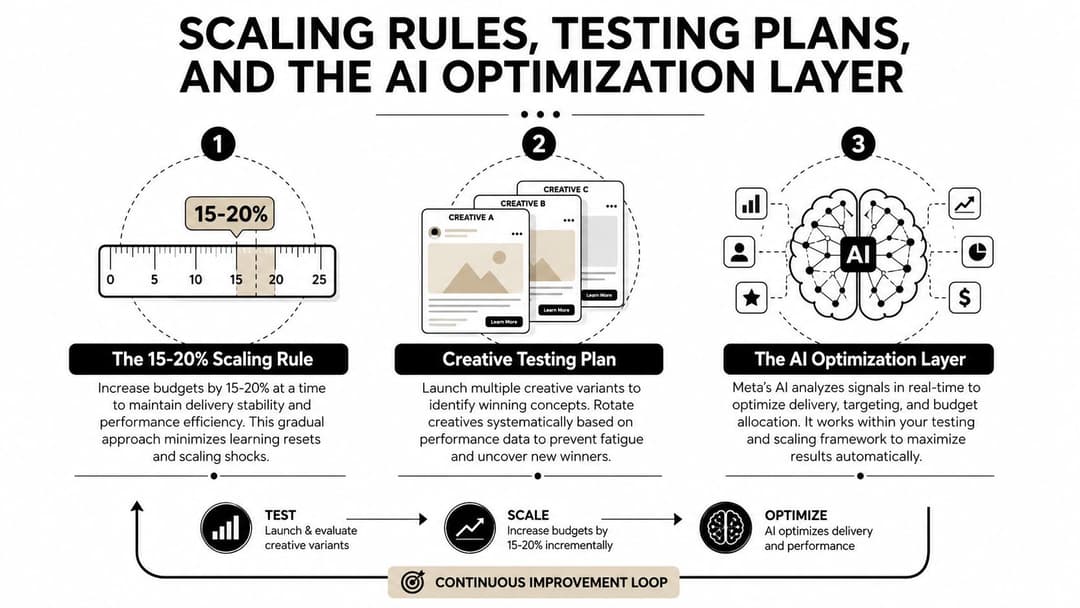
A winning Facebook ad budget breaks fastest when the team confuses scale with expansion. One good campaign can still fall apart if you push spend too hard, test inside the winner, and starve the account of new creative. The better move is blunt, keep scaling controlled, keep tests isolated, and use automation for the repetitive parts.
Use incremental scaling, not heroic jumps
The clean rule is simple. Raise budget by no more than 15% to 20% per change, usually every 48 to 72 hours, because bigger jumps can shake performance and send the campaign back into learning budget optimization guidance. If a campaign is healthy, protect it. Do not ram it with a sudden increase and call that a growth plan.
Vertical scaling means raising budget on the current winner. Horizontal scaling means duplicating into new audiences. Use vertical scaling when the campaign is stable and still has room to absorb more spend. Use horizontal scaling when the audience is getting narrow, frequency is climbing, or the current setup has already squeezed most of the available reach.
Keep creative testing on a separate track
Creative volume is the bottleneck in account growth. If the budget only feeds proven ads, performance may look stable for a while, then flatten hard when fatigue sets in. Reserve part of the budget for new hooks, new angles, and new formats so the account has replacements ready before the winners stop winning.
A practical split is easy to defend. Put most of the spend behind proven ads, then carve out a smaller testing budget for new concepts that rotate through on a schedule. The exact split depends on the account, but the rule does not. Tests need fuel, and scaling needs protection.
The discussion of profitable ad budget strategies from Wojo Media makes the point cleanly. Budget discipline matters just as much as creative output, and profit should decide what gets funded next.
Let automation absorb the repetitive work
The AI layer belongs here, but only if it keeps the account focused. AdStellar AI can ingest historical performance through secure OAuth, generate large batches of creative and audience combinations, and help allocate budget around what is already producing signal. That does not replace judgment. It removes manual setup drag so the team can spend time deciding which test deserves the next dollar.
AdStellar AI's performance automation approach follows the same logic. Use the system to keep budget concentrated on the highest-signal work instead of scattering spend across weak variations. In practice, the account does better when the platform handles repetition and the team protects the single highest-impact test, whether that is creative, audience, or offer.
Troubleshooting Common Facebook Ad Budget Problems
Most budget problems are not mysterious. They're symptoms. The mistake is to react to the symptom instead of diagnosing the structure behind it.
High CPM and shrinking reach
If CPM climbs while reach shrinks, don't immediately blame the budget amount. The more likely issue is audience saturation, creative fatigue, or both. You've asked the same people to respond to the same message too many times, and Meta is paying more to find fresh impressions.
The fix is to refresh the creative and widen the room the campaign has to breathe. Consolidate ad sets if the account is too fragmented, then remove one layer of variation so the system can find clearer patterns. The internal Meta ads budget allocation mistakes piece is a useful reference when the structure itself is the problem.
Conversions disappear after a budget increase
When a campaign collapses after a spend jump, the issue is usually not that you increased budget. It's that you increased it too hard, too fast, and forced the campaign to relearn. Meta does not love volatility, and neither does your CPA.
The remedy is simple. Roll the budget back, stabilize the campaign, then raise it in smaller steps. If the account needs a bigger leap, build it through multiple increments instead of one aggressive push. That gives Meta time to keep the same optimization path intact.
Don't mistake instability for scale readiness.
The account won't spend
If a campaign won't spend, the budget isn't always the problem. The audience may be too narrow, the bid may be too restrictive, or the setup may be asking for more precision than the account can support. In a scarce-budget environment, the temptation is to keep adding targeting detail. That usually makes the problem worse.
The smarter move is to simplify. Broaden the audience, reduce the number of ad sets, and stop splitting budget across too many directions. Small budget advice is really an instruction to reduce variables until the system can give you usable feedback.
Too many ad sets, not enough learning
This is the classic rookie trap. More ad sets feel like more testing, but they usually mean less signal per test. If none of the ad sets get enough conversions, none of them learns, and the whole account drifts.
Your fix is to consolidate. One offer, one audience, one creative lane if necessary. That's not being conservative, that's being efficient with scarce learning capital. Once the account can produce stable data, you can add complexity back in.
A Worked Example Scaling From $1,500 to $15,000 Per Month
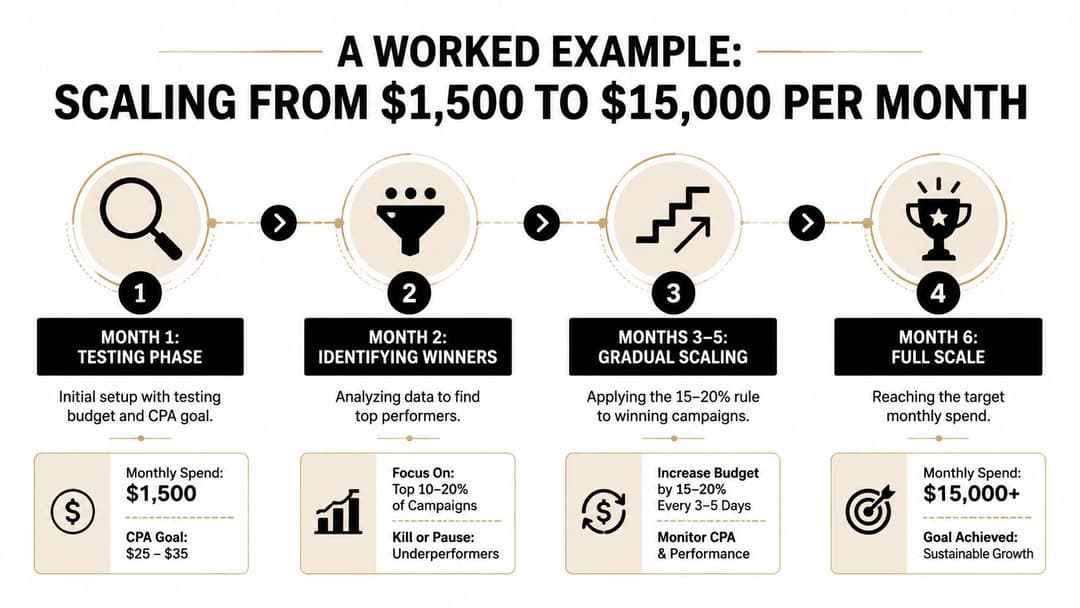
A DTC skincare brand starts with $1,500 per month and a $38 target CPA. The owner wants scale, but the account can't support five audiences and four offers. So month one is ugly in the right way, one offer, broad targeting, ABO, and only enough structure to learn.
Month one
The brand keeps the setup simple. One prospecting campaign, one retargeting layer, a few creative variations, and no obsession with perfect segmentation. The goal isn't profit yet, it's finding a message that can survive the learning phase without the budget getting scattered.
The wrong move would be splitting that $1,500 across five ad sets. Each one would get starved, the data would blur, and nobody would know which lever mattered. Instead, the brand uses the first month to identify one creative direction that can carry spend.
Month two and beyond
Once there's a stable winner, the brand moves to CBO and lets budget follow performance. Creative iteration becomes the main job, not audience tinkering. By the time spend reaches $4,500, the account has enough signal to justify more aggressive allocation decisions.
By the time the budget reaches $15,000 per month, the structure is no longer a testing playground. Retention gets its own line, prospecting carries the bulk of new acquisition, and Advantage+ campaigns can be layered in where they fit. The important shift isn't the budget size, it's that budget is now reinforcing a proven system instead of trying to discover one from scratch.
That's the pattern worth copying. Start narrow, get one winner, then spend your way into scale with restraint.
The One Budget Decision That Will Move Your Account This Week
Pick one campaign, one audience, and one offer. Fund that setup until it produces a stable CPA, and stop pretending a scattered account is a smart account.
After that, your priorities are clear. Add creative volume first, introduce a second ad set only after the first is stable, and then switch into CBO or Advantage+ once the signal is reliable. If you're still trying to force budget into a messy structure, you're not scaling, you're funding confusion.
The bigger shift is strategic. In the AI-driven Meta environment, more budget should go toward creative production and iteration, not endless audience slicing. That's where the power is now.
- Cut the variables. One campaign, one audience, one offer.
- Protect the winner. Don't scale a weak setup by force.
- Feed the machine. New creative is the primary fuel.
Make that one decision this week and your account gets easier immediately.
AdStellar AI helps teams launch, test, and scale Meta campaigns by automating creative generation, budget allocation, and performance learning across ad sets. If you want a tighter way to manage facebook ad budgets without drowning in manual setup, visit AdStellar AI and see how it handles the testing and scaling workflow in one place.