Your campaign dashboard is full of creative variations, but the assumptions behind them may still be guesses. You've tested headlines, formats, and calls to action, yet you may not know why buyers choose you, what stops them from converting, or whether the audience producing cheap clicks will create valuable customers.
Strong audience research methods connect those missing pieces. Qualitative research helps you uncover motivations, language, objections, and context. Quantitative research helps you validate patterns, compare segments, measure behavior, and prioritize conversion potential. Neither category works well in isolation. Interviews can reveal a powerful customer insight, but analytics and controlled experiments must show whether that insight changes results.
The practical workflow is straightforward. Use interviews, focus groups, social listening, surveys, and psychographic profiling to form hypotheses. Use analytics, experiments, modeling, competitive intelligence, and cohort analysis to verify and prioritize them. Each method below explains when it fits, how to execute it, what to measure, useful tools, prompts to ask, and what the findings mean for ads and growth.
1. Surveys and Questionnaires
Surveys are useful when you need structured answers from a broad audience. They can reveal preferences, pain points, demographics, purchase intent, satisfaction, and objections through email, web forms, social platforms, or in-product prompts. Online surveys are the dominant quantitative audience research method in market research, with 85% of market research professionals using them regularly. Mobile surveys have reached 47% adoption, and mobile devices accounted for 61.1% of global survey responses in Q3 2024, up from 57.2% in Q3 2023, according to Axis Intelligence's market research methods overview.
That mobile behavior should shape execution. Keep the form short, use responsive layouts, and avoid complex grids that become difficult to complete on a phone. A DTC brand can survey its email list before launching a campaign, while a SaaS company can ask new users which problem they're trying to solve immediately after signup.
Build questions around decisions
Ask questions that change a campaign choice, not questions that satisfy curiosity.
- Use closed-ended questions: Let respondents rank benefits, select objections, or choose the buying stage that best describes them.
- Add one useful open field: Ask, “What nearly stopped you from buying?” The wording often supplies ad language you wouldn't have written internally.
- Apply conditional logic: A respondent who hasn't purchased shouldn't see the same questions as a repeat customer.
- Segment the answers: Compare responses by acquisition source, customer status, product use case, and other meaningful groups.
Survey findings can inform positioning, creative angles, landing-page copy, and audience exclusions. For a broader workflow around selecting platforms and organizing research inputs, see these audience research tools.
2. Focus Groups
Focus groups expose reactions that individual answers can hide. A moderator presents an offer, ad concept, product experience, or category problem, then observes how participants explain, challenge, or build on one another's responses. The interaction can uncover shared language and disagreements, but it can also introduce conformity and dominant voices.
Use focus groups when you're deciding which message deserves further testing, not when you need a reliable estimate of how many people hold a view. An agency might show several creative directions to a narrowly screened audience. A B2B SaaS team could explore how buyers describe procurement friction, integration concerns, or internal approval requirements before writing campaign copy.
Control the room and the interpretation
Recruit participants who share the behavior or buying context you're studying. A group of current customers may discuss product value very differently from non-buyers who understand the category but haven't converted. Use a screener before inviting anyone, and keep groups homogeneous enough that participants can speak about comparable experiences.
A capable moderator should ask for independent reactions before inviting group discussion. Written responses, ranking exercises, and silent concept selection can prevent one confident participant from setting the tone. Record sessions with consent, then code recurring themes rather than treating the loudest opinion as the winning idea.
Practical rule: Use focus groups to discover language and friction. Use surveys, analytics, and experiments to judge how broadly that insight applies.
For advertising, translate discussion into testable hypotheses. If participants repeatedly describe an offer as “easy to start” rather than “powerful,” create both angles and test them against a control. Don't publish the focus group's preferred concept as though it has already proven its ability to generate profitable conversions.
3. Customer Interviews and User Testing
A campaign can attract clicks for the wrong reason. Interviewing a churned customer may reveal that the ad promise appealed to a use case the product was never designed to serve. A non-purchaser might identify delivery uncertainty, rather than price, as the conversion barrier. One-to-one interviews expose the decision sequence: what started the search, which alternatives entered consideration, who influenced the choice, and what nearly stopped it.
User testing adds observed behavior. Ask participants to interact with an ad, landing page, checkout flow, or product while describing what they notice, expect, and misunderstand. This helps explain what happened but not why in campaign and analytics data.
Build evidence from real decisions
Use prompts that recover a recent story instead of asking participants to approve a hypothetical benefit:
- “Tell me about the last time you tried to solve this problem.”
- “What did you search for first?”
- “Which options did you reject, and why?”
- “What did you expect after clicking the ad?”
- “What would have made the decision easier?”
Follow the answers toward motivations, workarounds, perceived risks, and the language participants choose without prompting. A question about faster setup may produce polite agreement, while a reconstruction of the last buying attempt can reveal whether setup, trust, budget, or internal approval controlled the decision.
Test different creative or page variations with separate participants when possible. Invite campaign, product, and sales teammates to review recordings, then compare observed behavior with the intended customer journey. Interviews provide depth, but they are slow and interpretive. User testing shows friction in context, yet a short task may miss longer-term objections. Use both to form hypotheses, not to estimate demand.
Organize the result as a pattern library. Group repeated motivations, objections, decision stages, and customer phrases into messaging inputs. Apply those findings to improve conversion rates with clearer ad promises, consistent landing-page language, and calls to action that match the user's decision stage. Feed the strongest signals into controlled tests before scaling them across campaigns.
4. Social Listening and Sentiment Analysis
Social listening captures conversations people start without a survey prompt. For performance marketers, it is the observation stage between uncovering motivations and testing campaign messages. Monitor brand mentions, competitor discussions, product reviews, forums, hashtags, and category language for recurring frustrations, emerging needs, and reactions to market claims. Keyword monitoring and automated sentiment classification can surface changes quickly, but sarcasm, context, and industry terminology still require human review.
Start with the buying problem, not only the brand name. Buyers may discuss implementation, cost, fit, or trust without naming a vendor, revealing demand that will not appear in account data yet. Track separate groups for your brand, competitors, category problems, product terms, and campaign language so analysts can distinguish a broad objection from a competitor-specific complaint.
A performance marketer can compare complaints about competing products with the promises those competitors make in ads. If buyers praise a capability but describe implementation problems, test practical onboarding against a broad innovation claim. A SaaS team can monitor feature requests for messaging gaps. An e-commerce team can mine reviews for customer language about fit, durability, and product quality.
Use these signals to build hypotheses:
- Repeated objections can inform FAQ copy, comparison angles, or retargeting messages.
- Unprompted benefits may reveal value customers express differently from your positioning.
- Timing signals can connect seasonal complaints, launches, and recurring events to creative timing.
- Influential participants may shape the language adopted by wider communities.
Social volume indicates attention, not conversion potential. A loud discussion may come from a narrow community, while a quieter issue may affect high-value buyers. Validate promising themes with owned research, behavioral analytics, and controlled experiments before shifting budget. Feed confirmed language into ad concepts, landing-page tests, and audience signals that can be scaled after performance is proven.

5. Psychographic and Lifestyle Profiling
Demographics describe who someone is. Psychographic profiling explores what they value, how they live, what they believe, and which motivations influence a decision. Two people in the same age and income bracket can respond to completely different promises because one prioritizes convenience while the other prioritizes control, sustainability, recognition, or performance.
Use this method when demographic targeting produces broad audiences but weak message fit. An outdoor brand might distinguish people who regularly pursue hiking and trail activities from those who only match an age range. A wellness subscription can separate customers seeking routine and accountability from those interested in experimentation and optimization. A premium brand may need to understand whether status, craftsmanship, scarcity, or self-reward drives demand.
Create profiles from behavior, not imagination
Combine survey responses, content engagement, purchase patterns, customer language, and relevant interest data. A persona should explain a decision, not merely describe a fictional lifestyle. Include the audience's desired progress, perceived risks, social context, trusted information sources, daily constraints, and reasons for choosing one solution over another.
Then turn each profile into a message test. For a sustainability-oriented segment, compare an environmental impact angle with a product-performance angle. For a convenience-driven segment, compare reduced effort with faster completion. Keep the product promise truthful, and don't assume that a declared value always predicts purchase behavior.
Psychographic traits can change as circumstances and interests evolve. Review profiles against current customer behavior rather than treating them as permanent labels. The strongest output is a set of audience hypotheses that connects motivation to offer, creative treatment, channel, and measurable action.
6. Website and Behavioral Analytics
A paid campaign can generate healthy click volume while visitors abandon the product page. Analytics helps locate the break in that journey by showing what people do after the click: which pages they view, where they pause, when they start a form, and whether they reach signup, checkout, or purchase.
Set up the measurement path before drawing conclusions. Define key conversion events and useful micro-conversions, such as video engagement, scroll depth, calculator use, form starts, and repeated product views. Apply UTM parameters consistently so campaign, channel, device, and audience comparisons remain interpretable.
The same abandonment pattern can have different causes. A mismatch between the ad promise and landing page may require a message change. Slow mobile interaction points to a technical fix. Unclear pricing or weak proof calls for a page revision. Segment the journey to determine whether the issue affects a traffic source, device type, campaign, or audience group.
Use the following cuts to turn behavior into campaign decisions:
- Traffic-source behavior: Compare paid social, search, partner, and organic visitors by engagement and conversion path.
- Device differences: Check whether mobile and desktop visitors face different friction.
- Journey stages: Match prospecting, consideration, and retargeting creative to the actions visitors take.
- Conversion quality: Connect lead or purchase events to downstream value where possible, rather than optimizing only for volume.
For teams that need a clearer view of individual visits and paths, website visitor tracking can complement broader analytics. LinkedIn advertisers can assess relevant LinkedIn analytics tools when professional audience behavior matters.
Treat each drop-off as a question, not an explanation. Session review, interviews, and controlled tests can show whether the next action should change the creative, landing page, targeting, or technical experience.
7. A/B Testing and Multivariate Testing
Testing turns an audience belief into a measurable decision. An A/B test compares a control with a treatment, while a multivariate design evaluates combinations of variables. You can test ad angle, hook, format, offer, landing-page headline, call to action, audience definition, or funnel stage, depending on the question.
Start with a written hypothesis. “People who care about implementation risk will respond better to proof of guided setup than to a broad efficiency claim” is testable. “Let's try new creative” isn't. Define the primary business metric before launch, such as qualified leads, purchases, CPA, CPL, or ROAS, and decide what secondary signals will help diagnose the result.
Protect the learning
A clean test changes one meaningful variable at a time. Keep a control based on the current best practice, document the audience and delivery conditions, and avoid ending the test because an early result looks exciting. The required sample and duration depend on baseline conversion behavior, traffic, spend, and the size of effect you need to detect.
Test bold differences as well as small refinements. A new customer story, objection-based hook, or offer structure can reveal more than another minor color change. When you need a practical framework for separating variants and interpreting outcomes, use this guide to split testing.
A winning ad is evidence for a specific context, not proof that every audience will respond to the same idea.
Record the hypothesis, setup, result, and next action in a shared testing log. Over time, the archive becomes an audience knowledge base. It also prevents teams from repeating failed tests because the reasoning disappeared when the campaign was paused.
8. Lookalike and Propensity Modeling
Once you know which customers create value, modeling helps you find more people with similar potential. Lookalike modeling identifies prospects who resemble a chosen source audience. Propensity modeling scores the likelihood of conversion, retention, expansion, or churn. Both methods turn audience research into campaign priorities, but neither can compensate for weak source data or an unclear outcome.
Start with the business decision. An e-commerce team seeking profitable acquisition may build a source from customers with strong downstream value rather than every purchaser. A subscription brand could separate retained customers from churn-risk users. A SaaS team might score prospects using product engagement and sales-stage behavior, then direct outreach toward accounts with stronger commercial signals.
Source selection shapes the result more than audience size alone.
Before building a model, define the event being predicted and check that it is recorded consistently. Remove duplicate records, low-quality conversions, and events that do not represent meaningful value. Compare the modeled segment with broad targeting and with alternative source audiences, then test each under comparable campaign conditions.
Use these checks during activation:
- What outcome is being predicted? Clicks, leads, sales, retained accounts, and expansion events require different signals.
- Does the source audience have business value? Conversion volume can conceal weak retention or poor margins.
- Does performance hold across contexts? Test geography, creative angle, placement, and funnel stage separately.
- When should the model refresh? New conversion data can change the customer mix and market conditions.
Model scores should guide allocation and testing, not replace judgment. A high score does not explain motivation, while a low score may reflect missing data instead of weak demand. Combine model outputs with interviews, behavioral evidence, and creative experiments. Teams using predictive audience targeting can apply these signals to prioritize prospects and scale audiences after performance is validated.
9. Competitive Intelligence and Benchmarking
A competitor's new landing page can change how prospects interpret your offer before they ever see your ad. Review ad libraries, landing pages, offers, claims, formats, calls to action, and campaign timing. Record what appears repeatedly, what objections remain unanswered, and which audience situations receive little attention.
Use those observations to build hypotheses for testing. If several advertisers lead with speed, the claim may be expected in the category, but repetition does not show that it persuades. Test a more specific angle around setup support, integration, risk reduction, or a customer situation identified through interviews. A message that persists across campaigns merits examination, not automatic adoption.
Turn market signals into campaign tests
Keep one working record for screenshots, copy, landing-page links, dates, offer details, and your interpretation. Monitor a focused competitor set on the platforms where your audience encounters them. Track changes over time, such as new proof, revised guarantees, audience-specific pages, and shifts in promotional timing.
A competitor review can also challenge your explanation for declining performance. Rising CPA may reflect auction pressure, tracking changes, weaker conversion quality, or a different offer mix. Visibility from another advertiser cannot identify the cause by itself. Compare it with your campaign data, customer feedback, and conversion quality before changing budgets or creative.
Translate the review into a short test backlog:
- Message gaps: Answer an objection competitors leave unresolved.
- Proof gaps: Demonstrate evidence or process detail the category rarely explains.
- Audience gaps: Build creative for a use case competitors treat as generic.
- Format gaps: Show a valid benefit through a clearer demonstration.
For each test, define the audience, claim, proof, landing-page experience, and success event before launch. Keep the strongest competitor observations separate from assumptions about their results. Your goal is a credible reason to choose your offer, supported by evidence from your own experiments.
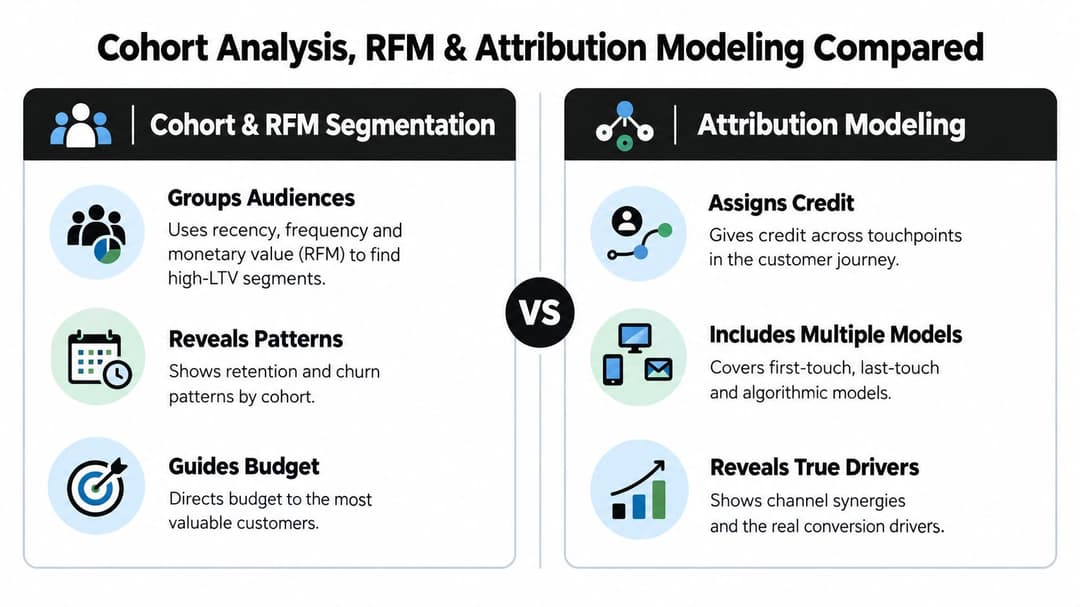
10. Cohort Analysis, RFM Segmentation, and Attribution Modeling
Acquisition metrics can reward the wrong audience if you stop measuring at the first conversion. Cohort analysis groups customers by a shared starting point, such as acquisition period, source, campaign, or initial behavior, then compares retention and value over time. RFM segmentation classifies customers by recency, frequency, and monetary value, while attribution modeling evaluates how multiple touchpoints contributed to the journey.
These methods answer different questions. Cohorts reveal whether acquisition quality changes over time. RFM identifies loyal, active, lapsed, and high-value customers. Attribution helps you examine whether awareness, consideration, and conversion campaigns contribute together rather than forcing every result into a single-touch explanation.
Build a useful measurement sequence
Start with dependable tracking. Define cohorts by acquisition source or initial behavior, calculate downstream value, and compare retention patterns. Then create RFM groups and adjust messaging accordingly. Loyal customers may respond to expansion or advocacy offers, while lapsed customers may need a reminder of the original problem, a new use case, or a reason to return.
For attribution, begin with simple first-touch and last-touch views so the team can understand the assumptions. Add multi-touch or algorithmic approaches only when the data and tracking support them. Check conversion paths, compare channel combinations, and test what happens when a touchpoint is reduced or removed. Attribution remains an analytical model, not a direct observation of causality.
A customer acquired through one channel may show modest immediate efficiency but stronger retention. Another may convert quickly but rarely return. Cohort and RFM analysis help connect audience research to budget decisions, creative sequencing, retention work, and acquisition quality. For a focused explanation of attribution in Amazon advertising, see this guide to Amazon Ads attribution.
10-Method Audience Research Comparison
| Method | Implementation complexity | Resource requirements | Expected outcomes | Ideal use cases | Key advantages |
|---|---|---|---|---|---|
| Surveys and Questionnaires | Low–Medium, requires careful design | Low cost per response; distribution channels & incentives | Quantitative metrics + some qualitative feedback | Large-scale audience validation, segmentation tests | Scalable, easy to analyze, cost-effective |
| Focus Groups | Medium–High, needs skilled facilitator | High per-session cost; recruitment and facilities | Rich, contextual qualitative insights | Creative concept testing, messaging exploration | Deep emotional insight; group dynamics surface ideas |
| Customer Interviews and User Testing | Medium–High, interviewer skill and protocol needed | Time-intensive; moderate per-participant cost | Deep individual motivations and usability findings | Churn analysis, prototype/usability testing, messaging refinement | Uncovers unexpected pain points; builds team empathy |
| Social Listening and Sentiment Analysis | Low–Medium, tool setup and taxonomy required | Ongoing subscription/tools; monitoring effort | Real-time organic sentiment and trend signals | Trend detection, reputation monitoring, competitor reaction | Captures unsolicited opinions; timely, continuous insights |
| Psychographic and Lifestyle Profiling | High, integrates multiple data sources and modeling | Data integration, surveys, and analytics resources | Values-driven personas and motivational drivers | Emotional targeting, niche audience positioning | Enables values-based messaging and stronger creative resonance |
| Website and Behavioral Analytics | Medium, tracking and analysis expertise needed | Analytics platforms, technical implementation | Objective behavior data: funnels, friction points | Funnel optimization, UX fixes, retargeting strategies | Reveals actual user behavior; integrates with ad platforms |
| A/B Testing and Multivariate Testing | Medium–High, experimental design and stats required | Sufficient traffic and testing platforms; analysis time | Statistically validated performance improvements | Creative, landing page, and audience performance optimization | Data-backed decisions; iterative performance gains |
| Lookalike and Propensity Modeling | High, ML models and quality data required | Historical customer data, data science or third-party tools | Scores for likely converters and similar audiences | Scaling acquisition, prioritizing high-intent prospects | Finds high-potential audiences; improves ROAS |
| Competitive Intelligence and Benchmarking | Low–Medium, monitoring and competitive analysis | Tools or manual monitoring; ongoing effort | Competitor messaging, creative patterns, market gaps | Positioning, idea sourcing, identifying underserved segments | Cost-effective public insights; identifies opportunity areas |
| Cohort Analysis, RFM Segmentation & Attribution Modeling | High, complex data hygiene and modeling | Clean historical data, analytics/attribution platforms | LTV by segment, retention trends, channel contribution | Budget allocation, retention strategy, multi-touch optimization | Prioritizes high-value segments and informs budget/touchpoint strategy |
Turn Research Into a Testing Roadmap
No single method can answer every performance-marketing question. Interviews and focus groups explain motivations, but participants may describe ideal behavior rather than actual behavior. Surveys help quantify priorities, but low response rates and weak sampling can distort interpretation. Analytics records behavior at scale, but it rarely explains the customer's internal reasoning. Experiments show what changes outcomes in a defined context, but they won't automatically explain why the result occurred or whether it will hold across every audience.
Survey research has become harder to interpret as participation has declined. The Council of American Survey Research Organizations standardized response-rate definitions in the early 1980s, and AAPOR completed later standardization work in the late 1990s. The AAPOR response-rate resource records major declines in participation, including a fall in American National Election Studies response rates from 77% in 1952 to 50% in 2016, and a decline in Pew Research Center telephone survey response rates from 36% in 1997 to 9% in 2016. Contemporary telephone interviewing in the United States regularly obtains response rates below 10%, which makes sampling, weighting, mixed modes, and alternative measurement increasingly important.
A practical sequence reduces the risk of acting on one weak signal. Begin with qualitative discovery from customer interviews, focus groups, social listening, and psychographic research. Look for repeated motivations, decision sequences, objections, and customer language. Then validate those hypotheses through surveys and behavioral analytics, checking whether the reported priorities match observed paths, engagement, and conversion behavior.
Prioritize evidence by business risk
Use cohort analysis, RFM segmentation, attribution, lookalike audiences, and propensity models to identify which segments deserve investment. These methods help distinguish a promising message from a commercially valuable audience. They also reveal when a low-cost acquisition source produces customers who don't retain, expand, or purchase again.
Benchmarking makes the learning more durable. Edison Research and SSRS maintain repeatable audio benchmarks, including Edison Podcast Metrics, Share of Ear, The Infinite Dial, and Edison Download Metrics. For The Infinite Dial 2025, SSRS reported a national sample of 5,020 people aged 12 and older in its benchmark research. The broader lesson is useful for marketers: consistent questions, samples, and fielding windows make trend comparison more meaningful than isolated feedback.
Fragmented digital markets require even more triangulation. Measurement infrastructure can be limited in difficult regions, platform signals can shift quickly, and local benchmarks may be inconsistent, as discussed in DW's reporting on digital growth and audience measurement. If one platform reports a sudden audience change, compare it with owned analytics, customer conversations, survey responses, and conversion quality before changing the entire media plan.
Turn the process into a repeatable operating habit:
- Choose one assumption: For example, “New buyers need implementation reassurance more than a lower price.”
- Define the confirming metric: Choose the business outcome that would support the hypothesis, such as qualified leads, purchases, CPA, CPL, or ROAS.
- Document the test: Record the audience, message, control, treatment, budget boundary, time frame, and decision rule.
- Run a contained experiment: Keep the test narrow enough that a negative result is affordable and interpretable.
- Apply the learning: Update the creative brief, audience definition, landing page, or next test based on the evidence.
AdStellar AI can fit into the execution layer for teams running Meta campaigns. Its Targeting Strategist can analyze custom audiences and interest signals, while AI Insights ranks audiences, creatives, and messages against metrics such as ROAS, CPA, and CTR. That doesn't replace research. It can help teams produce and compare audience and creative combinations after the research has produced a clear hypothesis.
Choose one audience assumption today, write down the evidence that would confirm it, and launch a focused test rather than another unstructured batch of variations. The result should change what you make next, who you target next, or how you measure the next campaign. That feedback loop is how audience research becomes a growth system instead of a document that nobody revisits.
AdStellar AI helps performance teams create, launch, test, and compare Meta ad combinations across creatives, copy, audiences, and campaign goals. Visit AdStellar AI to connect campaign research with repeatable testing and performance insights.