You've built the audience everyone recommends. The lookalike is based on purchasers, interest layers cover the category, exclusions are clean, and the creative has already survived several rounds of testing. Yet delivery keeps finding the same people, the available pool feels smaller, and acquisition efficiency continues to weaken.
That situation is often treated as a creative problem. Sometimes it is. But when audiences overlap, high-intent users sit outside familiar demographic categories, and privacy changes remove behavioral visibility, the deeper issue is usually targeting saturation. Predictive audience targeting offers a different operating model, but it only beats manual selection when the underlying data is strong enough to support a useful prediction.
Why Your Current Audience Strategy Is Hitting a Wall
A senior media buyer can usually recognize the pattern before the dashboard confirms it. The campaign starts with a carefully defined customer profile, then adds interests, behaviors, exclusions, and a purchaser-based lookalike. Early delivery looks promising. Over time, the same audience definitions compete with one another, available users receive repeated impressions, and the buyer responds by adding more layers.
That response often creates the illusion of sophistication without adding much signal. A person interested in premium products isn't necessarily ready to buy, while a high-intent visitor may not resemble the brand's existing customers closely enough to enter a conventional lookalike audience. Manual segmentation organizes known attributes well, but it has difficulty ranking changing intent.
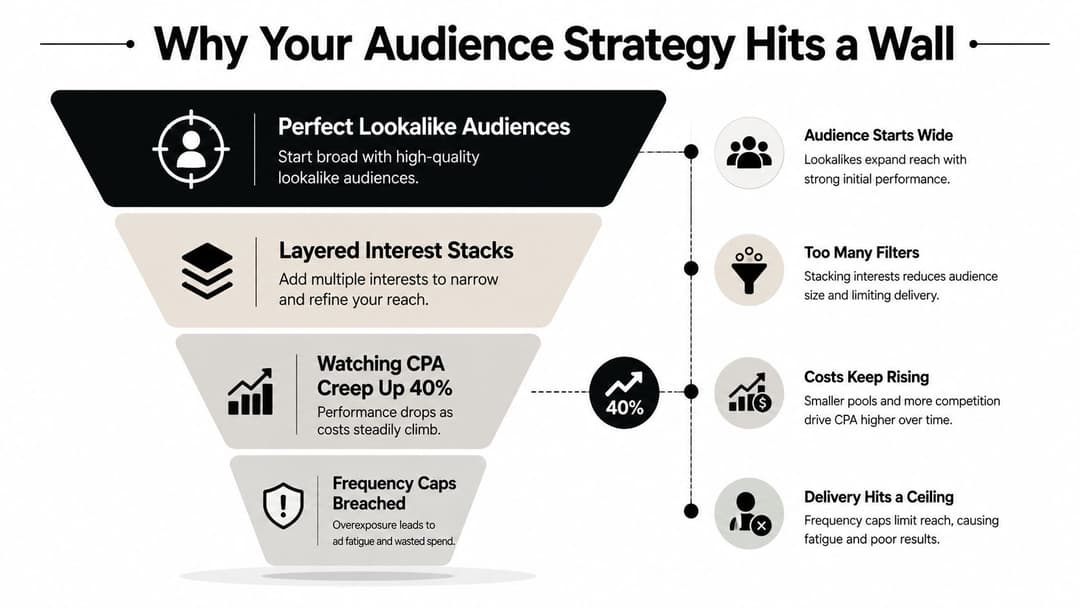
The ceiling comes from the inputs
Traditional audience selection depends on historical proxies such as demographics, interests, past purchases, and declared preferences. Those inputs can still be useful, especially when a brand has limited conversion data, but they don't answer the question a performance campaign ultimately asks: who is most likely to convert next?
Privacy restrictions also change the quality and availability of user-level signals. That makes a strong first-party foundation more important, as outlined in this practical guide to what first-party data means for marketers. The challenge isn't just reaching more people. It's separating fresh intent from old similarity.
Practitioner rule: Treat audience fatigue as a signal-quality problem before treating it as a creative problem.
Predictive targeting changes the unit of decision. Instead of asking whether a user belongs to a predefined group, the system estimates whether the user's observed behavior resembles the behavior of people who converted. That doesn't make manual targeting obsolete. It gives buyers another route when static categories stop distinguishing likely buyers from merely eligible users.
What Predictive Audience Targeting Does
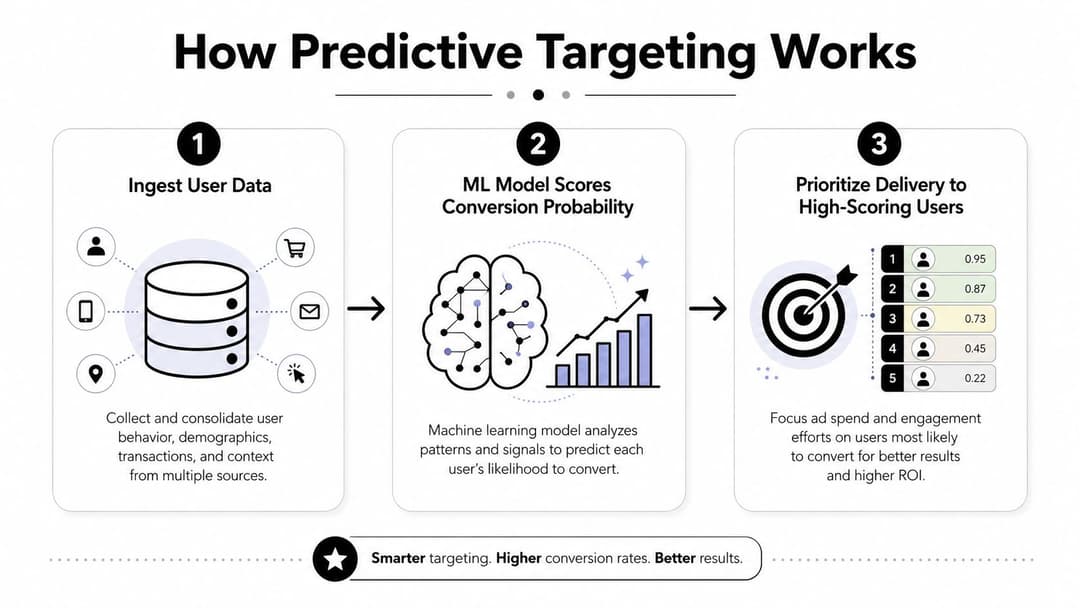
Predictive audience targeting uses historical outcomes and behavioral features to estimate which unseen users are more likely to convert. Rather than sorting people only by labels such as “luxury shopper” or “enterprise buyer,” the model identifies patterns linked to conversion and ranks users against those patterns.
A credit score provides a useful comparison. It summarizes several signals into a probability-based ranking that supports a decision under uncertainty. A predictive advertising score works similarly. It can improve prioritization, but it cannot guarantee a purchase.
The model pipeline
A practical predictive system usually connects four stages:
- Training data: The system starts with historical conversions and non-conversions. Clear outcome labeling matters more than a large volume of anonymous activity.
- Feature engineering: User actions become model inputs. These may include content engagement, ad interactions, browsing patterns, device switching, and time-of-day activity, as described in this overview of AI audience targeting mechanics.
- Probability scoring: The model estimates how closely an unseen user matches patterns associated with conversion. The result is a score or ranking, not a guaranteed outcome.
- Audience generation: The advertiser or platform applies a delivery rule, such as prioritizing users above a selected confidence threshold or allocating impressions according to predicted value.
Predictive targeting earns its advantage only when the inputs and feedback loop are usable. A small or poorly labeled seed audience can produce unstable rankings. Delayed conversion reporting can leave the model optimizing against outdated behavior, while frequent, reliable outcome updates let it adjust its weighting as conditions change.
The system therefore differs from a fixed segment. A static audience keeps its original rules. A predictive audience can revise its ranking as new conversions and non-conversions enter the training set.
For a deeper explanation of the modeling concept, see this guide to predictive modeling for advertising. Predictive targeting still requires suitable creative, a sound offer, clean measurement, and sufficient conversion feedback. It does not replace those fundamentals, and an AI label does not prove that its output is reliable.
The Behavioral Signals That Power Predictive Models
A model can only rank users as well as the behavioral evidence allows. The most useful signals usually combine recency, depth, frequency, and commercial value rather than relying on one isolated event.
First-party behavior often provides the clearest foundation. Website engagement can include product views, content depth, scroll activity, cart additions, and checkout initiation. Email interactions, app activity, purchase recency, order value, and customer-service outcomes can add context that ad platforms can't infer reliably from a single session.
Platform-native signals fill gaps. Ad interaction history, video completion behavior, page engagement, device switching, and the quality of the seed audience can help a platform identify patterns among users it can reach. Contextual and intent signals can supplement those inputs, while CRM integrations allow offline outcomes to influence future scoring.
A user who abandoned a valuable cart recently should generally carry more predictive relevance than someone who visited a homepage long ago. That isn't a universal weighting rule. It illustrates why recency and action depth tend to matter more than a broad interest label.
Signal quality matters more than signal volume
The post-iOS privacy environment makes first-party collection, consent, event prioritization, and platform-native measurement more important. Reduced tracking can leave a model with fewer observable paths, so marketers should evaluate whether the remaining events are accurate and commercially meaningful.
Teams that want to connect engagement signals with customer experience can use resources such as calculate customer satisfaction metrics, then determine whether those outcomes belong in their customer-value framework. Satisfaction data won't automatically improve an advertising model, but it can help distinguish a valuable customer from a shallow conversion.
| Signal Type | Data Source | Relative Weight | Example |
|---|---|---|---|
| Transactional | Website, commerce platform, CRM | Highest when tied to value and recency | Recent purchase or high-value checkout |
| Intent | Product pages, search behavior, content consumption | Strong when repeated and recent | Several product interactions within a short period |
| Engagement | Email, video, social, app | Context-dependent | Repeated ad interaction or deep content engagement |
| Contextual | Consumed content and surrounding environment | Supporting | Engagement with content related to the category |
| Negative | Non-conversion, bounce, unsubscribe, refund | Essential for calibration | Repeated low-quality visits or a refunded order |
The diagnostic checklist is straightforward. Verify that conversion events represent business value, remove noisy or duplicated events, separate meaningful conversions from soft engagement, and confirm that the model can receive new outcome data regularly. This is the practical foundation of behavioral targeting, where actions matter more than assumed identity.
When Predictive Targeting Fails and How to Diagnose It
Predictive targeting can fail in ways that do not immediately show up in dashboards. Delivery may expand and activity may look healthy while the model learns from weak, biased, or outdated inputs. Diagnose the inputs before judging the algorithm.
The first failure mode is a weak seed audience. A seed built from page views, brief visits, or low-intent leads teaches the model to find browsers rather than buyers. A small or narrow converter pool creates another risk: the system overgeneralizes from limited patterns and settles on broad proxy traits, generic titles, or superficial similarities. Before predictive targeting can beat manual selection, the seed needs enough qualified outcomes to represent the customers the campaign is meant to acquire.
The second failure mode is poor signal-to-noise quality. Duplicate events, missing purchase values, inconsistent attribution, and contaminated conversion definitions make the positive class unreliable. If tracking artifacts and meaningful outcomes both appear as successes, the model cannot distinguish them. Check event quality before adding audience complexity. Server-side transmission through the Facebook Conversion API can support measurement resilience, but it does not repair incorrect event definitions or poor source data.
The third failure is a slow feedback loop. If conversion and non-conversion outcomes arrive infrequently, the system has fewer chances to correct drift. That weakness shows up faster when offers, inventory, creative, or buying conditions change. Set a feedback cadence that matches the speed of the campaign, then compare predictive performance with a manual control under the same conditions.
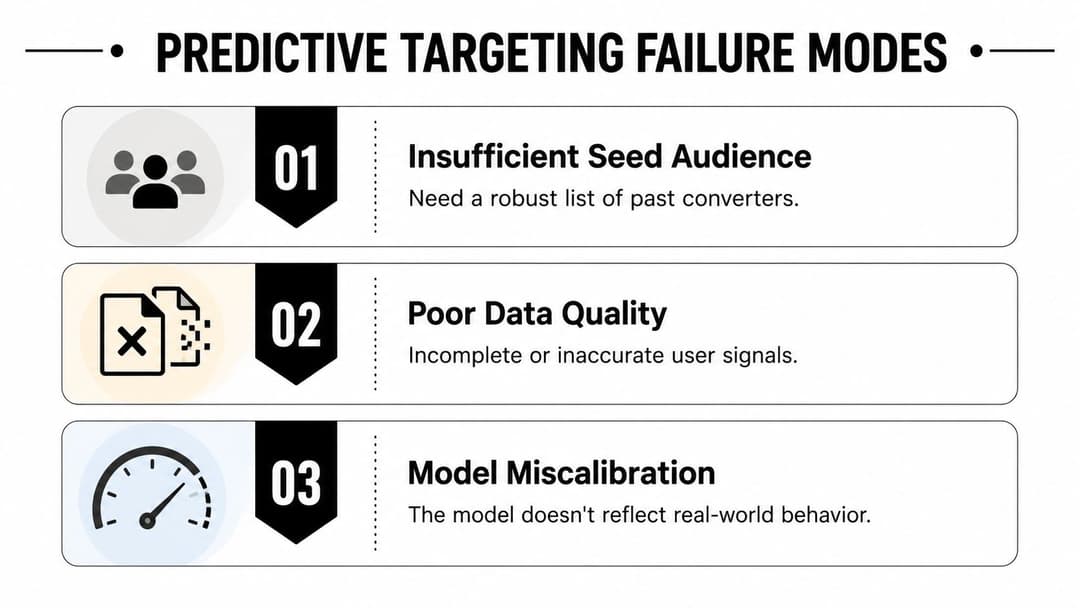
A buyer's diagnostic test
Before trusting the model, inspect the system in this order:
- Seed intent: Is the seed built from completed purchases, qualified opportunities, or another business outcome, or is it dominated by cheap engagement?
- Event integrity: Do timestamps, values, deduplication, consent status, and attribution rules create a consistent training signal?
- Coverage: Does the seed represent the customers you want more of, or only one narrow acquisition path?
- Drift: Have the offer, product mix, landing page, or creative changed enough to reduce the relevance of older behavior?
- Feedback cadence: Does the model receive usable outcomes often enough to respond to current performance?
Do not treat reach as proof of quality. Comscore reported that ID-free Predictive Audiences reached a 96% incremental audience versus the same ID-based audience, demonstrating how predictive modeling can extend reach without exact identifiers (Comscore's ID-free targeting analysis). The business test remains downstream value, qualified conversion rate, and cost efficiency.
If those measures do not beat the manual control after a fair test, keep the manual approach. Predictive targeting is useful when data quality, seed coverage, and feedback frequency support it, not as a default replacement for buyer judgment.
Implementation Options from Native Tools to AI Platforms
Teams choose among three implementation paths. The right choice depends on data maturity, operating capacity, and how much control the buyer needs over the model.
Native Meta tools are the simplest starting point. Lookalike Audiences, Advantage+ Shopping campaigns, and related automated delivery options reduce setup work and keep optimization inside Meta's environment. They suit teams that want fast deployment and have clean conversion tracking. The trade-off is limited visibility into the model's internal decisions and dependence on one platform's available signals.
Third-party data platforms can add enrichment, intent information, or identity-safe audience construction. They may help when a brand's first-party dataset is incomplete, but integration, consent management, audience governance, and ongoing list maintenance become the advertiser's responsibility.
A full-stack AI platform sits closer to the campaign workflow. AdStellar AI can connect with Meta Ads Manager, ingest historical performance, generate campaign and audience combinations, and rank performance across goals such as CPA, CPL, or ROAS. That approach can reduce manual assembly, but it still depends on accurate event data and disciplined testing. Teams evaluating automation alongside broader technology strategy may find Faberwork LLC's latest insights useful for framing the operational trade-offs.
| Implementation Type | Best For | Key Limitation | Typical Cost |
|---|---|---|---|
| Native platform tools | Lean teams and straightforward Meta programs | Walled-garden signals and limited model transparency | Platform media spend and any applicable platform fees |
| Third-party data platform | Brands needing enrichment beyond native events | Integration, consent, and audience maintenance | Vendor-dependent subscription or usage pricing |
| Full-stack AI platform | Agencies and growth teams managing repeated testing and optimization | Requires clean data and process adoption | Vendor subscription, service fees, or usage-based pricing |
The practical choice is less about buying the most advanced tool and more about removing the bottleneck. If the team can't maintain event quality, a new platform won't solve the problem. If the team spends its time exporting audiences, rebuilding campaigns, and manually comparing combinations, automation may create value by shortening the feedback cycle.
Launching Your First Predictive Campaign
Start with the customer outcome, not the platform setting. Define the conversion you want the model to prioritize, then separate high-value customers from low-value actions. A purchase, qualified sales opportunity, or retained account usually teaches a different lesson from a page view or an unqualified form fill.
Audit the event stream before creating an audience. Check deduplication, purchase values, timestamps, consent handling, exclusions, and whether the platform receives both positive and negative outcomes. If the data is incomplete, begin with a controlled test rather than giving the model unrestricted budget.
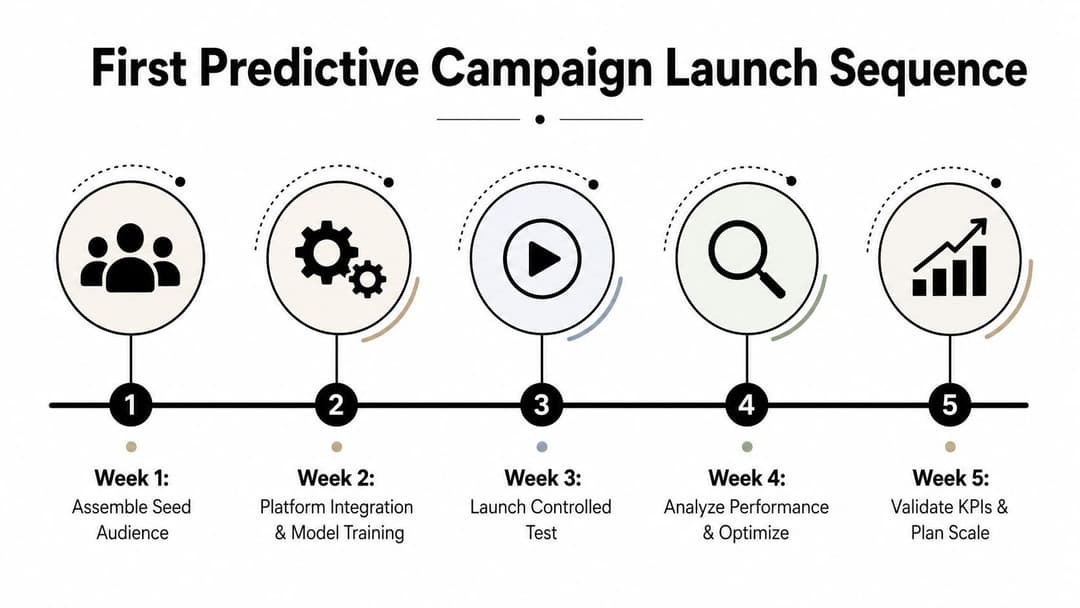
Build a controlled test
Use a clean control structure where possible. Keep the offer, landing page, conversion event, and creative logic consistent enough that audience quality remains the main variable. Don't change the audience, bid approach, creative package, and attribution settings at the same time, or the result won't tell you what caused the change.
Give the model room to explore without allowing an unvalidated audience to consume the entire account budget. The correct budget depends on conversion value, sales-cycle length, and the platform's delivery behavior, so use guardrails rather than an arbitrary universal threshold.
Review performance at three levels:
- Early delivery: Check event firing, spend distribution, audience overlap, placement quality, and whether excluded customers are still entering the pool.
- Learning period: Compare qualified conversion rate, cost efficiency, conversion lag, and downstream value against the manual control.
- Maturity review: Inspect whether performance holds as the audience expands, or whether the model is only harvesting the same high-intent users already present in the control.
Don't kill a segment because it has a weak first day, and don't scale it because of an attractive early click rate. Wait for the conversion window that matches the buying cycle, then compare business outcomes.
Teams that need help mapping available data sources before launch can use audience research tools. The most useful launch question is simple: does the model identify incremental qualified demand, or does it rename demand you already knew how to reach?
Scaling Predictive Audiences with Automation
Scaling changes the operating problem. A buyer can manually export a customer list, create a lookalike, upload exclusions, review delivery, and rebuild the audience. That workflow becomes fragile when conversion data changes quickly or when several campaigns compete for the same high-propensity users.
Automation closes the loop by connecting outcomes to audience decisions. A mature setup can ingest purchase and lead quality signals, evaluate creative performance, update propensity rankings, and shift delivery toward cohorts that continue to produce valuable outcomes. The important distinction is not that the system makes decisions automatically. It's that the system can make those decisions repeatedly without waiting for a buyer to reconstruct the workflow.
What the feedback loop should contain
Post-purchase behavior is often more valuable than the initial conversion alone. Customer value, repeat purchase patterns, refunds, lead qualification, and sales outcomes can help distinguish a conversion that should be replicated from one that should be excluded from future optimization.
Creative data belongs in the loop as well. If one message attracts low-quality leads while another produces qualified demand, the audience model should not evaluate those users as interchangeable. Audience, message, placement, and outcome need to remain connected.
Automation can also support fatigue management by refreshing seed inputs, suppressing converted users, and identifying when a previously useful pattern has decayed. It won't eliminate fatigue automatically if the conversion event is wrong or the account lacks enough fresh feedback. Operational speed amplifies the quality of the system you give it.
Decision test: Graduate from native tools when manual audience maintenance, campaign assembly, and performance triage are slowing the feedback loop more than they are improving control.
The industry is moving toward privacy-conscious modeling, broader contextual understanding, cross-platform measurement, and closer coordination between audience prediction and creative generation. Those developments won't remove the need for diagnosis. They make diagnosis more important, because an opaque model can scale a flawed assumption faster than a manual buyer can.
Start with native automation when your data is limited and the workflow is simple. Add enrichment when you have a clear signal gap. Consider a dedicated platform when you have recurring campaign volume, reliable conversion feedback, and a measurable cost to manual execution.
AdStellar AI helps teams connect historical Meta performance with campaign building, audience exploration, creative testing, and performance insights in one workflow. If your predictive targeting process is slowed by manual setup and disconnected feedback, visit AdStellar AI to evaluate how its automation fits your campaign operation.