You're seven days from Black Friday, the prospecting campaign is still cold, and your discount plan assumes shoppers will wait for one short burst of demand. Meanwhile, competitors have been educating audiences, testing creative, and collecting intent for weeks. Launching harder at the last minute may buy reach, but it can also buy expensive traffic, exhausted margins, and a reporting dashboard full of noise.
Holiday marketing campaigns now need to behave like an operating system, not a single promotion. The strongest programs connect early discovery, peak conversion, shipping deadlines, gifting, retention, and post-holiday demand. They also account for shoppers who use AI tools to compare products, prices, specifications, and reviews before they ever click an ad.
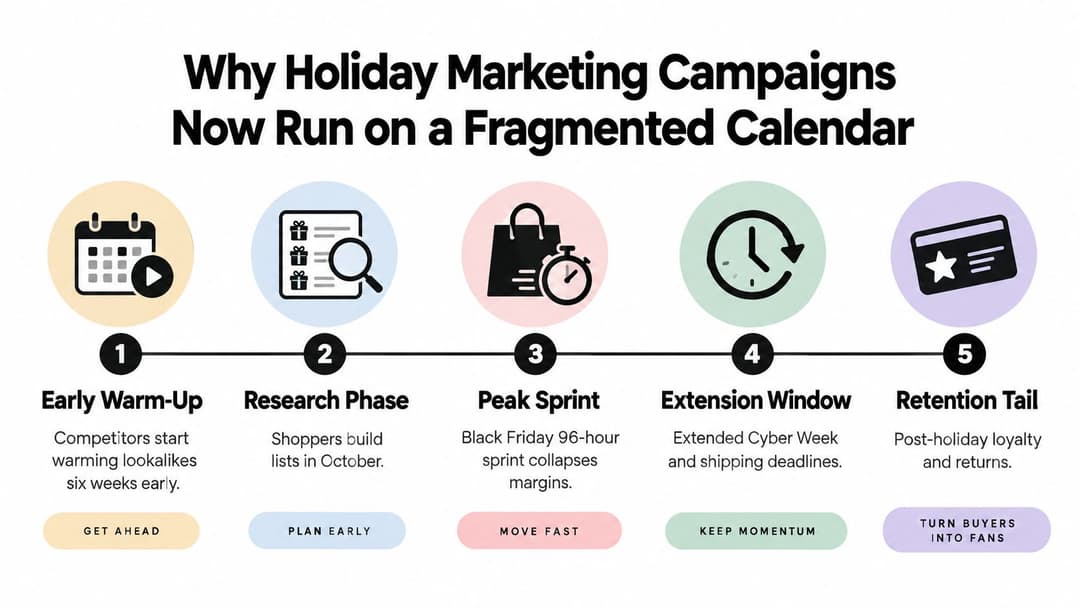
Why Holiday Marketing Campaigns Now Run on a Fragmented Calendar
A DTC brand that treats Black Friday as one sprint usually discovers the problem too late. By the time the offer goes live, other advertisers have already warmed prospecting audiences, built retargeting pools, and established creative patterns. The late entrant then increases spend into the most competitive auction while customers are comparing several brands at once.
The holiday window is fragmented into distinct buying states:
- Early warm-up: Mid-October through early November, when shoppers research products, save ideas, and build gift lists.
- Research and consideration: The period when education, comparisons, demonstrations, and value framing earn future demand.
- Cyber Week peak: The high-pressure promotion window, where urgency rises but discounts can erode contribution margin.
- Post-peak recovery: The days after Cyber Week, when brands need to convert remaining intent without pretending every shopper is still waiting for the same deal.
- Retention tail: The run toward Christmas Eve and New Year, shaped by delivery confidence, gift cards, returns, self-gifting, and loyalty.
The economics explain why late launches feel punishing. In 2024, advertisers were expected to spend $299.2 billion during the final quarter, with more than half concentrated in the holiday season, while holiday shopping was projected to generate nearly $1.4 trillion in total retail sales. That scale turns Q4 into a high-stakes competition across social, search, video, and commerce media, not a niche promotional period. Seasonal marketing statistics provide the broader context.
Build an always-on funnel
Start prospecting before the promotion is fully revealed. Early creative should help people understand the product, identify the right use case, and compare alternatives. Retarget engaged visitors and video viewers as the offer becomes clearer, then shift December messaging toward gift guides, delivery certainty, gift-ready packaging, and retention.
Consumer timing supports that approach. Mintel-based guidance cited by Amazon Advertising said 42% of customers expected to shop before Thanksgiving and 27% planned to shop between Thanksgiving and Cyber Monday in 2025. Other reporting indicated that more than half of consumers began shopping from September through early November, while social media held the largest planned budget share in one 2026 advertiser survey, at 68%, ahead of performance TV and connected TV at 54%, and online video at 44%. The WARC global ad-spend report captures this broader shift toward earlier, digital-first planning.
AI-assisted comparison shoppers add another layer. They don't only respond to a clever hook. They ask whether the product is worth the price, compare specifications, look for deal changes, and assess trust signals. Your creative needs to answer those questions directly, with clear product facts, transparent pricing, credible proof, and a landing page that says exactly what the ad promised.
Your Pre-Holiday Readiness Audit and Q4 Timeline
A holiday account rarely fails because the team lacks ideas. It fails because one operational layer can't handle pressure. Audit budget pacing, audience hygiene, creative inventory, and measurement before the auction becomes expensive.
The four checks that prevent avoidable damage
Budget pacing logic should distinguish between planned spend and available demand. A daily budget that can't flex toward proven ad sets will starve winners, while an unrestricted increase can create a margin problem. Set spend controls by campaign role, not just by account total.
Audience hygiene matters more as purchase behavior accelerates. Refresh lookalike seeds with relevant Q4 purchasers, exclude recent converters from acquisition campaigns where appropriate, and separate existing customers from genuine prospecting. A broad audience isn't a substitute for clean exclusions.
Creative inventory needs enough variation to survive fatigue. Build at least 6 to 8 concepts per ad set, with 3 hook variants per concept, and make sure the variations change the reason to buy, not merely the background color. A product demo, comparison, customer reaction, and gift-use scenario give the delivery system more useful options than several near-identical statics.
Measurement must be tested before launch. Verify the pixel, Conversions API, server-side events, event prioritization, and deduplication. Confirm that purchase values, currencies, and product IDs arrive consistently in Meta and your analytics platform. A broken event path is especially costly during a period when decisions happen quickly.
Use a reverse timeline from Black Friday:
- T-60: Verify tracking, QA landing pages, and approve creative briefs.
- T-45: Refresh lookalike and broad-audience seeds using current purchasers and high-intent visitors.
- T-30: Soft-launch prospecting tests at 20% of peak budget to identify hooks before the auction tightens.
- T-14: Review fatigue, replace weak concepts, and lock the creative replacement cycle.
- T-7: Confirm bid strategies, daily caps, exclusions, stock positions, and day-part rules.
- T-0: Monitor spend, conversion quality, inventory, customer care, and margin throughout the peak.
- T+3: Launch retention, gift-card, cross-sell, and post-purchase messaging based on actual buyer behavior.
Before October 1, score each item:
- Green: Tested, documented, and owned by a named person.
- Yellow: Working but unproven under seasonal volume.
- Red: Missing, unreliable, or dependent on manual intervention.
A practical launch checklist should include both platform setup and business readiness. Use this campaign launch checklist to turn the audit into a repeatable preflight process.
Practical rule: Never let the first meaningful tracking test happen after the holiday offer goes live.
Building Segments, Offers, and Copy Frameworks That Match Each Shopper Phase
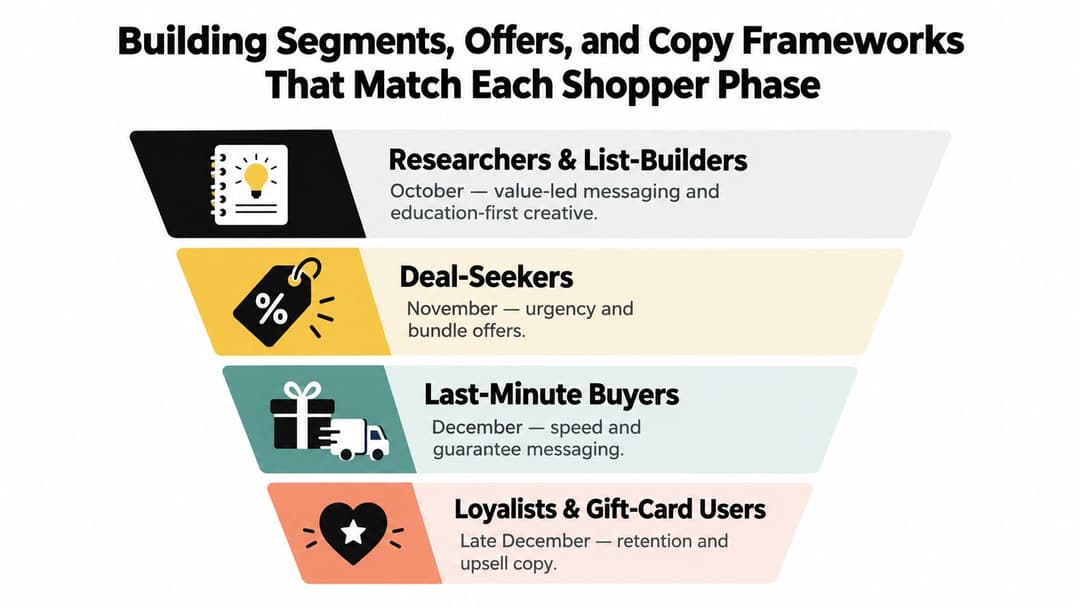
Demographics won't tell you enough during the holidays. A parent researching a gift, a repeat customer waiting for early access, and a deal hunter comparing prices may share the same age range, but they need different reasons to act.
Start with four intent groups:
- Researchers and list-builders need confidence before urgency. Use education-first creative, product comparisons, gift guides, and a free-shipping threshold that makes the eventual purchase easier to justify.
- Deal-seekers respond to a clearly bounded offer. Use a percentage discount with an explicit expiry, but show the original value and the conditions without hiding important terms.
- Gift-givers need reassurance. Lead with recipient and occasion, then support the offer with gift-ready packaging, bundle positioning, delivery clarity, and an extended return window.
- Self-gifters and lapsed buyers need recognition rather than generic acquisition language. Use loyalty offers, exclusive early access, and a self-reward angle that acknowledges the purchase is for them.
Use a three-block copy system
Hook: Name the problem, recipient, or occasion.
Proof: Show the price change, product evidence, stock context, customer proof, or comparison point.
CTA: Tell the shopper what to do and when the opportunity ends.
Examples of short primary text include:
- “A thoughtful gift, without the last-minute scramble.”
- “Compare the features before you choose your holiday favorite.”
- “Your early-access offer ends tonight.”
- “Gift-ready packaging, simple returns, less guesswork.”
Headline formulas should stay specific:
- Gift for [recipient], ready for [occasion]
- Save on [product], through [deadline]
- The practical upgrade for [use case]
- Compare [product category] with confidence
Descriptions can reinforce logistics rather than repeat the headline:
- “Ships quickly. Gift-ready options available.”
- “Clear pricing, useful details, easy returns.”
- “Bundle value for the person who has everything.”
Keep the first line understandable without a click. Meta may truncate longer text, and AI comparison tools may extract product claims from the visible copy and landing page. Don't bury the differentiator beneath seasonal decoration.
For audience structure and exclusions, this Facebook audience segmentation guide offers a useful operational reference.
Producing Creative at Scale and Launching Winners Without Burning Budget
A working assembly line beats a holiday brainstorm. Fix the three variables before production begins: shopper phase, offer type, and proof asset. The proof might be UGC, a product demonstration, a comparison, packaging footage, or a review excerpt that the brand has permission to use.
For each angle, create four hook lines, two statics, two UGC cuts in 9:16 and 1:1, and one carousel. That creates a 7-asset cell. Six cells for one product produce roughly 42 ads per SKU, enough variation to test meaningful angles without asking designers to invent a new campaign every morning.
Creative cell matrix per shopper phase
| Shopper Phase | Static Ads | UGC 9:16 | UGC 1:1 | Carousel | Hook Lines |
|---|---|---|---|---|---|
| Early researchers | 2 | 2 | 2 | 1 | 4 |
| Peak deal-seekers | 2 | 2 | 2 | 1 | 4 |
| Gift-givers | 2 | 2 | 2 | 1 | 4 |
| Retention and self-gifting | 2 | 2 | 2 | 1 | 4 |
Use one campaign structure where the platform can allocate toward promising combinations. Advantage+ placements and campaign budget optimization can help distribute delivery, but don't confuse automation with strategy. Name every asset by phase, angle, offer, format, and version so a buyer can identify fatigue without opening each ad.
A sensible testing routine includes a clear evaluation gate. Let each ad gather enough impressions to produce a meaningful signal, then cut it if it misses the account's dynamic ad-level CPA or hold-rate target. The plan notes recommend evaluating around $50 to $75 per ad before making that call. Treat that as a testing control, not a universal truth. A high-AOV product and a low-AOV product shouldn't share the same threshold.
Creative rule: Promote winners into broad and lookalike prospecting. Don't recycle the same winner into every retargeting layer until frequency makes the message feel stale.
Refresh roughly every 7 to 10 days when delivery is heavy, and keep unused concepts in a parking lot. Late-deal windows often need a different emotional register, such as delivery confidence or a final gift solution, rather than another version of the original discount ad.
AI can speed production when the brief and approval rules are already clear. For teams adapting short-form concepts across placements, a resource on how to render TikTok ads with AI can help expand the format mix without turning every variation into a manual edit. AdStellar AI is another workflow option for generating combinations of creative, copy, and audiences, then using performance insights to rank and launch campaign variations through a Meta connection. Keep human review in the loop for claims, prices, exclusions, and brand safety.
Use this ad creative strategy guide to formalize the brief, naming system, and testing workflow before production starts.
Bidding, Budget Pacing, and Audience Expansion Levers
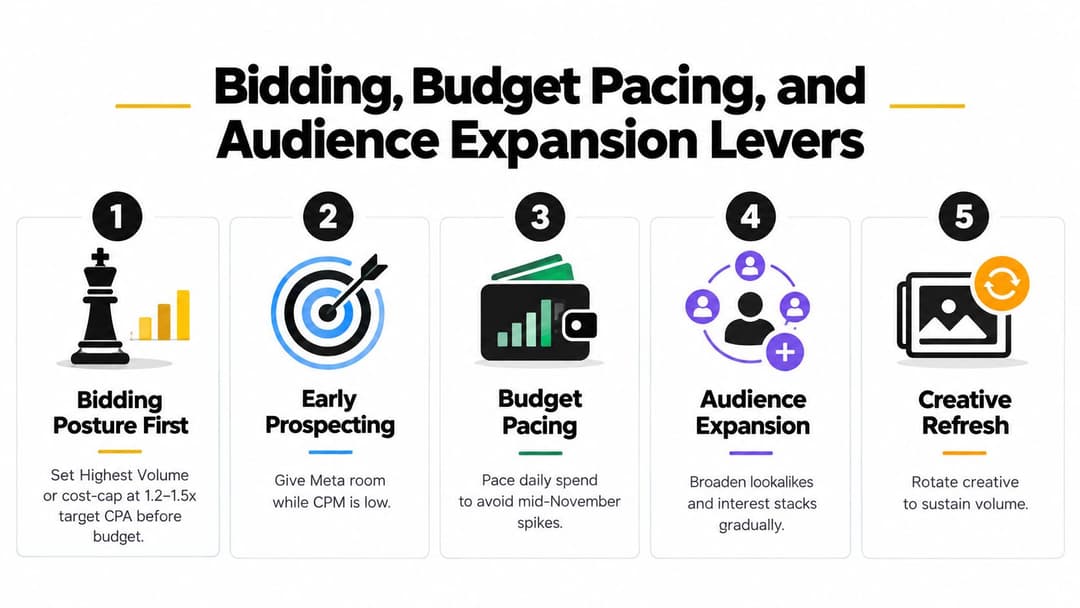
Set the bidding posture before setting the budget. Early prospecting usually benefits from Highest Volume or a cost cap that gives Meta room to find converters while demand is still developing. The working guidance here is a cost cap around 1.2 to 1.5 times target CPA, but that range only makes sense when the target reflects current economics and the account has enough conversion signal.
As peak approaches, tighten the control based on the business constraint. A bid cap can protect efficiency, while value optimization can prioritize stronger orders when average order value varies. Don't switch strategies because the calendar changed. Switch when the cost of delivery, conversion quality, inventory, and margin require a different trade-off.
Use a scaling rubric, not adrenaline
Pace budgets weekly, then monitor daily for operational exceptions. A fixed 20% daily cap can hide demand surges and leave winners underfunded during the morning shopping rush. Build three budget tiers:
- Proven performers, 60%: Stable campaigns with acceptable CPA, conversion quality, and margin.
- Expansion, 30%: Broad audiences, top 10% lookalikes, and Advantage+ Audience signals sourced from validated winners.
- Experiments, 10%: New creative angles, new audience inputs, or late-deal offers that can be stopped quickly.
Scale only when the signal is consistent. A campaign with ROAS above 2.0x for three consecutive days and stable CPA qualifies for a 20% budget lift under this rubric. Anything below the account's 21-day benchmark gets paused rather than repeatedly edited. Editing resets learning and can turn a weak campaign into a permanently uncertain one.
Avoid stacking Advantage+ Shopping over manual retargeting when both campaigns address the same users. That structure can cannibalize demand and make incrementality difficult to read. Separate acquisition, consideration, retention, and customer lists, then decide where automation has enough room to work.
A budget plan should also include a stop condition for operational risk. Pause or restrict spend when stock, shipping promises, tracking, or customer service cannot support the advertised offer. The cheapest conversion is still a bad result if it creates refunds, complaints, or an avoidable margin loss.
For account-level allocation examples and planning mechanics, see the Facebook ad budgets guide.
KPIs, Measurement, and Reading Signal Through December Congestion
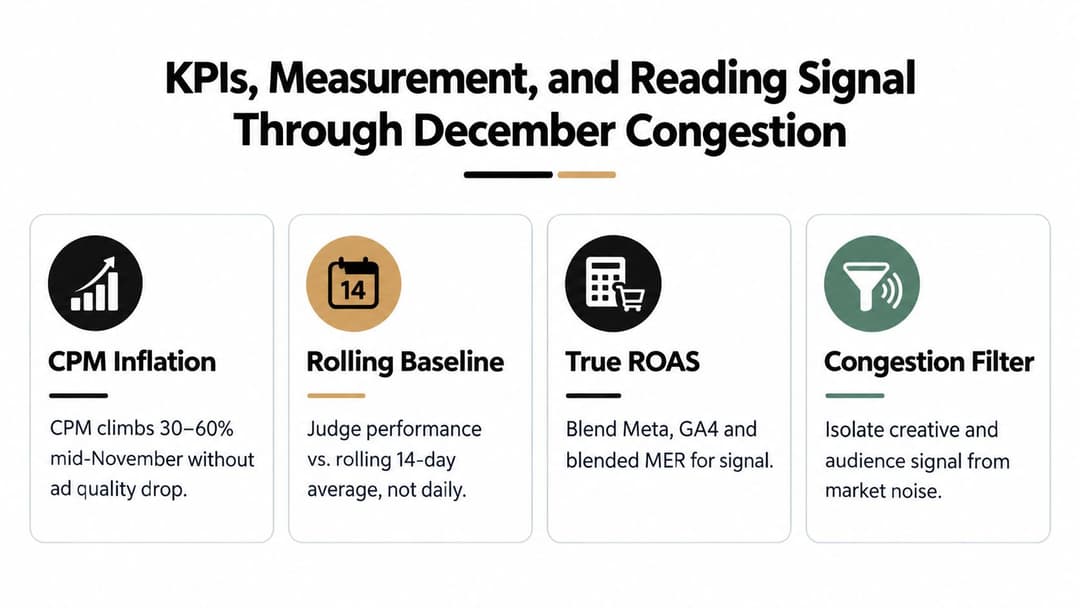
December metrics often look broken because the market is compressed, not because every ad suddenly became irrelevant. Seasonal competition can push CPM higher, so judge performance against your own rolling baseline instead of comparing one volatile day with an ordinary period.
The useful question isn't “Did CTR fall?” It's “Did the ad produce qualified downstream behavior at an acceptable blended cost?” Open rates and CTR can lose explanatory power when shoppers are overwhelmed by offers. Conversion quality, landing-page continuity, add-to-cart cost, and revenue contribution deserve more weight.
Read the account through four lenses
- Auction pressure: Track CPM trends and compare them with a rolling 14-day baseline, rather than reacting to a single spike.
- Funnel efficiency: Watch cost per add-to-cart and cost per conversion by shopper phase.
- Cohort quality: Compare December 1 through 31 purchase cohorts with September baseline cohorts to identify whether seasonal buyers behave differently.
- Blended economics: Use MER alongside platform ROAS. MER absorbs delivery volatility and exposes whether total paid-media spend is supporting the business, not just one attributed channel.
During Black Friday week, use 7-day click plus 1-day view attribution to recover upstream signal. For final Cyber Week decisions, switch back to 7-day click so the team isn't over-crediting incidental views.
Keep the daily dashboard intentionally small. Each ad set needs only:
- Spend
- Conversions
- Cost per conversion
- Hold rate
Naming conventions make that dashboard useful. Encode phase, objective, audience tier, and creative angle in campaign and ad-set names. A clean naming system turns the post-sale read into a short operating review rather than a forensic exercise.
Reporting discipline: Don't optimize a holiday campaign to the metric that is easiest to improve. Optimize the metric that protects contribution and future demand.
For a deeper process for separating creative, audience, and market effects, use this campaign performance analysis guide.
Beyond Cyber Week and What to Do Next
Cyber Week is an important event, but it isn't the whole holiday business. Consumer timing is split between early planning and late buying. Recent data showed 45% of consumers started before November, while 62% still expected to buy in December, and nearly 40% split purchases between online and in-store. Experian's holiday shopping trends support an always-on, cross-channel sequence rather than a single peak.
AI-assisted discovery makes the post-peak lesson even more important. One global holiday retail report found that 64% of shoppers planned to use AI tools during the season, while another report said over half of consumers turned to AI for shopping support, especially price checks and deal alerts. Shopify's global holiday retail report highlights why structured product information, transparent pricing, current reviews, clear availability, and consistent landing-page claims matter. Deal assistants need facts they can compare, not vague urgency.
Several tactics deserve less attention:
- Seven-touch retargeting chains often create repetition without adding new information. Replace them with behavior-based messages tied to product views, cart status, delivery needs, and prior purchase.
- Generic urgency copy becomes background noise. Replace “Shop now” with a concrete reason to act, such as a shipping deadline, gift-ready option, or offer expiry.
- Blanket lookalikes can dilute signal. Replace them with refreshed seeds, broad testing, and audience tiers that reflect actual customer value.
Post-holiday 30-60-90 day action plan
| Phase | Focus Area | Key Actions | Owner |
|---|---|---|---|
| First 30 days | January demand capture | Re-engage gift-card users, build post-purchase upsells, and turn December objections into January creative | CRM and paid social |
| Days 31 to 60 | Creative and seasonal preparation | Refresh concepts, recalibrate frequency controls, and seed Valentine's Day and Mother's Day prospecting | Creative and media |
| Days 61 to 90 | Account consolidation | Clean the catalog, consolidate audiences, and benchmark next year's Q4 baseline against this year's cost-per-purchase curve | Growth and analytics |
Graduate winners into evergreen only when they pass a simple rubric. The creative must meet the account's CPA or ROAS floor across more than one audience tier, remain relevant without the holiday deadline, and have a landing page that supports the promise. It should also survive a controlled budget increase without a sudden deterioration in conversion quality. If it needs a holiday-only discount to work, keep it seasonal rather than forcing it into evergreen.
AdStellar AI helps performance teams generate and organize creative, copy, and audience combinations, launch Meta campaigns, and rank results against goals such as ROAS, CPA, or CPL. Visit AdStellar AI to turn this holiday testing and scaling rubric into a repeatable campaign workflow.