Most Meta advertisers have been there: three weeks into a campaign, budget steadily draining, creative refresh after creative refresh, and still no clear signal about what is actually working. The instinct is to throw more budget at the problem or try a completely different audience. But more often than not, the real issue is not the targeting or the spend level. It is the absence of a deliberate creative strategy.
The campaigns that scale on Meta and the ones that stall share a common differentiator. It is rarely budget size. It is almost always the quality and consistency of the creative decision-making behind them. Advertisers who build systems around their creatives outperform those who rely on instinct and occasional luck, even when the latter are spending more.
Ad creative strategy is the deliberate system for planning, producing, testing, and iterating on your ad creatives to drive better performance over time. It is what separates a media buyer who occasionally stumbles onto a winning ad from one who reliably produces them. This guide covers everything you need to build that system: the core components of a strong creative strategy, how to construct a testing framework that generates real learning, how to interpret performance signals at the creative level, which formats to use and when, and how to turn individual winners into a repeatable playbook.
The Building Blocks of a Strong Ad Creative Strategy
Before getting into tactics, it helps to be precise about what ad creative strategy actually means. It is not a mood board or a brand guideline document. It is an operational system: a structured approach to deciding which creatives to make, how to test them, and how to use what you learn to produce better ones next time. The emphasis is on the word system. Ad hoc creative decisions, even good ones, do not compound the way a system does.
Every effective ad creative strategy rests on three core components.
Creative formats: The medium you choose shapes how your message lands. On Meta, the main options are static image ads, video ads, and UGC-style content. Each has distinct production requirements, performance characteristics, and ideal use cases. A strong strategy does not pick one and ignore the rest. It maps formats to objectives and tests across them deliberately.
Messaging angles: This is the conceptual frame around your offer. Are you leading with a pain point the audience recognizes? Leaning on social proof from existing customers? Showing a transformation from before to after? The angle is often more important than the execution. Two ads with identical visuals but different angles can produce dramatically different results. Identifying which angles resonate with which audiences is one of the highest-value activities in creative strategy.
Audience-creative alignment: Not every message works for every segment. A cold audience seeing your brand for the first time needs a different creative approach than a warm retargeting audience that already knows your product. Mapping your creative angles and formats to the right audience segments is what makes a strategy coherent rather than just a collection of ads.
There is a broader reason why creative strategy has become so central to Meta advertising success. The platform's algorithm is increasingly sophisticated at using creative signals to find the right people. Strong creative does not just convert the audience you target. It effectively does targeting work on its own, because the algorithm reads engagement signals and expands delivery toward people who look like those responding. This means that investing in creative quality and strategic variety is not just a creative decision. It is a targeting decision.
How to Build a Creative Testing Framework That Actually Scales
There is a significant difference between running A/B tests and having a creative testing framework. A/B tests produce data. A framework produces learning that compounds over time. The distinction matters because without structure, you can run dozens of tests and still not know why one ad outperformed another.
The foundation of a useful testing framework is variable isolation. When you change multiple elements between two ads simultaneously, such as the hook, the visual style, and the headline, you cannot attribute the performance difference to any single factor. Structured testing means changing one variable at a time so that every test teaches you something specific and actionable.
A practical testing hierarchy works from broad to specific. Start at the top level by testing across formats and angles. Which resonates more: a pain-point angle or a transformation angle? Does video outperform static for this audience and offer? These broad tests eliminate weak directions quickly without wasting production resources on detailed variations of concepts that do not work.
Once a format and angle show promise, move to the next level: testing specific creative elements within that direction. This is where you isolate hooks, since the first three seconds of a video or the first line of copy is often the primary driver of whether someone stops scrolling. Test different opening statements while keeping everything else consistent. Then test CTAs, visual compositions, and headline phrasing in the same methodical way.
The volume question matters more than most advertisers realize. Running a handful of variations gives you directional signals at best. Running a meaningful number of variations simultaneously accelerates your learning curve because you reach statistical confidence faster and reduce the risk that a single ad's performance is driven by external factors like day of week or audience saturation. The challenge has historically been production capacity. Creating ten to twenty meaningful variations manually takes significant time and resources.
This is where bulk creative production tools change the equation. Platforms like AdStellar allow you to generate hundreds of ad variations by mixing multiple creatives, headlines, audiences, and copy combinations, then launch every combination to Meta in minutes rather than hours. When production is no longer the bottleneck, testing volume becomes a realistic part of your strategy rather than an aspiration.
One more principle worth internalizing: every test should have a hypothesis before it runs. "Let's see what happens" is not a framework. "We believe a pain-point hook will outperform a curiosity hook for this cold audience because the product solves a specific problem" is a hypothesis. When the results come in, you are either confirming or refining a belief, not just collecting data points.
Reading the Signals: What Your Creative Performance Data Is Telling You
Data without interpretation is noise. Understanding what your creative metrics are actually telling you is what separates advertisers who optimize effectively from those who make reactive decisions based on surface-level numbers.
Three metrics form the core of creative-level evaluation, and each tells a different part of the story.
CTR (click-through rate) is your scroll-stopping signal. A high CTR means your creative is compelling enough to interrupt someone's feed and earn a click. A low CTR, especially on a creative with significant impressions, tells you the visual or hook is not landing. CTR is the earliest signal you will get on a new creative, which makes it useful for quickly cutting underperformers before they consume too much budget.
CPA (cost per acquisition) is your conversion signal. A creative can generate strong CTR and still produce a poor CPA if it attracts clicks from people who are not genuinely interested in the offer. CPA tells you whether the creative is doing the full job: attracting the right people, not just any people. When CTR is strong but CPA is weak, the disconnect is often in the landing page experience or in the audience-creative alignment.
ROAS (return on ad spend) is the ultimate efficiency measure. It contextualizes everything else by connecting creative performance to business impact. A creative with a strong ROAS is not just converting. It is converting profitably. This is the metric that determines whether a creative earns more budget or gets paused.
Knowing when to call a creative a winner versus recognizing one that is simply spending is a skill that develops with practice. Early in a campaign, look for directional signals rather than definitive conclusions. A creative that shows strong CTR in the first 48 to 72 hours is worth watching closely. One that is spending at pace but generating no clicks or conversions is worth pausing early before it drains budget without generating learning.
Creative fatigue is one of the most important and commonly mishandled dynamics in Meta advertising. As an ad accumulates impressions within a given audience, engagement typically declines over time. The instinct is to retire the ad entirely. But often the smarter move is to refresh the execution while preserving the underlying angle. If a pain-point message drove strong performance, the angle itself has validated value. New visuals, a different hook, or updated copy can extend the life of that angle considerably. Abandoning what worked is a missed opportunity. Refreshing it is a strategy.
Creative Formats for Meta: Choosing the Right Medium for Your Message
Format is not just a production decision. It is a strategic one. The medium you choose shapes how your audience receives your message, how much friction exists in the creative process, and how well the ad fits the context in which it appears.
Static image ads are fast to produce, easy to iterate on, and highly effective for direct offers with clear value propositions. When your message is simple and the offer is compelling on its own, a clean, well-designed image ad can outperform more elaborate formats. Static ads also tend to load faster and render consistently across devices, which matters for conversion-focused campaigns where every second of friction counts.
Video ads offer higher engagement potential and stronger storytelling capacity. They give you time to build context, demonstrate a product, and create emotional resonance that a static image often cannot achieve. Video is particularly effective for awareness-stage campaigns where the goal is to introduce your brand or product to a cold audience and leave a lasting impression. The tradeoff is production complexity and cost, though AI-powered creative tools are reducing both significantly.
UGC-style content has become one of the most discussed formats in the Meta advertising community for good reason. Content that looks and feels like something a real customer created blends into organic feed content more naturally than polished brand advertising. It reduces the immediate "this is an ad" signal that causes many users to scroll past, and it builds trust through perceived authenticity. UGC-style ads tend to perform particularly well for products where social proof and peer validation are meaningful purchase drivers.
Matching format to funnel stage is a practical framework that improves strategy coherence. Awareness campaigns, where the goal is reach and first impressions, often benefit from video and UGC-style content because both formats create more context and emotional connection. Conversion-focused campaigns, where the goal is a direct action from a warmer audience, frequently perform well with clear, direct image ads that remove ambiguity and focus attention on the offer.
One element that deserves more attention than it typically gets is ad copy and headlines. These are creative variables in their own right, not afterthoughts layered onto a visual. The headline is often the first text element a viewer reads, and it can dramatically amplify or undercut the impact of even a strong visual. Treating copy as a separate variable in your testing framework, rather than writing it once and leaving it unchanged, is one of the higher-leverage adjustments most advertisers can make to their creative strategy.
Systematizing Your Winners: From One Good Ad to a Repeatable Playbook
Finding a winning creative is valuable. Building a system that reliably produces them is transformative. The gap between those two outcomes usually comes down to documentation and institutional knowledge.
Many advertising teams run campaigns, find what works, and then move on to the next campaign without capturing why it worked. When team members change or campaigns end, the learning disappears. The next cycle starts from scratch, repeating the same discovery process that already happened. This is one of the most common and costly inefficiencies in performance marketing operations.
A creative winners library addresses this directly. The concept is straightforward: when a creative performs well, you document not just the ad itself but the factors that contributed to its performance. Which format was it? Which angle did it use? Which audience did it run against? What offer was in play? What was the hook? This structured documentation turns individual wins into transferable knowledge.
The next step is extracting the transferable insight. A winning creative tells you something specific if you look closely enough. Was it the hook that drove the strong CTR? Was it the visual style that felt native to the feed? Was it the offer itself that drove conversion? Identifying the specific element that carried the performance allows you to apply it to new variations rather than simply trying to replicate the original ad in different contexts.
This is where the concept of angle-led iteration becomes powerful. If a transformation angle drove strong performance for one product, test that same angle structure across other products or audiences. If a specific hook format generated high CTR, build a library of hooks using that structure. Winners become templates, and templates become a playbook.
AI-powered platforms are changing how this process works in practice. Rather than manually reviewing performance data and building documentation spreadsheets, tools like AdStellar automatically rank creatives, headlines, copy, audiences, and landing pages by real metrics including ROAS, CPA, and CTR. The Winners Hub surfaces your best-performing assets in one place with actual performance data attached, so you can instantly identify what worked and add it directly to your next campaign. The AI Insights leaderboard scores everything against your own benchmarks, making it easy to spot patterns across campaigns rather than analyzing each one in isolation.
The practical result is that your creative strategy gets smarter with every campaign rather than resetting. Each cycle of production and testing adds to a growing body of knowledge about what works for your brand, your audience, and your offers. That compounding effect is what separates advertisers who build scalable systems from those who are perpetually searching for the next winning ad.
From Strategy to Execution: Closing the Loop
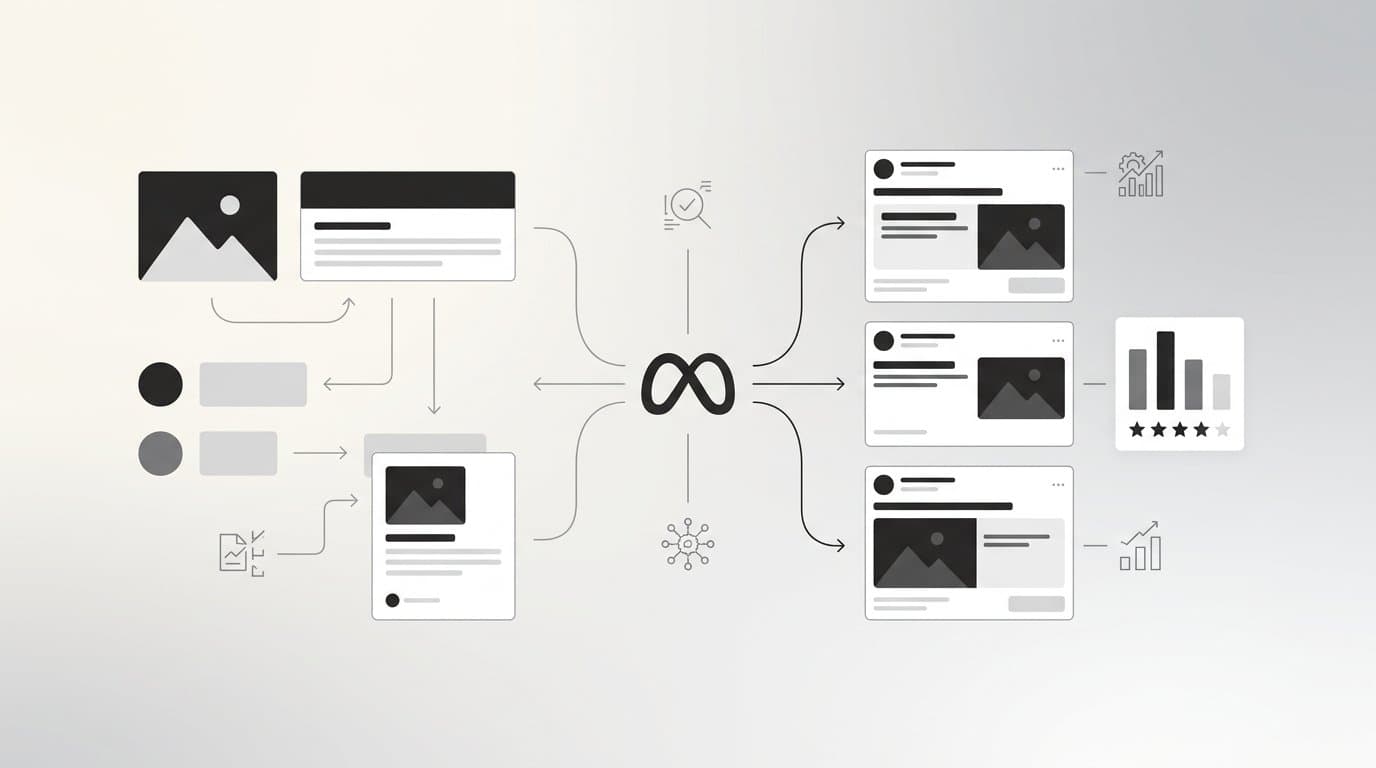
The full creative strategy loop looks like this: plan your angles and formats based on what you know about your audience and offer, produce variations at scale, launch and test systematically with isolated variables, read performance signals at the creative level, and feed winners back into the next production cycle. Each pass through the loop generates more signal, more institutional knowledge, and more efficiency.
The challenge most advertisers face is not understanding this loop. It is executing it at the speed and volume required to generate meaningful results. Producing enough creative variations to run a real testing framework, analyzing performance data across dozens of ads, documenting winners, and translating insights into new creative briefs is a significant operational load. Most teams simply do not have the bandwidth to do all of it consistently.
This is exactly the gap that AdStellar is built to close. The platform handles creative generation, campaign launch, and performance analysis in one place. You can generate scroll-stopping image ads, video ads, and UGC-style creatives from a product URL or brief. The AI Campaign Builder analyzes your past performance, ranks every creative and audience by results, and builds complete Meta campaigns with full transparency into the strategy. Bulk Ad Launch creates hundreds of variations and pushes them live in minutes. AI Insights and the Winners Hub surface your top performers automatically, so you always know what to build on next.
The creative strategy cycle that used to take weeks, from briefing to production to launch to analysis, compresses into days. That speed advantage compounds over time, because faster learning cycles mean faster iteration, and faster iteration means better performance.
Ad creative strategy is not a project with a finish line. It is a continuous loop of production, testing, and optimization. The advertisers who win consistently on Meta are not the ones who occasionally find a great ad. They are the ones who build systems that reliably produce great ads, learn from every test, and get smarter with every campaign.
If you are ready to run that system without the operational overhead, Start Free Trial With AdStellar and see how the platform can compress your creative strategy cycle, from generating winning creatives to surfacing your top performers automatically, all in one place.