Dynamic creative optimization (DCO) lets you hand an ad platform a set of building blocks and have it assemble, test, and favor the ad combinations that perform best. The catch is that it answers "which combination won" far more reliably than "why it won," and that gap is where most DCO campaigns go wrong.
On Meta, DCO sits behind a setting in Ads Manager, but the same idea also applies more broadly to generating and testing many variations. This article covers how dynamic creative optimization works, how it differs from A/B testing and catalog ads, what to feed it, and how to read the results without drawing false conclusions.
How Dynamic Creative Optimization Works Under the Hood
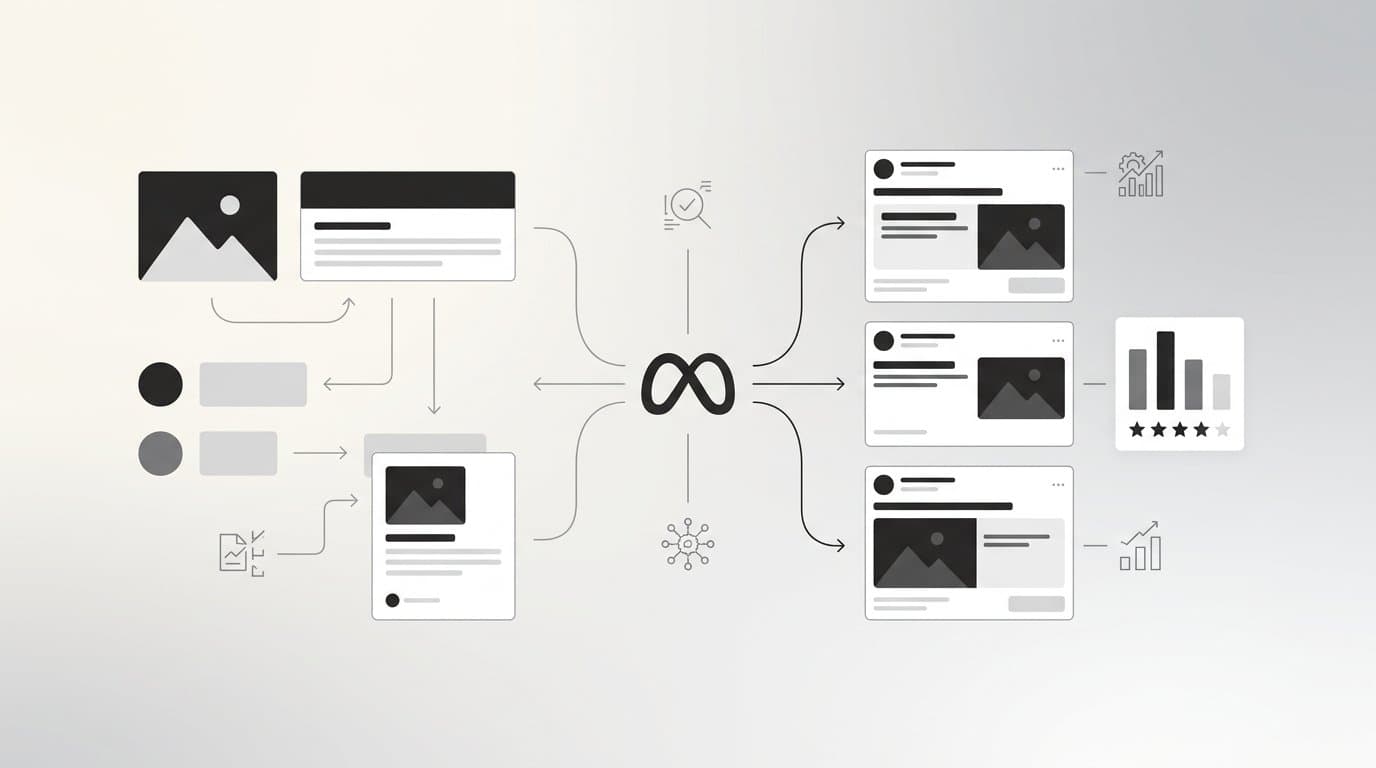
You supply components: images or videos, headlines, primary text, descriptions, and calls to action. The platform's delivery system mixes them into individual ads and shows different combinations to different users. Instead of you deciding which headline goes with which image, the system makes that call impression by impression.
The loop runs in four steps:
- Assemble. The system builds combinations from your pool.
- Deliver. Combinations are shown to early impressions, usually spread widely at first.
- Read signals. Engagement and conversion signals come back, such as clicks, add-to-carts, and purchases.
- Favor the leaders. Delivery tilts toward combinations that look strongest, while weaker ones get less exposure.
Because the system keeps learning as impressions accumulate, the mix of ads a given audience sees changes over the life of the campaign.
Two meanings of the term
The phrase gets used two ways. The narrow meaning is platform-native DCO: Meta's dynamic creative setting, which lives at the ad level and lets Meta handle the assembly and delivery. The broader meaning is the practice of producing and testing many variations across separate ads, campaigns, or even outside the platform, then reading which elements keep winning. Both share the same logic of many inputs, automated selection, and a shift toward what works. They differ in who controls the mixing and how much visibility you get into each combination.
Component limits
Meta caps how many of each component you can add inside a single dynamic creative ad, covering images or videos, headlines, text options, descriptions, and calls to action. Those caps and the exact placement of the toggle in Ads Manager have changed over time, so check Meta's current documentation before planning a pool around specific numbers. As of 2026, treat any figure you read in a blog post, including this one, as something to confirm at the source.
Dynamic Creative vs. Standard A/B Testing vs. Personalized Feeds
Three approaches get lumped together, and they solve different problems.
- Manual A/B test: You change one variable and hold everything else constant. The answer is clean, but it is slow, and you can only test one question at a time.
- Meta dynamic creative: Many variables change at once. Exploration is faster, but attribution is murkier because elements are always tangled together.
- Product-feed dynamic ads (catalog ads): The system pulls items from your product catalog and shows each viewer products they are likely to want. The creative template is fixed. The personalization is in which products appear.
That last row is the source of a common mix-up. Dynamic product ads and DCO are different mechanisms. One selects products per viewer from a feed. The other selects creative components from a pool you built. You can run both in the same account, but switching on one does not give you the other.
The core tradeoff
DCO tells you which combination won, not always why. If a specific image and headline pairing produces the best CPA, you know the pair works. You do not automatically know whether the image, the headline, or the interaction between them did the lifting.
The math shows why it appeals anyway. Imagine a DTC skincare brand with 4 images and 5 headlines. That is 20 possible combinations. Building 20 separate ads by hand, each with its own naming, tracking, and review, is tedious and easy to get wrong. Under DCO it is a single ad with two lists of assets. Add three primary text options and the count jumps to 60, which nobody would hand-build.
Use A/B testing when you need a defensible answer to one question, like "does a price-led headline beat a social-proof headline?" Use DCO when you need to explore a wide space quickly and are willing to accept a less precise explanation.
What to Feed the System: Building a Strong Asset Pool
The system can only optimize among what you give it. A pool of 30 near-identical variations gives it very little to learn from. Diversity beats volume: your variations should differ in angle, such as price, social proof, problem and solution, or urgency, not just in button color or a swapped adjective.
A starter set
- Visuals: 3 to 5 across formats, such as a product shot, a lifestyle image, and a short video.
- Headlines: 3 to 5, each testing one distinct angle.
- Primary text: 2 to 3 options with different openings and lengths.
- Call to action: one clear choice that matches the offer.
Keeping the CTA fixed removes one variable that rarely moves results much and keeps the pool manageable.
Avoid clashing assets
Because the system mixes components freely, every headline must work with every visual. If one headline promises 20% off and one image features a bundle deal, some users will see an ad that contradicts itself. Those incoherent pairings waste spend and muddy the data. Before launch, scan the grid mentally: could any headline sit on any image without confusion? If not, remove or rewrite the offender.
Filling the pool faster
Producing enough distinct assets is often the real bottleneck. AI creative generation helps here. With AdStellar's AI Ad Creative, you can generate image ads, video ads, and UGC-style avatar content from a product URL, then refine any ad through chat-based editing. You can also pull competitor ads from the Meta Ad Library as inspiration, using the angles they lean on as a starting point for your own versions. The aim is a pool that covers several angles without booking a designer for each one.
Reading DCO Results Without Fooling Yourself
Delivery systems tend to concentrate spend on early leaders. If a combination gets a lucky start, it can attract more impressions, which makes it look even better relative to the rest. A "winner" can therefore reflect a small sample and early noise rather than a real advantage. There is no universal spend or conversion threshold that guarantees a result is conclusive, so treat any specific cutoff you see quoted without a source with suspicion, and lean on your own account's volume and history.
Pick the right yardsticks
Judge by ROAS, CPA, and CTR measured against your own benchmarks, not against industry averages of unknown origin. Weigh them in that order for most conversion campaigns. CTR alone can reward clickbait: a provocative headline may pull clicks from people who never buy, lifting CTR while CPA worsens.
Break results down by asset
Look at performance by individual image and by individual headline, not only by top combination. Then check whether the same elements keep showing up near the top across several campaigns. A pattern that repeats in three campaigns is far stronger evidence than a single test, however dramatic.
A common misread
Suppose a headline about free shipping appears to win. On closer inspection, it was mostly paired with the strongest image in the pool, a bright, clear product shot. The headline may be riding that image's coattails. The fix is a follow-up isolated test: run the free-shipping headline and a competing headline against the same image and see whether the gap survives.
Keep learnings reusable
Findings die in screenshots unless you store them. AdStellar's AI Insights ranks creatives, headlines, copy, audiences, and landing pages on leaderboards by ROAS, CPA, and CTR, and scores them against goals you set. The Winners Hub then collects your best performers with their real data, so a proven headline or image can go straight into your next campaign.
A Practical Workflow: From Asset Pool to Scaled Winners
- Set the goal and benchmark. Decide on the target CPA or ROAS before launch, so results have something to be measured against.
- Build the pool. Use the starter set from the previous section, with distinct angles and no clashing pairs.
- Launch. Give the campaign a budget large enough to produce meaningful conversion volume for the number of combinations in play.
- Let it gather data. Resist edits during the early learning period, since each change resets some of what the system has figured out.
- Cut waste. Remove assets that consistently lag on your primary metric.
- Promote winners. Move the strongest elements into a fresh campaign, ideally with an isolated test to confirm why they worked.
- Refresh the assets. Add new inputs before performance drops, not after.
Why the loop never ends
Creative fatigue is the reason. As the same people see the same ads repeatedly, response tends to fall: CTR softens, CPA climbs, and frequency rises. A winning combination has a shelf life, so the pipeline needs regular new inputs. Treat DCO as a rolling process of discovery, not a one-time setup.
Scaling with bulk launches
When you want to test combinations at both the ad set and ad level, with different audiences in the mix, the manual work multiplies quickly. AdStellar's Bulk Ad Launch mixes creatives, headlines, audiences, and copy, generates every combination, and pushes them to Meta in a few clicks instead of hours of duplication.
Handing off the daily busywork
Once campaigns are live, the recurring chores are checking numbers, pausing losers, moving budget, and queuing new variants. AdStellar's AI media buyer agent in Slack handles that layer. It analyzes performance, pauses underperformers, shifts budget toward ads that are converting, and launches new variants, so you spend your time on strategy instead of refreshing Ads Manager.
Start With a Small, Varied Pool and One Real Test
Dynamic creative optimization is a fast way to find winning combinations, but it only works as well as the inputs you give it and the care you take reading the output. Diverse angles, coherent pairings, and a habit of validating apparent winners in isolated tests matter more than the size of the pool.
Your next step is simple: build a small, varied asset pool, with a few visuals, a few headlines on different angles, and a couple of text options. Run one test against a benchmark you set in advance, then check which elements repeat as winners.
Ready to transform your advertising strategy? Start Free Trial With AdStellar and be among the first to launch and scale your ad campaigns 10× faster with our intelligent platform that automatically builds and tests winning ads based on real performance data.