Your team has plenty of ad ideas. New hooks, fresh images, alternate offers, tighter CTAs, broader audiences, retargeting layers, landing-page tweaks. What's usually missing isn't variation. It's proof. Performance shifts, but nobody can say with confidence whether the new headline worked, the audience changed, the day was unusually strong, or the platform delivered traffic differently.
That's why the best practices for testing ad campaigns have to function as an operating system, not a loose set of tricks. A useful test needs a hypothesis, a controlled comparison, a primary metric, enough traffic, a stopping rule, and a record of what happened. A weak process gives you “winners” you can't trust. A strong one gives you reusable knowledge you can apply across the next campaign, the next audience, and the next budget cycle.
The point of testing isn't only to pick a winner. It's to learn what caused the result, protect spend from bad reads, and turn each experiment into evidence your team can use again.
The practices below move from fundamentals to scale. They cover creative structure, copy variation, audience and funnel context, timing, exploratory campaigns, result validation, and the operational controls that keep high-volume testing clean. They also address a practical reality for growth teams today: once you start producing many combinations, automation matters. Used well, it reduces setup work without handing strategy over to a black box.
1. A/B Testing and Multivariate Testing
A paid social team launches six new ads on Monday. By Friday, one combination is ahead, but nobody can explain why. The headline changed, the image changed, and the audience mix shifted with it. You have a result, not a reliable lesson.
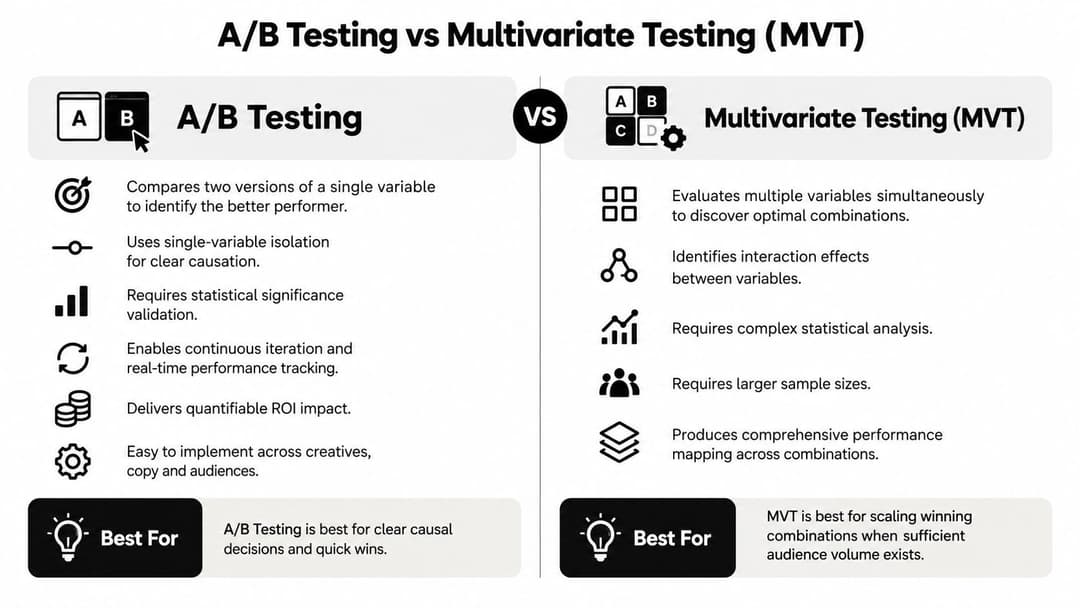
A/B testing fixes that by isolating one variable at a time. Test one headline against another. Test one image format against another. Test one offer frame against another. If the result moves, the team can connect that movement to a specific change and reuse the learning across the next campaign cycle.
Multivariate testing answers a different question. It helps teams examine how several variables interact, such as whether a risk-reduction message works better with a product demo than with a customer proof asset. That can be useful, but it demands more traffic, tighter setup, and cleaner analysis. Without that discipline, multivariate testing produces noisy combinations that look promising and teach very little.
Choose the method based on the question
Use A/B testing when the goal is diagnosis. Which headline gets more qualified clicks? Which CTA improves trial starts? Which opening hook lowers cost per lead?
Use multivariate testing when the goal is interaction. Which combination of headline, image, and CTA works best within a controlled audience and funnel stage? At that point, the team is no longer asking what changed performance. It is asking how variables work together.
That distinction matters because ad experimentation should function like an operating system. Isolate variables first. Test them inside a clear audience and funnel context. Validate the result. Then feed the learning into the next round of creative and media decisions.
What works in practice
An e-commerce brand testing product image angles on Meta should keep copy, CTA, landing page, and audience stable. A SaaS team comparing “save time” versus “reduce operational risk” should hold the visual and targeting constant. Those tests produce learnings you can apply again, not just one temporary winner.
After a few clean A/B rounds, multivariate testing becomes more useful. The weak options are gone. The team already knows the strongest hook, a short list of viable visuals, and the CTA styles that deserve more spend. Now the job shifts from basic selection to combination management.
This is also where scale creates operational friction. Once a team is testing many creative, audience, and offer combinations at once, setup and tracking can break down fast. AdStellar AI can help manage that volume by organizing combinations and reducing manual duplication work, while the team still controls the hypothesis, variable order, and decision rules.
- Start with one meaningful variable. Small wording changes rarely justify a full test unless that wording reflects a different message strategy.
- Run variants concurrently. Side-by-side delivery reduces distortion from weekday shifts, auction changes, and campaign learning phases.
- Keep audience and funnel stage fixed for diagnostic tests. A message for cold prospecting should not be judged against behavior from retargeting traffic.
- Use multivariate tests only after narrowing the field. Fewer inputs make interaction effects easier to interpret.
- Record every test. Save the hypothesis, variables, launch date, primary metric, and outcome in one place so future campaigns inherit the learning.
If your team needs a clean refresher on split-test structure, AdStellar's guide on what split testing is is a useful starting point.
2. Continuous Testing
Many teams test in bursts. They launch alternatives during a crunch, pick a winner, then go back to campaign maintenance until performance falls off again. That pattern feels productive, but it usually creates long gaps where nobody is learning.
Research from Harvard Business School found that at any given point, roughly 8% of startups use an A/B testing technology, while nearly 18% adopt one over a four-year panel, which suggests experimentation is often episodic instead of continuous in real operating environments, according to this Harvard Business School experimentation study. The fix is simple in concept and harder in execution: turn testing into a standing workflow.
Build a cadence, not a reaction
A growth team running paid social across several offers should maintain a live queue of test ideas. One week may focus on new hooks. The next may rotate fresh proof points into existing winners. Another may test offer framing for colder audiences. The campaign stays live, but the learning engine never stops.
This matters most when you manage many campaigns at once. Agencies and in-house performance teams often lose momentum because launching tests requires too much manual work. Creative files need naming, ad sets need duplication, audiences need mapping, reporting needs cleanup. If the workflow is clumsy, the testing habit disappears.
Keep one lane for stable revenue and one lane for controlled learning. Teams that mix both inside the same workflow usually end up protecting neither.
A practical cadence usually includes a backlog, a review rhythm, and a clear definition of what qualifies as a test versus a routine edit.
- Maintain a test queue: Capture ideas as they come up, then prioritize them.
- Review on a schedule: Weekly or bi-weekly reviews prevent “we'll look later” drift.
- Refresh systematically: Replace fatigued creative with intentional variants, not random swaps.
- Treat the process as ongoing: Testing works better as an operating habit than as an emergency tactic.
3. Audience Segmentation Testing
A campaign can post acceptable blended CPA and still hide two different failures. One audience may be carrying performance while another burns budget on a message that never had a chance. Segmentation testing fixes that by treating audience, message, and funnel stage as connected variables instead of one pooled average.
A useful segment is not just a demographic slice. It reflects buying context. A B2B team may separate technical evaluators from budget owners because each group responds to different proof. An ecommerce brand may split first-time visitors, cart abandoners, and repeat buyers because the same offer rarely moves all three groups equally.
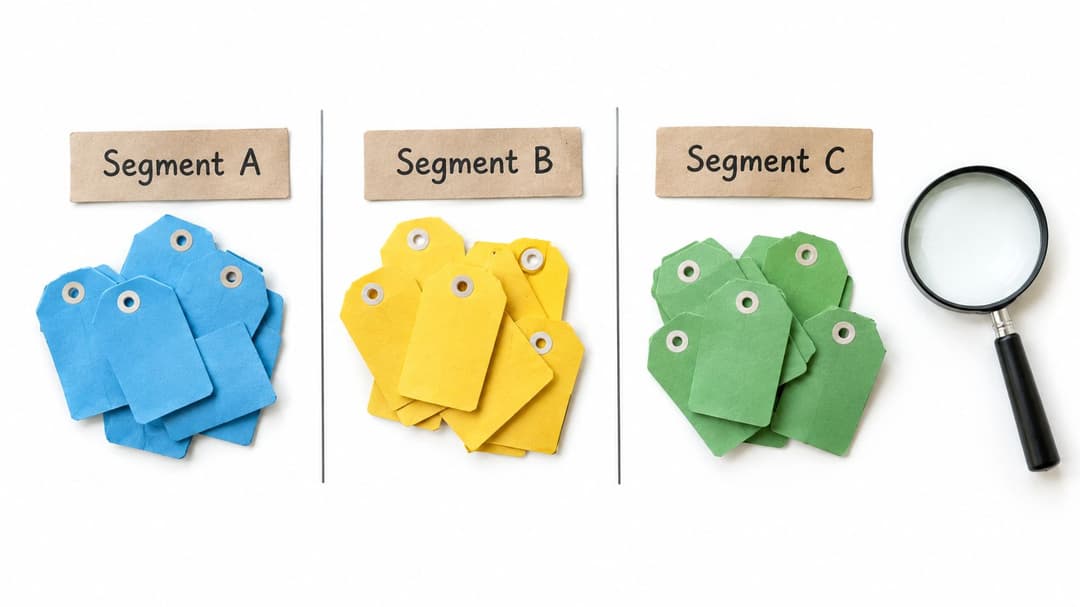
The operating rule is simple: isolate the audience variable first, then test message fit inside that segment. If you change audience, creative angle, and landing experience at the same time, the result is a ranking, not a learning system.
Use a small set of segments with clear business logic:
- New prospects versus returning visitors
- Prospecting versus retargeting
- High-intent product viewers versus broad interest audiences
- Role-based buyers such as operations, finance, or IT
- Geographic groups where pricing, shipping, or offer terms change
After that, judge each segment on its own economics. A message can win with retargeting and fail with cold traffic. A premium angle may convert fewer users but still produce stronger margin in a high-value audience. Those trade-offs matter more than a single account-wide average.
For teams building audience tests in Meta, this guide to Facebook audience segmentation for campaign structure and targeting is a useful reference.
At scale, this becomes an operating system problem. Teams need a way to keep segments clean, compare like-for-like setups, validate what changed, and feed the result into the next round without duplicating manual work across dozens of combinations. AdStellar AI helps manage that testing volume while keeping the strategic controls intact.
4. Creative Testing Framework
Creative testing breaks down when teams confuse volume with method. Producing many ads isn't the same as testing well. If each asset changes multiple variables at once, the reporting may rank assets, but it won't explain why one worked.
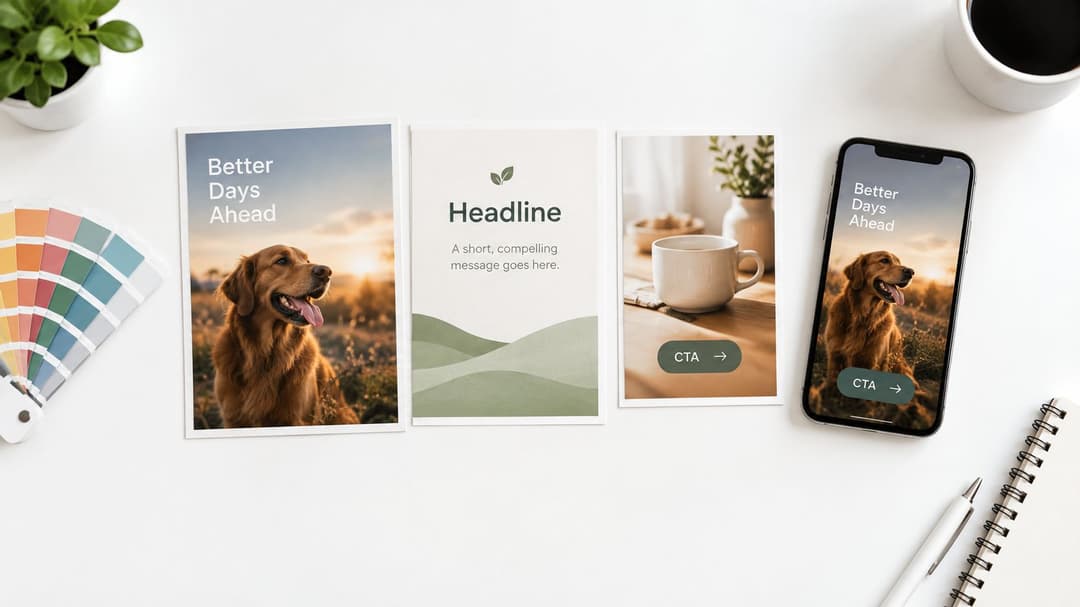
A better framework separates the major creative levers. Visual style. Format. Hook. Body copy. CTA. Proof type. Offer framing. That lets you test in layers. First identify a stronger image style. Then test two hooks within that style. Then compare CTA framing once the message is stable.
Separate idea quality from execution quality
A DTC brand might compare studio product photography against creator-style user-generated content. A B2B marketer might test a feature-led static graphic against a testimonial-led short video. Those are useful comparisons because they map to distinct creative hypotheses, not just different files.
Many teams rush here. They see one top-performing ad and instantly duplicate every visible detail. But sometimes the “winner” succeeded because of the opening line, not the design format. Sometimes the image did the work and the CTA barely mattered.
A practical structure for creative rounds
Use batches that answer one clear question. For example, compare three hooks on the same visual. Or compare static versus video with the same promise and audience. Once a pattern repeats, promote it into your next round rather than rebuilding from scratch.
Strong testing frameworks don't ask, “Which ad won?” They ask, “Which creative principle earned the result?”
If you want a tighter process for framing message-led experiments, AdStellar's article on message testing best practices is worth reviewing.
5. Statistical Significance Testing
A familiar failure mode looks like this. A new ad launches on Monday, CPA drops by Wednesday, and the team starts shifting budget before the week is over. By Friday, conversion quality softens, retargeting costs rise, and no one is sure whether the “win” was real or just early volatility.
Statistical significance testing exists to prevent that kind of false confidence. In an experimentation system, its job is simple: protect decisions. Define the hypothesis, primary KPI, sample requirement, randomization approach, and stopping rule before launch. Then hold the line. Do not call a winner early because the chart looks good halfway through the run.
A result also has to matter operationally. A small lift can be statistically reliable and still too weak to justify new production, account restructuring, or a broader rollout. Teams that scale testing well separate two questions: is the effect real, and is it large enough to change how we work?
That distinction becomes more important as test volume increases. Once you are comparing many creative, audience, and funnel combinations, weak reads pile up fast. AdStellar AI helps manage that volume without losing control of the decision rules, but the principle stays the same. Isolate the variable, validate the outcome, then feed the learning into the next round instead of treating every short-term lift as a reusable truth.
One practical safeguard is to keep the measurement stack narrow. Use one primary success metric, a few guardrails, and a clear threshold for action. Current experimentation guidance from Statsig on A/B testing and feature flag best practices also stresses retesting important wins and checking whether performance holds across relevant segments before full rollout.
Use these rules in practice:
- Write the decision rule before launch: Set the KPI, minimum sample, and stop condition in advance.
- Avoid early peeking: Review pacing, but do not declare a winner before the planned readout.
- Judge economic impact, not just confidence: A result should change budget efficiency, conversion quality, or workflow enough to matter.
- Validate across context: Check whether the result holds by audience, placement, or funnel stage before scaling it broadly.
- Retest high-stakes wins: If a result will change spend allocation or creative direction, confirm it.
For teams planning that threshold upfront, AdStellar's guide to sample size for testing is a useful reference.
6. Conversion Funnel Testing
A familiar failure pattern starts after a promising click-through report. Prospecting creative pulls attention, spend increases, and the same angle gets copied into retargeting, landing pages, and follow-up offers. Conversion rate stalls because the test isolated the ad, but ignored where the buyer was in the journey.
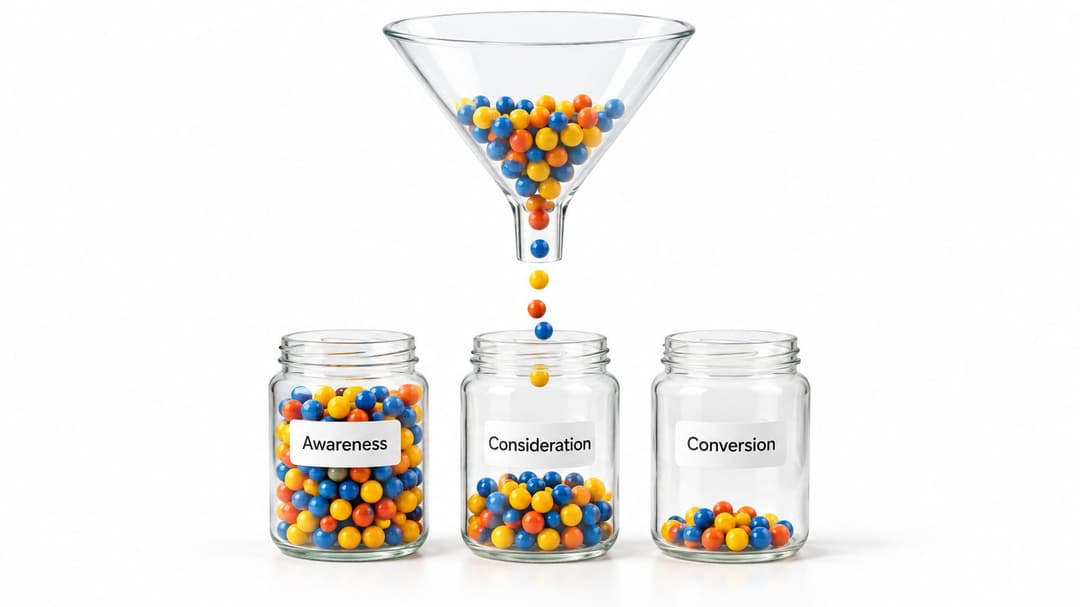
Funnel testing works best as a system, not a creative swap exercise. The job is to test message, audience intent, and post-click path together, then decide whether the friction sits in the ad, the offer, or the handoff between stages. That is how teams keep strategic control while increasing test volume.
Here is a practical way to structure it:
At awareness, test entry points. Use angles built for discovery, problem recognition, or category education. Measure qualified traffic signals that fit that stage.
At consideration, test proof. Compare benefit framing, objection handling, product explanation, and trust elements. Watch whether users continue deeper into the site or return later through branded or direct paths.
At conversion, test decision triggers. Offer clarity, pricing presentation, shipping details, guarantees, urgency, and CTA language usually matter more here than broad storytelling.
That sequence matters because a weak lower funnel often gets blamed on the wrong asset. The ad may be fine. The landing page may be asking for too much too early. Or retargeting may still be speaking like a first introduction.
One useful operating rule is to track drop-off by stage before changing creative. If click-through is healthy but product page engagement is weak, fix the post-click experience first. If retargeting traffic reaches checkout and abandons, test reassurance and offer mechanics before rewriting prospecting ads. Teams that want a clearer framework for connecting ad tests to the post-click journey can use this guide to improve conversion rates across the full path.
For high-volume programs, the operating system view becomes practical. AdStellar AI can manage many ad and audience combinations, but the discipline stays the same. Keep stage definitions clear, isolate the handoff you are testing, and promote winners only after they prove they can do their job in that specific part of the funnel.
A top-of-funnel winner earns the right to inspire the next test. It does not automatically earn rollout across the whole funnel.
7. Learning Campaigns and Exploration Testing
Not every campaign should be judged by immediate efficiency. Some should be judged by how much they teach you. That distinction matters because the safest optimization program in the world can still stagnate if it only protects current winners.
Exploration campaigns give teams room to test new angles, unfamiliar audiences, fresh formats, or adjacent offers without forcing those experiments to compete directly with mature campaigns. A DTC brand may use them to trial a new product story. A SaaS team may probe a new vertical. An agency may use them to pressure-test unusual creative directions before a broader rollout.
Protect the learning lane
The mistake is mixing exploratory ideas into your core scaling campaigns without labeling them as such. Once that happens, weak early experiments can distort budget decisions, reporting, and stakeholder confidence. Exploration needs its own logic and expectations.
Document every result, including the tests that failed clearly. Those losses are often the fastest route to sharper future hypotheses. They tell you which claims didn't resonate, which formats looked promising but didn't convert, and which audiences need a different entry point.
The most useful failed test is the one that rules out a tempting bad idea before you put real budget behind it.
A practical exploration lane usually includes a separate campaign structure, a narrower set of hypotheses, and a monthly review that decides what should be promoted into the core program.
8. Temporal Testing
A Monday launch can make an average ad look like a winner. A Friday slowdown can bury a strong one. If the timing is uneven, the test is uneven.
Temporal testing treats time as one of the variables in your experimentation system, alongside audience, offer, creative, and funnel stage. That matters because ad performance rarely behaves in a straight line across the week, the month, or the quarter. Retail accounts react to payday cycles, weekends, and promotions. B2B accounts often compress engagement into working hours and lose intent outside them.
The operating rule is simple. Compare variants across the same time window whenever possible, and let the test run long enough to pass through a normal business cycle. Otherwise, teams end up crediting creative for demand patterns, platform volatility, or short-lived spikes that had nothing to do with the ad itself.
A practical read on timing usually comes from three layers:
Scheduling. Was each variant exposed to the same mix of hours and days?
Market context. Did a sale, holiday, product launch, competitor push, or site issue distort the period?
Position in the funnel. Did timing change click behavior, or did it change downstream conversion quality?
That third point gets missed often. An ad may attract cheaper traffic late at night and still produce weaker lead quality or lower purchase intent. Temporal testing keeps teams from mistaking cheap delivery for real efficiency.
I prefer a simple discipline here. Keep the creative test clean, then annotate the calendar aggressively. Note promotions, inventory constraints, landing page changes, and any external event that can explain a swing. Over time, those notes become a decision asset. They show whether a pattern is repeatable, seasonal, or just noise.
This is also where scale can create operational drag. Once a team is testing many audience, message, and scheduling combinations at once, the calendar itself becomes part of test management. AdStellar AI helps organize that volume so teams can compare like-for-like windows, preserve control over what changed, and feed timing insights back into the next iteration instead of losing them in campaign sprawl.
Use temporal findings carefully. A strong result at a strong moment is useful, but it does not automatically mean the asset is a durable winner. Confirm timing effects in a later cycle, then decide whether the lesson belongs in scheduling, creative strategy, or both.
9. Competitive Benchmarking and Parity Testing
Competitive review is useful for generating hypotheses. It's less useful when teams treat it like proof. Just because a competitor uses a certain visual format, discount structure, or CTA style doesn't mean it's working for them, and it definitely doesn't mean it will work for you.
Still, there's value in parity testing. If several brands in your category emphasize the same product objection, you should know whether your message is underdeveloped there. If the market has shifted toward creator-led social proof and your account still relies on polished static assets, that's a reasonable hypothesis to test.
Use benchmarks as context, not direction
An industry snapshot summarized in analysis found that structured A/B testing appears on fewer than 0.2% of all websites, but usage climbs among large properties, with about 32% of the top 10,000 sites using an A/B testing or personalization platform, versus roughly 20.95% of the top 100,000 and 11.5% of the top 1 million, according to this industry analysis of A/B testing adoption. The practical lesson isn't that you should mimic large brands. It's that experimentation tends to concentrate where traffic and decision value are highest.
For ad teams, that means two things. First, benchmark your own current baseline before obsessing over external patterns. Second, direct structured testing toward the campaigns, audiences, and funnel points where volume is high enough to justify the effort.
- Track visible patterns: Save competitor hooks, offers, formats, and proof styles.
- Test parity intentionally: Don't copy. Build a hypothesis from what you observe.
- Prioritize high-traffic segments: That's where clean reads and valuable decisions are most likely.
- Use your own baseline first: Historical performance usually matters more than category imitation.
10. Feedback Loop Testing and Rapid Iteration Cycles
Testing compounds only when learning travels. If results stay trapped in one media buyer's notes or one campaign manager's memory, the organization keeps paying to relearn the same lessons.
A feedback loop makes the process durable. One hypothesis gets logged. The variant structure gets documented. The result gets interpreted. Then the team decides whether to scale, retest, retire, or adapt the insight for another audience or offer. That cycle sounds straightforward, but it often breaks under operational load.
Operational controls matter more as test volume grows
Recent enterprise guidance puts more weight on governance problems that invalidate tests in practice, including overlapping audiences, mid-test changes, and delayed rollout decisions. It recommends controls such as mutual exclusion, freezing variants during the run, using feature flags, and deploying winners in phases rather than all at once, as outlined in this enterprise A/B testing best-practices guide. Those concerns are especially relevant when teams launch many creative combinations at once.
That's the point where a testing system either matures or turns noisy. Bulk creative testing can produce useful signal, but only if launch rules, naming, exclusions, and result reviews stay consistent.
- Log every test the same way: Hypothesis, setup, KPI, dates, result, and action.
- Freeze active variants: Mid-run edits make clean interpretation much harder.
- Control overlap: Shared audiences contaminate reads when many tests run together.
- Scale in phases: Let winners prove themselves in production before broad rollout.
10-Point Comparison of Testing Best Practices
| Approach | Implementation complexity | Resource requirements | Expected outcomes | Ideal use cases | Key advantages |
|---|---|---|---|---|---|
| A/B Testing & Multivariate Testing | Low → High (A/B simple; MVT requires complex stats) | Moderate → High (MVT needs large sample sizes, statistical tools) | Validated causal lifts; optimal element combinations | Landing pages, ad creatives, messaging; scaling with volume | Clear causation (A/B); interaction discovery and combination optimization (MVT) |
| Continuous Testing (Always‑On) | Medium (process + automation required) | Ongoing resources, monitoring tools, automation | Continuous performance improvements; reduced creative fatigue | High-volume portfolios; always‑on campaigns | Real‑time adaptation; compounds gains over time |
| Audience Segmentation Testing | Medium (segmented campaign structures) | Rich audience data, tracking, multiple variants | Higher relevance and conversion per cohort | Personalized messaging, lifecycle targeting, lookalikes | Improved targeting, budget allocation, reduced ad fatigue |
| Creative Testing Framework (Visual & Copy) | Medium (creative production + test design) | High (asset production, design resources) | Higher CTR/engagement and ROAS | Creative refreshes, format testing, brand experiments | Direct impact on engagement; discovers winning creative patterns |
| Statistical Significance Testing | High (statistical expertise, careful setup) | Significant sample sizes, analytics/stat tools | Statistically validated results with confidence levels | Any experiment requiring robust validation | Prevents false positives; provides decision confidence |
| Conversion Funnel Testing | High (multi‑stage tracking & attribution) | Cross‑channel data, analytics platforms, longer timelines | Reduced funnel drop‑off; improved end‑to‑end conversion | Full customer journey optimization, TOF→BOF strategies | Stage‑specific optimization; better budget allocation and LTV |
| Learning Campaigns & Exploration Testing | Low→Medium (governance for experiments) | Dedicated exploration budget (10–20%), tolerance for loss | New insights and potential breakout opportunities | Discovery of new segments, novel messaging, early market tests | Finds novel winners; prevents local maxima in optimization |
| Temporal Testing (Time/Seasonal) | Low→Medium (scheduling + analysis) | Historical time data, time‑based bidding tools | Optimized timing and bids; reduced wasted spend | Time‑sensitive promotions, multi‑timezone campaigns, seasonality | Improves efficiency by timing; captures seasonal effects |
| Competitive Benchmarking & Parity Testing | Medium (intel collection + analysis) | Competitive tools, market benchmarks, monitoring | Contextualized performance and realistic targets | Market positioning, strategy planning, creative inspiration | Provides context vs peers; identifies competitive gaps |
| Feedback Loop Testing & Rapid Iteration | Medium→High (process discipline + tooling) | Cross‑team coordination, automation, documentation | Faster learning velocity; compounded iterative gains | Growth teams, agencies with rapid experiment cadences | Systematizes learn‑implement cycles; accelerates optimizations |
Build Your Next Testing Cycle With Confidence
The strongest testing programs don't rely on instinct alone, and they don't confuse output with insight. They operate from a compact discipline. Write one hypothesis. Choose one primary metric. Define the minimum improvement that would matter to the business. Set the stopping rule before launch. Confirm tracking, traffic quality, and audience structure. Then let the variants run in a controlled environment long enough to produce a fair read.
That sequence protects you from the most common ad-testing mistakes. It reduces false confidence from early peeking. It lowers the chance that a timing artifact or audience mix-up gets mistaken for a creative breakthrough. It also forces a harder but more useful question after every result: was this only statistically credible, or was it operationally worth shipping?
That second question matters because not every winner deserves immediate scale. Some variants should move into a controlled rollout phase first. Let them prove they can hold performance in a broader audience, under higher spend, or in a new funnel segment. At the same time, keep exploration active in a separate budget lane or campaign structure. Stable revenue and deliberate learning should support each other, not fight for the same decision logic.
Best practices for testing become less about isolated campaign tactics and more about system design. You need a repeatable way to isolate variables, test audience and funnel context, validate results, archive learnings, and launch the next round without rebuilding the process from zero. Teams that do this well usually look calmer from the outside because they aren't improvising every decision. They've turned experimentation into routine operations.
Automation can help, but only when it serves that discipline. If your team needs to produce, compare, rank, and iterate across many creative, copy, and audience combinations, a platform like AdStellar AI can fit naturally into the workflow. The practical value isn't magic. It's operational advantage. You can generate many structured variants, keep testing volume manageable, and review performance patterns without losing strategic control over hypotheses, metrics, and rollout decisions.
The point isn't to launch more tests for the sake of activity. It's to run better tests, learn faster, and build a body of evidence your team can trust the next time performance changes. That's what turns ad testing from a recurring scramble into a repeatable growth system.
AdStellar AI helps teams build and launch large volumes of creative, copy, and audience combinations without turning the testing process into manual busywork. If you want a more structured way to compare variants, rank what's working, and keep iteration moving across Meta campaigns, visit AdStellar AI.