You're looking at a test result in Meta Ads Manager, the spend is climbing, the team wants an answer, and the data still feels thin. That's where many who run these tests get into trouble. They either call a winner too early because one ad looks better today, or they wait forever for “perfect” certainty and miss the window to act.
Sample size for testing sits right in the middle of that tension. It's the guardrail that keeps a campaign decision from turning into a guess. But in real ad accounts, you rarely get ideal conditions. Budgets get cut. traffic is uneven. Creative fatigue shows up before the test finishes. Stakeholders want a decision by Friday.
You don't need a Ph.D. to handle this well. You need a practical framework, a few hard rules, and the discipline to separate a meaningful business signal from random movement.
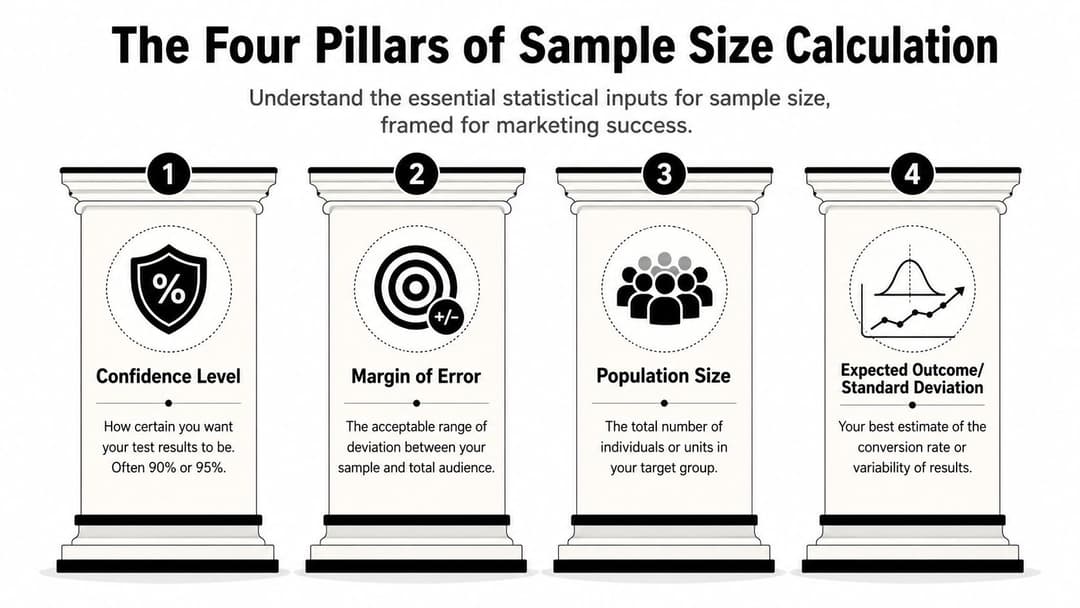
The Four Pillars of Sample Size Calculation
A media buyer launches a creative test on Monday, sees one ad pulling ahead by Wednesday, and gets asked for a decision before the week ends. The answer depends less on the calculator than on the assumptions fed into it.
Those assumptions usually come down to four inputs. Get them right, and the test has a fair shot at producing a decision you can defend. Get them wrong, and even a clean-looking result can push budget into the wrong ad set.
Baseline conversion rate
Baseline conversion rate is the starting point. It tells you what “normal” looks like before the test begins.
Use recent account data that matches the test you are running. If the experiment is limited to one audience, placement, or funnel step, pull the baseline from that slice. Blended account averages create false confidence because they smooth over the very differences the test is trying to measure.
This input matters because every later choice depends on it. A baseline that is too optimistic can make the required sample look smaller than reality. A baseline that is too stale can do the same thing, especially in accounts where seasonality, offer changes, or creative fatigue move performance fast.
Minimum detectable effect
Minimum detectable effect, or MDE, is the smallest lift that would justify action. In ad accounts, that usually means a change large enough to alter spend allocation, CPA targets, or the next creative decision.
Real-world pressure often manifests itself. A team with limited budget may want to detect a 3 percent improvement, but proving a tiny lift often takes longer than the creative will stay fresh. If the test cannot realistically collect enough data before the audience shifts or the offer changes, the “perfect” MDE is not the right one.
Set the MDE around a decision threshold, not around wishful precision. If a result would not materially increase conversion rates or change how you buy media, it does not deserve a long test window.
A practical rule works well here. Pick the smallest effect that would make you do something different next week.
Statistical significance
Statistical significance sets your false-positive tolerance. In plain terms, it defines how much risk you accept that an apparent winner is just random variation.
For many campaign tests, teams stick with a conventional threshold and keep it consistent across experiments. Consistency matters more than trying to squeeze a win out of borderline data by changing the rule after launch. Mid-test adjustments are one of the fastest ways to turn a disciplined process into result shopping.
There is also a trade-off here. A stricter threshold gives more protection against false wins, but it usually requires more data and more time. If your budget or traffic cannot support that, the honest move is to frame the result as directional and limit the size of the decision.
Statistical power
Power is the test's chance of catching a real effect. Low power creates a common problem in paid media. A better ad or page looks “inconclusive” because the test never had enough volume to separate signal from noise.
That happens all the time in smaller accounts. The team ran the test correctly, but the account could not generate enough conversions before the campaign changed. In that case, the right response is not to pretend the result is definitive. It is to scale back the claim, pool similar tests where appropriate, or reserve formal testing for higher-volume parts of the funnel.
This is why sample size planning should sit inside a larger testing process. A clear Facebook ad creative testing framework helps teams choose higher-signal variables, avoid fragmented setups, and save strict significance standards for tests that can reach them.
The four pillars work together. Tighten one, and the others get more demanding. That is the practical reality behind sample size for testing. You are not solving a math exercise. You are balancing statistical quality against budget, traffic, and the amount of time the campaign can stay stable enough to learn from.
How to Determine Your Sample Size
You launch a test on Monday, check results on Thursday, and one variant is up 18%. The team wants to push budget into the winner before the weekend. This is the point where sample size planning either saves the decision or gets ignored.
The practical job is simple. Turn a statistical requirement into a test you can afford to run.
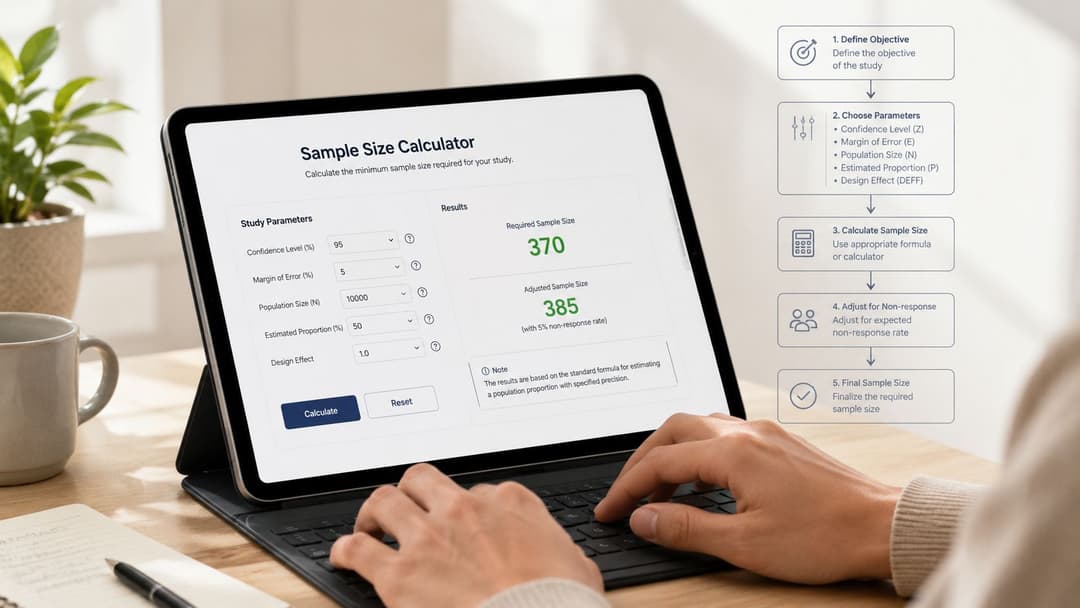
A practical calculation workflow
Start from the business decision, not the calculator.
If a winning result would only justify a small copy tweak, the sample requirement can be lighter because the downside of being wrong is smaller. If the result will change budget allocation, landing page direction, or offer strategy, use stricter assumptions and make sure the account can support them.
A reliable workflow looks like this:
- Pull a clean baseline: Use recent, stable data from Meta Ads Manager, GA4, or your attribution tool. Avoid using last quarter's average if the account has already changed its audience, offer, or optimization event.
- Set the minimum detectable effect: Choose the smallest lift that would change what you do next. A tiny lift that looks nice in a deck but would not change spend or strategy is not a useful target.
- Choose your confidence level: Keep it consistent across similar tests so results are easier to compare and easier to defend.
- Choose your power target: Match it to the risk of missing a real winner. High-stakes tests deserve more protection against false negatives.
- Run the calculation before launch: If the required volume is unrealistic, change the test plan before money is live.
For marketers, the useful output is rarely the raw sample number by itself. The better question is: how many days and how much spend will it take to get there at current delivery levels?
That is where weak planning shows up fast. A test might need a perfectly reasonable number of conversions on paper, but still be a poor fit for a campaign that refreshes creative every 10 days or has volatile daily spend.
Where marketers go wrong
The first mistake is picking an MDE that makes the test easy instead of picking one that makes the result useful.
A team might say they want to detect a 3% lift because smaller gains matter over time. Fair point. But if the account cannot realistically hold a stable setup long enough to measure that lift, the test design is misaligned with the account. In practice, it is often better to test bigger changes, stronger offers, or clearer creative contrasts.
The second mistake is importing someone else's assumptions. Benchmarks help set expectations, but they do not replace account history. A broad review of Meta ads performance benchmarks can help frame what is normal by objective or industry, but the baseline that matters most is your own recent performance under similar conditions.
The third mistake is treating the calculator as final truth. Calculators assume a cleaner testing environment than most ad accounts possess. Budgets shift. Learning phases reset. Audience quality drifts. Promotions start halfway through the test. Good operators account for that mess before they call a result conclusive.
Don't choose an MDE because the sample size looks manageable. Choose it because the outcome would justify action.
Turning the number into a campaign plan
Once you have the required sample, translate it into delivery reality. Estimate how long each variant needs to run, how much spend each arm needs, and whether the campaign can stay stable for that long.
If the answer is no, adjust the design early.
That usually means one of four moves:
- Narrow the question: Test one meaningful variable at a time so the result is easier to interpret.
- Raise the MDE: Look for changes large enough to matter operationally and large enough for the account to detect.
- Use a faster proxy metric: For early screening, clicks or landing page views may tell you enough to eliminate weak ideas before you test deeper conversion outcomes.
- Characterize the result: If volume is limited, treat the test as directional and keep the decision size proportional to the evidence.
I use this rule often: if a test cannot reach a credible sample before the campaign, offer, or audience changes, it is not a good candidate for a formal winner-loser decision. It may still be worth running as a directional read, but the claim needs to stay narrow.
Landing page quality affects this more than many ad teams admit. If the page creates friction, conversion rates stay low, variance stays high, and every test takes longer to resolve. Teams working on both media and post-click performance should also look at ways to increase conversion rates, because a stronger page does not just improve efficiency. It also makes future tests easier to complete with confidence.
Real-World Examples for Ad Campaigns
Sample size gets easier to understand when you tie it to the metrics marketers manage. The calculation logic is the same, but the operational reality changes depending on whether you're testing CTR, CVR, or CPA.
Creative test using CTR
A CTR test is often the fastest test to run because clicks usually arrive sooner than purchases. That makes it useful for early-stage creative screening.
In practice, this works best when the only decision you're making is whether one angle earns more attention than another. It works poorly when teams confuse a CTR lift with proof of better business outcomes. A curiosity-driven headline can pull more clicks and still send weaker traffic downstream.
So the right workflow is usually staged. Use CTR to eliminate obvious losers. Then move finalists into a deeper test using a lower-funnel metric. If you skip that second step, you risk scaling ads that win on cheap attention and lose on revenue quality.
Landing page test using CVR
Sample size pain usually surfaces. Conversion rates tend to be lower than click rates, so every meaningful difference takes longer to verify.
One practical benchmark is worth anchoring on. For highly reliable A/B tests using 95% significance, 80% power, a baseline conversion rate of 2–5%, and a minimum detectable effect of 2–5%, the requirement is at least 30,000 visitors and 3,000 conversions per variant, according to this A/B testing sample size reference.
That number surprises a lot of teams because it exposes how hard it is to prove small lifts in low-conversion funnels. If you run a niche campaign, that traffic requirement may be unrealistic. In that case, the wrong response is pretending the test is conclusive. The right response is reframing the question.
A low-baseline CVR test can be statistically correct and still be operationally impossible on your current budget.
Audience test using CPA
CPA testing feels intuitive because cost per acquisition is what leadership often watches. But it's a composite metric. It absorbs changes in CPM, click behavior, on-site conversion, and auction conditions all at once.
That makes CPA useful for budget decisions, but noisy for diagnosis. If one audience has a better CPA, you still need to know why. Was the traffic cheaper? Was the message a better fit? Did the landing page resonate differently?
For day-to-day operations, I'd use CPA as the final business readout, not the only diagnostic measure. Pair it with supporting metrics so the result leads to an action, not just a report.
A quick reference table
Below is a practical summary of how to think about sample size estimates per variant when the baseline CVR sits in the range covered by the benchmark above.
| Baseline CVR | MDE (Relative) | Required Sample Size per Variant |
|---|---|---|
| 2–5% | 2–5% | 30,000 visitors and 3,000 conversions |
| Higher than that range | Larger relative effect | Qualitatively lower than the benchmark in many cases |
| Lower than that range | Smaller relative effect | Qualitatively higher than the benchmark in many cases |
The point of the table isn't to replace a calculator. It's to give you a smell test. If someone proposes a low-CVR landing page test with a tiny target lift and a short timeline, the design is probably underpowered.
Teams that are building more mature experimentation programs usually pair these test types instead of treating them as interchangeable. That broader mindset is useful when you're optimizing digital strategies for growth, because not every metric should carry the same decision weight.
If you want to sharpen how you structure holdouts and comparisons before running these experiments, this piece on control group testing is worth reading.
Smarter Testing with Advanced Adjustments
A simple A/B test is fine when you're comparing one clear control against one clear challenger. Most ad accounts don't stay that tidy for long. You end up testing multiple headlines, hooks, audiences, placements, and offers under deadline pressure.
That's where marketers either overcomplicate the setup or pretend a multivariate mess is still a clean two-cell test. It isn't.
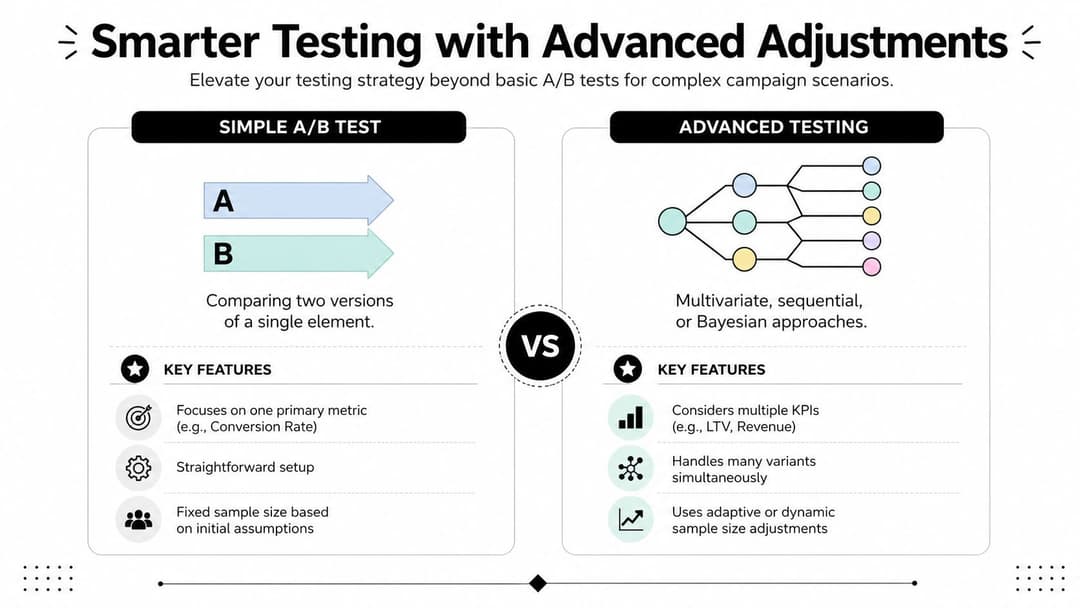
When simple tests stop being enough
Every extra variant splits the available traffic. That means each comparison gets less information unless you increase the total sample or reduce the scope.
This is why multivariate enthusiasm often crashes into account reality. A team wants to test headline, image, CTA, and audience all at once. The account can't feed enough clean data into every branch. The result is a lot of weak reads and very little confidence.
The practical fix is restraint:
- Test major drivers first: Offer, audience, and creative concept usually matter more than tiny copy edits.
- Keep one primary success metric: Don't let a test try to answer five business questions at once.
- Limit live branches: If traffic is modest, fewer cells beat broader curiosity.
Sequential testing when traffic is tight
When a fixed sample design asks for more data than you can realistically collect, sequential testing becomes attractive. It lets you evaluate data as it accumulates without using the sloppy “peek every day and stop when it looks good” habit that creates false confidence.
Used correctly, sequential testing can reduce required sample sizes by 20–80% compared to fixed-sample tests, and it's especially helpful for low-traffic platforms or expensive experiments, according to this analysis of small-sample A/B testing.
That doesn't mean it's a free pass. Sequential methods need a proper framework before launch. The stopping rules have to be defined in advance, and the team has to respect them.
Decision lens: If traffic is scarce but the decision is time-sensitive, a well-designed sequential test often beats a fixed-horizon test you'll never fully power.
Advanced methods are not a license for chaos
More advanced methods can help, but they don't rescue weak experimental discipline. If the question is fuzzy, the metric is unstable, or the variants are changing midstream, no methodology is going to clean that up after the fact.
A lot of marketers hear “advanced testing” and assume the answer is more automation or more dashboarding. Improvement usually starts earlier. Define the one business decision the test should support. Then choose the lightest method that can answer it credibly.
For teams experimenting in fast-moving social environments, adjacent growth systems can offer useful parallels. This breakdown of an X follower growth system is relevant because it shows how repeatable workflows matter as much as raw experimentation volume.
If your operation is already struggling with test setup and throughput, this guide to Facebook ad testing automation methods can help tighten the mechanics around execution.
Pragmatic Rules for Everyday Campaigns
Perfect sample size planning is nice in theory. In live media buying, you'll still face tests that are worth running even when the ideal sample is out of reach. The goal then isn't statistical perfection. It's making the best possible decision without lying to yourself about the certainty.
What to do when the perfect sample is unattainable
Start by sorting tests into two buckets. Some are decision-critical. Budget shifts, landing page rollouts, pricing pages, or major audience changes belong here. Those deserve stricter standards and enough runway to finish properly.
Others are directional. Early creative screening, angle exploration, and message discovery fit this category. These can still be valuable, but only if everyone agrees the output is guidance, not proof.
That distinction solves a lot of internal friction. The team stops asking every test to carry the same burden.
Rules that hold up under pressure
When timelines are tight, these rules work:
- Pre-commit the stop condition: Decide whether the test ends by sample reached, budget exhausted, or a fixed calendar window.
- Don't stop because the chart looks exciting: Random variation often looks most convincing right before it reverses.
- Prefer fewer, cleaner variables: One answer beats five shaky guesses.
- Write the action before the launch: If Variant B wins, what changes on Monday? If there's no clear difference, what happens then?
A lot of bad testing comes from ambiguity, not bad math. Nobody defined the decision. Nobody agreed on the threshold for acting. The platform got blamed for confusion that the team created.
How to read imperfect results honestly
If a test ends early or stays underpowered, don't force a yes-or-no conclusion. Report what the data suggests, what it does not establish, and what the next step should be.
That may sound less decisive, but it's how disciplined operators protect budgets. There's a big difference between “Variant B appears promising and should move to a larger confirmatory test” and “Variant B is the winner.” One is honest. The other is often expensive.
Underpowered tests can still be useful if you treat them as filters, not verdicts.
For teams building a more repeatable process around these day-to-day decisions, this guide to Facebook ad testing best practices is a solid operational reference.
If you want to move faster without turning testing into chaos, AdStellar AI helps teams launch and structure large-scale Meta ad experiments with less manual setup. It's built for marketers who need more variations, cleaner workflows, and faster feedback loops without losing control of what they're testing.