You're launching campaigns, the creative looks strong, and the dashboard still feels fuzzy. You can see clicks, maybe a few purchases, but you're not sure whether you're reaching people with actual intent or just paying to show ads to anyone who happens to fit a broad profile. What is behavioral targeting in that situation? It's the part of the ad stack that turns real user actions into audience decisions, so your spend follows behavior instead of guesses.
That's why behavioral targeting became a core performance lever. A large industry model estimated that 86% of programmatic advertising in Europe used behavioral data in 2016, and that behavioral data already underpinned €10.6 billion of the €16 billion digital display market. The same analysis projected €21.4 billion of digital ad spend informed by behavioral targeting by 2020, which shows how quickly the market moved toward signal-based buying. European behavioral targeting model
For growth teams, the appeal is simple. Behavioral targeting replaces static assumptions with observable actions, like visits, searches, clicks, purchases, and return sessions, so you can respond to intent that's already showing up in the data. But it's also where the hardest trade-offs live, because the same signal density that makes it powerful also makes it privacy-sensitive and harder to operate as identifiers fragment.
Why Behavioral Targeting Matters for Performance Marketers
You can run a clean media plan and still feel like the audience is wrong. The copy is tight, the landing page converts, but the targeting is so broad that the campaign spends against people who were never close to buying. That's the moment behavioral targeting earns its place, because it stops asking who someone is in the abstract and starts asking what they've done.
Behavioral targeting matters because it uses inferred intent. Instead of leaning on age, job title, or location alone, it looks at signals like browsing depth, return visits, cart activity, and search terms, then uses those actions to shape delivery. A performance marketer doesn't need perfect certainty to make that useful, just a better read on who is already moving toward a decision.
Why this changes paid social and display
The practical gain is relevance. If someone browsed pricing pages twice, added a product to cart, and came back the next day, that pattern tells you more than a declared demographic ever could. Behavioral targeting lets ad platforms react to that pattern with different creative, offers, or exclusions, which is why it's become central to retargeting and sequential messaging.
That doesn't make it magical. It works best when the signal is strong enough to predict next action, and it weakens when the audience is new, the segment is too thin, or the intent changes quickly. For many teams, the difference between wasted spend and cleaner performance is just whether the campaign is built around observed behavior or broad interest proxies.
Practical rule: if you can name the action that justified the ad, the targeting is probably doing useful work.
For a simple starting point, many marketers pair this with interest-based targeting guidance so the team can see where behavior outperforms softer interest signals and where it doesn't. That comparison usually makes the value obvious, especially in display and paid social environments where timing matters as much as audience shape.
How Behavioral Targeting Actually Works
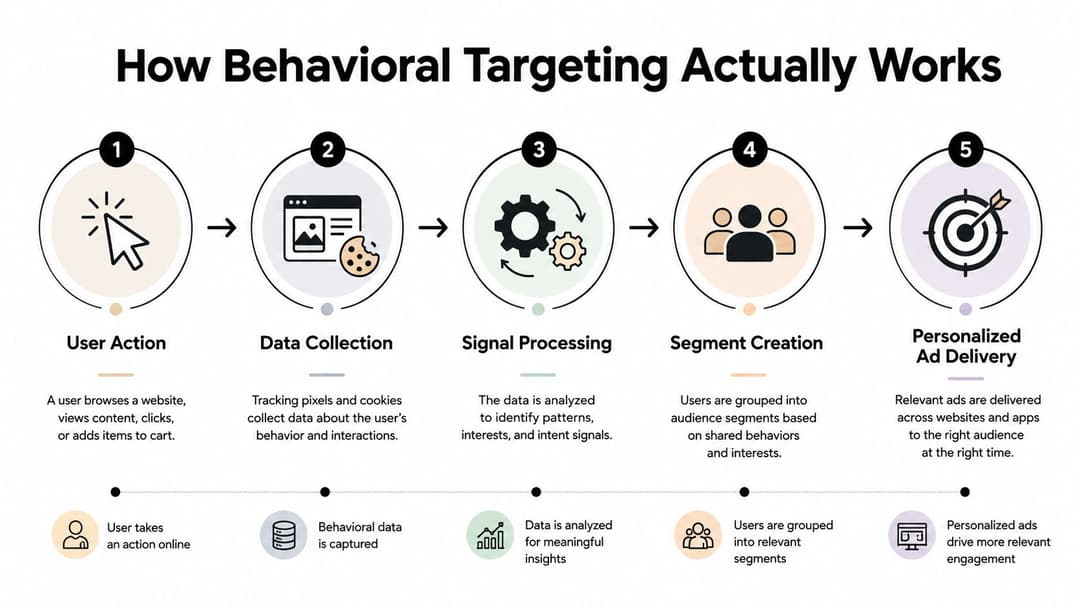
Behavioral targeting is a signal-driven segmentation pipeline. A user does something observable, then the system collects that action, groups it with similar behaviors, and serves an ad matched to that pattern. The stack usually relies on tracking pixels, cookies, tags, server logs, and platform identifiers, and the operational requirement is simple but unforgiving, the same user has to be recognized across sessions so prior behavior can still inform the next impression. Behavioral targeting process overview
From action to audience
The first layer is data capture. Pages viewed, searches, clicks, purchases, and return visits become signals only after a tag, pixel, or log source records them. That's why teams working on behavioral targeting usually care less about raw traffic and more about whether the event stream is clean enough to trust.
The second layer is segmentation. A system groups users into audiences based on shared behavior, which is why retargeting can feel so precise when someone has already shown intent. If you want a plain-language primer on that downstream use case, Silver Spoon Agency's retargeting basics for marketers is a useful companion read.
The third layer is matching. Once the audience exists, the ad platform needs a way to connect that user or device back to delivery, often through hashed identifiers or device IDs. That's where first-party and third-party signals both come into play, because the platform can only act on behavior it can still connect.
Recognize the workflow as collect, group, match, serve, because every break in that chain lowers the quality of the result.
First-party data and the tracking stack
The cleanest version usually starts on your own properties. Website activity, CRM events, and logged-in behavior tend to be easier to link than scattered third-party data, which is why many are rebuilding around their own consented signals. If you're mapping that infrastructure, a practical companion is website visitor tracking, since the event architecture is the part teams underinvest in.
That's also where the old cookie-only mental model starts to break down. Behavioral targeting still works, but increasingly because teams can preserve enough continuity across sessions, devices, and consent states to make the signal useful, not because they can assume every identifier will persist forever.
Behavioral vs Contextual vs Demographic Targeting
Behavioral targeting gets praised as if it always wins. In practice, that's too simple. It's more precise than demographic targeting, but it's also more dependent on reliable data, and it can lose to contextual targeting when the audience is sparse or privacy constraints are tight.
The three approaches side by side
Behavioral targeting uses past actions. That's its edge, because it's trying to infer intent from what people did, not what they said they were. Contextual targeting uses page or content context, which makes it easier to scale and easier to defend from a privacy standpoint, but it's less personalized. Demographic targeting relies on declared or inferred profile data, which can be broad enough for reach but often too loose for high-efficiency performance work.
| Approach | Core signal | Where it shines | Where it struggles |
|---|---|---|---|
| Behavioral | Past actions | Retargeting, high relevance | New users, thin segments |
| Contextual | Content context | Brand safety, awareness | Lower personalization |
| Demographic | Profile data | Audience expansion | Precision and intent |
That table is why teams shouldn't default to behavior just because it sounds more advanced. If a market has heavy privacy restrictions, low-intent traffic, or weak historical data, contextual targeting can be the more scalable option. If the campaign is built for awareness, demographic targeting can still make sense because the goal isn't immediate conversion, it's broad reach and message exposure.
The useful lens is not “which is best,” but “which signal exists strongly enough to justify spend.” A product launch for new users often has too little historical behavior to support a strong behavioral segment, while a remarketing program with recent cart activity can make excellent use of it. That's why the right choice depends on data availability, compliance constraints, and the stage of the funnel.
For teams comparing stack choices, demographic ad targeting is still worth understanding because it shows where behavior is additive and where it's just overfitting.
Bottom line: behavior wins when the signal is rich, recent, and connected. Context wins when compliance and scale matter more than precision.
Real Campaign Examples and Performance Results
A behavioral segment that is built well usually shows its value in revenue, not just clicks. In a landmark 2010 study using proprietary data from 12 major advertising networks, analysts found that behaviorally targeted advertising generated 2.68 times as much revenue per ad as non-targeted run-of-network ads in 2009. The same study found that behaviorally targeted ads converted clickers into buyers at 6.8%, versus 2.8% for run-of-network ads, and that behavioral advertising represented 17.9% of respondents' ad revenue that year, rising from 16.2% in Q1 to 19.4% in Q4. 2010 behavioral advertising study
Where the pattern shows up in practice
Those results match what performance teams tend to see across different channels. E-commerce brands use browsing and cart signals to bring back users who are already close to purchase. SaaS teams use feature usage and login behavior to drive upgrades or reactivation. DTC teams often combine product-page behavior with broader audience modeling so acquisition does not collapse into a tiny remarketing pool.
The strongest use cases are usually warm audiences. Recent site visitors, cart abandoners, and logged-in users with recent activity give you cleaner intent signals and faster feedback. Cold audiences require more caution, because prospecting from weak or stale signals can create segments that look precise in a dashboard but do not hold up in market.
What breaks campaigns
Over-segmentation is the most common failure. Teams split audiences so finely that each segment becomes too small to sustain delivery or learn efficiently. Stale behavior creates a different problem, because the system keeps optimizing against an action that no longer predicts the next purchase. Creative fatigue also matters, since even a strong behavioral segment will wear out if it keeps seeing the same message.
| Common mistake | What it does | Better move |
|---|---|---|
| Too many micro-segments | Starves delivery | Merge related behaviors |
| Stale signals | Lowers intent accuracy | Refresh recency windows |
| Reused creative | Cuts response | Match message to segment |
The practical lesson is simple. Timely signals, segment sizes that can learn, and creative that still reflects what the user was doing produce better results than chasing hyper-specific segments that cannot scale.
The Privacy Challenge and the Post-Cookie Reality
The hardest part of behavioral targeting now is preserving usable signal under tighter identity rules. The old cookie-centric version of the tactic is no longer the full story. Most practical explainers still talk as if browsing history alone defines the model, but teams now have to work with first-party data, consented CRM inputs, platform-native events, and modeled alternatives when third-party identifiers become unreliable. Adobe on the post-cookie shift
What changes when identifiers weaken
Behavioral targeting still depends on connecting actions across sessions, but that connection is harder to maintain than it used to be. As identifiers disappear or fragment, marketers have to rely more on data the business owns, such as logged-in activity, email engagement, purchase history, and consented site events. Precision also changes shape, because the question is no longer how much data can be collected. It becomes what can still be observed and legally connected.
A first-party data strategy stops being a buzzword and becomes an operational requirement. If your site does not capture meaningful events, or your CRM is not tied cleanly to media activation, behavioral targeting loses a lot of its edge. The same is true if consent is handled carelessly, because privacy rules and identifier persistence are now central constraints in major markets. Behavioral targeting and privacy constraints
What teams are doing instead
The better response is to rebuild behavior around durable signals. That means collecting events on owned properties, feeding consented CRM audiences into ad platforms, and using modeled or contextual layers when direct identifiers cannot carry the full load. Many teams are also relying more on platform-native automation, because those systems can absorb partial signals and make more of the data that still exists.
Practical implementation usually comes down to signal quality. Logged-in actions, repeat visits, email clicks, and purchase history often give cleaner intent than broad third-party tracking ever did, but they require disciplined tagging, consent management, and audience governance. Teams that treat those inputs as the core of activation usually get more stable performance than teams waiting for old tracking patterns to come back.
The current model builds better decisions from the data you can still connect. That is a smaller promise, but it is the one that matches how the market works now.
Privacy did not kill behavioral targeting. It forced marketers to be more disciplined about which behaviors are actually observable, consented, and durable enough to activate.
Measurement Frameworks and Optimization Best Practices
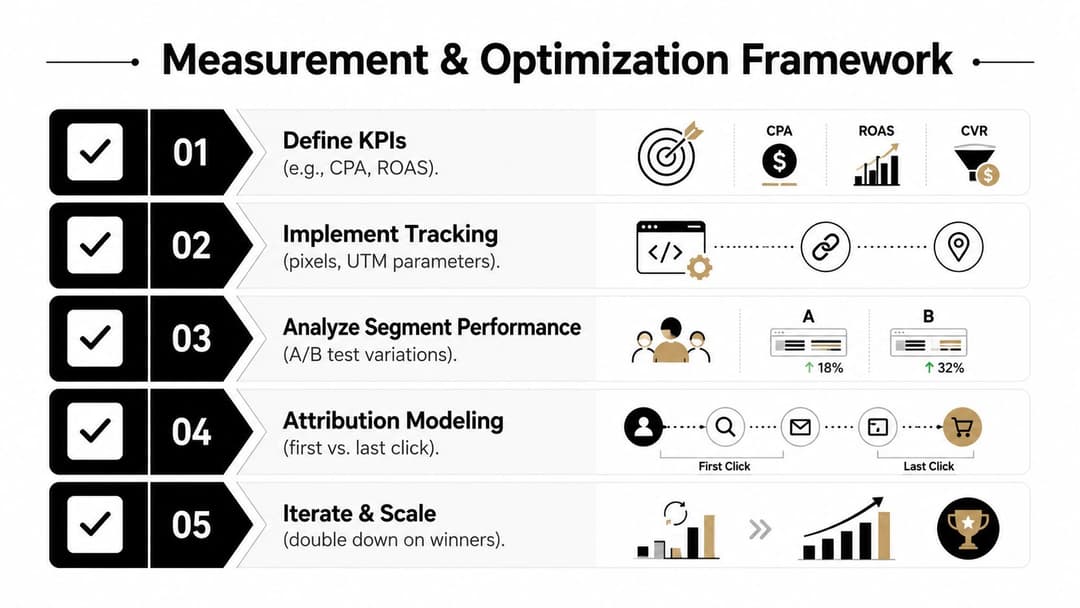
Behavioral targeting only matters if it changes results you can defend. The right measurement setup starts with segment-level performance, not just account-level averages, because a high-performing retargeting pool can hide a weak prospecting layer or the other way around. Use conversion rate by segment, acquisition cost by audience tier, and return on ad spend where the platform and attribution model support it.
What to measure first
Start by separating warm and cold behavioral audiences. Warm audiences usually deserve tighter recency windows and more aggressive creative refreshes. Cold audiences need broader comparisons so you can tell whether the signal is useful or just correlating with a lucky pocket of demand.
Then test one thing at a time. If you change the audience, the offer, and the landing page all at once, you won't know what moved the result. The cleanest approach is to hold creative constant, compare behavioral segments against each other, and then rotate creative only after the segment winner is clear.
How to keep the system healthy
- Define the segment by intent: Group by action, not by convenience. A cart abandoner is not the same as a casual browser, even if both visited the site.
- Use exclusions deliberately: Keep recent converters out of acquisition pools so you're not paying to reacquire existing buyers.
- Refresh based on recency: If a behavior no longer predicts action, stop treating it as a strong signal.
- Watch frequency carefully: High-intent users can burn out fast when the same creative follows them too long.
- Check incrementality: A segment that converts in attribution isn't always driving net-new demand.
For teams that want to go deeper into automated analysis, machine learning in advertising is the right next read because the challenge isn't collecting data, it's deciding what to do with it quickly enough to matter.
The key is to treat behavioral targeting as a living system. It should get sharper when new data arrives, not just bigger. If the same audience keeps underperforming, that's usually a signal to rewrite the segment definition before you rewrite the media plan.
Scaling Behavioral Targeting with AI-Driven Platforms
Manual behavioral targeting works until the campaign map gets too wide. A few segments are manageable, a few creative variants are manageable, but dozens of audience and message combinations across multiple campaigns quickly turn into spreadsheet work. That's where AI-driven platforms matter, because they help teams operationalize behavior instead of just labeling it.
What automation changes
A platform like AdStellar AI is one option for teams that need to turn behavioral signals into repeatable campaign setup, since it can ingest historical performance, generate many creative and audience combinations, and rank what's working against goals like ROAS, CPL, or CPA. That kind of workflow matters when your real bottleneck isn't ideas, it's execution speed and testing volume.
The useful shift is not that AI replaces strategy. It's that it handles the repetitive assembly work so marketers can spend more time deciding which behaviors deserve attention, which segments should be excluded, and which messages should be matched to which audience. In practical terms, that means less time building variants by hand and more time reading performance patterns that explain why a segment is winning.
Where humans still matter
Automation can't fix a weak signal. If the underlying behavioral definition is sloppy, the model will just scale the mistake faster. The marketer still has to decide whether the audience is built from first-party events, consented CRM data, platform engagement, or a modeled proxy, because each source carries a different level of certainty.
There's also a timing issue. Even a strong model needs fresh behavioral input to keep making good decisions, and performance teams should watch for drift when user intent changes. That's especially true in channels where audience structure, creative fatigue, and platform learning interact all at once.
The best use of AI here is practical, not philosophical. Use it to scale the parts of behavioral targeting that are repetitive, and keep humans focused on the parts that determine whether the signal is worth spending on.
AdStellar AI helps growth teams launch, test, and scale Meta campaigns by turning audience logic, creative variation, and performance feedback into a faster workflow. If you're working through the shift from cookie-based behavior to first-party and modeled signals, visit AdStellar AI to see how it supports bulk ad creation, audience testing, and data-backed optimization.