You're in Ads Manager, the product is solid, the landing page is ready, and the creative finally looks like something you'd be comfortable putting real budget behind. Then you hit the audience panel and the easy part ends. Broad might work. Detailed targeting might work. A lookalike might work better. But if you can't explain why a given audience should care about the ad they're seeing, you're mostly buying hope.
That's where interest based targeting still earns its place. Not as a magic switch, and not as a relic from earlier Facebook ad playbooks, but as a practical way to turn audience hypotheses into structured tests. Used well, it helps you reach new people, shape creative around what they already care about, and feed cleaner performance signals into the rest of your account.
Beyond Broad Strokes An Introduction to Modern Targeting
A common failure pattern goes like this. A team launches with broad targeting because the platform says automation will find the right people. Performance is uneven, spend drifts into weak traffic, and nobody can tell whether the problem is the offer, the creative, or the audience. The next move is often overcorrection. They pile in interests, stack restrictions, and choke delivery before the system can learn anything useful.
Good media buying lives between those extremes.
Interest based targeting works best when you treat it as a testing framework for demand discovery. It gives you a way to express a clear market hypothesis. People who follow trail running content may respond differently than people who follow general fitness. Founders may care about speed and growth. Corporate operators may care about compliance and reporting. Those are not cosmetic differences. They affect click quality, conversion intent, and eventually ROAS.
What the setup screen is really asking
When you choose interests, you're not just selecting categories. You're deciding which version of your market gets to meet your product first. That choice shapes everything downstream, including the comments your ad attracts, the objections you hear, and whether your best creative gets shown to people who can convert.
That's also why interest thinking matters outside Meta. If you're exploring upper-funnel inventory, Podmuse's guide to YouTube audio ads is useful because it shows how context and listener mindset can create audience relevance even when the ad format looks very different from paid social.
For teams trying to connect audience strategy to the wider tooling stack, this overview of an ad tech platform is a helpful way to frame where targeting, automation, and measurement fit together.
Understanding Interest Based Targeting Fundamentals
Interest based targeting is easiest to understand if you stop thinking like an advertiser and start thinking like a skilled librarian.
A good librarian doesn't know you only by age, city, or job title. They notice what you browse, what you return to, what authors you like, and what subjects keep pulling you back. Then they make an educated recommendation about what you're likely to want next. Ad platforms do something similar. They build a profile from signals and use that profile to decide which ads a person is more likely to engage with.
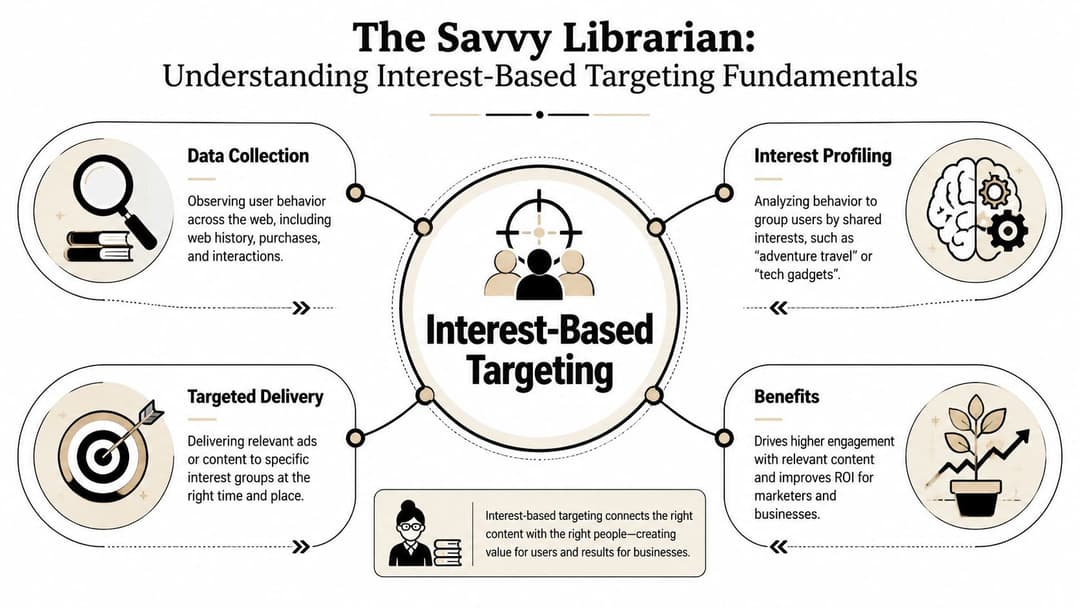
How platforms build interest profiles
Platforms such as Meta infer interests from on-platform and connected activity. That can include pages followed, content engaged with, groups joined, ad interactions, and other behavioral patterns that suggest recurring attention around a topic. The key word is infer. The platform is making a prediction about what someone cares about. It isn't reading intent directly.
That distinction matters because many newer buyers treat an interest label as truth. It's better to treat it as a directional signal.
For a practical companion to this idea, these Meta ads targeting best practices are useful because they frame audience choices as testable assumptions rather than fixed truths.
What an interest actually means in practice
An interest doesn't mean “this person will buy.” It means “this person has shown enough related behavior that the platform thinks this topic is relevant.” That's a big difference.
Here's the mental model I use with teams:
- Demographics tell you who someone is: age range, location, language, life stage.
- Behaviors suggest what they've done: device use, purchases, platform actions.
- Interests point to what keeps pulling their attention: recurring topics, communities, content themes.
When you understand that split, the audience panel becomes easier to read. You stop asking, “Which setting is best?” and start asking, “Which signal best matches the buyer mindset for this offer?”
Interest based targeting works when the interest is close enough to buying motivation that your creative can bridge the gap.
Why this still matters
Interest targeting gives you a starting map when you don't yet have enough first-party data to rely on customer lists or mature lookalikes. It also gives you a language for segmenting cold traffic. A broad audience can work, but broad doesn't explain itself. A well-structured interest test does.
That's why experienced buyers often use interests less as a final answer and more as a way to isolate patterns. The audience is the hypothesis. The creative and conversion data decide whether that hypothesis was good.
Weighing the Pros and Cons for Your Strategy
Interest based targeting still solves a real problem. It gives you a controlled way to reach people who've shown thematic relevance before they know your brand exists. That makes it useful for launches, new accounts, new products, and category expansion. It also gives teams cleaner learning than a single catch-all audience when they need to understand which market angle resonates.
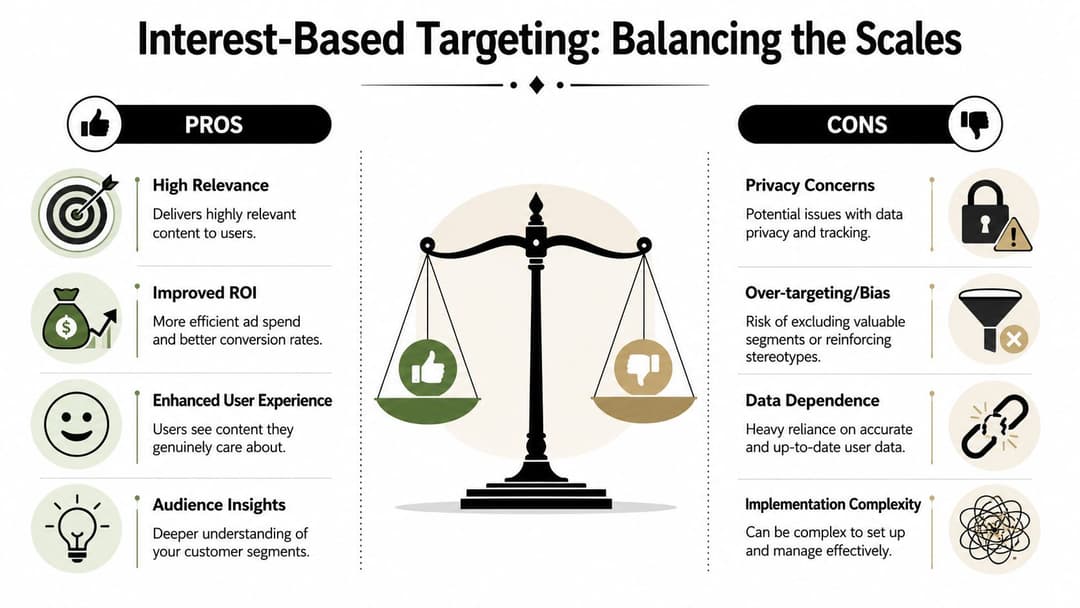
Where interest targeting helps
The biggest upside is structured cold prospecting. You can enter a market with a point of view instead of waiting for the algorithm to invent one for you. That's useful when creative is built around a specific use case or identity.
It's also operationally simple. Teams can generally launch interest tests quickly, read the first wave of signals, and cut obvious mismatches fast.
A few situations where it tends to help:
- New offers: You need fast feedback on which audience angle deserves budget.
- Distinct personas: The same product serves different buyer motivations.
- Creative testing: You want to know whether the message failed or the audience did.
- Market research: You're looking for adjacent segments your brand can speak to.
Later in this section, a short walkthrough is worth watching if you want another perspective on audience targeting trade-offs:
Where it breaks down
The weakness is signal quality. Privacy changes, weaker tracking, and platform-side inference mean some interests are broad, stale, or only loosely connected to actual purchase intent. If you target a giant category like “shopping” or “fitness,” you may get plenty of delivery and very little insight.
Another issue is false precision. Teams often believe that narrower means better. It doesn't. Over-layering can create an audience that looks smart in setup but performs badly because it's too constrained, too noisy, or too small to deliver stable learning.
Practical rule: If you can't explain why an interest should connect to your offer within one sentence, it probably doesn't belong in the test.
A balanced way to use it
Here's the trade-off in simple terms:
| Approach | What it gives you | What it risks |
|---|---|---|
| Broad targeting | More delivery freedom, less manual setup | Harder diagnosis, weaker audience insight |
| Interest targeting | Clearer hypotheses, audience-level learning | Inaccurate labels, over-targeting risk |
| Lookalikes or modeled audiences | Closer to known customer patterns | Depends on source quality and account maturity |
Teams also need to stay aware of privacy and legal expectations around data use, consent, and platform policy. You don't control how the platform classifies every user, but you do control how responsibly you design campaigns and what you choose to optimize toward.
A Step-by-Step Guide to Building Effective Interest Audiences
Most weak interest campaigns fail before launch. The audience is either too obvious, too broad, or copied from a competitor without any real reasoning behind it. The fix isn't more interests. It's better audience construction.
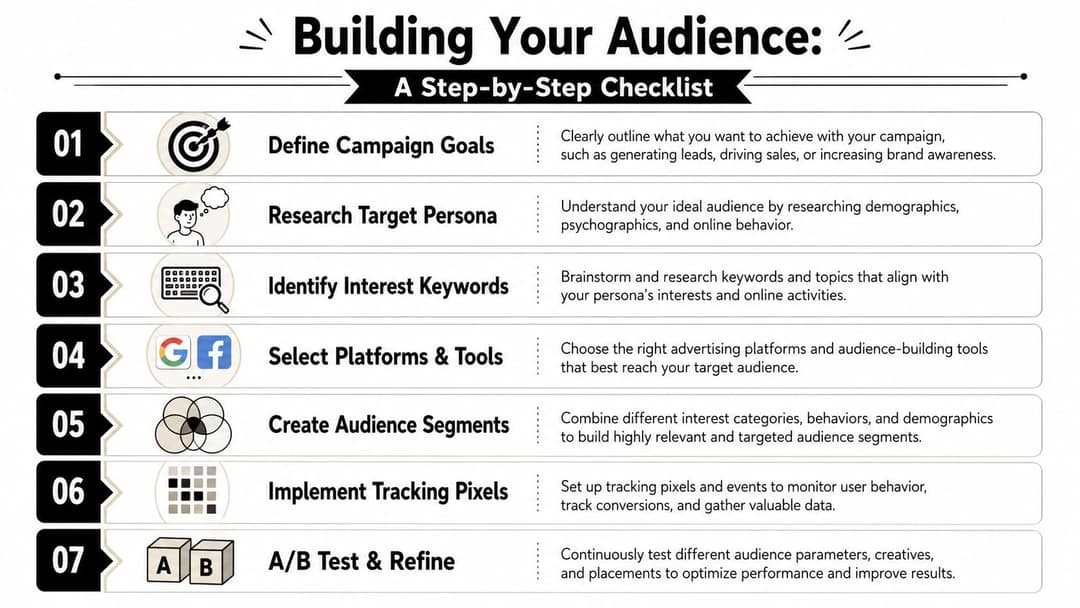
Start with the buying angle
Don't begin in Ads Manager. Begin with the reason someone buys.
If you're selling premium coffee gear, “coffee” is not your starting point. The sharper question is whether the buyer sees coffee as convenience, hobby, ritual, status, or gift. Each of those motives points to different interests, different creative, and different offers.
Write down three things before you touch audience setup:
- The job the product does
- The type of person most likely to care
- The context that makes the offer feel timely
That gives you a real hypothesis instead of a keyword list.
Build audience candidates in layers
Use platform suggestions, search prompts, customer interviews, site search terms, Reddit threads, review language, creator ecosystems, and competitor positioning to generate audience ideas. Then separate them into buckets.
A simple structure works well:
- Core identity interests: hobbies, roles, communities, professions
- Problem-aware interests: tools, influencers, content tied to the pain point
- Adjacent lifestyle interests: values, tastes, routines, complementary products
Many teams benefit from a more systematic segmentation workflow. A guide to automated audience segmentation can help turn rough research into cleaner audience groups without relying on memory or spreadsheets.
Layer only when it sharpens intent
Layering interests can improve specificity, but only when the combination reflects a real overlap in buyer motivation. “Yoga” plus “sustainable living” says something coherent. “Fitness” plus “business” usually doesn't.
Use layering for one of three reasons:
- To filter broad categories: narrow a large topic into a more defined segment
- To express identity plus values: combine who they are with what they care about
- To isolate use case: pair a category with a context that makes purchase more plausible
Avoid stacking so many conditions that delivery becomes erratic. If the platform struggles to spend, your audience may be conceptually neat but operationally useless.
Build audiences like a researcher, not like a collector. More labels don't create more clarity.
Exclude what clearly doesn't fit
Exclusions are underrated. They're one of the cleanest ways to improve traffic quality without rewriting your entire setup.
Consider excluding:
- Recent buyers: if the campaign is purely for new customer acquisition
- Existing leads: if the offer is introductory and they've already crossed that step
- Irrelevant segments: groups that repeatedly generate clicks without business value
Not every campaign needs heavy exclusions, but thoughtful exclusions often matter more than a long list of added interests.
A practical launch structure
Keep the first version simple enough to learn from. I prefer a small set of distinct audience ideas over one crowded audience where all the signals blur together.
A practical starting structure looks like this:
| Audience type | Example logic | Why use it |
|---|---|---|
| Single focused interest | One clear niche with obvious relevance | Good for clean read on a strong hypothesis |
| Layered audience | Identity plus value or context | Useful when broad interest alone is too loose |
| Adjacent audience | Related but not identical category | Helps uncover hidden demand |
| Broad or platform-led | Minimal restrictions | Useful as a benchmark against manual setup |
What doesn't work well is one giant ad set containing every interest you could think of. If it wins, you won't know why. If it loses, you won't know what to fix.
The Art of Matching Creative to Audience Interests
A lot of advertisers talk about targeting as if the audience selection does all the work. It doesn't. The ad itself is part of the targeting. If your audience says “minimalist design lovers” and your creative screams discount-store clutter, the setup is broken even if the audience logic was sound.
Why generic creative wastes good targeting
The fastest way to ruin an otherwise smart interest test is to run one generic ad across every segment. You'll still get impressions, maybe even clicks, but your results won't tell you much. You haven't tested the audience. You've tested whether a bland message can survive in multiple contexts.
Strong audience-creative matching does three things at once:
- Names the right problem
- Uses the right visual language
- Frames the offer in the right terms
That's why a useful primer on personalized marketing videos matters here. Even when you're not producing full video funnels, the lesson holds. Relevance comes from tailoring message and format to the audience's frame of reference.
Three examples that make the difference clear
A DTC home goods brand might target two interest groups for the same lamp.
For people interested in minimalism, the creative should feel quiet, clean, and space-aware. The copy might focus on simplicity, visual calm, and design that doesn't dominate a room. The product is the same. The emotional job is restraint.
For people interested in luxury interiors, the same lamp should be photographed differently. Richer setting, material detail, craftsmanship cues, more emphasis on finish and status. The product is still the same. The reason to care is different.
A B2B SaaS company selling project management software runs into the same issue. Targeting startup founders with a collaboration message built for enterprise PMs often falls flat. Founders tend to react to speed, visibility, fewer tools, and getting the team moving without process overhead. Enterprise project managers are more likely to care about handoffs, reporting clarity, governance, and stakeholder visibility.
A local service business can use the same principle. A med spa targeting people interested in wedding planning should lead with timing, confidence, and event readiness. The same business targeting skincare enthusiasts can speak more directly to routines, ingredients, and treatment consistency.
Good creative doesn't just fit the brand. It fits the reason that audience might stop scrolling.
A simple pairing framework
When I review campaigns, I usually ask four questions:
- What does this audience already believe?
- What language do they use for the problem?
- What visual cues signal “this is for me”?
- What offer framing reduces resistance for this segment?
If your team can answer those four questions, your interest targeting becomes much more valuable. If you can't, the audience setup is probably doing guesswork that the creative should be handling.
Measuring Success and Scaling With AI
Interest targeting gets expensive when teams confuse activity with progress. A campaign can produce clicks, comments, and decent-looking top-line traffic while still failing the only test that matters. Does the audience produce profitable customer actions at an acceptable cost?
Read performance at the right depth
For interest based targeting, I care about metrics in layers.
The first layer is diagnostic. Click-through rate, landing page behavior, thumb-stop quality, and outbound engagement help you spot obvious creative-audience mismatch. But they're not decision metrics on their own.
The second layer is where budget decisions start to become real:
- CPA: whether the audience can acquire customers efficiently
- ROAS: whether the spend turns into enough revenue to justify scale
- Conversion quality: whether leads or purchases are valuable downstream
If an audience has cheap clicks but poor conversion economics, it isn't a winner. It's just easy traffic.
Structure tests so the results mean something
Most messy accounts don't have a targeting problem. They have a test design problem.
To evaluate interest audiences cleanly:
- Hold creative as steady as possible: if the audience changes and the creative changes, you can't isolate the cause
- Separate major interest themes: don't blend several hypotheses into one ad set
- Use naming that preserves logic: audience, angle, and creative concept should be obvious from the label
- Judge on business outcomes: not just platform-friendly engagement
That's where many teams hit a ceiling. They know what to test, but they can't operationalize enough combinations fast enough to learn at account speed.
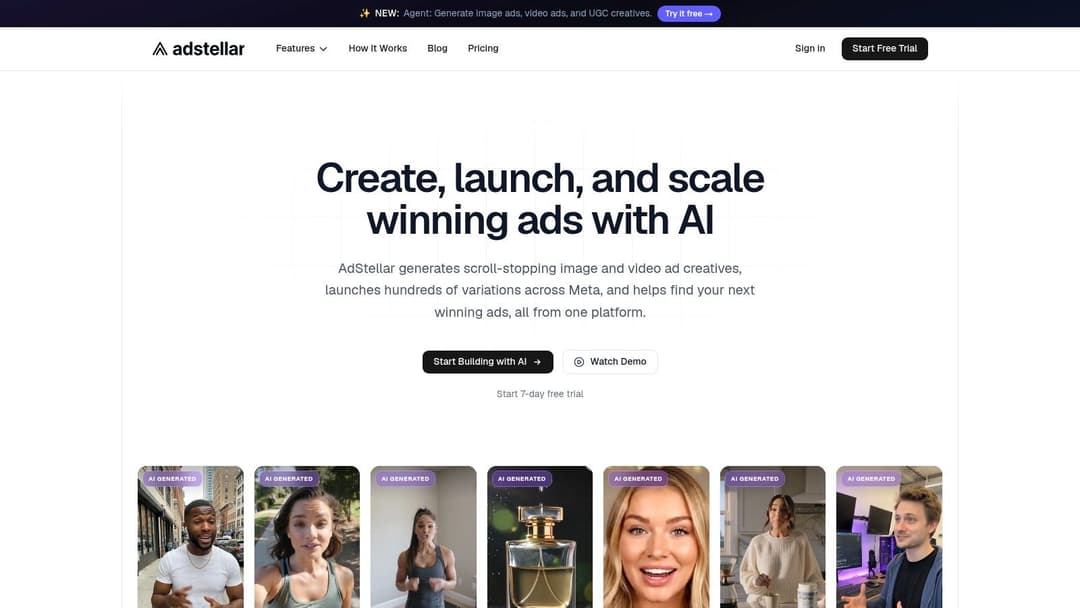
Where AI changes the workflow
AI matters here because interest targeting is combinatorial. One audience can pair with several messages, several hooks, several formats, and several offers. Testing that manually is slow, error-prone, and usually cut short by team bandwidth rather than strategic judgment.
A strong option in this category is AdStellar AI, which is built to launch, test, and scale large sets of audience and creative combinations from Meta performance data. For teams exploring this shift, its perspective on performance marketing AI is useful because it connects automation to a core media buying bottleneck: turning messy account data into repeatable testing and scaling decisions.
Manual testing teaches you what happened. AI-assisted testing helps you act on that learning fast enough for it to matter.
What scaling should actually look like
Scaling doesn't mean taking one winning interest and forcing budget into it until performance breaks. It means finding the underlying pattern behind the win.
Sometimes the actual winner isn't “entrepreneurship” as an interest. It's a message about time savings that resonated with self-directed operators. That insight should influence the next audience batch, the next creative set, and maybe even your landing page.
The most durable workflow looks like this:
| Stage | Human job | AI-assisted job |
|---|---|---|
| Hypothesis | Define audience angles and buying motives | Organize combinations and launch variants |
| Test reading | Interpret why something won or lost | Surface high-performing patterns quickly |
| Scale | Decide what strategic insight to expand | Push budget and new combinations based on signals |
| Iteration | Refine market understanding | Keep learning from fresh performance data |
When teams get this right, AI doesn't replace judgment. It removes the manual drag that keeps good judgment from being applied at scale.
The Future of Interest Based Targeting
Interest based targeting isn't going away. It's changing shape.
The old habit was to treat interests like fixed audience buckets. The better approach now is to treat them as inputs to a system of testing, creative alignment, and performance interpretation. That's a much stronger use case. It fits how modern ad accounts work, where audience signals, creative signals, and conversion signals all interact.
The marketers who keep winning with interests won't be the ones who memorize the longest targeting lists. They'll be the ones who can translate buyer psychology into clean audience hypotheses, pair those hypotheses with sharp creative, and read the data without fooling themselves.
Human strategy still matters because platforms can't tell you why a market cares. Your team has to do that. But execution speed matters too, and teams that rely only on manual setup will struggle to test enough combinations to keep pace.
Interest targeting is no longer a beginner feature. Used well, it's a disciplined way to find message-market fit inside paid acquisition. The next competitive edge comes from combining that discipline with systems that can launch, learn, and scale faster than a person clicking through ad sets one by one.
If your team is still building and testing audience-creative combinations by hand, AdStellar AI can help you turn interest targeting into a faster, more structured workflow. It connects with Meta Ads Manager, launches large sets of audience and creative variations, and uses live performance data to highlight what deserves more budget and what should be cut.