Your Meta account says a campaign is working. ROAS looks healthy. Purchases are coming in. The dashboard gives you a clean story.
The problem is that dashboards often answer the easiest question, not the most important one.
They tell you who converted after seeing or clicking an ad. They don't automatically tell you whether the ad caused that conversion. Some of those customers may have bought anyway because they already knew the brand, were ready to purchase, or came back through another channel. That gap between reported performance and actual causal impact is where marketers get into trouble.
Control group testing solves that problem. It gives you a disciplined way to separate background demand from ad-driven demand. If you've ever had to defend budget in a meeting, explain why a campaign should scale, or decide whether Meta is producing net new revenue versus harvesting existing intent, this is the method you need.
A lot of writing on control group testing misses the middle ground. Academic explanations get too statistical too fast. Basic marketing posts flatten the idea into "just run an A/B test," which isn't the same thing. What follows is the practical version. The kind you'd hand to a new paid social manager before they touch budget.
Beyond Clicks and Conversions The Need for True Measurement
A common paid social scenario looks good on paper. You launch a Meta campaign, attribution reports fill up, and revenue climbs alongside spend. The team starts to scale because the platform appears to be finding buyers efficiently.
Then someone asks the right question. Would those purchases have happened anyway?
That question is the starting point for incremental lift. Incremental lift means the conversions that happened because ads were shown, not just the conversions that happened after someone was exposed. That's the difference between correlation and causation. A customer can see an ad and still buy for reasons unrelated to that ad.
Practical rule: If your measurement approach can't estimate what would've happened without the ad, it can't tell you incremental impact.
This issue shows up outside advertising too. In product and research work, teams often compare synthetic testing with direct human feedback because automation can model behavior but not fully replace real-world validation. The same logic applies in media measurement, which is why this breakdown of AI testers vs human UX research is useful. The method matters as much as the output.
In paid social, platform attribution is still helpful. It tells you what happened within the platform's reporting logic. But if you're trying to answer whether spend is creating net new demand, you need a cleaner comparison model. That's where control group testing becomes the standard.
For a broader view of that attribution gap, AdStellar's piece on measuring true ad attribution is a helpful companion. It frames why reported conversions and causal conversions often diverge.
What marketers usually get wrong
Many new buyers assume "someone saw the ad and purchased" is enough evidence. It isn't.
A stronger measurement mindset looks like this:
- Separate exposure from effect: Exposure tells you an ad was present. Effect tells you the ad changed behavior.
- Account for existing intent: Branded search, email, direct traffic, and repeat buyers can all inflate perceived ad impact.
- Use comparison, not assumption: You need a credible baseline to know what would've happened without the campaign.
Once you start thinking this way, reported ROAS becomes a directional metric, not the final answer.
What Is Control Group Testing in Marketing
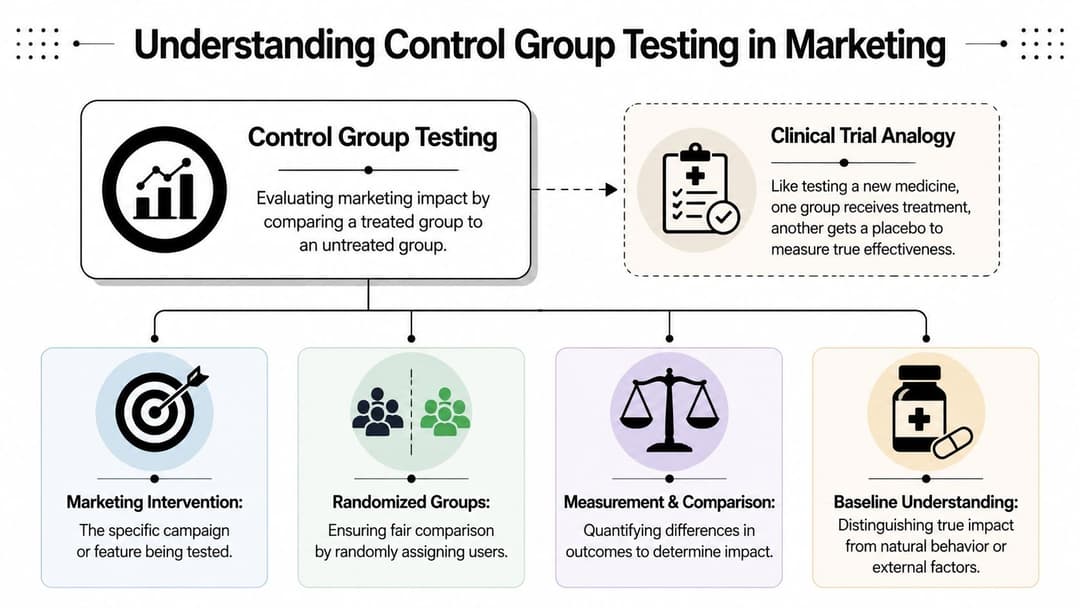
Control group testing is a structured way to measure whether marketing changed an outcome. One group gets the treatment, which in this case means exposure to your ad. Another similar group does not. You then compare what happened between the two groups.
That logic comes from experimental science. Historically, the inclusion of a control group has been a defining criterion for what scholars define as an "experiment," with many reserving the term exclusively for study designs that include a control group. In standard experimental practice, the control group is identical to the experimental group in every aspect except that it does not receive the treatment, thereby isolating the treatment as the only potential source of difference, as described by Britannica's explanation of control groups.
The simple analogy that makes it click
Think of a medical trial. Researchers give one group the medicine and another group no medicine or a placebo. If the two groups are otherwise alike, differences in outcomes point back to the treatment.
Marketing uses the same idea.
- Test group: People eligible to see your campaign
- Control group: Similar people intentionally held back from the campaign
- Observed difference: The gap in outcomes between the two groups
If purchases rise more in the exposed group than in the holdout group, you have evidence that advertising created value beyond what would've happened naturally.
Why this matters more than standard reporting
Most platform reports are descriptive. They summarize activity inside the ad system. Control group testing is causal. It asks whether the campaign changed behavior.
That distinction matters when you're trying to answer questions like these:
| Question | Standard attribution can help | Control group testing helps more |
|---|---|---|
| Which ad got more clicks? | Yes | Sometimes |
| Which campaign received more attributed purchases? | Yes | Partly |
| Did the campaign create net new conversions? | Not reliably | Yes |
| Should we keep funding this channel? | Directionally | More defensibly |
If you also use broader planning models, this connects naturally with what media mix modeling is. MMM helps at the channel and budget level. Control group testing helps when you want a direct experimental read on causality inside a live environment.
A clean test doesn't prove that ads touched a conversion. It shows whether ads changed the result.
That single shift in thinking changes how you judge performance.
Key Types of Control Group Tests for Marketers
Marketers often use the phrase "test" loosely. That's how teams end up using the wrong method for the wrong question. If you're trying to optimize creative, one format works well. If you're trying to measure incrementality, you need a different design.
A B testing
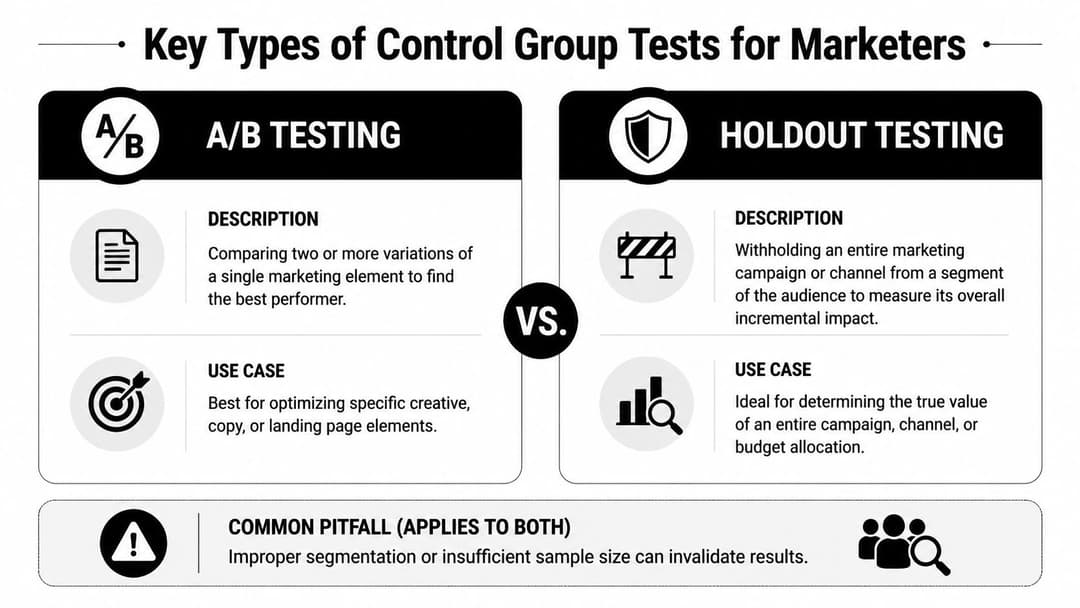
An A/B test compares one version of something against another version. You might test two headlines, two videos, or two landing pages. Both groups still receive marketing. You're comparing variation A versus variation B, not ads versus no ads.
Use A/B testing when you want to answer questions such as:
- Creative choice: Which image or video gets stronger engagement or lower CPA
- Message testing: Which angle resonates better with prospecting audiences
- Landing page optimization: Which page layout produces stronger conversion rates
The limitation is straightforward. A/B testing won't tell you whether the campaign itself generated new demand. It only tells you which version performed better within the ad delivery system.
Holdout testing
A holdout test, often called an incrementality test, compares a group exposed to ads with a group that is intentionally excluded from them. This is the standard form of control group testing for measuring causal lift.
This is the right option when you want to know:
- Whether Meta is driving conversions that wouldn't have happened otherwise
- Whether retargeting is adding value or just claiming credit
- Whether a new budget increase is producing net new revenue
A simple way to think about it is this. A/B testing asks, "Which ad version works better?" A holdout test asks, "Is this advertising doing anything meaningful at all?"
Field note: If leadership is debating whether a channel deserves budget, a holdout design is usually more useful than another creative split test.
The tradeoff is operational. Holdout testing is harder to set up well because you need clean audience separation, disciplined exclusions, and enough volume for the result to be interpretable.
Geo based testing
Geo tests split by market, region, city, or another geographic unit. One area receives the media treatment. Another similar area does not, or receives a different level of spend.
Geo tests are useful when user-level holdouts aren't practical, when channels overlap heavily, or when a brand wants to observe broader market effects that may spill beyond individual ad exposures.
They work best when you can reasonably compare markets and keep outside differences under control. Their main weakness is that geography introduces noise. Regions differ in demand patterns, seasonality, competition, and local events.
Which one should you use
The quickest way to choose is to start with the decision you're trying to make.
| If you're asking... | Use this test | Why |
|---|---|---|
| Which ad or message should we run? | A/B test | It compares variants directly |
| Is this channel causing incremental conversions? | Holdout test | It compares ads versus no ads |
| Can we test market-level impact? | Geo test | It works when market splits are more practical |
Teams get into trouble when they use A/B tests to answer incrementality questions. That's a category mistake. If both groups are exposed to ads, you're optimizing execution, not proving causal value.
How to Design a Statistically Sound Ad Test
A common failure looks like this. A team launches a Meta campaign, sees conversion lift after three days, and declares success. Two weeks later, performance settles back to baseline and no one can explain why.
That usually is not a reporting problem. It is a test design problem.
A statistically sound ad test works like a fair product trial. You need two groups that start from the same place, one clear difference between them, and a measurement window long enough to capture normal buying behavior. The goal is not to get a result fast. The goal is to get a result you can trust enough to use for budget decisions.
Start with one decision
Before you build audiences or set budgets, write down the exact decision the test is meant to support.
Good examples:
- Channel decision: Is Meta prospecting driving net new purchases?
- Audience decision: Does retargeting produce conversions that would not have happened through email or direct traffic?
- Budget decision: Does higher spend create more incremental conversions, or only more attributed conversions?
That sentence matters more than many teams expect. If the question is fuzzy, the setup will be fuzzy too.
A useful rule is one test, one variable, one business decision. If you change creative, audience, bid strategy, and landing page at the same time, the outcome may shift, but you will not know what caused it.
Build comparable groups first
The fastest way to ruin a test is to compare people who were never meaningfully alike.
Your exposed group and control group should come from the same source pool whenever possible. If one group is full of warm site visitors and the other is mostly cold prospects, the result is biased before delivery even begins. Random assignment helps because it spreads those hidden differences across both groups instead of stacking them on one side.
Use this as a pre-launch check:
- Match the starting pool. Create both groups from the same audience source when possible.
- Keep exclusions clean. Make sure the control group is withheld from the campaign you are testing.
- Check overlap outside the test. If other campaigns can still reach the holdout group, you are no longer measuring a clean ad versus no-ad comparison.
- Freeze major changes. Avoid changing offer, site experience, or conversion tracking in the middle of the test.
The practical idea is simple. If the groups are not comparable at the start, no amount of statistical language at the end will fix the test.
Give the test enough volume and enough time
Marketers often focus on sample size and forget time-to-conversion. Both matter.
If your product has a seven-day consideration cycle, a three-day read will miss part of the impact. If your audience is too small, random variation can look like a real lift. Statistical significance only means something when the test had a fair chance to observe the behavior you care about.
A good habit is to plan around the buying cycle first, then pressure-test whether your audience volume can support that window. For example, a low-ticket impulse purchase may reveal signal quickly. A high-consideration B2B lead gen campaign usually needs more time for form fills, qualification, and delayed conversions to show up.
If you want to see how disciplined testing connects to execution in practice, these data-driven advertising examples are useful context.
Choose the KPI before launch
Do not wait for results and then pick the metric that looks best. That turns analysis into storytelling.
Pick the primary KPI in advance based on the decision you are trying to make:
- Ecommerce: purchases, revenue, or contribution margin if your team can measure it reliably
- Lead generation: qualified leads or pipeline quality, not just raw form fills
- Awareness: lift-based survey outcomes or brand recall when the platform and study design support them
You can track secondary metrics, but the primary success metric should be fixed before launch. That keeps the team aligned and reduces the temptation to explain away a weak result.
For a more tactical view on setup choices inside Meta, AdStellar's guide to Facebook ad testing best practices is a useful companion.
Use a simple sanity check before spending
Before launch, review the design like a media lead reviewing a budget request. Ask whether the test would still make sense to someone who did not build it.
| Check | What good looks like |
|---|---|
| Is the question specific? | One decision, written in plain language |
| Are the groups comparable? | Same source pool, clean separation, minimal overlap |
| Is the KPI fixed? | Primary metric chosen before launch |
| Is the window realistic? | Long enough for normal conversion behavior |
| Will the result change an action? | Budget, audience strategy, or campaign structure will change based on the outcome |
If one of those boxes stays unchecked, pause and fix the design first. That extra hour of planning usually saves weeks of false confidence later.
Implementing Control Group Tests in Meta Ads Manager
Meta gives advertisers native tools to run lift-style studies, but the setup works better when you think through the business logic before you open the interface. The platform can help create structure. It can't decide what you're trying to learn.
Choose the study type based on the outcome
At a high level, marketers usually think in two directions.
One path focuses on brand impact, where the question is whether exposure changed awareness, recall, or perception. The other focuses on conversion impact, where the question is whether ads changed downstream actions like purchases or leads.
That sounds obvious, but teams still misclassify studies. If your CFO wants to know whether revenue increased because of ads, a brand-oriented setup won't settle the argument.
Define the holdout logic before touching budgets
In Meta's environment, the control group needs to be intentionally withheld from ad exposure for the campaign being tested. The strategic decision isn't just "can Meta split the audience?" It's whether the split matches your real operating conditions.
Ask yourself:
- Are you testing one campaign or a broader program?
- Will other campaigns still reach this audience elsewhere in the account?
- Does the control group remain clean enough to act as a baseline?
If your audience overlaps heavily across campaigns, the test may answer a narrower question than you think. It may show lift for one campaign setup, not for all Meta activity.
Budget and timing should match the business rhythm
Native lift studies aren't just another ad set. They need enough live delivery and enough post-exposure time for behavior to show up. Product category matters here. Impulse purchases and considered purchases don't move on the same clock.
Creative readiness matters too. If you need to generate multiple ad variants before the test launches, tools like the ShortGenius Meta ad creator can help speed up production so setup delays don't become the reason a study slips.
Don't treat the lift study as a reporting add-on. Treat it as a planned experiment with budget, timing, and exclusions set in advance.
For context on the measurement friction inside the platform, this article on Meta ads attribution challenges is worth reviewing. It helps explain why native reporting and causal testing often lead to different interpretations.
What to watch once the test is live
During the run, resist the urge to interfere unless something is clearly broken. Mid-test changes can contaminate the result.
The useful monitoring questions are operational:
- Is delivery stable?
- Are exclusions holding?
- Did another team launch overlapping campaigns?
- Has the business entered a period that makes comparison unreliable, such as a major promo push?
If the setup stays disciplined, the final read will be far more credible.
Automating Incrementality Testing with AdStellar
Manual control group testing is possible. It's also slow. Teams need to build audiences, protect holdouts, monitor overlap, read results carefully, and repeat the process often enough for testing to become a habit rather than a one-off project.
That's where automation becomes practical.
Why manual workflows break down
Most paid social teams don't fail because they reject experimentation. They fail because experimentation competes with campaign launches, creative reviews, reporting deadlines, and budget changes.
A manual testing workflow usually creates friction in three places:
- Setup drag: Audience splits and exclusions take time to build and verify
- Interpretation inconsistency: Different buyers read the same result differently
- Poor continuity: One test runs, then no one repeats the process for the next campaign cycle
What automation changes
Automation helps when it turns testing into a repeatable operating process instead of an occasional analysis task. In this context, a platform like AdStellar AI can support automated workflows around audience management, launch processes, and result handling so teams can keep incrementality testing closer to day-to-day execution.
That matters because the core value of control group testing isn't one isolated answer. It's the pattern you build over time. Which audiences generate true lift. Which creatives change behavior. Which budgets create new demand and which merely soak up existing intent.
Good automation doesn't replace experimental thinking. It removes the manual work that stops teams from applying that thinking consistently.
For performance teams running Meta at scale, that's the difference between saying testing matters and operating that way week after week.
Common Pitfalls in Control Group Testing and How to Avoid Them
The biggest testing mistakes usually don't happen in the analysis. They happen in setup and interpretation.
Audience pollution
A control group only works if it stays meaningfully unexposed to the treatment you're testing. If users in the holdout group still see related ads through overlapping campaigns, another account structure, or nearby channel activity, your baseline gets contaminated.
Avoid this by tightening exclusions before launch and checking with adjacent teams. This is especially important in larger accounts where prospecting, retargeting, and catalog campaigns can overlap without anyone noticing.
Tests that end before behavior settles
Some teams read performance too quickly because they want a yes or no answer. That can miss delayed conversions and distort the comparison.
Match the test length to the buying cycle, not to reporting impatience. If your product usually requires consideration, let the observation window reflect that. Flat early results don't always mean no effect.
Seasonality and business noise
Promotions, product launches, stock issues, and creative refreshes can all interfere with clean comparison. A holdout test launched during a chaotic period may produce a result that's technically real for that moment but not useful for future planning.
Pick calmer windows when possible. If you can't, document what else changed during the test so leadership reads the result with the right context.
A short walkthrough can help reinforce what to watch in live experiments:
Misreading an inconclusive result
Not every test produces a decisive answer. That doesn't mean the work failed.
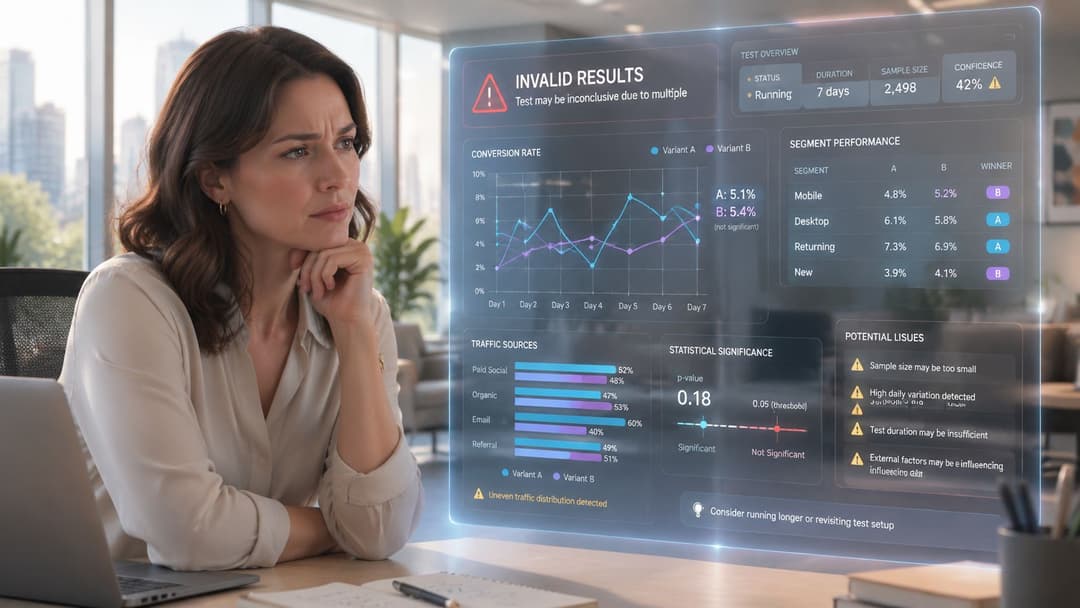
Sometimes the takeaway is operational. The audience was too mixed. The window was too short. The campaign wasn't large enough to create a readable difference. A mature team treats inconclusive results as feedback on test design, not as proof that measurement doesn't work.
- Ask whether the setup was clean: Weak execution can hide real effects.
- Separate no signal from no impact: Those aren't the same conclusion.
- Log the learning: Better testing compounds when teams document what invalidated the read.
If you're running Meta ads regularly, AdStellar AI is worth evaluating as part of your workflow. It gives teams a way to launch, test, and manage campaigns with more structure, which makes control group testing easier to sustain instead of treating it like an occasional side project.