You've launched a paid social campaign with a dozen new ads, several audiences, multiple offers, and enough placement data to fill a dashboard. One variation is producing cheaper clicks, another is generating stronger conversion volume, and a third looks promising only inside a narrow retargeting pool. You can see the differences, but you can't tell whether the message, audience, offer, landing page, or delivery conditions caused them.
That's the problem with producing more creative without building a testing system. Message testing best practices depend on clear hypotheses, controlled comparisons, meaningful success metrics, and fast learning cycles. They don't mean launching every possible combination and choosing the ad with the highest short-term result.
The operating system below moves from strategic angles and audience context to controlled tests, message-to-page coherence, fatigue, offer structure, and continuous automation. AdStellar AI can reduce the repetitive work involved in generating variations, importing historical performance, launching campaigns, and monitoring results, while your team keeps responsibility for the judgment behind each test.
1. A/B Testing with Statistical Significance
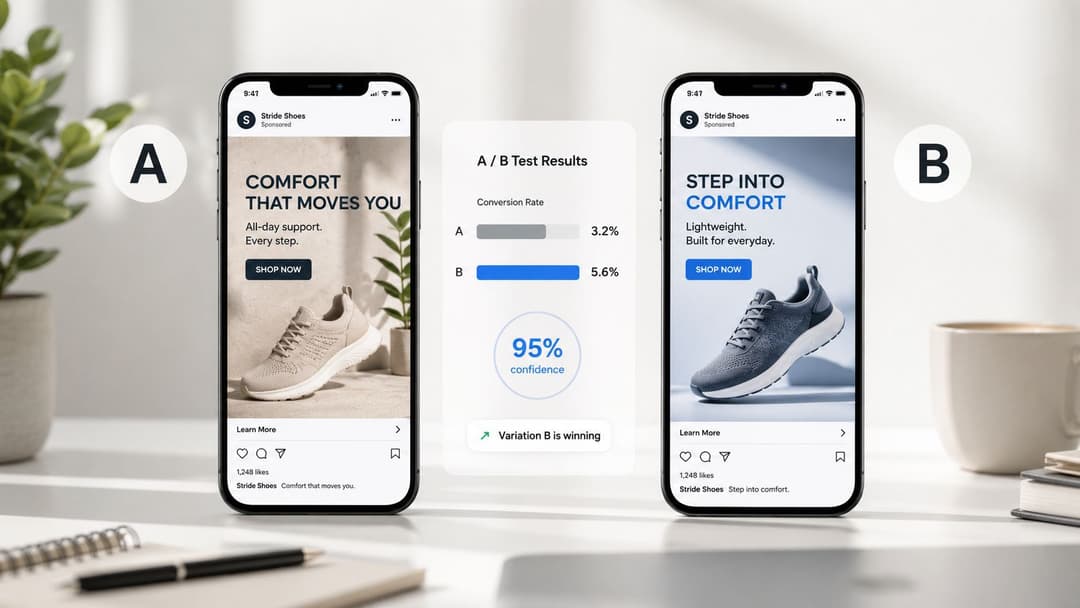
A/B testing works when it answers one clear question. Will message A or message B produce a better result against a defined metric for the same type of audience? The variants should receive comparable delivery conditions, and the team should decide the primary metric before launch.
That metric might be purchases for an ecommerce campaign, qualified leads for B2B SaaS, or cost per acquisition for a subscription product. Secondary metrics such as click-through rate and cost per click can explain the result, but they shouldn't replace the original success criterion after the test begins.
Statistical discipline matters because paid social results fluctuate. A message that leads for a short period may benefit from random delivery, an unusual day, or a temporary audience pocket. Quantitative monadic testing guidance recommends at least 100 respondents per message for a statistically reliable score, with larger samples needed for subgroup comparisons, as outlined in this sample-size guide for testing. Live campaign requirements vary with baseline performance and the lift you're trying to detect. One testing example estimates about 1,500 recipients per variant to detect a 10% lift at 95% confidence and 80% power, compared with about 400 per variant for a 20% lift and about 70 per variant for a 50% lift in an SMS experiment (SMS A/B testing guidance).
Isolate the variable that matters
If a shoe brand changes the headline, product photography, CTA, and discount at once, the winning ad may be better because of any one of those changes, or because the combination happened to fit the audience. Start with one major variable. Compare a lifestyle image with a product-only image, or a benefit-led message with an urgency-led message, but avoid treating a full creative rebuild as a clean copy test.
Practical rule: Define the hypothesis, audience, primary metric, minimum sample requirement, and stopping rule before you spend.
AdStellar's AI Insights can help rank message variations against goals such as ROAS, CPL, or CPA. Historical performance ingestion can also inform the next hypothesis, but it shouldn't become a reason to skip controlled validation. Let the platform reduce analysis and setup time, while the team decides what constitutes a fair comparison.
2. Audience Segmentation and Message Personalization
A message can fail because it's wrong, or because it's being shown to the wrong person. A first-time visitor who has only browsed a category doesn't need the same argument as a repeat customer who already understands the product. Treating both people as one audience forces the ad to compromise.
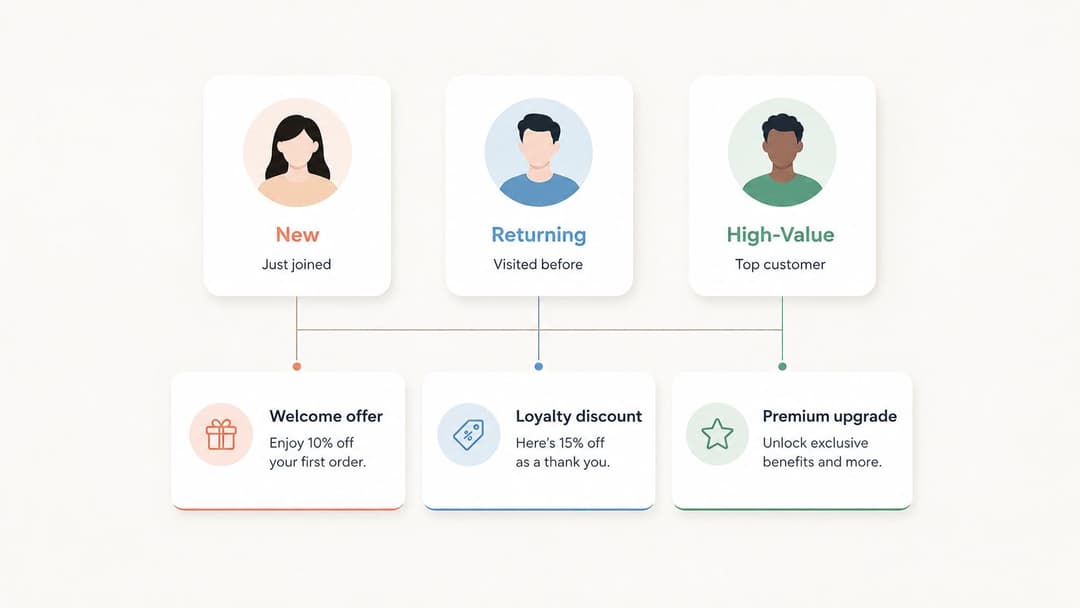
Start with a small number of meaningful segments. New prospects, returning visitors, cart abandoners, existing customers, and high-value customers often require different levels of education, reassurance, and incentive. The right segmentation depends on the business, but each segment should represent a distinct decision context rather than a convenient filter in Ads Manager.
A fashion retailer might show browse-only users a new-collection message, while cart abandoners receive a direct reminder about the product they considered. A SaaS company could lead with operational simplicity for smaller businesses and emphasize governance, integration, and financial impact for enterprise buyers. A repeat customer may respond better to early access or loyalty language than to an introductory discount.
Match the message to the funnel state
Segment-specific testing is more useful than creating dozens of tiny audiences that can't produce dependable learning. Test the same strategic angle within each major segment, then compare whether the response changes. If a convenience message wins among new prospects but a proof-focused message wins among returning users, that's a positioning insight, not just an ad-level result.
Use behavioral signals such as product views, checkout events, app activity, and email engagement where available. Demographics can add context, but behavior usually provides a clearer indication of what the person needs next. Meta audience data can help confirm whether a segment is large enough to support a test, while this guide to Facebook audience segmentation provides a useful framework for structuring those groups.
AdStellar can generate multiple message variations for each segment, which makes personalization more practical for lean teams. Don't publish every generated option automatically. Screen for brand fit, claim accuracy, offer eligibility, and a clear difference between variants.
A useful segment changes the decision you're asking the customer to make. If it doesn't, it probably doesn't need its own message.
Keep the CTA aligned with intent. “Learn more” may suit an unaware prospect, while “Complete your order” makes sense for a high-intent visitor. Personalization should clarify the next action, not add superficial references to audience labels.
3. Test Message Frameworks and Angles
Minor copy edits often produce minor learning. Changing “Try it today” to “Get started today” can be useful once the strategic direction is clear, but it won't tell you whether the audience cares more about saving time, avoiding risk, gaining status, or accessing a better outcome.
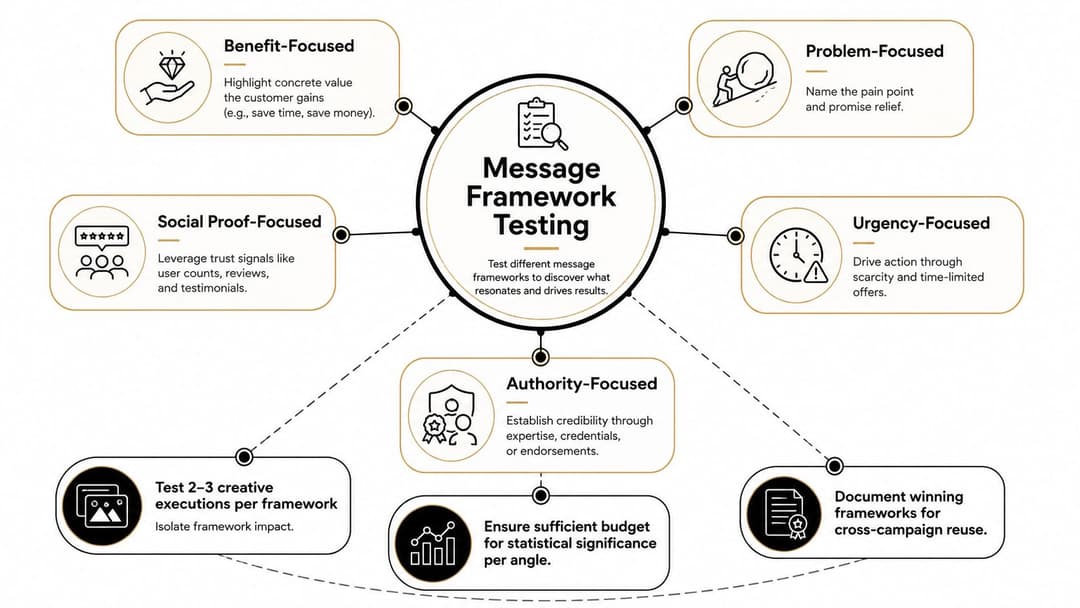
Test the underlying angle first. A benefit framework promises a useful result. A problem framework names the cost of staying with the current situation. Social proof reduces uncertainty through evidence of adoption, while authority uses expertise or provenance to create confidence. Urgency can prompt action when the offer has a time or availability constraint.
For a project-management platform, compare an efficiency angle with a risk angle and a collaboration angle. The first might focus on reducing manual coordination, the second on preventing missed work, and the third on keeping teams aligned. Those are not interchangeable phrasings. They ask the prospect to value different outcomes.
Separate framework from execution
A framework needs more than one execution. If one angle appears in a polished video and another appears in a weak static design, the test measures production quality as much as message quality. Give each framework comparable treatment across formats, hooks, visual hierarchy, and CTA strength.
A practical sequence looks like this:
- Map distinct hypotheses: Identify several plausible reasons the audience might act, then remove angles that make unsupported claims.
- Create comparable executions: Give each strategic angle multiple versions so one poor ad doesn't represent the entire framework.
- Use one primary decision metric: Pair behavioral results with comprehension or open-ended feedback when the message is still at the concept stage.
- Record reusable learning: Preserve the winning angle, audience context, objections, and evidence. Don't reduce the result to a single ad ID.
Survey guidance recommends monadic exposure, random assignment, a focus on two to four variants, and at least one open-ended comprehension question alongside closed-scale ratings (message testing guidance from SurveyMonkey). That combination helps distinguish a persuasive message from one that merely attracts attention.
AdStellar can generate multiple executions from a selected framework, but automation shouldn't decide which customer tension deserves emphasis. Your team still needs to connect the angle to product truth, audience research, and the buying stage.
4. Use Multivariate Testing Carefully
Multivariate testing examines combinations rather than isolated elements. A paid social team might compare a founder story with a trust-oriented CTA and an access-based offer against a product demonstration with a trial CTA and a savings message. The test asks whether those elements reinforce one another in a way a single-variable comparison would miss.
Interactions can change the result. An urgency message may perform better with a vivid lifestyle image than with a technical product shot. A “book a demo” CTA may fit an enterprise proof point, while a self-serve trial CTA may fit a simple implementation message. When a headline and CTA interact, test them as a pair before scaling either element independently.
The trade-off is statistical power. Each additional headline, visual, CTA, and offer creates more combinations competing for traffic. A test can look thorough yet remain inconclusive if variants receive too little exposure or too few conversions. Production capacity is not a reason to expand the matrix.
Reserve MVT for high-impact questions
Start with a small design built around variables that plausibly interact. Fractional factorial designs test a subset of combinations instead of every possible arrangement. Sequential testing may also fit campaigns where traffic or budget cannot support a full matrix.
Before launch, document:
- The suspected interaction: Explain why the headline and CTA might reinforce each other.
- The combinations being tested: Keep the matrix small enough to fund properly.
- The primary outcome: Choose conversion, qualified lead rate, or revenue as the decision metric.
- The interpretation plan: Define what to do if one element wins alone but loses within a combination.
Use clear objectives, an appropriate method, audience context, and a defined iteration plan (copy testing and message testing methods). AdStellar's bulk generation can handle the production burden of combination testing, while your team protects the test design and traffic allocation. For a workflow that covers automated matrix creation and variation management, see this automated ad variation testing guide. Automation organizes the options, but it cannot create statistical power or decide which interaction reflects a real customer need.
5. Build Sequential Testing and Continuous Learning Loops
A winner shouldn't end the testing process. It should create the next question.
Suppose an ecommerce team learns that an availability-based message performs better than a generic discount message. The next test shouldn't restart with unrelated copy. It might apply the same urgency logic to a new product category, pair it with free shipping, or test whether the message works for returning visitors as well as new prospects. Each result narrows uncertainty and expands the team's understanding of what drives action.
This approach turns message testing into an operating rhythm:
- Write a hypothesis based on prior evidence.
- Select the audience and primary metric.
- Run a controlled comparison.
- Validate the result and inspect downstream quality.
- Document the learning.
- Deploy the winner and define the next test.
Keep a learning record
A test archive should capture more than the winning text. Store the audience, placement, format, offer, landing page, delivery period, primary result, confidence assessment, and qualitative feedback. A SaaS team may learn that proof points work best for enterprise prospects, but that insight is incomplete unless it also records which proof point, CTA, and funnel stage produced the result.
Create a shared testing calendar instead of treating experimentation as spare-time work. Review learnings across creative, media buying, product marketing, and lifecycle teams. A message that performs well in acquisition may also improve onboarding or sales enablement, while a recurring objection in comments may suggest a product or landing-page issue.
The useful output of a test is not “Variant B won.” It's “This audience responds to this promise under these conditions, so the next test should challenge or extend that rule.”
AdStellar's auto-learning models can surface emerging patterns as fresh performance data arrives. They're most useful when paired with manual hypothesis discipline. The platform should shorten repetitive work, not turn experimentation into an unexamined stream of automated edits. This overview of continuous learning reinforces the value of feeding each result into the next decision.
6. Test Message-to-Landing Page Coherence
A strong ad can create a weak conversion experience if the landing page changes the promise. Someone who clicks an ad about a free trial shouldn't arrive on a generic homepage and have to search for the trial. A prospect responding to a specific product benefit should see that benefit repeated clearly on the destination page.
This is message matching, but the principle extends beyond headline repetition. The ad and page should agree on the offer, product, audience, tone, visual language, and next action. If the ad uses a limited-edition message and the page displays a broad product catalog, the customer has to resolve uncertainty before continuing. That extra work can erase the value of the original hook.
Pair the message and destination deliberately
Build a simple map of major ad angles and their landing pages. Prioritize the combinations that receive the most spend or attract the highest-intent traffic. Then inspect whether the destination delivers what the ad led the user to expect.
For an apparel campaign, an ad promoting winter coats should lead to a focused winter-coat collection rather than the homepage. For a B2B software campaign, an ad emphasizing implementation speed should lead to a page that explains onboarding, not a general feature list. For a founder-led product, the page should continue the story or move quickly to the product proof that made the ad compelling.
Test coherence as a pairing, not as two disconnected assets. Keep the ad message constant while changing the destination, or keep the destination constant while changing the ad angle. If both change together, you won't know whether the result came from the promise or the page.
Use dynamic landing-page tools such as Unbounce, Instapage, or Leadpages when many high-value angles require personalized destinations. AdStellar can help map message variants to specific pages and route traffic consistently. Before launch, verify mobile rendering, tracking parameters, offer eligibility, and checkout or form behavior.

7. Test Frequency and Fatigue Thresholds
Message performance changes as people see it repeatedly. A hook that works during the first exposure can become invisible, irritating, or unbelievable after repeated delivery. Frequency isn't automatically bad, though. Retargeting audiences may need repeated reminders, while cold prospects may react negatively to aggressive repetition.
Test the message rotation, not just the number of impressions. Keep the audience and offer comparable, then compare a single repeated message with a small set of related variants. This shows whether fatigue comes from the delivery level, the wording, the creative format, or the absence of a new reason to act.
A retailer promoting a seasonal sale might find that one urgency message loses attention faster than a rotation that moves from product discovery to proof to a closing reminder. A SaaS team might use an educational message for early exposures, then introduce a product demonstration for warmer users. The sequence should reflect the buyer's changing questions rather than repeat the same claim with cosmetic edits.
Read fatigue through several signals
Don't use frequency as a standalone success metric. Watch click-through rate, cost per click, conversion rate, CPA, comment quality, and downstream customer quality together. A message may attract fewer clicks as the audience becomes familiar with it while still producing more qualified conversions, or it may maintain clicks while attracting low-intent traffic.
Use comparable cohorts where possible and distinguish concurrent delivery from sequential exposure. Someone who sees an ad several times in a short period has a different experience from someone who encounters it occasionally over a longer buying cycle. Document the exposure context so the learning can transfer.
- Rotate the reason to act: Change the proof, benefit, objection, or use case, not only the headline.
- Protect message continuity: Keep the strategic promise recognizable while refreshing the execution.
- Review comments and reactions: Qualitative signals can reveal irritation or confusion before conversion data fully shifts.
- Re-test after audience changes: Tolerance can change as the pool becomes warmer, smaller, or more familiar with the brand.
AdStellar's message-variation system can support rotation-based tests, while this guide to frequency capping on Facebook Ads offers additional context for managing repeated delivery. Don't declare a universal fatigue threshold. It belongs to the audience, offer, placement, and buying cycle.
8. Test Offer Type, Incentive Structure, and Value Clarity
The offer can overpower the message, which makes it one of the easiest variables to misread. A discount may increase conversion while reducing profit, attracting customers with weak retention, or training existing buyers to wait. A free gift may appear less aggressive but create stronger perceived value for a new customer. A bundle may improve order economics while reducing the number of individual products purchased.
Test offer structure independently from the surrounding message whenever possible. Compare percentage discounts, fixed-value savings, free shipping, bundles, buy-one-get-one mechanics, access, exclusivity, or service-based incentives. Then test how clearly the value is communicated. “Save half” and a specific currency amount can feel different even when they describe the same commercial proposition.
A skincare brand might compare a free gift with purchase against a direct discount for new customers and a bundle for repeat buyers. A SaaS company could test monthly versus annual value framing, provided the pricing and conditions remain accurate. An ecommerce retailer might find that a product benefit drives attention, but the incentive determines whether the customer completes checkout.
Measure profit, not only response
Conversion rate is an incomplete decision metric when offers change margin or customer quality. Track revenue, gross profit where available, refund behavior, repeat purchase, lead quality, and sales acceptance alongside acquisition cost. The best-performing offer is the one that supports the business objective, not necessarily the one that produces the cheapest initial conversion.
Use an offer ladder carefully. Test different levels only when the commercial rules are clear and the audience can receive each offer. Keep exclusions, minimum order conditions, expiration language, and eligibility consistent with the landing page and checkout experience.
Clear value beats complicated value. If a customer needs to calculate the incentive before understanding it, the offer is asking the ad to do too much work.
AdStellar can generate and organize offer articulations across audience and creative combinations, but every claim needs commercial and legal review. Preserve the strongest value explanation in the next round, then challenge the structure, condition, or audience fit rather than changing everything at once.
8-Point Message Testing Comparison
| Item | Implementation complexity | Resource requirements | Expected outcomes | Ideal use cases | Key advantages |
|---|---|---|---|---|---|
| A/B Testing with Statistical Significance | Moderate, simple designs but needs careful setup | Moderate traffic/budget and sample-size calculations | Clear, statistically validated winner and incremental lifts | Single-variable optimizations (copy, CTA, image) with sufficient traffic | Quantifiable decisions; low-risk scaling; straightforward analysis |
| Audience Segmentation and Message Personalization | High, more campaign structure and targeting logic | Robust first‑party data, segmentation tools, and creative variants | Higher relevance, CTR and conversion uplift; improved ROAS | Personalization across lifecycle, behavior, demographics | Tailored messaging increases efficiency and reduces ad fatigue |
| Testing Message Frameworks and Angles | Medium–High, requires varied creative concepts | Multiple creative executions and larger sample sizes | Identifies high-impact narratives and emotional/rational drivers | Strategic positioning and discovering repeatable messaging frameworks | Reveals core motivators; often larger lifts than minor tweaks |
| Multivariate Testing (MVT) for Complex Interactions | High, complex experimental design and analysis | Very large traffic and advanced statistical/tools support | Finds synergistic element combinations and interaction effects | Testing many elements (headline×CTA×image) when scale permits | Discovers non-obvious winners; efficient for many simultaneous variables |
| Sequential Testing and Continuous Learning Loops | Medium, process discipline and documentation required | Ongoing testing cadence, knowledge management and reporting | Compounding improvements and institutionalized learnings | Organizations building a testing culture and long-term optimization | Continuous improvement; prevents repeat mistakes; strategic accumulation |
| Message-to-Landing Page Coherence Testing | Moderate, requires landing-page variants and routing | Landing page infrastructure (dynamic pages) and mapping logic | Significant conversion uplifts from improved continuity | Conversion-focused campaigns where message matching matters | Reduces friction; improves conversions and ad quality scores |
| Testing Message Frequency and Fatigue Thresholds | Medium, requires cohort tracking and frequency controls | Audience-level frequency tracking and rotation-capable creatives | Optimal frequency caps and rotation strategies to avoid fatigue | Campaigns with repeat exposures and limited audience pools | Saves wasted impressions; extends message lifespan; optimizes spend |
| Testing Offer Type, Incentive Structure, and Value Clarity | Medium, business and margin coordination required | Offer management, financial modeling, and segmented tests | Large conversion and profitability shifts depending on offer | Pricing, promotion strategy, and LTV-aware acquisition tests | Often highest conversion lift; reveals price sensitivity and profit trade-offs |
Build the Next Test From the Last Winner
A dependable message testing system doesn't require endless creative production. It requires a repeatable decision sequence. Start with one hypothesis that names the audience, the message difference, and the business outcome you expect to change. If the question is too broad, the result won't tell you what to do next.
Choose the audience context before writing the variants. A prospect who has never heard of the product needs a different message from a returning customer. Select one primary metric, then define the supporting signals that will help explain the result. For acquisition, that might mean conversion or CPA as the decision metric, with CTR, landing-page engagement, lead quality, and profit as diagnostic measures.
Control the test design. Use random assignment where possible, isolate the main variable in an A/B test, and reserve multivariate designs for interaction questions that justify the extra complexity. Message testing guidance recommends monadic exposure, random assignment, two to four variants, one primary metric, and an open-ended comprehension probe when the study is designed to understand how people interpret the message (practical message testing recommendations). Set success criteria before fielding so the team doesn't redefine the win after seeing the data.
Validate significance and practical impact together. A small numerical difference may not justify a production change, while a meaningful business improvement may require a larger sample before you can trust it. The widely cited Advertising Research Foundation finding that copy testing can improve campaign effectiveness by 20% to 70% versus untested creative is a reminder of the strategic value of validation, not a promise that every test will produce that outcome (copy testing effectiveness context).
Then inspect what happens after the click. Does the landing page deliver the same promise? Does the offer remain profitable? Does the message attract customers who continue through the funnel? A winning ad that creates low-quality leads or unprofitable orders is a lesson about optimization boundaries, not a final answer.
Document the learning in language the next test can use. Record the audience, angle, format, offer, destination, result, confidence, and next question. Feed that learning into the next creative brief, not just a dashboard archive. The best teams build a library of validated hooks, objections, proof points, and audience-message matches.
Automation expands capacity, but it doesn't replace experimental judgment. AdStellar's bulk generation can produce large sets of creative, copy, and audience combinations; historical performance ingestion can make prior results available when forming new hypotheses; AI Insights can rank messages against ROAS, CPL, or CPA; and AI Launch can assemble campaigns from proven winners. Its auto-learning models can also identify high performers as fresh Meta data flows in. Your team still decides which ideas are strategically sound, which claims are supportable, and which test deserves budget.
Adoption of experimentation is widespread but uneven. A 2026 benchmark summary reports that 77% of marketers use A/B testing, while 17% actively A/B test landing pages, indicating a gap between knowing the method and connecting the ad experience to the conversion experience (2026 A/B testing benchmark summary). That gap is an opportunity for teams that test the whole path, from strategic angle to profitable customer action.
Start your next cycle with the last reliable winner, not a blank page. Ask what made it work, where it might stop working, and which adjacent hypothesis could turn one successful message into a durable growth system.
AdStellar AI helps paid social teams generate and organize message variations, ingest historical Meta performance, launch controlled campaign combinations, and use AI Insights to find stronger creative and audience pairings. Visit AdStellar AI to replace repetitive setup with a practical testing workflow that helps you learn faster and scale winning messages with greater control.