You've seen this happen in your own account.
A campaign starts strong. CPM looks normal. Clicks come in. Then frequency creeps up, comments get snarkier, CTR softens, and CPA starts drifting the wrong way. Nothing looks broken in a dramatic way, but performance gets less efficient every few days.
That's usually when teams focus on the wrong fix. They tweak copy, swap one image, or blame the algorithm. Sometimes the actual issue is simpler. The same people are seeing the same ads too often, and your budget is paying for repetition that no longer helps.
That's why frequency capping Facebook ads matters. Not as a box to tick in Ads Manager, but as a strategic control over reach, recall, conversion pressure, and creative burnout. Used well, it protects brand perception and stretches budget. Used badly, it can choke delivery or hide a deeper audience problem.
Stop Annoying Your Audience and Wasting Your Budget
A prospect visits your site after seeing a useful Instagram ad. They don't buy yet, but they're interested. Later that day they open Facebook and see the same ad. Then again in Stories. Then again the next morning. By the time they've seen that exact creative over and over, the message hasn't become stronger. It has become irritating.
That's the point where ad repetition stops being reinforcement and starts becoming waste.
Most advertisers don't notice it early because Meta reports frequency as an average. The dashboard might not look alarming at first glance, while a smaller subset of users is getting hammered with impressions. That's where budget leakage starts. You're still buying delivery, but you're no longer buying attention.
What overexposure looks like in practice
The symptoms usually show up before anyone on the team says “we have a frequency problem.”
- Creative response weakens: People stop reacting to the ad because it no longer feels new.
- Performance gets less efficient: You pay to show the same message again instead of reaching someone fresh.
- Brand sentiment slips: Repetitive ads often trigger hiding, scrolling, or annoyed comments.
- Retargeting gets sloppy: Warm audiences get over-served because they're small and easy for the system to hit repeatedly.
If that pattern sounds familiar, it helps to review the common audience fatigue symptoms in Meta ads before changing delivery settings.
Frequency problems rarely start as a targeting problem alone. They usually show up when a small audience, stale creative, and steady spend collide.
A good cap doesn't exist to make reports look tidy. It exists to protect the moment when your ad still feels useful. Once you think about frequency that way, the question changes from “Can I cap this?” to “How many times should this person really see this before I'm wasting money?”
Why Smart Frequency Capping Drives Ad Efficiency
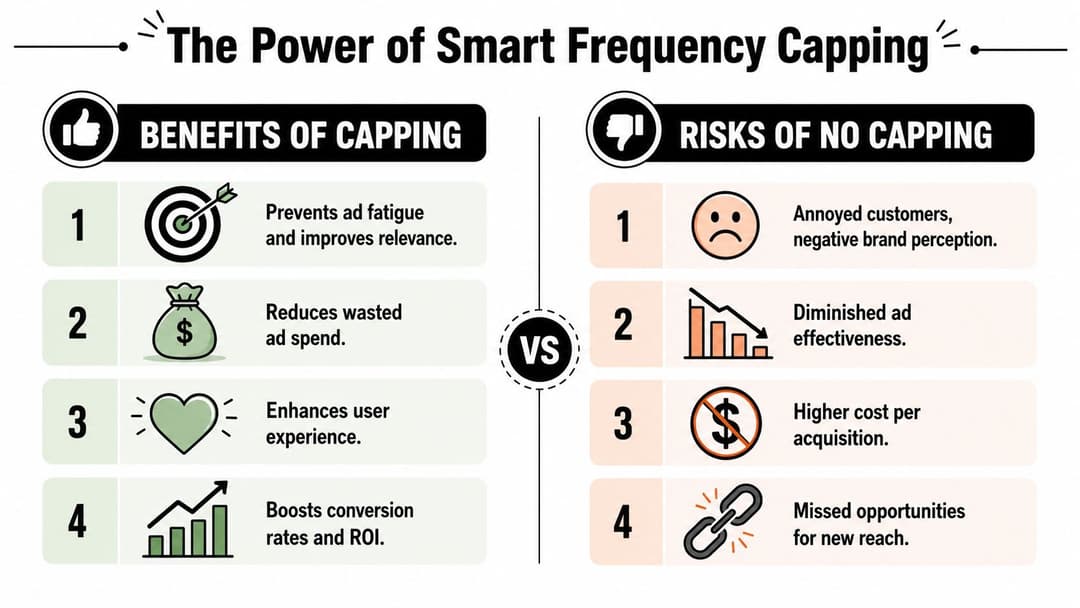
Frequency is one of the most revealing metrics in Meta advertising because it exposes how your budget is being distributed across people, not just impressions. When frequency rises too fast, the platform is often telling you that it's running out of fresh users inside your current setup.
That has two consequences. First, you pay to repeat yourself. Second, you limit reach because more spend goes back into the same audience pool.
Repetition helps until it doesn't
Not every extra impression is bad. Some repetition is necessary, especially when you're asking someone to remember a brand or take an action later. The mistake is assuming more exposure automatically means more impact.
Meta's own effective frequency research found that a frequency cap of 1 per week could capture up to 80% of total potential brand lift in ad recall, while a cap of 2 per week captured 95% of the total potential brand lift in purchase intent. The same research reported that ad recall lift slowed substantially after 1 exposure per week, while purchase-intent lift did not start to slow until close to 1.5 exposures per week.
That matters because it gives you a practical frame. If your objective is light awareness, low weekly exposure may do most of the work. If your objective is behavior change, you usually need a bit more repetition.
Why this improves efficiency
The best frequency strategy isn't “lowest possible.” It's “enough to matter, not so much that you burn budget.”
Here's what smart capping tends to improve:
- Budget allocation: More spend can go toward reaching new people instead of re-serving the same audience.
- User experience: People are less likely to feel chased by the same creative.
- Creative lifespan: Multiple ads can rotate before one concept gets exhausted.
- Optimization clarity: You can spot whether weak results come from message-market fit, audience quality, or simple overexposure.
A lot of account-level waste hides inside frequency. Teams often call it algorithm volatility when it's really delivery concentration.
For a broader framework on tightening Meta performance, this guide to Facebook ad optimization is useful alongside frequency management.
Practical rule: If frequency is rising and performance is flat or slipping, don't assume the answer is more budget. First ask whether you're just paying to repeat.
How to Configure Frequency Caps in Meta Ads Manager
Frequency capping on Meta is less universal than many advertisers expect. If you've worked in other ad platforms, you might assume there's a hard cap toggle available for every campaign type. There isn't.
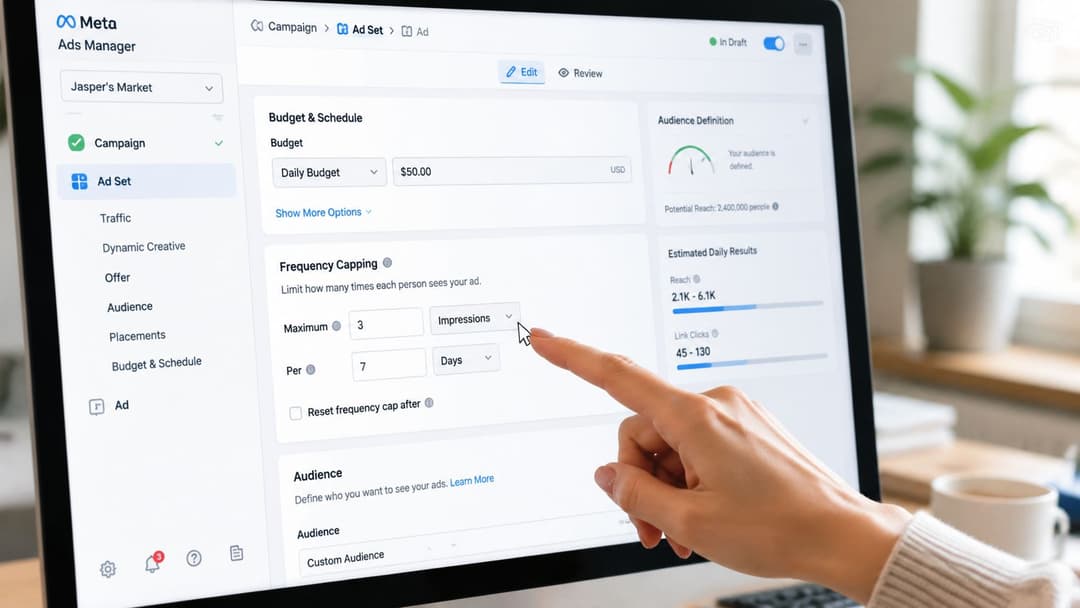
For most advertisers, the direct control lives inside Reach campaigns, and it's set at the ad set level.
Where the setting exists
Meta's help documentation for reservation and auction controls distinguishes between a frequency cap and a target frequency. It also notes that configuration options for ad sets can range from 1 to 90 impressions over 1 to 90 days.
In plain English, that means you're defining two things:
- How many impressions one person can receive
- Over what time period that limit applies
That structure is straightforward, but the business decision behind it is not. “3 impressions in 7 days” and “3 impressions in 30 days” are completely different strategies.
If you need a refresher on the campaign setup side before adjusting delivery controls, this walkthrough on posting ads on Facebook covers the basics.
How to set it in Reach campaigns
Use this sequence inside Ads Manager:
Choose the Reach objective Direct frequency capping is available at the ad set level for Reach campaigns.
Build the ad set Set audience, placements, schedule, and budget as usual.
Find the frequency control In the ad set delivery settings, set the number of impressions and the time window.
Match the cap to campaign intent Broader awareness usually calls for lighter repetition. Retargeting or short-window reminders can tolerate more.
Launch with room to learn Don't set an extremely restrictive cap just because overexposure worries you. If the cap is too tight for the audience and budget, delivery can become inefficient in a different way.
Here's a simple interpretation table:
| Setting style | What it means in practice | Best fit |
|---|---|---|
| Lower cap, shorter window | Light touch, broad reach bias | Cold awareness |
| Moderate cap, weekly window | Balanced repetition | Consideration campaigns |
| Higher cap, short window | Strong reminder pressure | Short retargeting windows |
What to do in non-Reach campaigns
Many advertisers find this aspect confusing. In Conversions, Traffic, Sales, and similar objectives, frequency usually isn't controlled with a direct cap. It's an output of your setup.
That means you manage frequency indirectly through:
- Audience size
- Budget pressure
- Campaign duration
- Creative depth
- Placement mix
A team running conversion campaigns with a narrow retargeting audience can't just wish for a hard cap that isn't there. They have to change the delivery environment.
For advertisers who prefer a visual walkthrough before making changes, this quick demo helps:
One important operational detail
If you use Reach, plan carefully before publishing. On Meta Reach campaigns, the cap is locked after the ad set is created, so changing it later requires cloning the ad set rather than editing it in place. That makes pre-launch thinking more important than usual.
Strategic Frequency Rules for Every Funnel Stage
The right cap depends less on platform mechanics and more on buying intent. Cold audiences need room to notice you without feeling stalked. Warm audiences usually need more reminders. High-intent audiences can handle tighter repetition, but only if the message and timing fit.
Creative depth changes the equation too. An audience can tolerate higher account-level frequency when it's seeing different hooks, formats, and offers instead of the same ad every time.
Use funnel stage, not one universal number
A lot of weak Meta strategy starts with one account-wide opinion like “frequency should stay low” or “retargeting needs heavy pressure.” Both can be wrong.
Use the funnel as your decision frame:
| Funnel Stage | Audience | Recommended Weekly Cap | Key Metric to Watch |
|---|---|---|---|
| Top of funnel | Cold prospecting audiences | Start low | Reach quality and early CTR |
| Middle of funnel | Site visitors, engagers, video viewers | Start moderate | CTR and return traffic |
| Bottom of funnel | Cart viewers, product viewers, sales retargeting | Start higher, monitor closely | CPA and conversion efficiency |
These are starting points, not fixed laws. The weekly cap should move with audience size, buying cycle, and creative rotation.
Top of funnel needs restraint
Prospecting campaigns are where advertisers most often waste reach through lazy repetition. If you're introducing a brand to new people, your first job is breadth with enough repetition to register, not constant pursuit.
Meta's earlier effective-frequency findings support that logic. Awareness effects showed strong gains at low weekly exposure, which is why broad-audience campaigns usually perform better when you resist the urge to over-serve.
That doesn't mean one impression solves awareness forever. It means extra exposures should earn their place.
Middle funnel is where nuance matters
This is the zone where someone knows you, but hasn't committed. They visited a page, watched a video, clicked an ad, or engaged with content. Repetition matters here because the buyer is comparing, forgetting, or postponing.
This is also where creative sequencing beats blunt pressure.
- Use different angles: Product benefit, proof, objection handling, and offer don't need to be crammed into one ad.
- Rotate formats: Static, video, carousel, and short testimonial cuts can share the load.
- Shorten audience windows selectively: Recent engagers can handle more pressure than older, colder visitors.
If you're trying to extend creative life while frequency climbs, a strong Meta ads creative refresh strategy matters as much as the cap itself.
If the audience is warm but the creative is repetitive, higher frequency won't feel persuasive. It will feel lazy.
Bottom funnel can handle more, but only briefly
High-intent audiences are different. A person who viewed a product, initiated checkout, or returned multiple times usually has a higher tolerance for reminders. That doesn't mean unlimited repetition is smart. It means your ceiling is higher, especially over a short decision window.
The trap is assuming a cap solves everything. For non-Reach objectives, Improvado's 2026 guidance on frequency capping says frequency is largely a function of audience size and spend, and lowering it often requires expanding the audience or reducing the budget, not just adjusting a setting that may not exist.
That's an important point for bottom-funnel media buying. When a tiny retargeting audience gets a healthy budget, high frequency is often structural, not accidental.
Creative depth determines how much frequency you can afford
Two ad sets can show the same average frequency and produce very different results.
One uses a single product image and one headline. The other rotates multiple concepts, creator-style clips, social proof angles, and offer variants. Same frequency metric. Completely different user experience.
When teams ask, “What's a good frequency for Facebook ads?” the better question is, “How many distinct useful impressions can we deliver before repetition becomes visible?”
That's where tools can help operationally. Platforms such as Meta Ads Manager, internal reporting dashboards, and AdStellar AI can surface rising frequency alongside creative performance so teams know when to rotate ads rather than force more spend through aging assets.
Common Frequency Capping Pitfalls and How to Fix Them
Most frequency mistakes don't come from ignorance. They come from oversimplifying. Advertisers either cap too aggressively and kill delivery, or they trust the average frequency metric and miss the fact that some users are seeing the ad far more often than they should.
That's why “set it and forget it” is the wrong mindset.
Pitfall one and pitfall two
The first two mistakes are opposites, but they often come from the same fear.
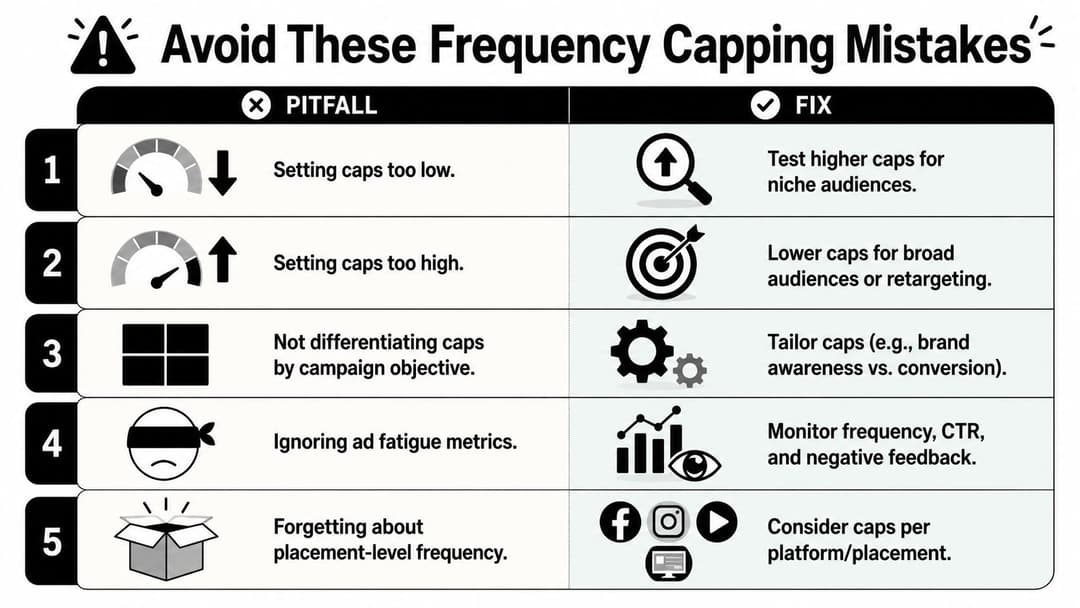
- Setting caps too low: You become so worried about fatigue that you limit delivery before the message has had time to land.
- Setting caps too high: You give the platform too much room, especially on small audiences, and delivery concentrates fast.
The fix is not guessing harder. The fix is reading frequency against outcome metrics. Watch where CTR starts to fade, where CPA starts climbing, or where comments and engagement quality change.
Pitfall three and pitfall four
A campaign objective should shape frequency tolerance. Many accounts ignore that.
- Using the same rule for every objective: Cold prospecting and cart recovery should not share the same frequency philosophy.
- Ignoring audience constraints: Small custom audiences will drive repetition even if your cap strategy sounds sensible on paper.
Segment your thinking. A broad Reach campaign and a narrow sales retargeting ad set aren't playing the same game.
If your return efficiency keeps eroding while delivery gets more concentrated, it's worth diagnosing the broader causes behind Meta ad ROAS declining over time, not just the cap itself.
Pitfall five
The final mistake is trusting the cap too strictly.
Jon Loomer's write-up on Meta Reach frequency capping notes two practical issues advertisers miss: the cap is locked after the ad set is created, which means adjustments require cloning, and the cap isn't always perfectly enforced, so placements should be audited separately when over-frequency is suspected.
That matters because average frequency can hide uneven delivery. One placement may be doing far more repetition than another.
Audit rule: When frequency looks suspicious, break performance down by placement and inspect where repetition is actually happening.
A cleaner troubleshooting workflow
When a campaign looks fatigued, use this order:
Check audience size against spend A narrow audience with a strong budget will usually force repetition.
Review creative variety If one concept is doing all the work, fatigue will arrive faster.
Inspect placement-level delivery Don't assume the cap is behaving perfectly everywhere.
Clone before changing Reach caps If you're in a Reach setup, remember that the original cap can't be edited.
Read frequency as a symptom High frequency often points to a deeper mismatch between budget, audience, and creative inventory.
From Capping Frequency to Mastering Ad Delivery
The strongest advertisers don't treat frequency as a setting. They treat it as feedback.
When frequency rises quickly, Meta is telling you something. Usually one of three things is happening. Your audience is too small for the spend. Your creative has gone stale and the system is leaning on the same people. Or your campaign objective naturally concentrates delivery and needs tighter strategic control around audience design and refresh cadence.
That's why frequency capping Facebook ads is only the start. The key skill is interpreting what frequency means inside the rest of the account.
What good operators do differently
They don't ask only, “What cap should I use?”
They also ask:
- Is this audience large enough for the budget I'm trying to spend?
- Do I have enough creative variation to earn repeated impressions?
- Is this campaign meant to maximize reach or drive action from a warm pool?
- Is rising frequency a problem, or just a normal result of a high-intent audience?
Those questions separate efficient scaling from noisy spend.
A clean frequency strategy respects the user and protects profitability at the same time. It keeps awareness campaigns broad, mid-funnel campaigns persuasive, and bottom-funnel campaigns disciplined. It also forces better creative operations because repeated exposure only works when the ad experience still feels relevant.
When teams get this right, frequency stops being a vanity metric and becomes one of the clearest diagnostic signals in the account.
If you're managing Meta campaigns at scale, AdStellar AI can help operationalize this process by monitoring frequency alongside creative and audience performance, then making it easier to launch fresh variations when repetition starts hurting results.