Teams reading about fb ad optimization often find themselves in the same spot. They have campaigns live, spend is going out every day, and the account looks busy, but the path from activity to profit is blurry. Clicks are coming in. Maybe leads too. But confidence is low because nobody is sure which lever moves the business.
This is the job of optimization. It isn't tweaking a headline because the dashboard feels stale. It's building a system that turns Meta from a volatile channel into a repeatable acquisition engine.
AI changes the speed of that system more than the logic behind it. The playbook still matters. You still need the right objective, clean measurement, disciplined testing, and clear scaling rules. What AI does is remove the slow manual work between each decision. It helps teams generate more testable variations, organize customer signals faster, spot patterns earlier, and launch the next round before momentum dies.
Setting Goals and Metrics That Actually Matter
Successful fb ad optimization starts before the first campaign goes live. If the goal is fuzzy, the account will optimize for the wrong outcome with perfect efficiency. That's how teams end up celebrating cheap clicks that never become customers.
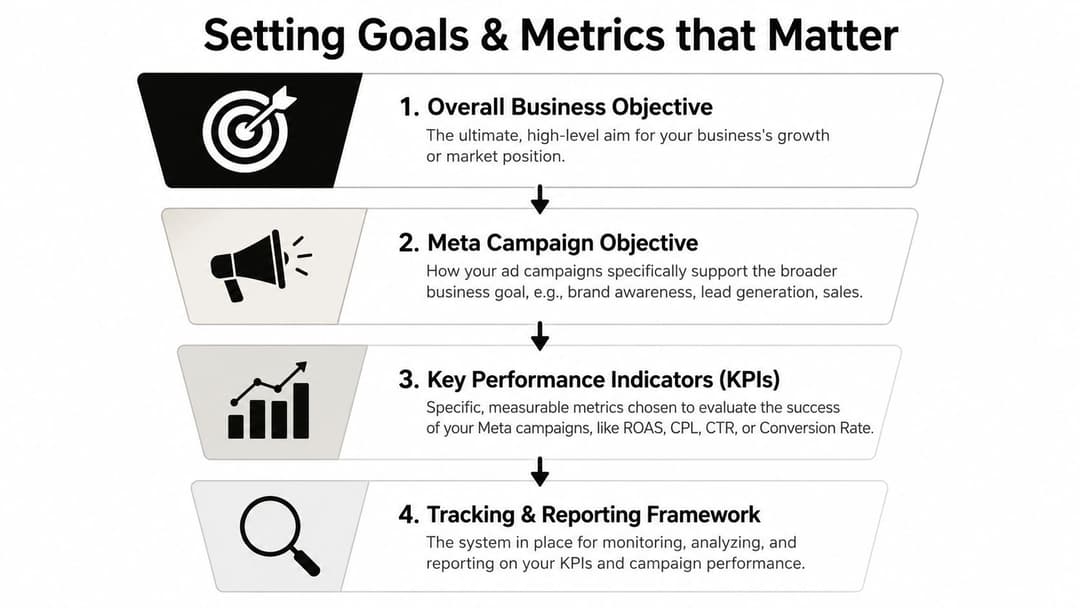
The fix is simple in theory and easy to skip in practice. Start with the business outcome, then choose the Meta objective that supports it, then define the metrics that prove it worked. Anything outside that chain is secondary.
Match the objective to the scorecard
A leads campaign and a traffic campaign should not be judged the same way. Sprout Social's Facebook benchmarks report an average CTR of 2.59% for Facebook leads campaigns and 1.71% for traffic campaigns across industries in 2026, while average Facebook engagement rate across account sizes is 0.15%. That's the clearest reminder that “good performance” depends on what you asked Meta to do.
Use a simple hierarchy like this:
| Level | What to define | What it prevents |
|---|---|---|
| Business goal | Revenue, qualified pipeline, booked demos, purchases | Optimizing for noise |
| Meta objective | Leads, traffic, sales, engagement | Picking the wrong delivery logic |
| Core KPI | ROAS, CPA, CPL, CTR, conversion rate | Reporting vanity metrics |
| Review cadence | Daily checks, weekly decisions, monthly trend review | Random changes based on emotion |
If you're running lead gen, CTR matters, but it's not the finish line. If you're running traffic, low-quality sessions can make a strong CTR look better than the campaign really is. If you're chasing engagement, don't pretend it's a revenue metric.
Practical rule: pick one primary metric that decides whether a campaign stays funded, then use supporting metrics to diagnose why it wins or loses.
Separate vanity from sanity
Most accounts carry too many metrics and too little clarity. A clean performance dashboard usually has three layers:
- Top-line decision metric: ROAS, CPA, or CPL
- Diagnostic metrics: CTR, CPC, landing page behavior, lead quality
- Delivery context: spend, frequency, reach, placement mix
That framing keeps teams from making bad calls. A campaign with a healthy CTR and weak downstream economics isn't a winner. It's a creative that creates curiosity without enough buying intent.
For retailers and brands that need a broader view of how paid social fits into channel mix, Reddog Group's social media guide is a useful companion because it helps connect campaign structure to real business priorities instead of isolated ad metrics.
A lot of teams also benefit from documenting this in one operating sheet before launch. The checklist can be basic: objective, primary KPI, guardrail metrics, attribution source, reporting owner, and decision frequency. If that sounds obvious, good. Most wasted spend comes from ignoring obvious things consistently.
For a practical view on how this ties into the broader acquisition system, this performance marketing breakdown is a helpful reference.
Building Your Creative and Copy Testing Engine
Most ad accounts don't fail because teams lack ideas. They fail because they test ideas in a messy way. Creative, angle, headline, format, and audience all change at once, then nobody knows why one ad won.
A testing engine fixes that. It turns creativity into a process.
Start with customer voice, not brainstorms
The strongest ad angles usually aren't invented in a meeting. They're pulled from what customers already say. A recent framework recommends mining reviews, support emails, and DMs to extract the top reasons people buy, the top personas, and the objections they need to overcome, then testing multiple ads per angle while separating statics from videos so one format doesn't absorb all the spend, as outlined in this customer voice framework.
That gives you a cleaner testing backlog. Instead of random concepts, you build campaigns around patterns like:
- Pain-led angles: the problem buyers want to stop dealing with
- Outcome-led angles: the result they want fastest
- Objection-handling angles: the hesitation blocking purchase
- Persona-led angles: the use case for one buyer segment
Angle comes before copy polish; a beautifully written ad built on a weak angle still loses.
Mine customer language first. Write ad copy second.
Test one variable at a time
A/B testing works when you isolate the change. Improvado's Facebook ads guide recommends testing one variable at a time, such as creative, headline, CTA, or audience, and running the test until the result reaches statistical significance. Winners are identified by a combination of high CTR, low CPC, and downstream economics such as low CPA or high ROAS.
That means your test design should look more like a lab and less like a casino.
A practical structure:
Angle test first
Hold audience and offer steady. Change only the message angle.Format test next
Compare static versus video within the winning angle.Hook and headline test after that
Keep the core promise stable. Change the entry point.CTA test last
Refine the ask once the message already resonates.
If you change all four at once, the result might look useful in Ads Manager, but it won't teach you anything repeatable.
Build batches, not one-offs
AI provides assistance here. Not with strategy by itself, but with production volume and pattern recognition. Tools that generate multiple copy variants, resize assets by format, and organize tests by angle remove the slowest part of the workflow.
One option is AdStellar AI's creative testing methodology, which shows how teams can structure high-volume variation testing without turning campaign setup into manual busywork. In practice, AI is most useful when it helps you produce organized batches of ads tied to one hypothesis.
Here's the workflow I trust most:
| Test layer | Human input | AI acceleration |
|---|---|---|
| Research | Review calls, tickets, reviews, DMs | Cluster themes and recurring objections |
| Angle creation | Choose the most commercially relevant themes | Draft multiple messaging routes |
| Asset production | Approve offer, brand framing, claims | Generate copy and format variations |
| Launch setup | Define naming, audience, and success metric | Bulk-create ads and push live faster |
| Readout | Judge economics and quality | Surface winning combinations quickly |
Judge creatives by business impact
A lot of mediocre fb ad optimization happens because teams stop at CTR. That's useful, but incomplete. A click that doesn't convert, qualify, or monetize is often just an expensive distraction.
Creative wins when it does three things together:
- Gets attention
- Qualifies intent
- Supports profitable action
Poor creatives often overperform on the first and fail on the next two. You'll see lots of cheap engagement, lots of comments, maybe lots of curiosity clicks. Then CPA or lead quality falls apart.
The goal isn't to find one hero ad. The goal is to build a machine that keeps producing the next winner before fatigue shows up.
Mastering Audience and Placement Strategies
A common failure pattern looks like this. The account launches with five interest stacks, three lookalikes, manual placement exclusions, and no clear reason for any of it. Spend fragments, learning stalls, and nobody knows whether the problem is the audience, the placement, or the offer.
Good audience strategy is simpler than that. Start with the amount of signal the account has, then decide how much control to give Meta's delivery system. AI speeds this up because it can surface which segments, exclusions, and placement patterns are worth testing before the team burns a week on manual setup. Tools like AdStellar AI are useful here when they organize audience hypotheses, map them to campaign structure, and cut bulk-build time.
Broad usually wins the first round
Broad targeting is often the best starting point when the account has clean conversion inputs and a product with real market breadth. The reason is practical. Tight targeting reduces the pool too early, which makes delivery less stable and learning slower. Broad gives the system room to match your ad to likely converters, especially when the creative does the filtering.
Use broad when these conditions are true:
- Conversion signals are trustworthy: the event being optimized reflects actual business value
- The offer can sell beyond a narrow niche: you are not limited to a tiny persona or geography
- The ad qualifies the click: the message makes clear who the product is for and who it is not for
Use narrower targeting only when it supports a business constraint or a messaging need. Examples include state-level compliance differences, separate offers by customer type, or a remarketing pool that reliably converts at a different CPA.
Match audience type to the job
Audience selection works best when each segment has a clear role in the account.
| Audience type | Best use | Common mistake |
|---|---|---|
| Broad | Prospecting when signal quality is good | Cutting it too soon after a few noisy days |
| Lookalike | Expanding from customers, qualified leads, or high-value actions | Building from weak source events or tiny seed lists |
| Interest targeting | Testing niche intent, product category fit, or early-market messaging | Stacking too many interests and making delivery inconsistent |
| Remarketing | Recovering warm demand with tailored offers or objections | Reusing prospecting ads instead of adapting the message |
Lookalikes still have a place, but source quality decides whether they help. A lookalike built from purchasers, qualified opportunities, or high-LTV customers can extend scale efficiently. A lookalike built from low-intent leads usually carries the same quality problem into a bigger audience. If you want a tighter framework for building them, this Meta lookalike audience guide for scaling modeled reach covers the setup decisions that matter.
One rule holds across all four audience types. Weak event quality poisons targeting faster than any audience tweak can fix it.
Placement decisions should follow outcome quality
Automatic placements are a strong default because Meta can often find cheap inventory you would not choose manually. But automatic does not mean blind. Placement reviews should happen after enough delivery exists to judge post-click performance, not just top-line CTR.
Use a simple review process:
- Check placement results against the optimization event: purchases, qualified leads, booked calls, or another real outcome
- Review creative fit by format: Reels, Stories, and Feed rarely perform the same with identical assets
- Cut or isolate placements only after a pattern repeats: one bad day is noise, a sustained quality gap is a decision point
Wasted spend often accumulates unnoticed. Audience reports might look fine while one placement keeps driving cheap clicks that never turn into revenue. The answer is not always to shut that placement off account-wide. Sometimes the better move is to pair it with creative built for that environment, then compare again. Vertical video may rescue Stories and Reels. Cleaner static framing may improve Feed. Placement optimization works best when it starts with asset-market fit, then uses exclusions sparingly.
The strongest accounts use audiences to create useful constraints and use placements to capture efficient inventory. They do not ask targeting to rescue weak ads, and they do not ask exclusions to solve a measurement problem.
Smart Bidding Budgeting and Scaling Rules
Budgeting is where a lot of supposedly optimized Meta accounts break. Teams either scale too early because one ad had a good day, or they stay too conservative and never let winners mature. Both mistakes come from treating budget as administration instead of strategy.
Use benchmarks as context, not commands
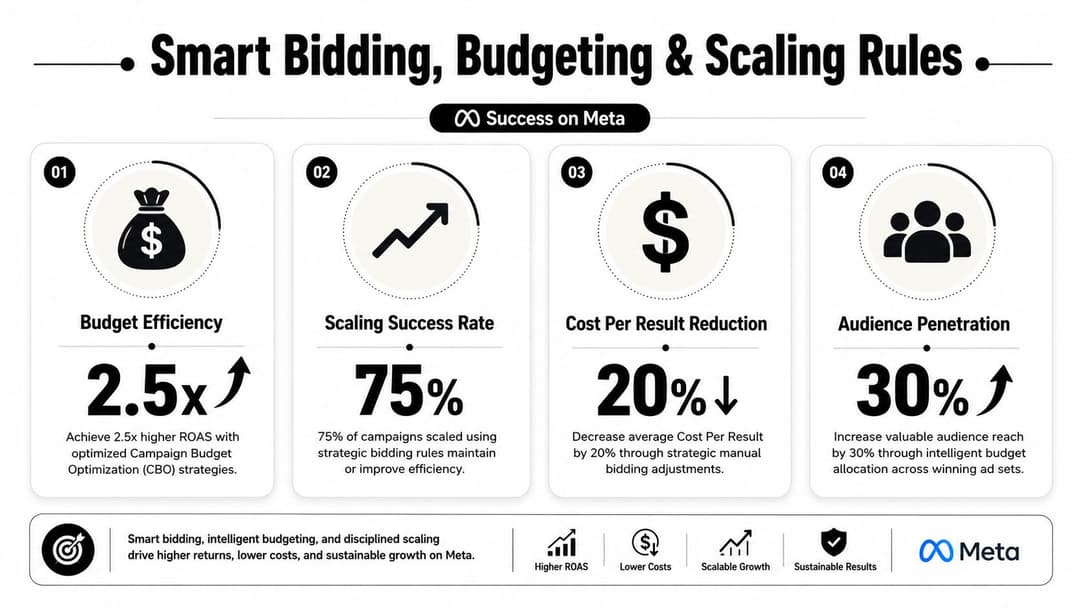
KlientBoost's Facebook ads statistics report an average Facebook CPM of $16.12 across industries. The same source also notes other datasets with average CPMs of $7.19 and $7.34 for all objectives, which tells you impression costs vary materially by dataset and objective mix. On the return side, the same benchmark compilation cites WeCanTrack's median Facebook Ads ROAS of 1.79 across 675 B2C companies, alongside a similar median of 1.8 across 636 B2C companies.
Those numbers matter for one reason. They remind you that spend efficiency can't be judged from CPM, CPC, or CTR alone. If you're paying meaningful money just to enter the auction, then the account needs a decision layer tied to ROAS, CPA, or CPL.
Pick the right budget structure
ABO and CBO both work. The right one depends on what you're trying to control.
| Structure | Best for | Risk |
|---|---|---|
| ABO | Early testing, cleaner ad set control, isolated comparisons | You can underfund strong pockets of demand |
| CBO | Consolidation, scaling proven setups, letting Meta shift spend | One winner can absorb budget too aggressively |
I prefer ABO when the goal is learning. It gives cleaner reads on audience or angle tests. I prefer CBO when the test phase has already identified stable winners and I want Meta to allocate more freely.
For more detail on that transition point, this guide to Facebook ad scaling strategies is a practical reference.
A short explainer helps here:
Scale with rules, not excitement
The cleanest scaling systems have predefined thresholds. If a campaign meets them, you increase spend. If it misses them, you hold or cut. No improvising because yesterday felt good.
A useful framework:
- Scale only from proven economics: if the campaign isn't meeting your target CPA or ROAS consistently, more budget usually amplifies the problem
- Separate testing budget from scaling budget: don't force one campaign to do both jobs
- Promote winners into a simpler structure: once a creative and audience combination proves itself, reduce clutter around it
- Watch post-scale quality: a campaign can keep volume while losing efficiency
Good scaling protects margin first and volume second.
Know when not to scale
Some campaigns look strong because they're riding novelty. New creative, fresh audience exposure, and a short winning window can make weak systems look healthy for a few days. Don't confuse temporary lift with stable demand.
Hold back when:
- the conversion event is noisy
- the offer changed recently and results haven't stabilized
- one ad is carrying the entire campaign alone
- lead quality or average order quality is slipping even if front-end metrics look fine
Smart budgeting is conservative in one way and aggressive in another. It's conservative about proof. It's aggressive once the proof is real.
Optimizing for Measurement in a Post-Pixel World
Monday morning, Ads Manager says a campaign is profitable. By Wednesday, sales is asking why the leads are weak, finance is questioning attributed revenue, and your pixel is missing chunks of conversion data. That is the reality behind a lot of fb ad optimization now.
Measurement needs to survive partial visibility. If your tracking stack only catches browser events, Meta learns from an incomplete version of the account, and you optimize toward whatever signal happens to be easiest to capture.
Feed Meta cleaner signals
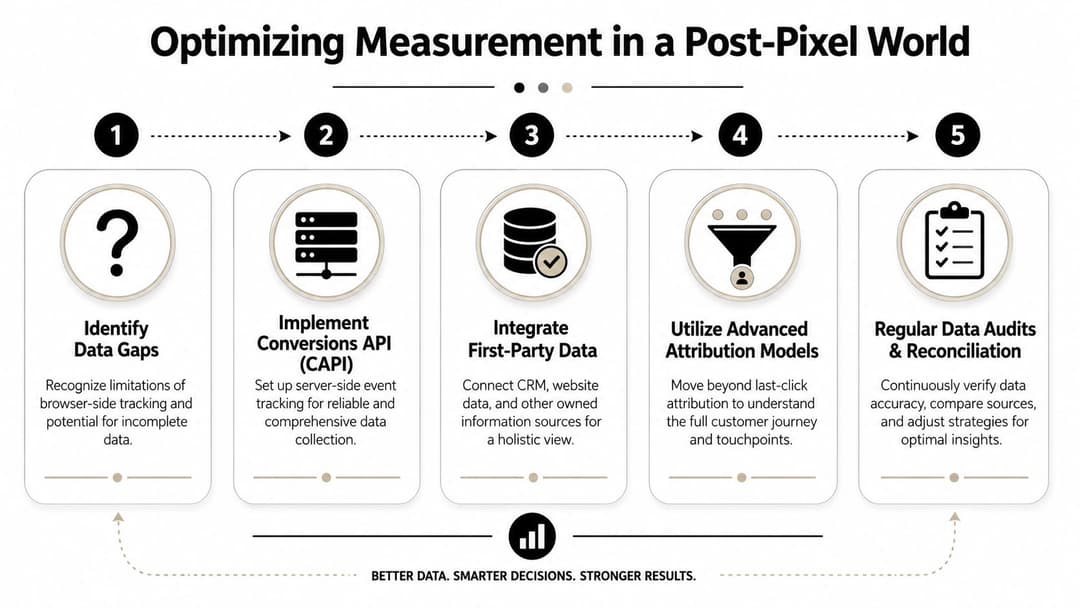
The job is simple to describe and harder to execute. Send Meta the highest-quality conversion signal you can, deduplicate it properly, and connect it to real business outcomes instead of treating Ads Manager as the final source of truth.
That usually means a measurement stack with four parts:
- Browser-side tracking: still useful for on-site behavior and event coverage
- Server-side event sharing: helps recover signal lost to browser restrictions and blocking
- CRM or backend feedback: shows which leads became qualified opportunities, purchases, or repeat buyers
- Regular reconciliation: compares Meta reporting against your checkout, CRM, or warehouse data
For implementation details, this guide to the Facebook Conversion API covers the setup logic that keeps browser and server events working together.
AI helps here too. AdStellar AI can speed up the operational side by flagging broken event flows, spotting mismatches between reported and actual outcomes, and tightening the feedback loop between campaign changes and measured results. That matters because tracking problems rarely announce themselves clearly. They usually show up as drifting CPA, unstable attribution, or sudden swings in reported ROAS.
Connect measurement to creative decisions
Good measurement should change what you test next.
If one hook drives cheap leads but poor close rates, that is not a creative winner. If another angle costs more upfront but produces qualified pipeline, that is often the better ad to scale. The point of measurement is not only to count conversions. It is to rank messages by business value.
A practical operating model looks like this:
| Input | What you collect | Why it matters |
|---|---|---|
| Ad platform data | Spend, CTR, CPC, CPA, ROAS | Shows delivery and front-end efficiency |
| Site and server events | Add-to-cart, lead, purchase, deeper conversion signals | Improves optimization and event coverage |
| CRM outcomes | Qualified leads, pipeline stage changes, closed revenue | Separates volume from quality |
| Voice-of-customer data | Objections, motivations, buyer language | Informs the next round of angles and copy |
AI can save real time instead of adding noise. Instead of manually stitching together ad angle names, CRM tags, and outcome data, teams can use AI workflows to classify creative themes, map them to downstream quality, and surface which promises are pulling in the right buyers.
Better measurement improves targeting decisions and creative decisions at the same time.
Build fallback logic for weak signal periods
Some weeks, purchase tracking is clean. Some weeks, it is not. Landing page changes, consent behavior, payment flow issues, and CRM delays can all distort the picture.
Strong operators plan for that before performance gets shaky. They define a fallback event hierarchy, set naming conventions that make reconciliation easier, and review backend outcomes on a fixed schedule. If purchase data becomes unreliable for a short window, they know whether to rely on qualified lead, initiated checkout, or another downstream proxy while the stack gets fixed.
That discipline keeps teams from making expensive edits based on bad measurement. In a post-pixel world, the accounts that win are not the ones with perfect attribution. They are the ones with faster feedback, cleaner backup signals, and a process that keeps Meta learning from the best data available.
Troubleshooting Common Optimization Problems
A lot of old Meta advice is built around long learning phases and relatively stable signal. That's outdated for many accounts. Recent guidance emphasizes 3- to 7-day optimization cycles and a heavier emphasis on creatives, especially in environments where signal is weaker and teams need to refresh faster, as discussed in this current Meta optimization guidance.
That changes how you troubleshoot.
If performance drops fast
Don't assume the algorithm just needs more time. In many cases, the problem is creative fatigue, weaker message-market fit, or attribution noise hiding what's happening.
Use this quick diagnosis table:
| Problem | Likely cause | First move |
|---|---|---|
| CTR drops | Hook fatigue or weaker offer framing | Refresh hooks and opening frames |
| CPC rises | Creative wear-out or weaker relevance | Swap in new angle variants |
| CPA rises with flat CTR | Click quality dropped after the ad click | Check landing page and qualification flow |
| ROAS falls suddenly | Demand quality changed or measurement got noisy | Verify backend outcomes before cutting spend |
If leads look cheap but bad
This is common in lead gen. The campaign can look healthy in Ads Manager while sales teams complain that nothing closes.
Fixes usually come from three places:
- Tighten the promise in the ad: clearer messaging filters out weak intent
- Improve the handoff page or form flow: friction in the right place can improve quality
- Send better downstream signals back into Meta: quality beats volume when the system can learn from it
If your account feels unstable
Shorter optimization windows mean you need a tighter operating rhythm. Review earlier, but don't overreact hourly. Refresh creatives faster, but don't abandon structured tests. Accept that some volatility comes from weaker attribution, then build a process that can still make decisions.
A practical weekly rhythm works well:
- Read performance by campaign and angle
- Flag fatigue and conversion quality issues
- Replace tired creatives with prepared variants
- Reallocate budget only after checking business outcomes
- Keep a record of what changed so you can trace cause and effect
The teams that handle fb ad optimization best today aren't the ones with the most dashboards. They're the ones with the cleanest decision process under imperfect data.
If you want to execute this playbook faster, AdStellar AI is built for that workflow. It helps teams generate large batches of Meta ad variations, launch organized tests, and identify winning creatives, audiences, and messages against business metrics like ROAS, CPL, and CPA, so the manual work between insight and action doesn't slow down the account.