Your follower count keeps inching up while reach slips and the pipeline stays quiet. That's usually the moment a team realizes a Facebook followers boost isn't a vanity project, it's an acquisition problem, and the wrong audience can make the numbers look healthy while the business result stays flat.
The practical question isn't whether the page got bigger. It's whether new followers are qualified, whether they see your next post, and whether the page can turn that attention into clicks, remarketing audiences, or sales. On Facebook, that means treating follower growth like a funnel with a cost, a conversion path, and a retention test.
What a Real Facebook Followers Boost Looks Like in 2026
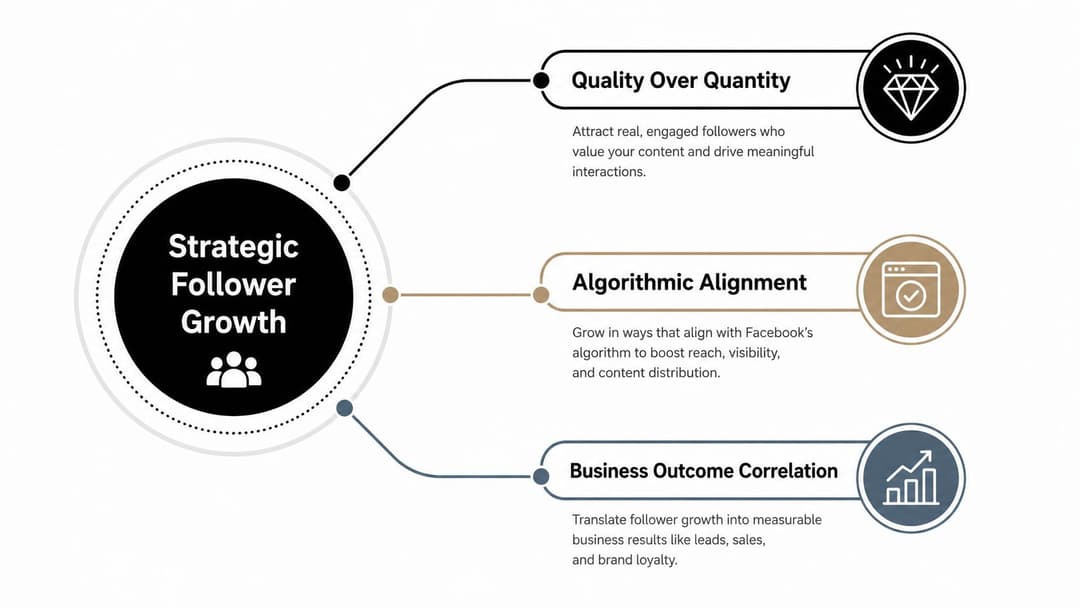
A lot of pages celebrate a follower bump that does not change the business. The count rises, but the audience does not react, reach stays thin, and the next post disappears into the feed. That is why the right lens is qualified follower acquisition, not raw volume.
Facebook is still enormous, with 3.070 billion monthly active users on the platform according to Sprout Social, so there is no shortage of people to reach. The problem is that reach is filtered hard, and Sprout Social's benchmark ranges show how constrained visibility can be, with B2B software at 1% to 3%, retail at 2% to 5%, and food brands at 4% to 7%. In that environment, follower growth only matters if the new audience can be exposed to future content and pulled into a next step.
The numbers that should shape your expectations
Buffer's Facebook benchmark data puts the average follower growth rate at 3.0% per month (Buffer benchmark data), and another benchmark set cited by Buffer shows growth can be as low as 0.5% per month in some cases. A widely cited industry benchmark says a solid rate is often 2% to 5% per month (benchmark discussion).
That is the right frame for sanity-checking your page. If a campaign adds a modest number of followers but they are responsive and relevant, that can outperform a flashy burst from low-intent traffic. If a page claims growth but engagement stays dead, the number is probably doing more vanity work than commercial work.
Practical rule: if the new followers do not engage, click, or fit the buying audience, you have bought a metric, not an asset.
The cleanest way to think about the channel is as a two-track system. Organic content compounds over time, while paid campaigns accelerate discovery and let you test audience quality faster. That is the model most serious performance teams end up using, because one track creates depth and the other creates speed.
A useful habit is to check whether growth is moving faster than the platform baseline rather than just looking at the total. The standard growth formula compares followers on the first and last day of the month against the starting base, which makes it easier to separate real expansion from a page that is barely moving. For a broader framework on audience building and paid support, boosting social media lays out the same trade-off between volume and downstream value.
If you are trying to separate real audience growth from fake or low-value attention, a resource on protect from fake followers is useful as a screening step. A bloated follower count can hide more problems than it solves.
Organic and Hybrid Tactics That Compound Over Time
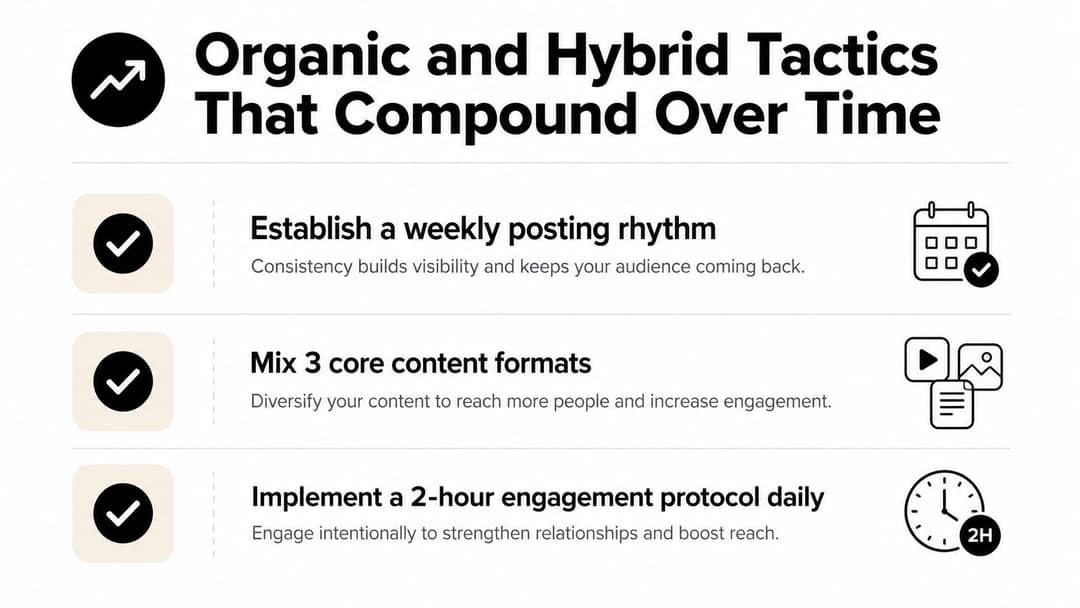
Organic follower growth still works, but only when it's treated like a system instead of a mood. Pages that post in bursts and vanish for days usually keep feeding the algorithm inconsistent signals, while pages that publish steadily give people more chances to react, share, and follow.
Buffer's benchmark dataset says posting frequency averages 34 posts per month (Buffer benchmark data), which is a useful reminder that consistency, not dramatic one-off campaigns, is what keeps a page visible. That doesn't mean every post has to be a major production. It means the page needs a repeatable rhythm that can support discovery.
What actually compounds
Reels are still the most obvious lever when you want organic reach to translate into follows. The Hootsuite guidance in the research notes that short-form video is the strongest engagement format on Facebook in 2026, and that matters because engagement is the signal that gets content shown to more people. If the video earns attention, the follow is easier to justify.
A follow is easier to win when the content gives people a reason to expect more of the same.
The highest-return behaviors are boring but effective. Reply to comments fast, invite people who already reacted to the post, and keep the page active enough that new visitors don't land on a dead wall. That's the point where hybrid growth starts to matter, because organic content creates proof and paid campaigns widen the funnel.
The RecurPost benchmark gives a practical range for what that can look like. Organic pages commonly add 100 to 500 followers per month, and that can move to 300 to 1,500 per month when Reels are added regularly (RecurPost guidance). The same source estimates 3 to 6 months for organic-only growth and 6 to 8 weeks for organic plus Reels (RecurPost guidance). That's not a promise, it's a realistic planning horizon.
Cross-promotion helps when the audience overlap is sensible. Email lists, creator partnerships, and adjacent-brand promotion are all useful because they move people from an existing trust relationship into a higher-frequency content environment. The point isn't to blast more people, it's to move the right people onto the page where the algorithm can keep working.
If you want a useful companion read on the organic side, how to get more likes on FB covers the same logic from the engagement angle. Likes alone don't solve follower quality, but they do help create the conditions for it.
Building a Meta Page Likes Campaign That Converts
A paid Page Likes campaign is one of the most misunderstood tools in Meta Ads Manager. Teams often use it as a shortcut to vanity growth, then wonder why the page fills with people who never interact again.
The clean setup is simple. Choose the Engagement objective, select the Page Likes engagement type, and exclude current followers so spend goes only toward net new acquisition. That exclusion sounds basic, but it is the step many teams miss, and it is one of the fastest ways to waste budget.
The setup that usually holds up
Creative should be short, clear, and specific. The first three seconds matter because the ad needs to answer one question quickly, why should this person follow the page? If the answer is vague, the click may still happen, but the follow quality tends to drop.
A useful way to think about targeting is to start with a narrow but relevant audience, then use a custom or lookalike layer where the product has enough signal. For teams working in markets where relevance matters more than raw scale, the page-likes workflow inside a Facebook campaign builder can be a practical option, and AdStellar AI includes a page-likes campaign build path plus audience tools that can support custom and lookalike setups. If you are setting up the page first, this guide on creating a Facebook business page is worth reading before you spend. For a creative-side reference, Meta Ads for meme marketing is a useful reminder that even lightweight creative still needs clear audience intent behind it.
Practical rule: if the ad cannot explain the follow in one sentence, it is probably too generic to justify paid acquisition.
Budget should begin small enough to read signal clearly. Practitioner guidance in the research recommends starting at $5 to $10 per day before scaling (video guidance). That is not because tiny budgets are magical, it is because you need enough data to see whether the audience and creative are working before you widen the spend.
The same guidance reports always-on paid strategies have been observed to increase followers by 6% to 8% per quarter on average, with some media partners reaching 16% in one quarter (video guidance). Those numbers are useful as directional benchmarks, not as universal outcomes. The better metric is cost per qualified follower, not a louder follower count.
A clean campaign does not end when the follow happens. The page needs a welcome path, a retargeting plan, and a few strong posts ready to catch new followers while interest is fresh. Without that, even a well-run Page Likes campaign turns into a temporary spike instead of a durable audience asset.
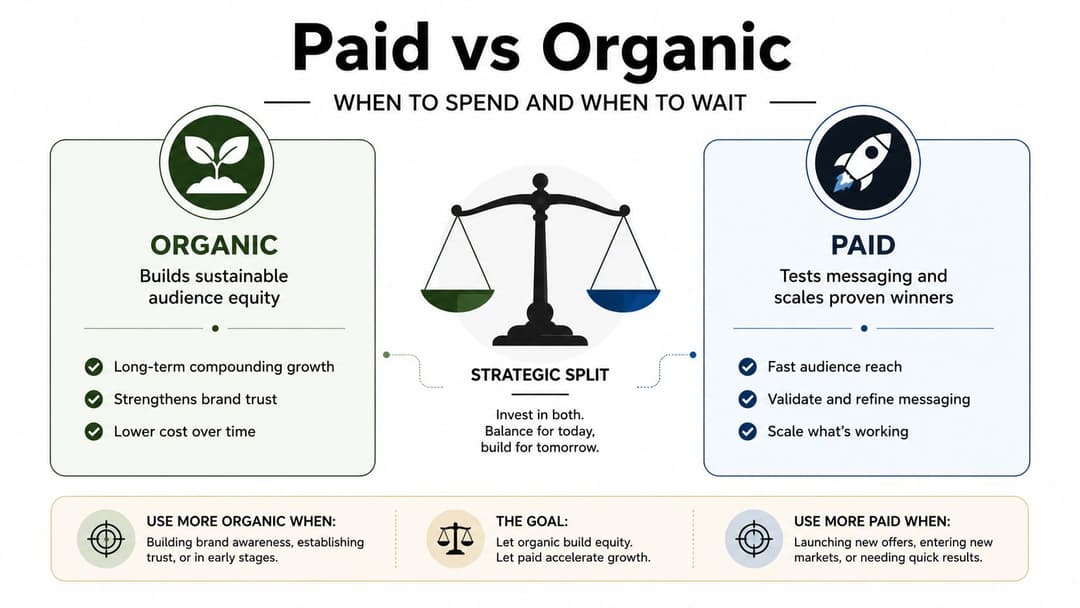
Paid vs Organic When to Spend and When to Wait
The wrong question is whether paid or organic is “better.” The useful question is which one gives you the right kind of growth at the right time, with the least waste.
Organic earns its keep when the brand already has a content engine, the niche rewards trust, and the team can keep posting without dropping quality. Paid earns its keep when you need speed, when the page is entering a new market, or when you want to seed a remarketing base before the rest of the funnel matures.
A practical split by job to be done
Organic is the better choice when you can afford time and you care about audience equity. It's slower, but it creates a page that behaves like a community. Paid is the better choice when you're testing positioning, launching into a new segment, or trying to get enough new followers quickly to support broader retargeting.
The cleanest hybrid approach is to let paid generate the first wave, then let organic content keep those people warm. That sequence works because paid solves the discovery problem and organic solves the retention problem.
If the page can't retain attention after the follow, the campaign didn't really acquire an audience.
When you need a start-to-finish campaign structure, use the same setup discipline every time. Exclude current followers, keep the creative direct, and avoid running one muddy post boost while hoping it behaves like a proper acquisition campaign. That's how budget gets lost in the gap between engagement and growth.
The RecurPost numbers from the earlier section give the pacing context. If organic growth is a months-long game, paid can produce faster movement, but only if the page and creative are ready to hold the audience once it arrives (RecurPost guidance). In practice, the strongest accounts use paid for momentum and organic for compounding.
Using AI Ad Automation to Ship and Test 10x Faster
Manual testing is where follower campaigns lose time. A marketer can have a solid strategy and still burn half a week rewriting hooks, swapping creatives, and checking audiences one by one.
AI-assisted ad automation changes the pace. AdStellar AI, for example, connects to Meta Ads Manager via OAuth, ingests historical performance, and generates many creative, copy, and audience combinations quickly, then uses AI Insights to rank what is performing against goals like ROAS, CPL, or CPA. For teams that want a structured prompt for campaign planning, strategy templates for marketers can help formalize the way concepts are briefed before launch.
What the speed gain changes
If you're testing a facebook followers boost manually, every new variation costs time before it costs money. With automation, the bottleneck shifts from setup to judgment, which is where experienced marketers add the most value. The point is not that AI thinks for you, it is that it compresses the number of hours between hypothesis and readout.
That matters most when you are trying to isolate which hook attracts qualified followers instead of cheap ones. A campaign built around page likes only improves if the team can compare audiences, creatives, and messaging fast enough to see what is producing the right people.
The fastest way to waste a follower budget is to test too few variations for too long.
The practical use case is straightforward. Generate enough combinations to challenge your assumptions, then let the system surface the winner. If one audience plus one hook keeps producing stronger follower quality, scale that combination instead of spreading spend across every idea in the brainstorm.
For a process view of how automation fits into acquisition work, AI for social media marketing connects the moving parts without treating AI as a magic layer. That is the right mindset. Use it to shorten cycle time, not to excuse sloppy strategy.
The key question is not whether AI can make more ads. It is whether it can help your team find the next qualified follower faster than manual iteration can. If the answer is yes, the tool earns its place. If it only increases output without improving read quality, it is just producing more noise.
Measuring Success Beyond the Follower Count
A follower total is the noisiest number in the entire workflow. It can rise while engagement stays flat, which is exactly how teams end up with a large page that doesn't move anything downstream.
The better measurement stack starts with cost per net new follower, then adds cost per qualified follower, where “qualified” means the person engages within a meaningful window after following. From there, the central question becomes whether those followers click, return, and convert.
The metrics that keep the funnel honest
UTM tagging is the simplest way to keep new follower traffic identifiable once it leaves Meta. If the page is sending real traffic, analytics should show it clearly. Meta's audience overlap tool is useful here too, because it helps confirm whether exclusions are preventing existing followers from being bought again.
Frequency is the early warning sign that often gets ignored. When it rises too far, creative fatigue usually follows, and follower acquisition gets more expensive because the same people are seeing the same message too often. That's the point where teams need to refresh hooks instead of pretending the audience is the problem.
You can keep the decision rules simple:
- Scale when cost per qualified follower is below target and frequency is still healthy.
- Hold when cost is on target but frequency keeps climbing.
- Pause when the acquisition cost no longer makes sense relative to downstream value.
That framework forces the conversation away from vanity growth and toward asset quality. It also keeps remarketing honest, because the follower cohort should eventually show up in click, engagement, or conversion data if the campaign is doing real work.
If your team wants a fuller operating view of the reporting layer, campaign performance metrics is the right companion topic. The point is the same either way, measure the audience by what it does, not just by how many people sit in the total.
Troubleshooting Why Your Follower Boost Is Stalling
Most stalled follower campaigns fail for the same three reasons. The creative gets stale, the audience gets saturated, or the page itself doesn't give new followers a reason to stay.
Creative fatigue shows up first. Cost per follower stops improving, frequency climbs, and the same hook keeps getting shown until people tune it out. The fix is not to tweak the budget and hope. It's to introduce fresh angles, new openers, and a different format before the audience has fully burned out.
Diagnose by symptom, not by guesswork
Audience saturation looks different. Cost per follower rises across all segments, not just one ad, which usually means the current targeting has been exhausted. At that point, the move is to expand with lookalikes, broader interest stacks, or adjacent audience groups that still match the page's value proposition.
The third failure is the conversion path mismatch. Followers arrive, but they don't engage with the page, click anything, or return after the first impression. That usually means the ad made a promise the page didn't keep, so the first few posts need to be clearer and more useful.
If the ad attracts attention but the page doesn't convert that attention into behavior, the problem is downstream, not upstream.
A simple diagnostic loop helps:
- Check whether frequency is rising faster than performance.
- Confirm the current audience isn't being hit with the same creative too often.
- Review the first few posts a new follower sees and ask whether they reinforce the promise of the ad.
If followers are growing but reach is flat, tighten exclusions and look hard at whether you're attracting inactive attention. If followers are showing up but not becoming part of the content ecosystem, the page needs a sharper reason to exist in the feed.
That's the core benefit of a Facebook followers boost. Not a bigger number for the dashboard, but a cleaner acquisition path that keeps paying off after the first follow. If you want a system that can launch page-like campaigns, test creative faster, and keep the audience quality visible from the start, visit AdStellar AI and see how the workflow fits your Meta setup.