You're probably staring at a social calendar that's already full, a creative team that's moving as fast as it can, and a pile of briefs that keeps growing anyway. The frustration isn't a lack of ideas, it's the gap between what you know you should publish and what your team can produce, review, and learn from before the next deadline hits.
That's where AI for social media marketing stops being a novelty and starts acting like infrastructure. The useful comparison isn't “AI versus humans,” it's AI as the production layer that helps teams draft faster, segment smarter, and learn from performance without turning strategy into a machine-only process. If you've ever wished your social workflow felt less like juggling tabs and more like a system, this guide maps that system from first principles to paid-social execution.
The Social Team's New Production Bottleneck
By midweek, the social manager has 30 unanswered briefs, three deadlines, and a design queue that won't budge. The strategist wants more variants. The paid team wants faster iteration. The community team wants quicker replies. Everyone is right, and the calendar still doesn't care.
That pressure is why AI now feels less like experimentation and more like an operational layer. In social, the bottleneck usually isn't intelligence, it's throughput. Teams need a way to get from idea to first draft to published asset without sacrificing judgment, and that's exactly the kind of gap automation has always filled in other functions, much like spreadsheets once changed finance workflows.
A practical resource if you're thinking about that shift from manual work to repeatable systems is Dooza's approach to automation, which shows how teams frame automation as workflow design rather than a pile of disconnected shortcuts. That mindset matters because the question isn't whether AI can create more content. It's where AI should sit in the process so the team doesn't just move faster into the same bottlenecks.
Practical rule: if a task repeats, has a pattern, and needs an initial draft or first pass review, AI is a candidate. If it requires brand judgment, sensitive messaging, or final approval, keep a human in the loop.
A lot of teams also discover that their real constraint lives upstream, in the creative production chain. That's why it helps to look at the ad creative production bottleneck before you look at tools. Once you see social as a production system, the rest of the conversation gets clearer, because you can separate what AI should generate from what humans should decide.
What AI for Social Media Marketing Actually Means
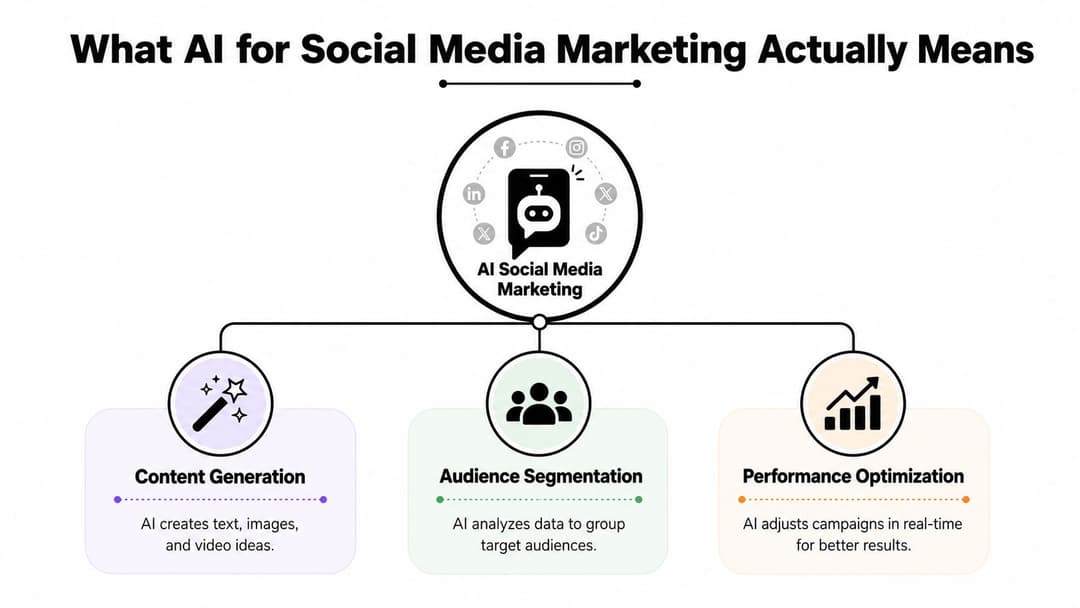
At a simple level, AI for social media marketing means using models that can draft content, analyze audience signals, and optimize performance based on data. That sounds broad because it is broad. The useful way to evaluate any tool is to ask which layer of the workflow it touches, and whether it helps with creative generation, audience segmentation, or campaign optimization.
The creative layer
The first layer is content generation. Generative AI drafts captions, headlines, post ideas, image concepts, and sometimes video directions. Under the hood, it's usually taking your prompt, your brand context, and any examples you've given it, then producing variations you can edit.
This is useful because social teams rarely need a blank-page brainstorm. They need a usable first draft fast. A platform like AI marketing campaign generator guidance becomes relevant here because the creative layer only matters if it can feed actual campaign work, not just content ideas.
The audience layer
The second layer is audience segmentation. Machine learning analyzes engagement history, behavior patterns, or topic clusters to group people into useful segments. On social, that might mean identifying which audience reacts to product demos versus founder-led posts, or which comment themes emerge around a launch.
NLP, or natural language processing, shows up here because it helps tools interpret comments, DMs, captions, and even sentiment in conversations. That's how social stops being only a publishing channel and becomes a signal source.
The optimization layer
The third layer is performance optimization. AI evaluates what's happening after launch and uses that information to adjust bids, budgets, timing, or creative selection. In paid social, this can mean prioritizing winning combinations. In organic, it can mean learning which formats or topics deserve more of the content calendar.
The best way to think about the whole stack is simple. Creative generates options, audience tools decide who should see them, and optimization tools decide what gets scaled. That three-layer model is the spine of most serious AI social systems, including the workflows discussed in performance marketing AI, because the value comes from connecting draft, delivery, and feedback.
Four Core Capabilities Every Team Should Know
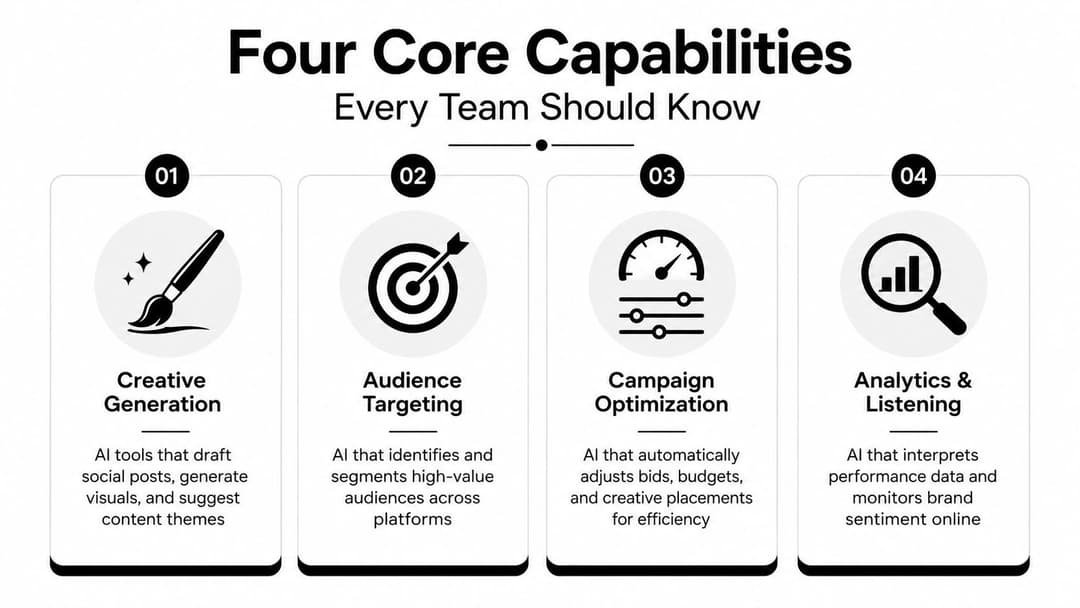
The four capabilities that matter most are easy to name, but teams often blur them together in practice. That's a problem, because a tool that writes captions is not the same as a tool that re-ranks audiences or summarizes listening data. If you know which capability you're buying, you know what you still need to own internally.
Creative generation
Creative generation is the most obvious use case. The model takes a brief, brand voice cues, and maybe a few past posts, then produces copy, hooks, image prompts, or ad variants. The output is usually first-draft material, not final publishable work.
That distinction matters. If the AI writes 20 hooks, the marketer still has to pick the angle, remove generic phrasing, and make sure the offer matches the audience. The strongest teams use AI to widen the top of the creative funnel, not to skip editing.
Audience targeting
Audience targeting is where AI helps identify or refine who should receive the message. That can mean clustering audiences by behavior, surfacing high-intent segments, or matching creative themes to different user groups. In paid social, the output can be a more useful audience structure for testing.
What the marketer still owns is the strategic frame. AI can suggest patterns, but it doesn't know your margin targets, seasonality constraints, or brand risk tolerance unless you encode those clearly.
Campaign optimization
Campaign optimization is the part of the system that reacts to results. AI can compare variants, detect patterns in performance, and help reallocate effort toward what's working. In practice, that means faster iteration, cleaner testing, and less time wasted on manual spreadsheet reviews.
A useful reference point here is top AI social media tools for creators, because a lot of tool lists stop at creation. The better question is whether the platform can also help you learn from output and feed those insights back into the next round.
Analytics and listening
Analytics and listening turn social activity into readable signals. AI can cluster comments by topic, summarize sentiment, and pull recurring themes from conversations across posts. That gives you a clearer answer to a question many teams ignore, which is not “what got engagement?” but “what should we do next?”
A practical reference table helps separate vanity from utility.
| KPI Family | Example Metric | What It Tells You | Watch Out For |
|---|---|---|---|
| Output | Number of variants tested | Whether AI is expanding the creative set | More variants doesn't mean better quality |
| Efficiency | Time saved per asset | Whether AI is reducing production friction | Time saved can hide weak output |
| Performance | CTR, CPA, ROAS | Whether the system is improving business results | Engagement gains may not translate to outcomes |
| Learning | Iteration speed, insight quality | Whether the team is getting smarter over time | Fast testing without a control is noisy |
Where AI Shows Up in Paid and Organic Social
In paid social, AI usually shows up first in the parts that are hardest to scale by hand. A Meta campaign starts with a brief, then AI drafts copy, proposes creative angles, and helps build a larger test set before launch. After that, the optimization layer matters more than the creative layer, because the system has to learn which combinations deserve more spend.
A tool like facebook ads and instagram fits naturally here because the Meta environment rewards fast creative iteration and audience testing. If your team is still building each ad one by one, you're asking humans to do work the machine is already better at, especially when the goal is speed plus structured learning.
A paid workflow that makes sense
The cleanest workflow is usually brief, first drafts, review, launch, then measurement. AI can generate multiple headlines, primary text options, and image directions, while humans check compliance, offer clarity, and brand fit. Once the campaign is live, the system helps surface which variants deserve budget or new iterations.
That same logic applies to audience work. AI can help identify segments, but the media buyer decides which audiences deserve a test budget and which should stay out of the account. The machine finds patterns. The marketer decides what those patterns are worth.
Organic social uses the same layers, just with different outcomes. AI can brainstorm content pillars, draft post variations, repurpose a blog into platform-specific formats, and sort comments by topic. For community management, it can help triage repetitive questions, but it should not replace the person handling edge cases or brand-sensitive replies.
For teams building content systems across channels, AI campaign generator is a useful mental model, because the value is not “make more posts.” It's “turn one idea into a repeatable production flow across paid and organic surfaces.”
AI is strongest when it creates first drafts and organizes data. Humans are strongest when they set the angle, approve the message, and decide what success actually means.
A Realistic Implementation Roadmap
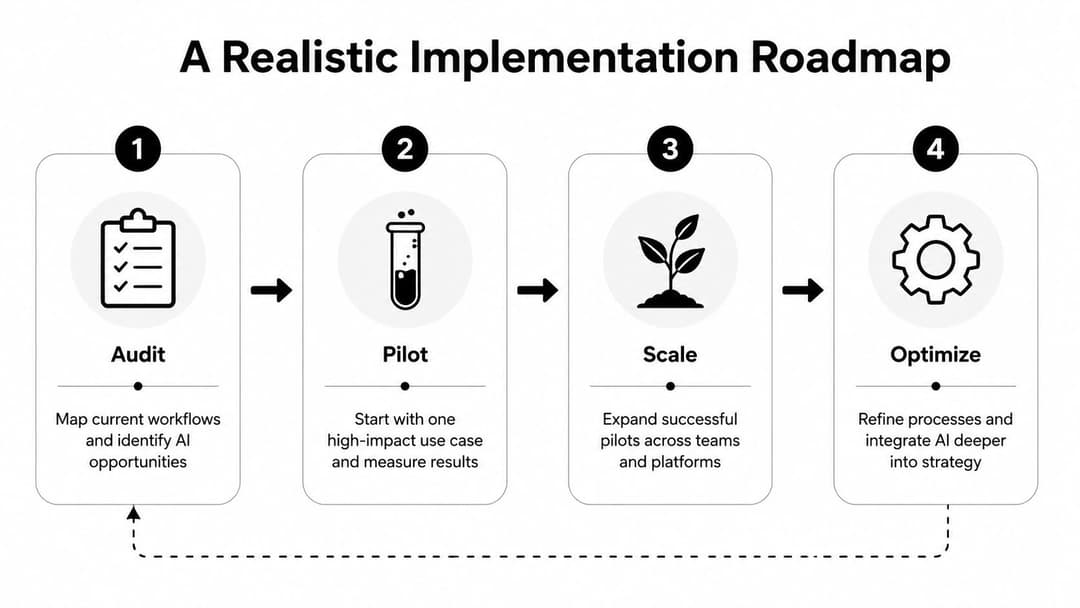
The fastest way to stall an AI program is to buy too much too early. Teams that do well usually start by mapping one painful workflow, not redesigning the whole department. That keeps the rollout practical and makes the wins easier to measure.
Audit first
Start by listing the steps in your current social process, from brief intake to approvals to publishing to reporting. Find the slowest handoff, the most repetitive task, and the place where the team spends the most time cleaning up avoidable mistakes. That's the best place to test AI first.
Pilot with one narrow use case
Pick one channel, one goal, and one KPI. A pilot should be small enough that you can compare AI-assisted work against your normal process without confusing the results. If the team can't say exactly what improved, the pilot isn't ready to scale.
Scale only when the process is stable
Once the pilot works, formalize governance, prompt libraries, and approval rules. This is also where the ai setup conversation gets real, because AI stops being a side experiment and starts touching permissions, review workflows, and shared assets.
Optimize for reuse
The final phase is not “more AI.” It's better AI use. A good system keeps improving prompts, shortens review cycles, and connects learnings from one campaign to the next. If your team can repeat the win without starting over, you've built something durable.
KPIs That Prove AI Is Actually Working
The easiest mistake is measuring AI by output alone. More posts, more variants, more drafts, all of that can look productive while business results stay flat. The more useful approach is to separate what AI produces from what it improves.
A clean framework uses four KPI families. Output metrics tell you whether production is expanding. Efficiency metrics tell you whether the team is wasting less time. Performance metrics tell you whether the work is moving business outcomes. Learning metrics tell you whether the team is getting better at making decisions.
| KPI Family | Example Metric | What It Tells You | Watch Out For |
|---|---|---|---|
| Output | Variants per brief | Whether AI is expanding creative breadth | Volume without strategic relevance |
| Efficiency | Time from brief to draft | Whether AI is removing production friction | Speed gains that create more revision work |
| Performance | CTR, CPA, ROAS | Whether the campaign is improving real outcomes | Short-term engagement spikes that don't convert |
| Learning | Test velocity, insight clarity | Whether the team is learning faster | Testing without a control or baseline |
The control matters more than the dashboard color. If AI-generated content “feels better,” that doesn't mean it performs better. The team needs a baseline, a comparison set, and enough discipline to stop calling activity a win just because it was easier to produce.
A second trap is mixing decision levels. Creative teams should care about draft quality and turnaround time. Paid teams should care about test efficiency and downstream conversion. Leadership should care about whether AI is improving the economics of the channel, not whether everyone is busier.
Common Pitfalls That Quietly Kill AI Programs
Generic output kills trust fast. If the team publishes AI drafts without editing, the brand voice blurs and the audience notices. The problem gets worse when teams use AI to produce more of the same content instead of sharper content.
Weak measurement is the other quiet failure. If you don't compare AI variants against a control, you can't tell whether anything improved. Engagement can go up while conversion quality stays flat, and teams mistake motion for progress.
Governance failures are subtler but more dangerous. If nobody knows who approves what, AI creates speed in the wrong places and risk in the sensitive ones. The healthiest teams keep a human review step where it matters and let automation handle the repetitive work around it.
The teams that get durable lift share a few habits. They keep prompts tied to real briefs, measure against a baseline, and let AI handle the first pass rather than the final decision. That combination is boring in the best way, because boring systems are the ones that keep working after the novelty wears off.
If you want to turn AI from a content shortcut into a real social operating system, AdStellar AI is built for that kind of workflow on Meta. It helps teams generate and manage ad assets, launch campaigns from structured inputs, and learn from performance data without rebuilding everything by hand. Visit AdStellar AI if you're ready to test a faster way to launch, learn, and scale paid social.