The struggle with facebook ads and instagram isn't because the platforms are too hard. It's because the workflow gets messy fast.
One campaign lives in Facebook Feed. Another is built just for Reels. Someone duplicates an ad set to test a new hook. Someone else changes the attribution settings. A product launch adds urgency, but the pixel is half-configured, the Instagram account isn’t linked cleanly, and nobody can say with confidence whether the last round of spend produced real profit or just noisy dashboard numbers.
That’s the point where Meta advertising stops feeling like growth and starts feeling like maintenance.
A better approach is to treat Facebook and Instagram as one operating system with different surfaces, different user behaviors, and one shared need for clean data, disciplined testing, and fast creative iteration. If you do that well, the platforms complement each other. If you do it poorly, they multiply your mistakes.
The Modern Meta Advertising Landscape
A common failure pattern looks simple on the surface. A team runs Facebook like a direct response channel and Instagram like a brand channel. Separate creative folders. Separate reporting habits. Separate assumptions about what each platform is “for.”
That split usually leads to bad budget decisions.

Why the ecosystem matters more than the individual app
Instagram now accounts for over 50% of Meta’s US ad revenue, with US ad revenue projected to reach $42.52 billion in 2026 and ARPU of $223, while Facebook still brings 3.07 billion monthly active users in 2025, the largest user base globally, according to Instagram ad revenue and Facebook platform scale data.
That combination matters. Instagram often carries premium creative momentum and stronger visual commerce behavior. Facebook still gives you massive reach, broad inventory, and a dependable performance backbone across age groups and buying stages.
When junior buyers ask which platform they should prioritize, the practical answer is usually “both, but not identically.”
What this changes in day-to-day campaign work
You don’t build one generic ad and spray it everywhere. You build one strategy and adapt execution by placement, audience temperature, and buying intent.
A few practical implications:
- Creative planning changes: Reels, Stories, Feed, and in-stream placements don’t reward the same opening frame or copy structure.
- Budget planning changes: If you isolate channels too early, you lose visibility into how they support each other.
- Reporting changes: Looking at Facebook and Instagram in separate silos hides where blended performance is coming from.
Facebook and Instagram aren’t competing media buys inside the same company. They’re connected delivery environments with different jobs in the same funnel.
That’s also why a strong influencer program can improve paid performance when you repurpose creator assets correctly. If you’re building that layer out, this E-commerce Influencer Marketing Guide is useful because it helps frame creator content as an input to paid social, not a separate channel with separate goals.
A lot of teams still ask whether the channel itself is worth the effort. If that debate is happening internally, this breakdown on whether Facebook ads work is the better conversation starter than another generic platform comparison.
Laying the Foundation for Cross-Platform Success
Bad setup doesn’t just create reporting errors. It changes what Meta can optimize toward.
If the account structure is sloppy, permissions are fragmented, and event tracking is incomplete, the algorithm learns from partial truth. That’s why some campaigns look “fine” in-platform while the business sees weak downstream results.
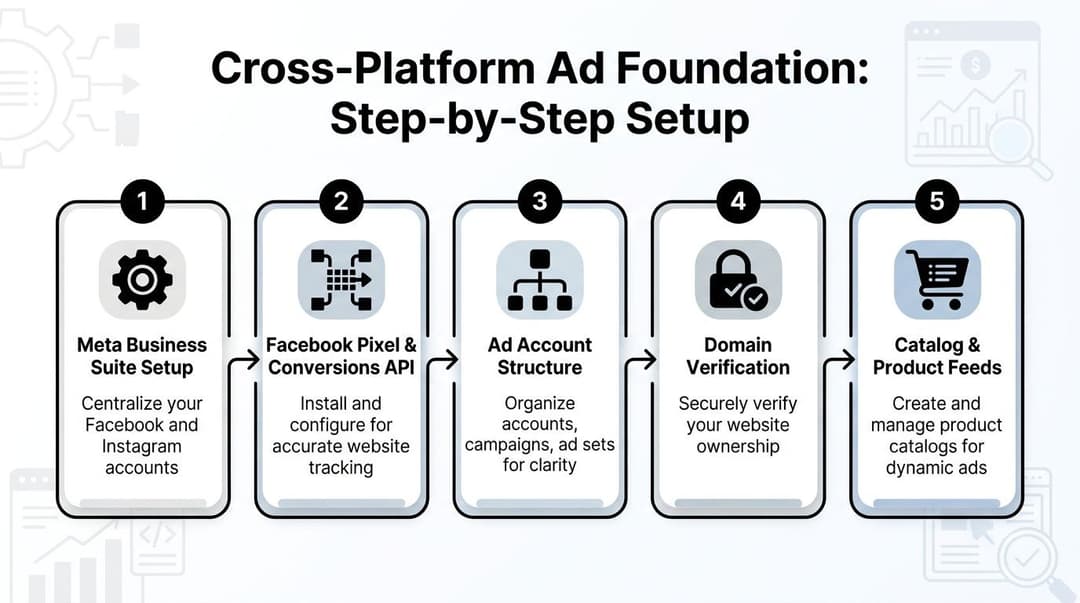
Start with ownership and account hygiene
Before touching campaigns, clean up the business layer.
At minimum, make sure your Meta Business setup includes:
One clear business owner Keep the Business Manager under an entity the company controls, not a freelancer’s profile or an old agency login.
Connected assets The Facebook Page, Instagram account, ad account, pixel, domain, and catalog should live in the same operational environment or be shared deliberately.
Defined permissions Give people the access they need, not broad access by default. Most account headaches come from messy admin rights.
Naming conventions that survive growth If your account naming only makes sense to the person who launched it, reporting gets painful as volume increases.
If the Facebook Page and Instagram account linkage is still messy, use a clean setup process for linking Facebook and Instagram before launching anything else.
Pixel setup is not optional
Many campaigns often break down without obvious signs.
Experts note that improper pixel tracking can turn optimization into guesswork and potentially inflate CPA by 20% to 50%. Omitting Purchase events can skew ROAS reporting by up to 40%, and properly configured tracking helps campaigns exit the Learning Phase twice as fast, based on the implementation guidance in this Meta tracking setup walkthrough.
That’s not a small backend detail. That’s the difference between informed optimization and fake confidence.
The setup order that works
I prefer a boring, repeatable sequence because it prevents hidden errors.
Install the base pixel across the full site
Put the base Meta Pixel across all key pages, not just the homepage or landing page template.
That includes product pages, lead forms, cart pages, and confirmation pages. If the base code only fires on the front door, Meta sees visits but misses the rest of the buying journey.
Implement standard events deliberately
Don’t treat events as a box to check. Decide what your business needs to optimize toward.
For ecommerce, that usually means the core commerce journey. For lead gen, it means the points that best signal qualified intent.
Use a short event map like this:
| Business type | Priority events to verify first | Why it matters |
|---|---|---|
| Ecommerce | ViewContent, AddToCart, Purchase | Meta needs progression signals, not just final sales |
| Lead gen | ViewContent, Lead, CompleteRegistration | You need a clean handoff from click to form completion |
| SaaS | ViewContent, Lead, trial or demo milestone | The system learns faster from meaningful intent signals |
Validate parameters, not just event firing
A Purchase event that fires without value or currency data is only half useful.
A Lead event that duplicates or fires on page refresh will pollute optimization. Use Events Manager and test complete journeys yourself. Click the ad, land on the page, submit the form, complete the purchase path. Don’t assume the developer got every parameter right.
Practical rule: If you haven’t tested the full user journey yourself, you don’t actually know your tracking is working.
Add Aggregated Event Measurement and domain controls
Post-iOS changes made event prioritization part of the job. If you skip this, delivery and reporting can drift.
Your checklist should include:
- Domain verification: Confirm the business controls the site domain tied to campaign activity.
- AEM prioritization: Rank the conversion events that matter most to your business.
- Consistency across landing pages: Keep event logic stable across templates and product flows.
This is the part many teams rush through because it feels administrative. It isn’t. It tells Meta which signals deserve priority when data visibility is constrained.
Use Conversions API as redundancy, not as a replacement story
The strongest setup uses browser-side tracking and server-side tracking together.
Conversions API helps recover signal loss and makes the account more resilient when browsers, privacy controls, or connection issues reduce browser-only visibility. You still need disciplined event mapping. CAPI won’t rescue a bad taxonomy.
Build structure before scale
A clean backend keeps the front-end workflow sane later.
That means:
- Separate testing from scaling campaigns
- Keep prospecting and retargeting distinct
- Use naming that includes market, objective, audience theme, and creative angle
- Document changes when major edits happen
Most “performance problems” aren’t performance problems. They’re data integrity problems hiding behind ad metrics.
Mastering Creative and Audience Strategy
Creative and audience decisions shouldn’t live in separate meetings.
The ad that wins with warm site visitors usually isn’t the ad that opens a cold broad audience. The Reel that earns attention may not carry enough product clarity for a Facebook Feed prospecting campaign. Good media buyers know that messaging and targeting shape each other.

Match the message to the audience temperature
Think in audience temperature before thinking in format.
A simple working model:
Warm audiences Use proof, offer clarity, objections, and product detail. These people already know you or have shown intent.
Mid-warm audiences Lean on category education, use cases, and comparison framing. They need confidence, not just exposure.
Cold audiences Start with a hook they recognize from their own problem. Don’t open with your internal product language.
This sounds basic, but many accounts fail because they use the same value proposition everywhere. Broad audiences need a sharper pattern interrupt. Retargeting needs less intrigue and more certainty.
Build creative by placement, not by crop
A square feed ad cropped into a Story is not a Story ad. A polished product demo cut into a Reel often looks like an interruption, not native content.
I usually break placements into roles:
Instagram Reels and Stories
These placements reward motion, immediacy, and a fast first second.
Use creator-style footage, product-in-use clips, strong on-screen text, and a single clear message. If the ad needs too much reading to make sense, it will struggle.
Facebook Feed
Facebook Feed gives you more room for argument.
In this realm, direct response copy can still do heavy lifting. Problem-solution framing, testimonials, objection handling, and stronger offer language often fit better here than in a quick vertical video placement.
Cross-platform retargeting
Retargeting doesn’t need prettier creative. It needs more specific creative.
Show what they viewed. Answer the objection they likely had. Reintroduce the offer in a tighter form. Many brands overproduce retargeting assets when they should be increasing relevance instead.
For practical examples of format thinking and layout choices, this guide on designing Facebook ads is a useful reference point.
Raw often works, but fatigue is the real operational problem
A lot of guides repeat the same advice: raw, real creative tends to outperform polished brand ads. That can be true. The bigger problem is what happens after the initial win.
As noted in this discussion of Meta creative trends and fatigue, many marketers agree that “raw and real advertising content” often beats polished creative, but there’s still no standard benchmark for how long a creative will last before performance drops. That gap matters a lot when your team is managing volume.
Once an ad starts working, teams usually make one of two mistakes:
- They keep spending until frequency and fatigue grind performance down.
- They refresh blindly and lose a winner too early.
Neither is disciplined media buying.
Creative fatigue isn’t just a design issue. It’s a scaling issue. The more variants you launch, the more important rotation logic becomes.
That’s why manual refresh cycles break once volume rises. You can’t rely on one designer, one buyer, and one spreadsheet to manage dozens or hundreds of variants across placements and stages of funnel.
A short walkthrough on creative thinking helps here:
Audience strategy should expand in layers
I don’t like treating audience selection as a binary choice between lookalikes and broad targeting. It works better as a sequence.
Start with the assets you already own:
| Audience layer | What goes into it | Best use |
|---|---|---|
| Custom audiences | Site visitors, customer lists, engaged users | Retargeting and seed creation |
| Lookalikes | High-quality source audiences | Controlled expansion |
| Broad targeting | Minimal constraints, strong creative | Scale and discovery |
That sequence gives you a cleaner learning path.
Custom audiences tell you what intent looks like. Lookalikes help extend that pattern. Broad targeting becomes more useful once your messaging and conversion tracking are stable enough to support algorithmic discovery.
What usually works and what usually fails
A few field notes matter more than theory:
- What works: Distinct hooks built around one buyer problem per ad.
- What works: Multiple creative forms around the same offer, instead of random offers with random visuals.
- What fails: Testing tiny copy changes when the underlying issue is weak angle-market fit.
- What fails: Reusing the same winner across every audience until saturation shows up everywhere.
If your team is running facebook ads and instagram at any meaningful scale, your advantage won’t come from one perfect ad. It will come from a system that keeps generating, testing, and rotating strong variants without losing strategic control.
Launching and Testing Your Meta Campaigns
Most launch problems start before the campaign goes live. They start when the objective is chosen out of habit.
If you want purchases, don’t default to traffic because it feels safer. If you want qualified leads, don’t optimize for top-of-funnel clicks and then complain about lead quality. Meta usually follows the signal you ask it to chase.
Pick the objective that matches the business outcome
Inside Ads Manager, the objective is a constraint on system behavior.
To put it practically:
Use sales or conversion-focused objectives when the account has usable event data
If the pixel and event setup are solid, this is usually the right place for ecommerce and performance-led offers.
You want the algorithm learning from outcomes that resemble revenue, not just visits.
Use leads when the conversion happens in a form flow
This fits native lead forms and many service businesses. It can also work for B2B if your downstream qualification process is disciplined and you aren’t grading campaigns only on form volume.
Use traffic carefully
Traffic has a role. It can help with landing page tests, content distribution, or early validation when conversion data is thin.
It becomes a problem when teams use it as a substitute for real conversion optimization.
If your KPI is revenue but your campaign objective is clicks, the reporting may look active while the business gets very little from the spend.
Decide between CBO and ABO based on the question you’re asking
A lot of buyers frame Campaign Budget Optimization and Ad Set Budget Optimization as a platform preference. It’s better to treat them as tools for different jobs.
| Setup choice | Best fit | Trade-off |
|---|---|---|
| ABO | Controlled testing | More manual budget management |
| CBO | Budget allocation across proven components | Less control over early distribution |
| Hybrid workflow | Test in ABO, scale in CBO | Requires process discipline |
If I’m testing multiple audience concepts or creative angles and I need cleaner reads, I prefer ABO. It reduces the chance that Meta starves one branch of the test too early.
If I already know the account has several viable combinations and I want the platform to allocate more fluidly, CBO is often more efficient.
Keep the first launch simple enough to read
The first version of a campaign should answer one question well.
Not five questions poorly.
A clean launch structure usually includes:
One business goal Revenue, leads, or another clearly defined action.
A limited set of variables Don’t test audience, hook, offer, landing page, and format all at once.
A clear naming system If you can’t read the naming and understand the test logic immediately, simplify it.
A decision window Decide in advance what kind of evidence will lead you to pause, duplicate, revise, or scale.
Many teams sabotage themselves. They launch a “test” with too many moving parts, then stare at mixed results that can’t support a clear decision.
Test one meaningful variable at a time
Good testing is less about complexity and more about isolation.
Here’s the structure I coach junior buyers to follow:
Creative test
Hold audience and offer steady. Change the hook, visual treatment, or message angle.
Use this when you’re asking whether the market isn’t responding to the product story.
Audience test
Hold the creative package steady. Change the audience structure.
Use this when you believe the message is working but delivery is hitting the wrong people.
Copy or framing test
Hold visual assets steady. Test headline and primary text variants that change the argument, not just punctuation.
Use this when the ad gets attention but not enough action.
For teams that need a practical workflow for experiment design, this guide on how to test for ads is a good starting point.
Common launch mistakes to avoid
These are the ones I see most often:
Too many ads in one ad set When every ad set becomes a dumping ground, spend fragments and learnings get muddy.
Editing too aggressively during learning Frequent changes reset the read. If you keep touching budget, targeting, and creative at once, you never get a stable signal.
Judging too early Some ads need enough delivery to reveal whether the hook is weak or the audience is wrong. Don’t panic because the first few hours look uneven.
Using duplicate near-identical creatives This clutters the account and makes it harder to identify real winners.
Bidding should follow campaign maturity
For most launches, simpler bid strategies are easier to manage.
Highest volume often makes sense when you want to gather signal and learn quickly. More constrained bidding approaches can help later, but only after you understand the account’s actual cost behavior and lead quality patterns.
The mistake isn’t using an advanced bid strategy. The mistake is using one before the account has earned the complexity.
Launching well means creating a campaign that can teach you something. If the structure is messy, the spend may still go out, but the lesson won’t be reliable.
Optimizing and Scaling with AI Automation
Scaling is where manual systems break.
A buyer can manage a handful of campaigns by hand. They can review metrics, duplicate winners, pause losers, and refresh creative manually. Once the account expands across offers, countries, placements, and audience layers, that approach becomes slow and error-prone.
The bottleneck stops being “finding ideas.” It becomes operational capacity.

The real scaling problem is saturation plus workload
As budgets grow, lookalike audiences often become saturated, CTR declines, and CPA rises. Existing guidance usually doesn’t tell marketers when that shift happens or how to predict when to move from custom audiences toward broader targeting, as described in this analysis of Meta scaling challenges.
That matches what operators see in the wild. A lookalike can look excellent at one spend level and mediocre later. The audience didn’t become “bad.” The account pushed deeper into less responsive inventory.
Manual workflows usually respond too late because the team is busy doing the mechanics:
- pulling reports
- comparing ad sets
- checking overlap
- building fresh variants
- relaunching combinations one by one
That lag costs money.
What good optimization actually looks like
At scale, optimization is mostly about decision quality and speed.
You’re trying to answer these questions repeatedly:
| Question | Manual approach | Better approach |
|---|---|---|
| Which creatives are fading | Spot it after performance drops | Flag patterns earlier |
| Which audience-creative pairs deserve more spend | Review ad sets one by one | Rank combinations systematically |
| Where to find new scale | Duplicate known audiences | Test broader and adjacent structures deliberately |
The point isn’t to automate thinking. It’s to automate repetitive execution so the team can focus on strategy.
Strong operators don’t scale because they click faster in Ads Manager. They scale because they build systems that surface better decisions sooner.
Where AI fits in the workflow
AI is useful when it solves a volume problem that humans can’t manage cleanly.
That includes:
Bulk creative generation Multiple hooks, formats, and copy variants built from one campaign brief.
Large-scale combination testing Creative, audience, and messaging permutations launched without manual assembly one asset at a time.
Performance pattern detection Identifying which themes, segments, and ad formats deserve extension or replacement.
Faster relaunch cycles Turning yesterday’s winners into today’s structured tests.
If you’re evaluating tools in that category, AI for social media marketing gives a broader view of how teams are applying automation beyond simple content drafting.
One option built specifically for this operational layer is AdStellar AI for Facebook ads. It connects to Meta Ads Manager, uses historical performance to inform new launches, and helps teams generate and deploy many creative, copy, and audience combinations without rebuilding each campaign manually.
When to scale and when to reset
Not every winner deserves more budget immediately.
Scale when:
- the offer is still landing
- the creative still feels alive
- the audience isn’t showing obvious signs of exhaustion
- the post-click experience is converting cleanly
Reset when:
- the same angle keeps underperforming across different audiences
- retargeting is carrying too much of the account
- new spend only finds weaker traffic
- reporting suggests momentum, but downstream business quality says otherwise
That’s the trade-off many teams miss. AI helps most when your real issue is campaign volume and reaction time. It won’t fix a weak product, a confusing offer, or poor landing page alignment. It will make it easier to discover those problems faster and stop wasting labor on account maintenance.
Your Path to Repeatable Campaign Growth
The strongest facebook ads and instagram programs don’t rely on one tactic. They run on a system.
That system starts with clean ownership, connected assets, and trustworthy tracking. It gets stronger when creative and audience planning happen together instead of in separate silos. It becomes profitable when campaign tests stay structured enough to teach you something. And it becomes scalable when the team stops doing high-friction manual work that software can handle more consistently.
The workflow worth keeping
A repeatable Meta workflow is usually simple on paper:
Set the foundation correctly Business assets, event tracking, domain controls, and account structure need to be stable.
Create for audience and placement Don’t force one message across every stage of funnel.
Launch focused tests Each campaign should answer a specific question.
Optimize with discipline Pause, iterate, or scale based on clear evidence, not dashboard anxiety.
Use automation where volume creates drag That’s where speed becomes an advantage instead of a source of chaos.
The key shift is this: media buying used to reward the person who could keep up manually. Now it rewards the team that can design a process, feed it clean inputs, and let automation carry the repetitive load.
That’s how you stop babysitting campaigns and start building a growth engine that can keep compounding.
If your team is spending too much time building, duplicating, and managing Meta campaigns by hand, AdStellar AI is worth a look. It’s built to help performance marketers generate bulk creative, audience, and copy variations, launch them into Meta faster, and use historical results to guide what gets tested and scaled next.