You open a Meta Ads report, break performance down by placement, and there it is. Audience Network. It's pulling a noticeable share of impressions, the clicks look cheap, and the campaign manager part of your brain wants to call that a win.
Then the performance marketer part kicks in.
Are those clicks coming from people who meant to engage, or from users tapping through an in-app banner between game levels? Is this placement helping you scale beyond crowded feed inventory, or is it quietly absorbing budget because the auction can buy cheap attention there?
That's the core question with the audience network in Facebook. It's not whether the placement exists, and it's not whether Meta can spend there. It's whether you can control it well enough to make it serve the objective you care about. If you're already dealing with Meta ads losing profitability, this placement becomes even more sensitive because cheap top-line metrics can hide expensive downstream waste.
The Audience Network Dilemma for Marketers
The problem usually starts with a report that looks better than the business does.
A campaign shows low CPC, healthy CTR, and plenty of delivery. But when you compare placements, Audience Network often behaves differently from Facebook Feed, Instagram Feed, Stories, or Reels. It can generate volume fast, yet that volume doesn't always carry the same intent.
That mismatch creates a recurring dilemma. If you turn it off too quickly, you might lose low-cost reach that helps awareness, app growth, or even certain conversion campaigns where Meta can still find efficient inventory. If you leave it unchecked, you can end up funding inventory that looks efficient in-platform but weakens what happens after the click.
Why smart teams get tripped up
Meta makes placement expansion easy. In many accounts, Audience Network appears because automatic placements are on. That's not bad in itself. The issue is that many advertisers evaluate it with the wrong lens.
A cheap click on a third-party app is not equal to a click from a user actively scrolling your feed ad. The context is different. The intent is different. The tolerance for interruption is different.
Practical rule: Don't judge Audience Network by front-end metrics alone. Judge it by what survives after the click.
That's why experienced buyers don't treat Audience Network as a default “on” or “off” switch. They treat it as a placement that needs a job description. If the goal is broad distribution at efficient media cost, it can earn its keep. If the goal is high-intent traffic quality, it often needs tighter control or exclusion.
The control question matters more than the definition
Most explanations stop at “it extends your ads beyond Facebook.” True, but incomplete. The useful question is simpler: What kind of result are you buying, and what failure mode are you willing to accept?
For awareness, the failure mode might be some messy engagement. That's tolerable if reach is the priority. For lead gen or e-commerce traffic, the failure mode is worse. You can fill reports with clicks that never become sessions, qualified leads, or purchases.
That's where most wasted spend happens. Not because Audience Network is always bad, but because marketers let it optimize for the wrong thing.
What Is the Facebook Audience Network Really
Think of Meta placements as two types of property.
Facebook and Instagram are the company-owned storefronts. Meta controls the environment, the feed experience, and the surrounding context. Audience Network is the franchise layer. Your ads still run through Meta's system, but they show up on third-party inventory that has integrated with Meta's technology and participates in Meta's auction.
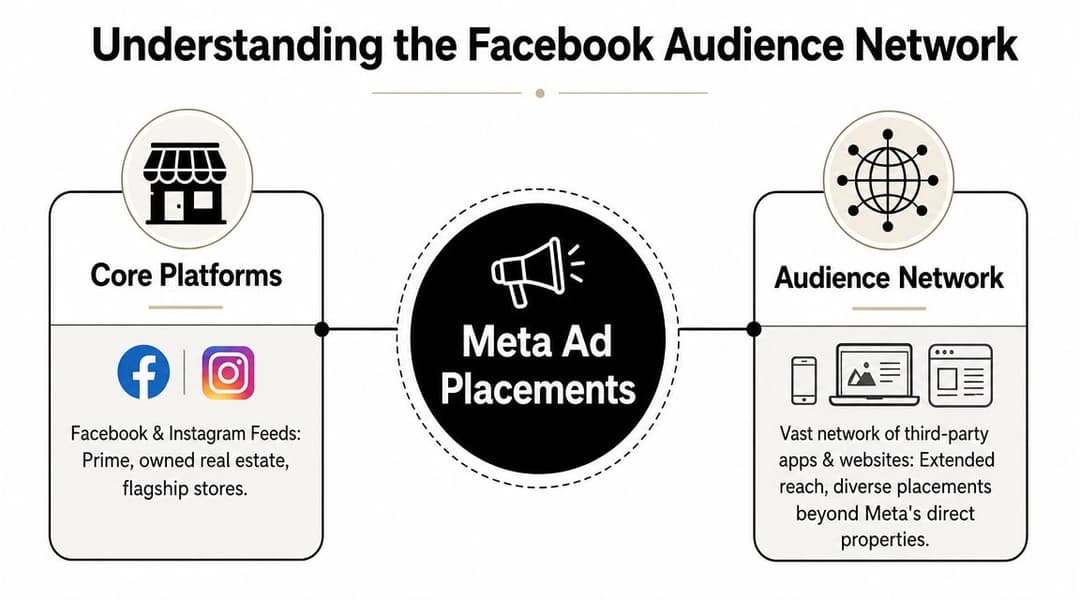
Meta's Audience Network extends ads beyond Facebook by placing them across more than 10 million partner apps and websites, which gives advertisers access to distribution well beyond Meta's owned apps, as described in this overview of how Meta Audience Network works.
How an ad gets there
You don't buy Audience Network through a separate platform. You still build campaigns in Meta Ads Manager, choose your objective, define your audience, set your optimization event, and select placements manually or automatically.
From there, Meta's auction decides where the ad can win delivery. If Audience Network is included, eligible inventory on participating apps and websites becomes part of that pool.
The advertiser workflow feels familiar even when the delivery environment is not. The same targeting logic follows the user outside Facebook and Instagram, but the surrounding experience changes. Your ad may appear in a utility app, mobile game, article page, or another third-party environment that has very different user behavior.
For a broader refresher on how these placements fit inside display strategy, this guide to digital ad display is a useful companion.
Why Meta built it
Audience Network solves two practical problems for Meta.
First, it gives advertisers more inventory to buy. When demand inside core placements gets crowded or expensive, Meta can extend delivery into partner environments. Second, it gives publishers and app developers a way to monetize their inventory through Meta's demand.
That's why Audience Network often shows up as a scale channel. It was built to monetize demand outside Facebook and Instagram, and to find incremental impressions where in-app inventory may be cheaper.
The simplest way to think about it is this: same advertiser controls, same auction logic, different environment.
Why that distinction matters
A marketer looking only at campaign setup may assume placement quality is roughly uniform because the buying interface is unified. It isn't.
Core-feed placements and third-party placements are not interchangeable just because they share the same dashboard. The user who pauses on an Instagram Reel is in a very different state from the user who gets interrupted by an ad inside another app. That gap is exactly why Audience Network can be useful and risky at the same time.
The Strategic Tradeoffs of Using Audience Network
Audience Network's appeal is easy to understand. It gives Meta more places to spend your budget, usually at lower media costs than premium owned placements. For the right objective, that's helpful. For the wrong one, it can become a leakage point.
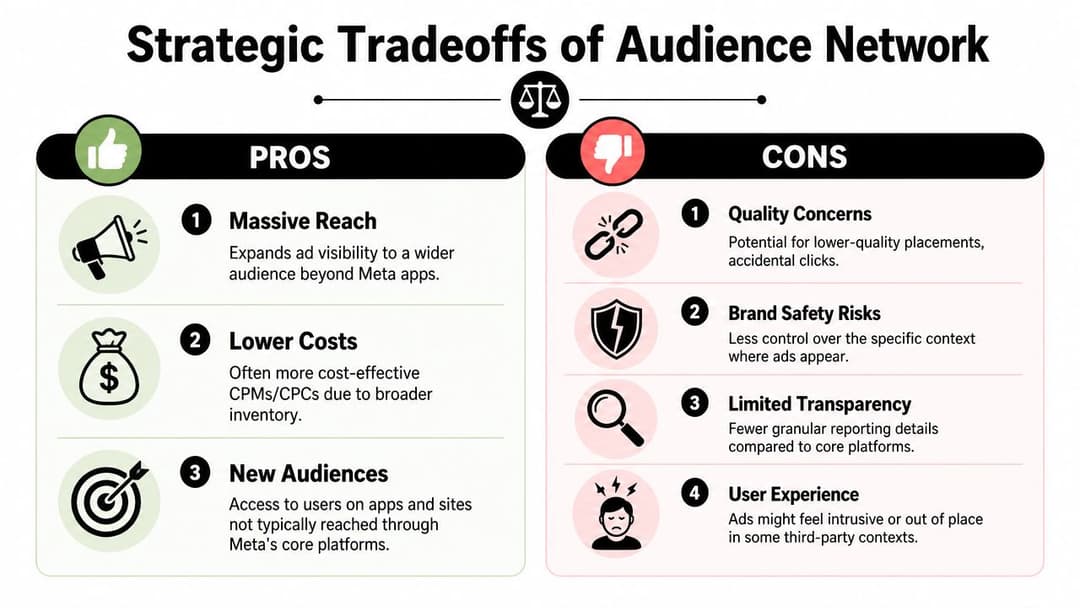
Meta Audience Network is a third-party reach and monetization layer that serves Meta ads outside Facebook and Instagram through publisher and app inventory that integrates Meta's SDK and auction system. In practice, inventory quality and user-intent signals can vary substantially by publisher mix and placement type, as noted in this explanation of Meta Audience Network mechanics.
Where it helps
The strongest argument for Audience Network is straightforward. It gives campaigns more room to scale.
That matters most when you care about broad distribution, not just high-intent sessions. If your job is to maximize awareness efficiently, lower-cost inventory can improve reach and smooth out delivery. It can also expose your message in environments your audience spends time in outside Meta's owned apps.
For smaller businesses comparing channels at a budget level, this overview on understanding advertising for SMBs helps frame why broad-reach inventory and direct-response inventory shouldn't be judged by identical standards.
Where it hurts
The downside is that cheap delivery often comes with weaker intent.
A user on Audience Network didn't open Facebook or Instagram to browse ads in-feed. They were doing something else inside another app or site. That interruption can still generate impressions and clicks, but it may not generate the same quality of post-click behavior.
The risk gets worse when campaign optimization rewards shallow engagement. If you optimize for clicks, link clicks, or video views, the platform can find plenty of low-cost supply that satisfies the metric without producing much business value.
Cheap traffic is only cheap if it keeps its value after the click.
The operational tradeoff
Audience Network also brings more variability. Publisher mix changes. App environments differ. Some placements are a natural fit for your offer, while others create accidental engagement or weak handoff to the landing page.
That's why experienced teams monitor it more like display inventory than like feed inventory. You need tighter diagnostic habits, better placement review, and cleaner event tracking. If you're already tightening signal quality with tools like Conversion API Gateway, Audience Network becomes easier to judge because you're less reliant on soft in-platform signals.
A lot of placement frustration comes from expecting consistency where the inventory itself is fundamentally mixed. The true skill is deciding when that variability is acceptable and when it's not.
Practical Use Cases and When to Deploy It
Audience Network isn't one thing operationally. It behaves differently depending on the objective, the optimization event, and how much room Meta has to chase cheap supply.
That means the right question isn't “Should I use it?” It's “For which campaign goal does this placement earn the right to stay on?”
Green light objectives
For awareness and reach, Audience Network often makes sense. If your priority is broad distribution at efficient cost, this is one of the placements worth testing early. Facebook's user base is concentrated in major markets including India at about 383M users, the US at about 196.9M, and Indonesia at about 122.3M, which helps explain why audience expansion matters for international campaigns, according to this roundup of Facebook audience scale by market.
That concentration matters because global advertisers don't just need premium feed inventory. They need enough inventory to keep delivery moving across regions and devices.
App install campaigns are another credible use case, especially when the conversion happens naturally inside a mobile environment. Users are already on a device, already inside apps, and often closer to the install action than they are in desktop-heavy flows.
Yellow light objectives
Retargeting and conversion campaigns sit in the middle.
If the campaign optimizes toward downstream conversion events, Audience Network can still work because Meta has to find placements that produce the event. The system has less room to hide behind cheap clicks when the optimization target is stricter.
Still, I treat this as a controlled test, not a default inclusion. For many accounts, it's worth comparing a version with Audience Network against a version limited to stronger owned placements. If you also run layered re-engagement strategies, this guide to remarketing in Facebook is relevant because placement quality matters even more when audiences are already warm.
Red light objectives
Traffic campaigns are where Audience Network most often causes trouble.
If your KPI is link clicks or even landing page views, the placement can absorb spend because it's very good at generating cheap surface-level activity. That doesn't mean the sessions are qualified. It often means the opposite. The same caution applies to video-view-heavy campaigns where completion metrics can look healthy without translating into anything useful later.
If the campaign objective rewards volume before quality, Audience Network needs extra skepticism.
A simple decision table
| Campaign Objective | Audience Network Suitability | Key Rationale |
|---|---|---|
| Awareness | High | Broad, lower-cost inventory can help maximize reach and frequency efficiently |
| Reach | High | Useful when scale matters more than strict post-click intent |
| App installs | Medium to High | Often fits mobile-first behavior, but still needs isolated testing |
| Conversions | Medium | Can work if optimization is tied to real downstream events and monitored closely |
| Retargeting | Medium | Better as a controlled experiment than a default setting |
| Traffic | Low | Cheap clicks can mask weak landing-page quality |
| Video views | Low to Medium | Easy to inflate engagement without corresponding business impact |
The mistake isn't using Audience Network. The mistake is using it with no objective-specific rules.
How to Manage and Optimize Audience Network Placements
If you decide to run Audience Network, don't bundle it into a broad ad set and hope Meta sorts it out. Treat it like a placement with its own behavior profile.

The first control is structural. Separate it.
Isolate it before you judge it
Create a dedicated ad set or a clean placement test so Audience Network doesn't hide inside blended reporting. If you compare all placements together, low-cost Audience Network traffic can make blended numbers look healthier than the owned placements are, or vice versa.
A clean setup usually includes:
- Separate ad sets: Keep Audience Network distinct from Facebook and Instagram placements when you need a real read on quality.
- Same creative where possible: Don't change message and placement at the same time if you want interpretable results.
- Shared optimization event: Compare placements against the same business outcome, not different success metrics.
- Consistent attribution settings: Don't let reporting differences create false conclusions.
Watch the gap after the click
One of the most useful diagnostics is the difference between link clicks and landing page views. A large gap can signal accidental taps, weak page load experience, or low-intent engagement that falls apart immediately after the click.
Independent practitioner guidance on using Meta Audience Network in 2026 recommends isolating the placement, monitoring CTR against landing-page-view gaps, and treating CTR spikes above about 5% as a warning sign for accidental taps or low-intent engagement.
That doesn't mean every high CTR is bad. It means Audience Network needs context. A flashy in-app placement can attract interaction that never becomes useful traffic.
Field check: If clicks rise much faster than landing page views or downstream conversion events, don't call it efficiency.
Use blocking and suitability controls
Meta gives advertisers ways to review and limit where ads run. Use them.
If certain apps or sites repeatedly drive poor post-click behavior, block them. If the category is a mismatch for the product, exclude it. A B2B lead gen campaign rarely benefits from random gaming adjacency. A mobile consumer app may tolerate it better.
Later in the evaluation cycle, this video is worth watching if you want a practical look at placement behavior inside Meta's ecosystem.
Match your optimization to your risk tolerance
Audience Network becomes safer when Meta is forced to optimize for an outcome that matters.
A purchase event, qualified lead event, or another hard conversion gives the system less freedom to chase hollow engagement. By contrast, campaigns optimized for cheap clicks, landing page views, or top-funnel video metrics need much closer supervision.
A practical workflow looks like this:
- Start narrow: Test Audience Network in its own ad set.
- Measure post-click quality: Compare clicks, landing page views, and downstream conversion behavior.
- Review placement quality: Use exclusions where obvious mismatches appear.
- Scale only what survives: Keep inventory that contributes to the actual KPI, not just the visible one in Ads Manager.
That's usually enough to separate hidden gems from budget drains.
Amplifying Audience Network with AI Ad Platforms
Audience Network is manageable by hand. It's just labor-intensive.
A disciplined buyer can isolate placements, rotate ad sets, compare post-click quality, review exclusions, and decide whether the placement deserves more budget. The problem is volume. Once you're testing multiple audiences, creatives, offers, and objectives, manual placement control starts slowing down the rest of the account.
Where automation actually helps
AI tools are most useful here when they reduce setup friction and improve pattern detection.
You still need the same operating principles. Separate tests. Clear optimization events. Strong post-click diagnostics. But software can help you generate more valid test combinations, move winning variants faster, and identify when a specific creative-placement combination works in Audience Network while another one doesn't.
That matters because Audience Network performance is rarely uniform. One angle, one format, or one audience can hold up well there while the rest of the campaign mix doesn't. Manual management often misses those pockets because teams don't have time to test enough combinations cleanly.
A practical workflow for scaled testing
An AI platform like AdStellar AI can fit into the stack. It's designed to automate bulk Meta ad creation, test many creative and audience combinations quickly, and learn from historical account performance. In practice, that can make Audience Network testing more systematic because you're not building every variation by hand.
The value isn't that AI makes Audience Network “good.” It doesn't.
The value is that AI can help you answer better questions faster:
- Which creative types collapse on Audience Network after the click?
- Which audiences hold conversion quality there?
- Which objective and placement combinations deserve separation?
- Which variants should stay limited to owned placements?
The real advantage
The best use of automation is not blind expansion. It's disciplined filtering at scale.
If your team already knows that Audience Network can help some campaigns and damage others, AI gives you a way to operationalize that knowledge across more tests without turning the account into a manual spreadsheet project. That's the difference between occasionally spotting a profitable placement and repeatedly finding one.
If your team wants a faster way to test placement, creative, and audience combinations inside Meta without building every variant manually, AdStellar AI is worth a look. It connects to Meta Ads Manager, helps generate and launch variations in bulk, and surfaces performance patterns that can make placements like Audience Network easier to evaluate against real goals such as CPA, CPL, or ROAS.